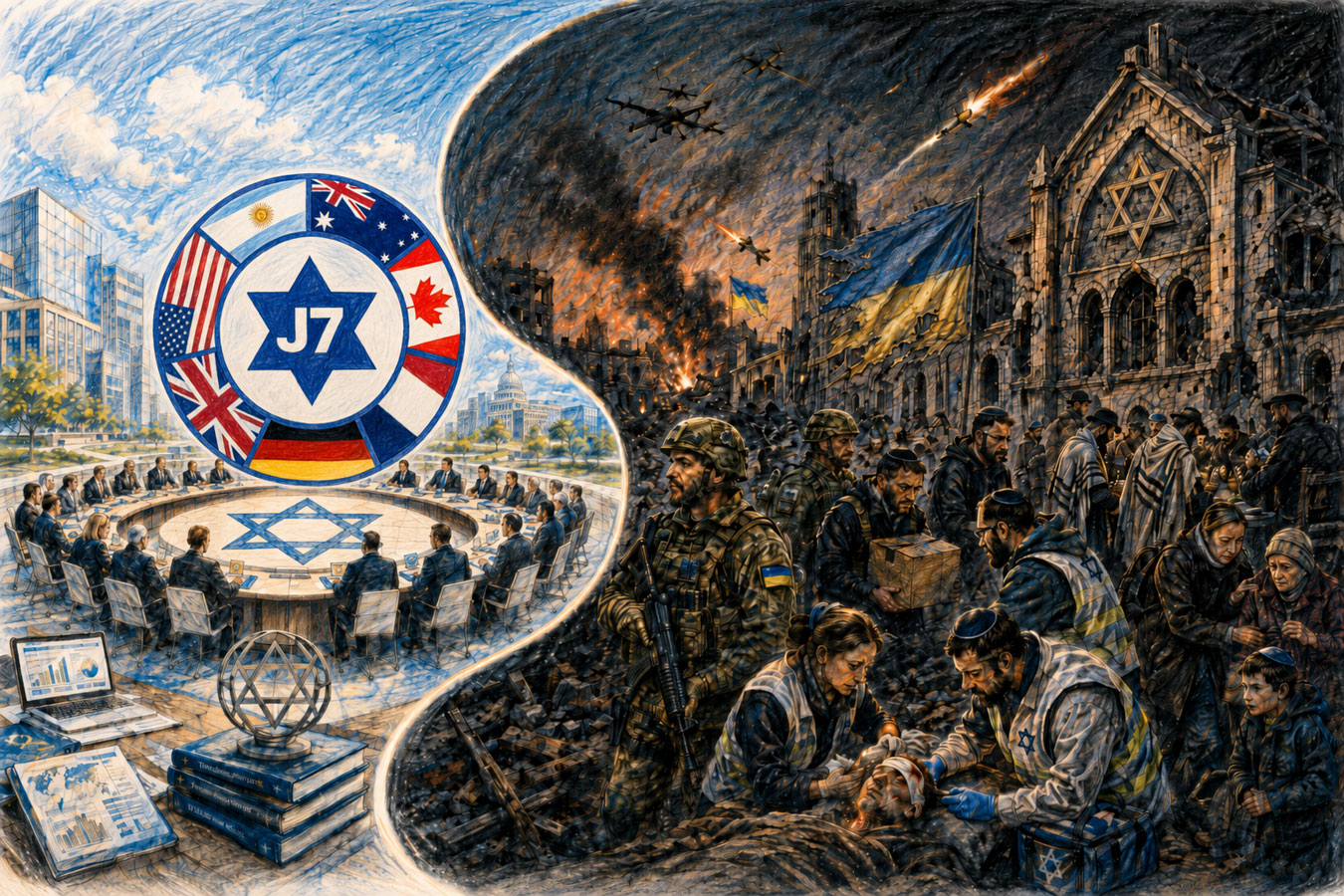
J7 — the union of the largest Jewish communities in the USA, Canada, the UK, France, Germany, Australia, and Argentina.
On July 29, 2026, the union of the largest Jewish organizations J7 published the second annual report J7 Annual Report on Antisemitism 2026. The authors recorded more than 23,000 antisemitic incidents during 2025 and stated that it became the deadliest year for Jews in the diaspora since the terrorist attack on the AMIA Jewish center in Buenos Aires in 1994.
According to the report, as a result of antisemitic attacks in 2025, 20 people were killed: 15 at a Hanukkah celebration on Bondi Beach in Sydney, two near the Heaton Park Synagogue in Manchester, two near the Jewish Museum in Washington, and one woman after an attack on participants of a rally in support of Israeli hostages in Boulder, USA.
The numbers are frightening and require immediate reaction.
However, when reading the report, an equally heavy question arises: where are the Ukrainian Jews in this picture, whom Russia is killing with missiles, drones, and artillery, who are dying in the Ukrainian army, and whose synagogues, schools, cemeteries, and community centers are being destroyed by Russian strikes?
The answer is uncomfortable: the architecture of J7 is such that it is practically incapable of seeing these people.
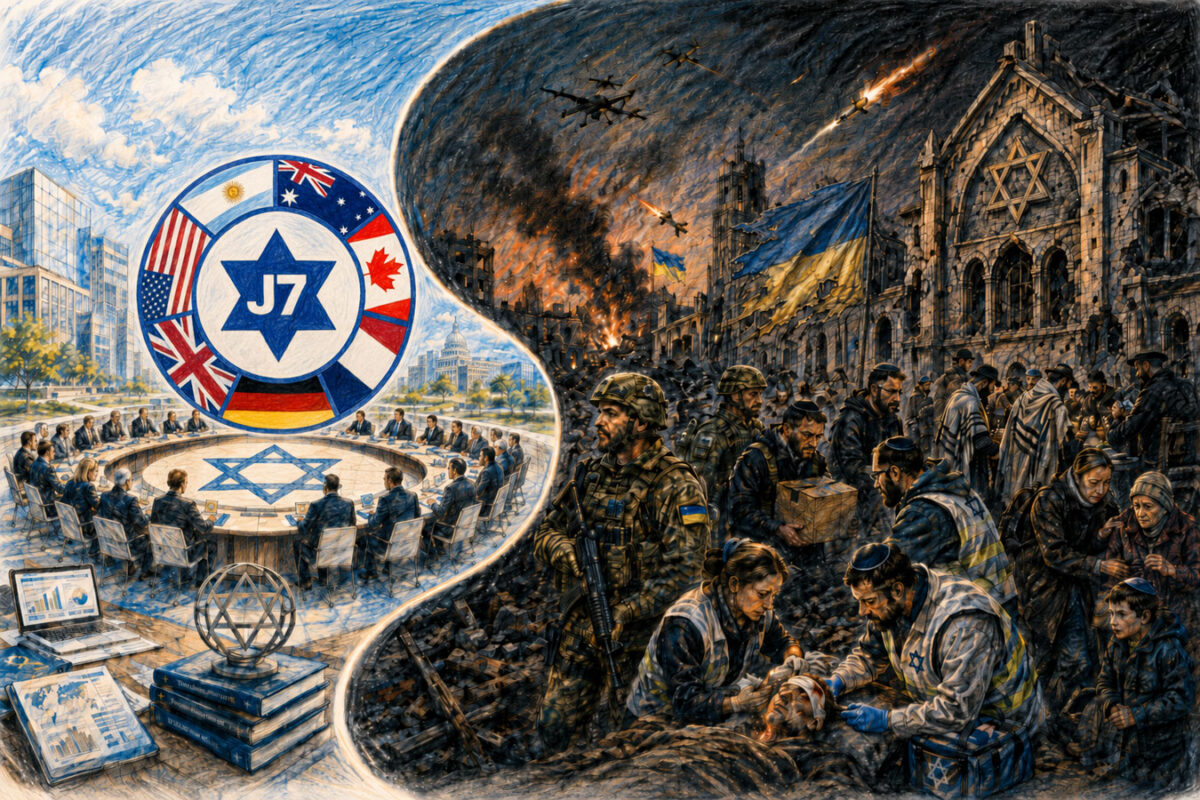
This is not a global report, although its title sounds global
J7 is the Large Communities’ Task Force Against Antisemitism, a union of organizations from seven countries with the largest Jewish communities outside Israel. It includes the USA, Canada, the UK, France, Germany, Australia, and Argentina.
Ukraine is not among the J7 members. Nor are most Eastern European countries, former USSR countries, and many other territories where Jewish communities exist.
Officially, J7 states that the seven covered countries unite more than 90% of the diaspora’s Jewish population. But this only means that the report covers countries with the largest number of Jews. It does not make it a complete picture of all the threats faced by Jews outside Israel.
Moreover, the 2026 edition included a separate chapter on Ireland, although Ireland is not a J7 member and its Jewish community numbers about 2,200 people. In six months, 143 antisemitic incidents were registered there.
This is an important detail. It shows that the geographical boundaries of the report are not absolutely closed. With political and organizational will, the authors are capable of paying attention to a small community outside the seven countries.
But there is no special chapter on Ukraine, where Jews have been living under Russian missile and drone strikes for four years, in the report.
What is said in the J7 Annual Report on Antisemitism 2026
The J7 Annual Report on Antisemitism 2026 is the second annual report of organizations from the largest Jewish communities in the USA, Canada, the UK, France, Germany, Australia, and Argentina.
The authors studied antisemitic attacks, threats, vandalism, online harassment, incidents at universities, and attacks on Jewish institutions registered in 2025.
A total of 23,174 antisemitic incidents were recorded in the seven countries. This is less than the record figure of 2024, but 136% more than in 2022 — before the Hamas attack on October 7, 2023.
The number of violent cases, without comparable data for Canada, was 718. This is almost twice the level of 2022.
In four antisemitic attacks in Australia, the UK, and the USA, 20 people were killed. That is why the authors called 2025 the deadliest year for the diaspora Jews in over 30 years. However, this only refers to victims of registered antisemitic attacks in the countries covered by the study.
The most incidents were recorded in Germany — 8,725, in the USA — 6,274, in the UK — 3,700, in France — 1,320, in Australia — 1,654, in Canada — 788, in Argentina — 713.
The report highlights several main problems: the rise of physical violence, the harassment of Jews under the guise of anti-Zionism, the dangerous situation in universities, the spread of hatred on social networks, and the tendency of Jews to hide their identity.
J7 demands that states strengthen the protection of synagogues and schools, protect Jewish students, investigate threats, maintain a unified record of crimes, and hold social platforms accountable.
The report is important but covers only selected countries and antisemitic incidents. That is why Ukrainian Jews, dying under Russian strikes and defending Ukraine, remain outside its scope.
Why a Russian missile “doesn’t count”
The main reason lies in the methodology. J7 counts not all Jews killed by violence, but victims of antisemitic attacks.
For a murder or attack to be included in such statistics, it is necessary to establish that the person was attacked because of their Jewish origin, religion, connection to a Jewish organization, or to Israel. If a Russian missile hits a residential building in Kyiv, Odesa, Kharkiv, or Dnipro and kills a Jew there, their death is counted as part of Russian war crimes and Ukraine’s overall losses, but not as an antisemitic murder.
From the perspective of statistical purity, there is logic in this. It is not possible to automatically declare every strike on an area where a synagogue is located as a deliberate attack specifically on Jews. The organization Jewish Heritage Europe, analyzing the damage to Jewish objects in Ukraine, also noted that Jewish buildings themselves, according to available data, were not always specifically chosen targets.
However, the correct separation of categories has turned into a large blind spot.
If a Russian missile was not aimed at a person specifically because of their Jewishness, it does not mean that the death of this person is not related to the security of the Jewish community. If a synagogue is destroyed along with neighboring houses, it still ceases to be a place of prayer, food distribution, medicine, and assistance to the elderly.
The problem with J7 is not the refusal to call every Russian attack antisemitic. The problem is the absence of a second category that would take into account the consequences of war and state terror for Jewish communities.
About 200 fallen Jewish defenders of Ukraine
On June 8, 2025, the Federation of Jewish Communities of Ukraine reported that, according to its estimate, about 200 Ukrainian Jewish servicemen had died since the start of the full-scale Russian aggression.
This is not final state statistics, but an estimate by a Jewish organization involved in organizing funerals, reading Kaddish, and supporting the families of the deceased. But even such an approximate figure is ten times the number of people on which J7 called 2025 the deadliest year for the diaspora in three decades. These two figures cannot be directly compared, as they relate to different periods and different categories of violence. However, ignoring this discrepancy is also impossible.
In just two weeks in the spring of 2025, the deaths of three Jewish defenders of Ukraine became known.
32-year-old Odesa native Tzvi-Hirsh, or Grisha, Tzvergzde served in the 34th brigade. Before the army, he was a chef and dreamed of opening the first kosher restaurant in Europe with a Michelin star in Odesa. He left behind a wife and two small children.
Andrey Kurovsky from Zhytomyr taught computer science at the “Or Avner” Jewish school for over 20 years. After being wounded, he underwent rehabilitation and returned to the front. Kurovsky died of a heart attack during a Russian assault on the positions where his unit was located.
44-year-old Maksim Nelipa was a journalist and a well-known Ukrainian TV presenter. After being wounded in January 2025, he also returned to the army and became a company commander. His son Artem, serving in the “Golani” brigade of the IDF, learned of his father’s death while in Gaza.
For J7, these people are not victims of antisemitism. But for the Ukrainian and global Jewish community, they remain fallen Jews who gave their lives defending their country from Russia.
NAnews — Israel News believes that such a distinction needs to be explained to readers directly, not hidden within methodological notes.
Synagogues, schools, and cemeteries under Russian strikes
In February 2026, the United Jewish Community of Ukraine published a list of approximately 40 Jewish objects damaged or destroyed since the start of the full-scale Russian aggression.
The list included synagogues, schools, cemeteries, Holocaust memorials, charitable institutions, nursing homes, and community centers. The authors emphasize that the real losses may be significantly higher, especially in temporarily occupied territories where it is impossible to send specialists to check the condition of buildings.
Only during 2025 were recorded:
- damage to the historic Brodsky Synagogue in Odesa;
- damage to the building over the grave of Rabbi Nachman in Uman;
- significant destruction of the buildings of the Jewish orphanage in Odesa;
- damage to the “Beit Baruch” nursing home in Dnipro;
- a strike on the Avenue of the Righteous Among the Nations in Babyn Yar;
- damage to the “Nachlas Eliezer” synagogue in Odesa;
- two hits on the central synagogue of Kherson;
- damage to the Rosenberg Synagogue in Podil, Kyiv;
- destruction of about 240 graves in the Jewish section of the city cemetery in Kharkiv.
On October 23, 2025, a large element of a presumably Russian cluster munition pierced the roof of the central synagogue in Kherson, passed through the prayer hall, and stopped in the rabbi’s office. Community staff and a Jewish woman who lived there because her own home was in a too dangerous area were in the building.
Seven minutes before the hit, Rabbi Yosef-Yitzhak Wolf left the office. Three months earlier, a Russian drone crashed into a car in which the rabbi was traveling with his family.
The Kherson synagogue is not only a prayer building. It distributes food, medicine, and other assistance to the remaining residents of the city. Damage to such an object means a blow to the entire survival system of the local Jewish community.
On the same night, a Russian drone damaged the synagogue in Podil, Kyiv. Windows were broken, the facade was damaged, and a drone fragment got stuck in the building’s wall. Nearby residential buildings were also affected.
One can argue about whether each synagogue was pre-selected as a Jewish target. It is indisputable that Russian aggression physically destroys the space of Jewish life in Ukraine.
Dangerous wording about “the deadliest year”
The J7 phrase that 2025 became the deadliest year for the diaspora Jews since 1994 formally refers to those killed in registered antisemitic attacks in J7 countries.
This is exactly how it should be formulated.
Without this clarification, it creates the impression that the authors counted all Jews killed by violence outside Israel. This is not the case. The statistics do not include Ukrainian military Jews, Jewish civilians killed under Russian strikes, or people who died due to the destruction of homes, hospitals, energy, and other civilian infrastructure.
Nor do they include the losses of other Jewish communities outside the geography of J7.
Therefore, the main drawback of the report is not only in the choice of seven countries but also in the mismatch between the narrow methodology and the global sound of its conclusions.
When an organization declares a certain year “the deadliest for the diaspora,” it is obliged to either study the diaspora as a whole or clearly specify the boundaries of its statement each time.
Why Ukraine disappeared from the Jewish agenda
In March 2025, the Israeli Jewish People Policy Institute published a separate study on the impact of the Russian war against Ukraine on Jewish communities.
The institute highlighted several consequences: a large-scale humanitarian operation, the migration of Jews from Ukraine and Russia, new security expenses, and the strengthening of state antisemitism within Russia. The study directly noted that after the Hamas terrorist attack on October 7, 2023, the war in Israel and its consequences largely overshadowed the impact of Russian aggression on Jewish communities.
This explains but does not justify the absence of Ukraine in the J7 report.
After October 7, Jewish organizations understandably focused on Israel’s security, the rise of antisemitism in Western countries, universities, social networks, and the streets of major cities.
At the same time, a division arose: Jews in London, Paris, Berlin, or New York are considered victims of antisemitism, while Jews in Kyiv, Kharkiv, Odesa, and Kherson are only seen as part of the general population of a warring country.
NAnews — Israel News considers such a division artificial. A Jew forced to hide from a Russian missile in a synagogue basement does not become a less important part of the global Jewish community just because the operator of the Russian drone did not have a personal list of congregants.
Different categories cannot be mixed — but both must be seen
The simplest solution would be to record all Russian attacks on Jewish objects in the category of antisemitism. But that would be a mistake.
An antisemitic crime implies an established or reasonably presumed motive of hatred towards Jews. A Russian shelling of a residential area where a synagogue is located may be a war crime and an act of state terror, but not necessarily a separate antisemitic attack.
Mixing categories would make the statistics less reliable and allow critics to question the entire report.
The correct solution is not to change the meaning of the word “antisemitism,” but to expand the analysis of the security of Jewish communities.
It should be about two independent data sets:
- Antisemitic crimes and incidents, committed out of hatred for Jews, Jewish organizations, or Israel.
- The consequences of wars, state aggression, and political violence for Jewish communities, even if a specific antisemitic motive for a particular attack is not established.
These figures cannot be added together. But they must be published side by side.
What needs to change in the next J7 reports
First of all, J7 must honestly define the geographical limits of the study. The title, press releases, and media messages should indicate that the conclusions apply to the seven countries and additional studied countries, not to the entire global diaspora.
The next report should contain a separate chapter on Ukraine — based on the same principle by which Ireland was included in the 2026 report.
Such a chapter should take into account:
- the killed and wounded Ukrainian Jewish servicemen;
- confirmed cases of the death of Jewish civilians;
- damage to synagogues, schools, cemeteries, and memorials;
- the loss of community centers’ ability to distribute food and medicine;
- the evacuation of families, children, the elderly, and Holocaust survivors;
- the destruction of homes and displacement of community members;
- the reduction or cessation of Jewish life in frontline and occupied cities;
- the impact of Russian strikes on energy on the operation of Jewish institutions;
- Russian state propaganda and the use of Holocaust history to justify aggression.
To collect information, a permanent working group should be created with the participation of Ukrainian Jewish organizations, rabbis of different directions, researchers of Jewish heritage, and international humanitarian structures.
Each damaged object should be considered not only as a building. It should indicate how many people it served, what programs were conducted there, and what assistance the community lost after the strike.
Separately, a verifiable registry of fallen Jewish defenders of Ukraine should be created. It should contain names, biographies, and information about families — with the consent of relatives. Behind the overall figure of “about 200” are teachers, journalists, chefs, engineers, entrepreneurs, fathers, and mothers.
This is not a dispute about statistics, but a matter of visibility
The J7 report performs important work. It shows the growth of antisemitism, warns of threats, demands the protection of synagogues and Jewish schools, and forces governments to respond.
But the importance of this study does not exempt its authors from criticism.
One cannot claim global security for Jews while simultaneously ignoring one of the largest and historically most important Jewish communities in Europe, which lives under the blows of the Russian state.
One cannot record every Russian missile as an anti-Semitic crime. But one also cannot pretend that Jews killed by it are not part of the overall picture of threats to the diaspora.
Ukrainian Jews are dying on the front lines, losing relatives, homes, synagogues, schools, and cemeteries. They organize aid under shelling, pray during air raids, and stay with their cities even when Russia tries to turn them into ruins.
A future global report on the situation of Jews must see not only the person killed with an anti-Semitic slogan. It must also see the person killed by the missile of an aggressor state.
Otherwise, it will not be a complete picture of the security of the global Jewish community, but a report only on that part of Jewish victims that is conveniently placed in pre-defined statistical frameworks.