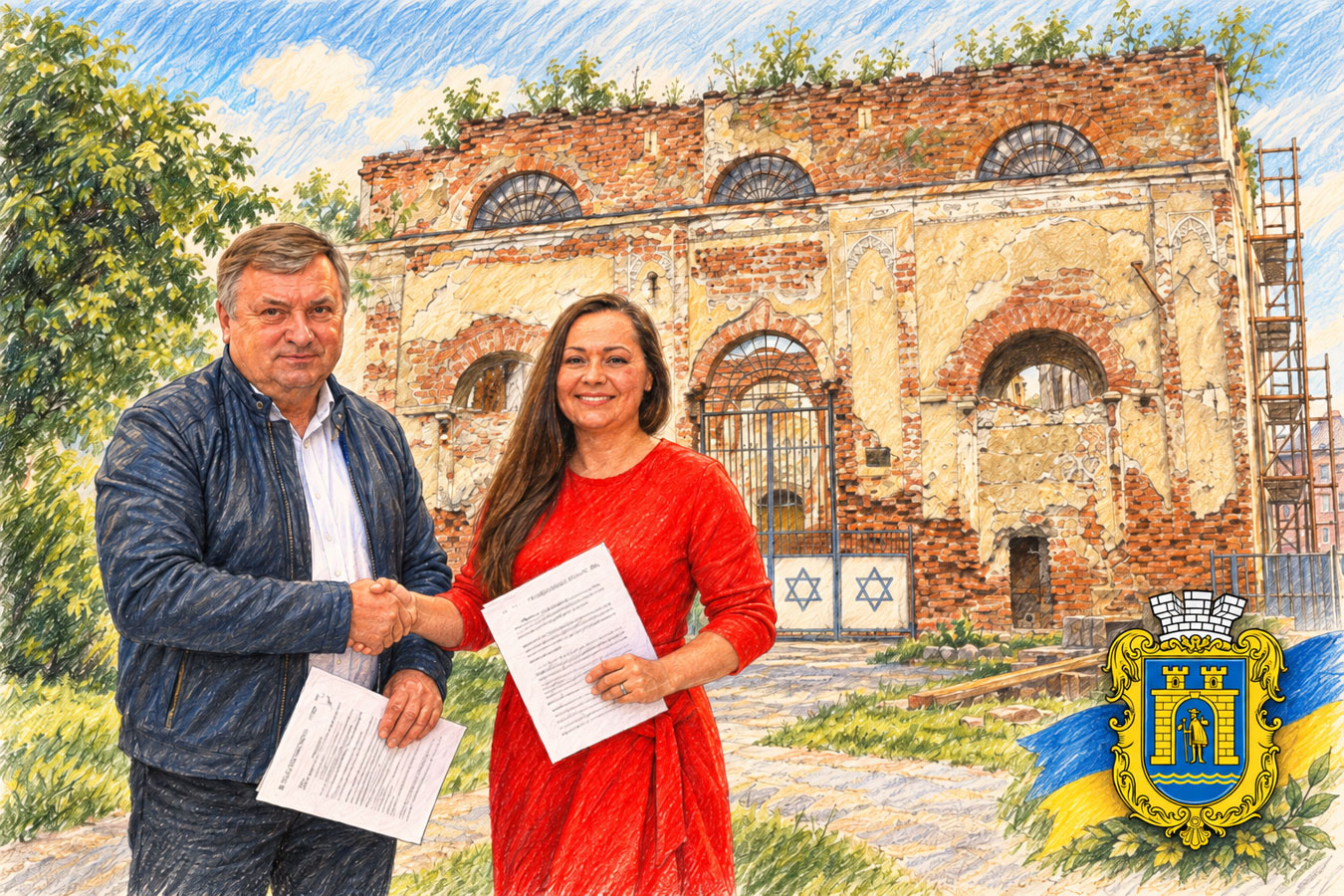
On September 19, 2026, at the Carpathian 8 Summit in Bukovel, the Stryi City Council and the charitable foundation ‘Spadshchyna UA’ signed a memorandum on the restoration of the Great Synagogue of Stryi and the creation of a cultural center based on it. The document was signed by the mayor of the city, Oleh Kanivets, and on behalf of the foundation, its founder Hanna Havryliv.
Here it is on the map – https://maps.app.goo.gl/Wg42zrAuRuxAb4Z78
Stryi is a city in the Lviv region in western Ukraine, south of Lviv. In Israeli, Polish, German, and Jewish documents, the name can be found in several forms: Stryj, Stryi, Стрий, סטרי. It is the same city.
The news itself is short. But if you unfold the history of the building behind it, it becomes a completely different scale: the synagogue of 1817, the large Jewish community of Stryi, the fire of the 19th century, the Holocaust, people locked inside before being sent to Belzec, the Soviet warehouse, the almost started conversion into a swimming pool, decades of destruction, descendants of Stryi Jews in Israel — and only now a new attempt to invent a future for the building.
And it is precisely an attempt. Construction work has not yet begun.
Author: Elena Gunko.
September 19: still a memorandum, not restoration
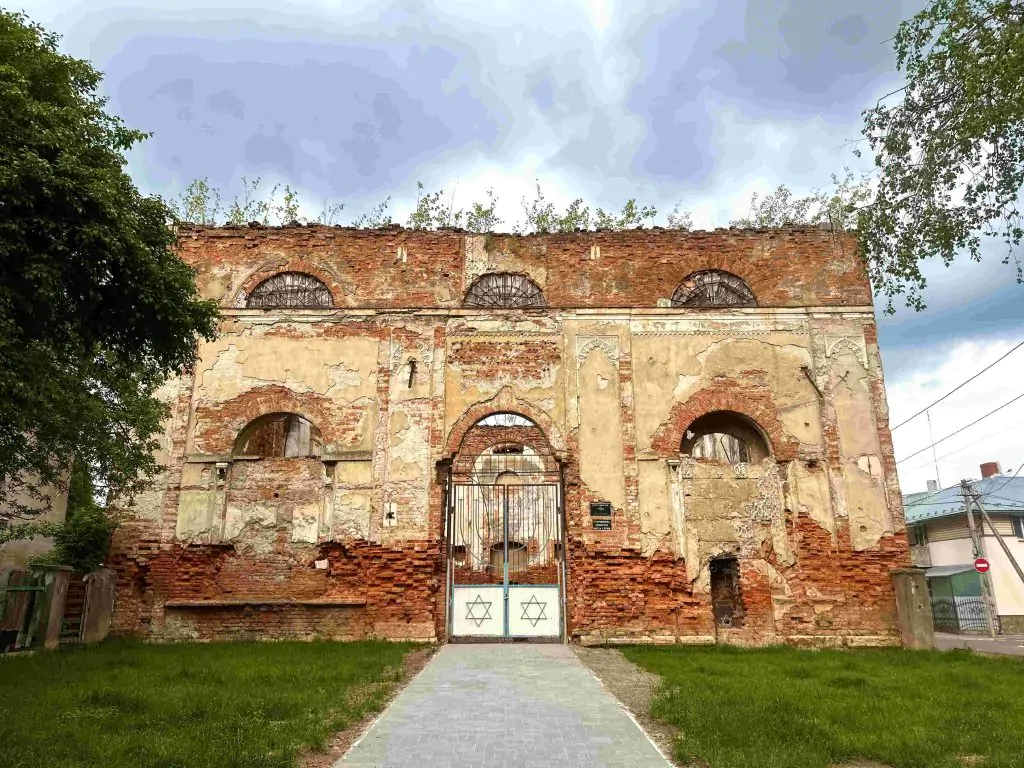
After signing the memorandum, the parties agreed to jointly prepare a project, seek specialists, international partners, and funding. After restoration, they want to use the building as a cultural space, preserving its architectural and historical value. Today it belongs to the territorial community of Stryi, is not used, and remains essentially a ruin.
This distinction is fundamental. There is still no published budget, approved architectural project, contractor, or date when workers will actually enter the site. The next stage is planned to be conducted in Stryi with the participation of Ukrainian and international partners.
And here it is necessary to immediately remove another possible confusion: ‘Spadshchyna UA’ is not a Jewish foundation. It is a Ukrainian organization working with historical architecture and cultural heritage. In this case, it, together with the city, is taking on a monument of Jewish heritage.
The model chosen is not museum-conservation. Hanna Havryliv talks about bringing the past into the modern life of the city — that is, about so-called adaptive use, where a historical object is not just repaired, closed, and left without function again. What exactly the cultural center inside will be — with a permanent exhibition of Jewish history, a Holocaust memorial space, an event hall, or all of this at once — has not yet been publicly decided.
1817. The Great Synagogue appears in the old Jewish quarter
Jews lived in Stryi long before the 19th century. Sources record the Jewish population of the city at least since the 16th century; in 1576, King Stephen Báthory allowed Jews to settle and acquire real estate in the city, and in 1689, the community received permission to build a new wooden synagogue instead of the destroyed previous one.
The large stone synagogue, of which the walls remain today, was built in 1817. Documents from 1827 already record two synagogues in Stryi: one from 1817, the second from 1821. This helps to clarify the dates, because in directories next to the Great Synagogue, another year can be found — 1858.
1858 is not the beginning of the building’s history, but a major reconstruction. After it, the synagogue acquired more pronounced classicist features. That is why in different descriptions of the monument, the 19th century, 1817, 1858, and the end of the 19th century may coexist — it is not necessarily a mistake, but different construction stages.
And this building changed several more times. It turned out to be much less ‘frozen in time’ than it seems from the current brick shell.
The fire of 1886 changed it once more
On April 17, 1886, a huge fire engulfed Stryi. A significant part of the city was affected, and the fire also touched the Great Synagogue.
After restoration, its architecture changed: oriental and neo-Moorish details appeared, which are well visible in pre-war photographs. Synagogue researcher Oksana Boyko associates this stage with construction work after the fire and suggests the possible involvement of the famous Lviv architect Julian Zachariewicz. But this is precisely a research hypothesis; there is no final confirmed document about Zachariewicz’s authorship.
There is also an interesting detail of the era: after the fire, Emperor Franz Joseph allocated funds for the restoration of the Stryi church and synagogue. The restoration work in the city in 1886–1887 was led by architect Sylwester Hawryszkiewicz.
So the familiar view of the Great Synagogue from old postcards is already the result of several lives of one building.
Behind the gates with the menorah, a thousand people were accommodated
From the old synagogue today, primarily the walls, parts of the architectural decor, and the metal gate remain. Its grille is made with a menorah motif, below are preserved Stars of David. Once, wide steps led to the main entrance, and on the gates was an inscription in Hebrew: ‘This is the gate of the Lord, the righteous shall enter through it.’
Inside, everything looked completely different than it does now.
Native of Stryi, writer Julian Stryjkowski, recalled a huge room for about a thousand worshippers. The women’s section was located on two levels — for the local Orthodox environment, such an arrangement even caused disputes. In the center was the bimah, where the Torah was read, on the eastern wall — the Aron ha-Kodesh with scrolls. The walls were blue, with biblical paintings: Noah’s Ark, the sacrifice of Isaac, Moses with the tablets. Light passed through large windows with colored stained glass, brass lamps hung from the ceiling.
The Great Synagogue was not standing separately in the middle of the city. It was located in the old Jewish quarter on Bozhnycha Square; nearby were the Beit ha-Midrash — the house of study and prayer, the mikvah, the Jewish hospital, other prayer buildings.
They prayed according to the Ashkenazi rite. Sources even mention a separate minyan of Stryi coachmen and carriage owners — a small everyday detail, but through it, it is better seen that this was a living public space, not just an ‘architectural monument.’
In some years, Jews made up almost half of Stryi
In 1880, 5,245 Jews lived in the city — 41.62% of the population. By 1910, the Jewish population exceeded ten thousand people, before World War II, it was about 12 thousand.
Yad Vashem provides a slightly different time point: in the early 1930s, about 11 thousand Jews lived in Stryi — about a third of the city’s population. There were a Jewish hospital, orphanage, charitable societies, libraries, schools, Zionist movements, the Bund, ‘Agudat Israel’; the local branch of ‘Ha-Shomer Ha-Tzair’ was the largest in Galicia.
So the Great Synagogue was not the building of a small religious group on the periphery of Stryi. It was within one of the main human worlds of the city itself.
And here NAnovosti — News of Israel | Nikk.Agency encounters the same problem more than once: a modern person sees an old synagogue in Ukraine and perceives it as a separate ‘Jewish object,’ although before the Shoah, such buildings were part of the everyday urban fabric. In our material about the expedition from Jerusalem to more than 30 synagogues of Podolia, we showed exactly this: sometimes from a huge Jewish environment today remains one building, a cemetery, and a few archival photographs.
September 1939: the USSR comes, but the synagogues are still open
After the division of Poland, Stryi was first occupied by German units, and a few days later the city came under Soviet control.
The Soviet authorities closed Jewish parties and independent community institutions, private trade gradually ceased, activists and some refugees were deported deep into the Soviet Union. But one detail in the Yad Vashem encyclopedia sounds quite unexpected: the synagogues remained open for the time being.
That is, the Great Synagogue continued to be a prayer space almost until the German attack on the USSR.
On July 2, 1941, the Germans occupied Stryi. From then on, the building’s history ceases to be only a history of architecture.
September 3, 1942: about three thousand Jews are locked in the synagogue
On September 3, 1942, a major action began in the Stryi ghetto, lasting three days. German forces gathered about three thousand Jews in the synagogue, and then deported them by rail to the Belzec death camp. Along with them, about two thousand Jews from the neighboring Skole were sent; approximately 500–600 people were killed on the spot during the arrests.
Yad Vashem in this episode writes specifically about the synagogue. And when further talking about the cultural center, it will no longer be possible to bypass this layer of history: the space built for prayer was used as a place of temporary detention before deportation to death.
In the fall of 1942, killings and deportations continued. In October, a new major action took place, in November about one and a half thousand more people were taken to the Janowska camp and Belzec. In February — March 1943, about another thousand Jews were killed.
But for the Great Synagogue itself, there was still another episode ahead.
May 22, 1943: more than a thousand people are again inside
On May 22, 1943, the liquidation of the Stryi ghetto began. German police surrounded the area, more than a thousand Jews were gathered and literally packed into the Great Synagogue. They were kept there for several days without water and food. Then they were taken to the local Jewish cemetery and killed.
On June 3, the Germans and their helpers continued to smoke people out of hiding: houses were set on fire, basements were flooded, explosives were thrown into bunkers. In the summer, the remaining Jewish labor camps in the city were destroyed.
Therefore, the Great Synagogue is simultaneously two monuments. One — to the life of Jewish Stryi. The second — to its destruction.
NAnovosti has already analyzed why the memory of the Holocaust in small Ukrainian towns often remains much less known than the history of the largest places of mass murder. In a separate material, we told why the local history of the Shoah gradually falls out of the memory of cities. Stryi shows this problem literally with its walls.
But the current ruin was not made by the Nazis
At this point, it is easy to make a historically beautiful but incorrect phrase: ‘the synagogue was destroyed during the Holocaust.’
No.
The building physically survived the war. In a photograph from 1964, the synagogue is still standing with a roof. After the war, its religious function was not restored, and the Soviet authorities used the premises as a warehouse.
The real turning point in the building’s condition occurred later. In the 1980s, it was decided to make a swimming pool here. For the sake of reconstruction, the vaulted roof and part of the historical structures were dismantled, but the pool itself was never built. After the removal of the roof, water, frost, and plants began to constantly destroy the brick.
It turned out to be a rather wild story. The synagogue survived the German occupation, although people were held inside it before deportation and murder, and a huge part of its architectural integrity was lost decades later — during an unfinished Soviet reconstruction.
Today, the walls, remnants of decorative elements, gates with a menorah and Stars of David are visible. The internal life of the building has almost disappeared.
And the memory of Stryi, meanwhile, moved to Israel
After the destruction of the community, a significant part of its memory continued to exist outside the city.
In 1962 in Tel Aviv, Sefer Stryj — ‘The Book of Stryi’ was published. The publisher is indicated as Organization of Stryi Emigrants in Israel — ארגון יוצאי סטרי בישראל. The book contains sections in Hebrew, Yiddish, and English, the history of the community, memories of former residents, and materials about the destroyed Jewish Stryi.
For such cities, a yizkor-buch — a memorial book of the destroyed community — often turns out to be something like an external city archive. The people are gone, the institutions have disappeared, the interiors are destroyed, but the former residents managed to record what the streets looked like, who prayed where, what schools there were, who served in the synagogue.
In Israel, there is also a separate memorial to the murdered Jews of Stryi at the Nachalat Yitzhak Cemetery in Givatayim. The Center for Jewish Art of the Hebrew University indicates that the monument was created on the initiative of the association of Stryi emigrants; it perpetuates the memory of the community that perished in the Shoah in Hebrew.
So the Israeli connection here is not invented for today’s material. It has existed for decades.
The Hebrew University documented the synagogue itself
There is an even more direct line.
The Center for Jewish Art of the Hebrew University in Jerusalem documented the Great Synagogue of Stryi in 1993 and 1997. Its database preserved a separate array of dozens of images of the building; the object is classified as a 19th-century Ashkenazi synagogue with neo-Moorish features.
For future restoration, these materials may turn out to be quite practical, not just academic. When a building stands without a roof for decades, a photograph from twenty or thirty years ago sometimes preserves a detail that is no longer there today.
In August 2026, specialists from the same Center again traveled around Ukraine and documented historical synagogues of Podolia. NAnovosti detailed this expedition: more than thirty objects were inspected, photographed, and recorded before further destruction or war changes them completely.
There is also a broader Ukrainian project to preserve Jewish heritage in digital form — we wrote about it separately.
In 2017, the Great Synagogue was already being saved by hand
The current memorandum did not arise from scratch. Before it, there were people who came to the ruin without a big budget and simply started with what they could do.
In 2017, local council deputy Petro Kurytnyk told a round table on the preservation of Jewish heritage in Lviv that the Great Synagogue became one of his main projects. They started with the restoration of the original metal gates, then cleaned up the debris inside the building, cut down trees and shrubs that were already growing in the walls and on the brickwork.
Volunteers from the Lviv Volunteer Center at the All-Ukrainian Jewish Charitable Foundation ‘Hesed-Arieh’, as well as local students, joined the work. In September 2017, American Donna Kerner, a descendant of a local Jewish family, visited Stryi; with her help, it was possible to attract equipment to remove plants from the upper parts of the high ruin.
And here an interesting continuity is discovered. Even then, the option of a future art center and cultural space with an exhibition on the history of the Jewish community of Stryi was discussed. That is, the idea that now appears in the 2026 memorandum was voiced in some form almost ten years ago.
By that time, there were already memorial signs at the entrance, installed in the 1990s by Israeli survivors and descendants of Stryi Jews.
Then why are Jewish organizations not yet named in the new project?
The question arises, especially if you know the entire previous history.
In the new project, Stryi City Council and ‘Spadshchyna.UA’ are officially involved. At the time of publication, we did not find confirmation that ‘Hesed-Arieh’, the Jewish community of Ukraine, the Hebrew University in Jerusalem, the organization of Stryi emigrants in Israel, or another Israeli fund have already joined the project as official partners.
But it would be premature to conclude someone’s exclusion from this. The memorandum itself provides for the next stage with the involvement of Ukrainian and international partners and the search for external funding.
Carpathian 8 Summit was quite a suitable place for this. The forum was held September 18–20, 2026, in Bukovel and brought together representatives of eight countries of the Carpathian region, EU institutions, business, local communities, and international partners. On September 19, the Ukrainian Cultural Heritage Fund stand was operating on the site, where they separately talked about the preservation, restoration of heritage, and international support for such projects.
But money and an international platform are only part of the task. It is still necessary to determine who will be responsible for the content of memory inside the restored building, and this is already a question no less complex than roofing or masonry.
Explanation for the Israeli reader: what may be unclear here
Stryi is a city in the Lviv region in western Ukraine, south of Lviv. In Israeli, Polish, German, and Jewish documents, the name can be found in several forms: Stryj, Stryi, Стрий, סטרי. It is the same city.
Galicia here has nothing to do with Spanish Galicia. It refers to a historical region of Central-Eastern Europe. Stryi was part of the Habsburg Monarchy and Austria-Hungary, interwar Poland, the USSR, and now it is Ukraine. Therefore, one family from Stryi could receive several different passports in their lifetime without moving from home.
Beit ha-Midrash — a house of study, a place for studying Jewish religious texts and prayer. Mikvah — a ritual bath. Bimah — a platform from which the Torah is read. Aron ha-Kodesh — an ark where Torah scrolls are stored. Minyan — the minimum quorum for public prayer; in traditional Orthodox Judaism, this is ten adult Jewish men.
Belzec, where Jews from Stryi were sent in September 1942, was a death camp. That is, not just a detention or forced labor camp, but one of the centers of Operation Reinhard, created by Nazi Germany specifically for the mass murder of Jews.
There is also the concept of a yizkor-buch, or memorial book of the community. After the Shoah, emigrants from destroyed towns and villages created such books in Israel, the USA, and other countries. Thanks to them, surnames, photographs, memories, and descriptions of life that physically no longer existed were preserved. Sefer Stryj, published in Tel Aviv in 1962, is just such a book.
And the last thing that is sometimes difficult to feel from modern Israel. When we see a Ukrainian city today and a separately standing ‘old Jewish synagogue,’ there is a feeling that Jews were a small historical group next to the main population. In Stryi, this is completely not the case: at the end of the 19th century, Jews made up more than 40% of the residents. The Great Synagogue was part of normal city life, like a market, school, or hospital.
209 years of history — and now everything again rests on practice
The Great Synagogue was built in 1817. In 1858, it was seriously rebuilt, after the fire of 1886, it was restored again and its appearance changed. In September 1942, about three thousand Jews were held inside before being sent to Belzec, in May 1943, more than a thousand people were again driven there, who were later killed.
After the war, the synagogue became a warehouse. In the 1980s, it was planned to make a swimming pool out of it, the vaults were dismantled, and it was left unfinished. In the 1990s, descendants of the community from Israel returned to it, the Hebrew University documented the ruin, in 2017, the walls were cleared of trees by Jewish and Ukrainian volunteers. Now in September 2026, the city and ‘Spadshchyna.UA’ are trying to launch a full-fledged project to return the building to city life.
But the memorandum does not guarantee anything yet. The old brick box needs engineering stabilization, a project, money, specialists, and then years of maintenance. And it is also necessary to solve a much less technical thing: can a modern cultural center be made in such a way that it does not turn the place of the Holocaust into just a beautiful historical decoration.
Perhaps this will be the main test of the project. Because here you cannot restore only the convenient half of the past.
The Great Synagogue of Stryi was a place of prayer. Then it became a place where people were locked before death. Then a warehouse, an unfinished swimming pool, and a ruin. Now it has another chance — but what exactly the city will bring back to life with these walls is yet to be decided.