
On September 4, 1921, in the midst of the XII Zionist Congress in Carlsbad, Vladimir Ze’ev Jabotinsky signed an agreement to create a Jewish gendarmerie in Ukraine. Symon Petliura was not at the negotiating table: the document was concluded by Jabotinsky and the head of the diplomatic mission of the Ukrainian People’s Republic in Czechoslovakia, Maksym Slavinsky. The project did not envisage the participation of Jews in the war against the Red Army, but rather the armed protection of Jewish communities from possible pogroms.
Author: Victoria Katsman
The phrase “Jabotinsky signed a treaty with Petliura” outlived the document itself and almost overshadowed its content. It contains two problems. Jabotinsky and Petliura did not meet personally, and Petliura’s signature is not on the agreement. However, this does not mean that the agreement did not exist: by the fall of 1921, the leadership of the Ukrainian People’s Republic was already operating in exile, and its official diplomat Maksym Slavinsky conducted negotiations on behalf of the Ukrainian side.
At the same time, the Ukrainian People’s Republic still hoped to return to Ukraine by armed means. Under the political leadership of Symon Petliura, a new campaign against Soviet power was being prepared. A Partisan-Rebel Headquarters was created in Poland, headed by Yuriy Tyutyunnyk. The plan envisaged the crossing of UPR army groups over the border from Polish and Romanian territories, their joining with anti-Bolshevik rebels within Ukraine, and an attempt to spark a broader uprising. Special reliance was placed on local peasant and partisan formations already operating against the Bolsheviks.
That is why the agreement on the Jewish gendarmerie had a very specific practical meaning: if UPR troops re-entered Ukrainian towns and villages, a separate Jewish structure was to appear behind them, which would not participate in battles but would protect local Jewish communities from possible pogroms.
Equally important is the timing of these events. On September 4, the XII Zionist Congress was underway in Carlsbad — the first after World War I and after the Balfour Declaration. While the global Zionist leadership discussed the future of the Jewish national home in Palestine, the British mandate, aliyah, land, funding, and relations with the Arab population, Jabotinsky was simultaneously dealing with another issue: what would happen to the Jews of Ukraine if the UPR army indeed returned there and the UPR again became the official Ukrainian authority.

For NAnews — Israel News | Nikk.Agency, this story is interesting not as another attempt to decide whether Petliura was “good” or “bad.” The preserved documents allow for more specific questions: what exactly did Jabotinsky intend to create, why did he not want to leave the safety of Jews at the level of promises, and why did his agreement with the UPR representative cause a severe conflict within the Zionist movement itself.
September 4, 1921: the fourth day of the XII Zionist Congress
The previous World Zionist Congress took place back in 1913. Over the next eight years, World War I ended, the Russian, German, Austro-Hungarian, and Ottoman empires collapsed, Britain occupied Palestine, the Balfour Declaration appeared, and Eastern Europe went through revolutions, civil wars, and mass violence.
The XII Zionist Congress was held from September 1 to 14, 1921, in Carlsbad, then Czechoslovakia, now Karlovy Vary in the Czech Republic. According to modern research, about 540 delegates from 42 countries participated, and about a thousand guests came to Carlsbad.
Among the most notable participants were:
- Chaim Weizmann — one of the main leaders of the Zionist movement, elected at this congress as president of the World Zionist Organization;
- Nahum Sokolow — chairman of the congress and one of the key representatives of Zionist diplomacy;
- Menachem Ussishkin — one of the leading figures of practical Zionism;
- Vladimir Ze’ev Jabotinsky — congress delegate and future founder of Revisionist Zionism;
- Arthur Ruppin — one of the main organizers of Jewish settlement in Palestine;
- Chaim Nahman Bialik — the greatest Jewish poet;
- Martin Buber — philosopher and one of the most famous Jewish intellectuals of his time;
- Yitzhak Ben-Zvi — future second president of Israel;
- David Yellin — educator, public figure, and one of the leaders of the Jewish Yishuv.
An interesting photo collage of congress participants is preserved in the National Library of Israel. Weizmann is marked as No. 1, Sokolow as No. 2, Ussishkin as No. 3, Ruppin as No. 10, Jabotinsky as No. 13, Buber as No. 34, and Ben-Zvi as No. 380.
Jabotinsky was not on the periphery of Zionist politics at this time. At the XII Zionist Congress, he was re-elected to the Executive Committee of the World Zionist Organization. Therefore, negotiations with Slavinsky took place when Jabotinsky himself was part of the top leadership of the global Zionist movement.
Thus, when the agreement on the Jewish gendarmerie in Ukraine was discussed on September 4, Jabotinsky was not at a separate Ukrainian conference or on a secret political trip. He was in Carlsbad among the leaders of the global Zionist movement and participated in one of the main Jewish political events of that time.
Jabotinsky, Slavinsky, Petliura, and the UPR: who is who in this story
Not all readers are equally familiar with the history of the Zionist movement, the Ukrainian People’s Republic, and the politicians of the early 20th century. Therefore, before analyzing the agreement itself, let’s briefly remind who Vladimir Jabotinsky was, who Maksym Slavinsky was, what role Symon Petliura played, and what the UPR represented in 1921. Without this, some details of the Carlsbad agreement simply lose their meaning.
Who is Vladimir Ze’ev Jabotinsky
Vladimir Ze’ev Jabotinsky (1880–1940) was one of the major leaders of the Zionist movement in the first half of the 20th century, a journalist, writer, translator, politician, and ideologist of Jewish self-defense. He was born in Odessa, then the Russian Empire, today Ukraine, studied law in Italy and Switzerland, and gained fame as a Russian-speaking journalist and publicist in his youth.
A turning point for him was the Kishinev pogrom of 1903. After it, Jabotinsky finally linked his activities with Zionism and the organization of Jewish self-defense. In the same year, he participated in the VI Zionist Congress — the last congress attended by Theodor Herzl. Jabotinsky advocated for the development of Hebrew, the creation of Jewish national institutions, and the right of Jews to defend their communities.
During World War I, Jabotinsky, together with Joseph Trumpeldor, sought the creation of Jewish military units within the British army. Thus, the Jewish Legion was formed. Jabotinsky himself served in the British army with the rank of lieutenant and participated in the military campaign in Palestine against the Ottoman Empire.
In 1920, during the Arab riots in Jerusalem, Jabotinsky participated in organizing Jewish defense. The British authorities arrested him and sentenced him to a long imprisonment, but after public pressure, he was amnestied and released from Acre prison.
By the time of the events in Carlsbad, Jabotinsky was already at the center of Zionist politics. In 1921, he joined the Executive Committee of the World Zionist Organization, was one of the figures of Keren Hayesod, and at the XII Zionist Congress was re-elected to the Zionist leadership.
Later, his political path would sharply diverge from Chaim Weizmann’s line. In 1923, Jabotinsky would create the youth movement Betar, and in 1925, the Union of Revisionist Zionists. He would become the founder of the direction known as Revisionist Zionism, demanding a more active struggle for mass aliyah, the creation of Jewish military power, and the openly proclaimed goal of creating a Jewish state.
For the modern Israeli reader, it is important to understand Jabotinsky’s political legacy. It is from the Revisionist tradition that Betar, Etzel, the Herut movement of Menachem Begin, and a significant part of the ideological tradition of the modern Israeli right-wing camp later emerged. Menachem Begin himself was the leader of Betar in Poland in his youth.
Jabotinsky died in 1940 in the USA while visiting a Betar camp. In his will, he asked to transfer his remains to Eretz Israel only by order of a future Jewish government. This happened in 1964 by decision of Prime Minister Levi Eshkol: Jabotinsky and his wife Joanna were reburied on Mount Herzl in Jerusalem.
Therefore, the person who discussed the creation of a Jewish gendarmerie with a Ukrainian diplomat on September 4, 1921, was not a random public activist. By that time, Jabotinsky already had his own experience in organizing Jewish self-defense and Jewish military units. This helps to understand why the idea of an armed structure to protect the Jews of Ukraine was quite consistent with his political logic.
Who is Maksym Slavinsky
Maksym Slavinsky (1868–1945) was not a random intermediary tasked with talking to Jabotinsky. He was a notable figure in the Ukrainian national movement of the early 20th century — a lawyer, journalist, translator, politician, and diplomat.
He was born in Stavyshche in the Kyiv region, graduated from the law and historical-philological faculties of Kyiv University, worked in the press, and was closely connected with the Ukrainian cultural environment even before the revolution. Together with Lesya Ukrainka, Slavinsky translated Heinrich Heine’s works into Ukrainian.
After the revolution, his activities were directly related to Ukrainian statehood. In 1917, Slavinsky represented the Central Rada at the Provisional Government in Petrograd. In 1918, he participated in negotiations with Soviet Russia, worked in the foreign policy system of the Ukrainian state, and for some time held the post of Minister of Labor.
Under the Directorate of the UPR, Slavinsky headed the Extraordinary Diplomatic Mission of the Ukrainian People’s Republic in Czechoslovakia. His task was to seek international support for the UPR, develop relations with Czechoslovakia, and seek political and military assistance for the Ukrainian government. Slavinsky personally knew the President of Czechoslovakia, Tomáš Masaryk, since 1911.
Therefore, in Carlsbad, Jabotinsky was not talking to a private emigrant or a person who had arbitrarily declared himself a representative of Petliura. He was facing the head of the official diplomatic mission of the UPR, who had many years of political experience.
Jabotinsky and Slavinsky were also acquainted long before 1921. Slavinsky called Jabotinsky an old good friend; even before World War I, both were associated with the newspaper “Russian News.” Therefore, the negotiations in Carlsbad did not begin between two people meeting for the first time at the Zionist Congress.
In his own report, compiled on September 16, 1921, Slavinsky described in detail the course of contacts with Jabotinsky, the participants of the meetings, the proposed further work, and the financial scheme of the future gendarmerie. This document allows us to reconstruct the negotiations in much more detail today than is evident from the brief text of the agreement itself.
After the mission was liquidated in 1923, Slavinsky remained in Czechoslovakia and taught history and literature in Ukrainian emigrant educational institutions. In May 1945, after the arrival of Soviet troops in Prague, he was arrested by SMERSH. The 76-year-old Slavinsky was taken to Kyiv, where he died in Lukyanivska prison.
Who is Symon Petliura
Symon Petliura (1879–1926) was born in Poltava to Vasyl and Olha Petliura and was the sixth of 11 children. The family came from Poltava townspeople of Cossack origin. Petliura first studied at a parish school, then at the Poltava Theological Seminary, from which he was expelled in 1901 due to his involvement in the Ukrainian national movement.
From a young age, he was involved in politics and journalism, was a member of the Revolutionary Ukrainian Party, worked as a teacher, accountant, publicist, and editor.
His wife, Olha Petliura, née Belska, was a teacher and later participated in the life of the Ukrainian emigration. The couple had a daughter, Lesya Petliura, born in 1911. She wrote poetry and died in 1941 from tuberculosis.
After the 1917 revolution, Petliura quickly found himself among the leaders of the Ukrainian national movement. He was involved in creating Ukrainian armed forces, was the general secretary of military affairs, and then became the Chief Ataman of the UPR army and one of the leaders of the Directorate of the Ukrainian People’s Republic. His political goal was an independent Ukraine and the fight against Bolshevik Russia.
After the military defeat of the UPR, Petliura continued to lead Ukrainian political and military structures in exile. That is why in 1921, his government maintained diplomatic missions abroad, including Slavinsky’s mission in Czechoslovakia.
For Jewish history, Petliura remains an extremely controversial figure due to the mass pogroms of 1918–1920. There is no evidence that he personally ordered pogroms, and the UPR leadership issued orders against anti-Semitic violence. However, as the head of political power and the army, Petliura remains associated with the question of responsibility for the failure to stop the mass killings of Jews and the fact that not all perpetrators were punished.
On May 25, 1926, Petliura was shot in Paris by Sholom Schwartzbard, who claimed to be avenging the Jews who died during the pogroms. In the 1927 trial, a French jury acquitted Schwartzbard.
In modern Ukraine, Petliura is primarily honored as one of the leaders of the struggle for an independent Ukrainian state and one of the creators of the Ukrainian army of the early 20th century. In 2026, the centenary of his death was included in the state calendar of memorable dates by the Verkhovna Rada.
His name is also used in the modern Ukrainian military tradition: the 152nd Separate Ranger Brigade of the Ground Forces of the Armed Forces of Ukraine bears the name of Symon Petliura.
Therefore, for the Israeli reader, it is important to understand the duality of his image: in Ukrainian historical memory, Petliura is primarily a symbol of the struggle for statehood and resistance to Bolshevik Russia; in Jewish memory, his name is inseparable from the tragedy of pogroms and the question of government responsibility for mass violence.
What is the Ukrainian People’s Republic
The Ukrainian People’s Republic, UPR was a Ukrainian state that emerged after the 1917 revolution on the territory of the former Russian Empire.
Initially, the UPR was proclaimed as an autonomous republic, and on January 22, 1918, it declared full independence.
Over the next few years, the UPR experienced war with the Bolsheviks, German and Austro-Hungarian presence, a change of power to the Ukrainian state of Hetman Pavlo Skoropadskyi, and the subsequent restoration of the republic by the Directorate.
During this period, Ukraine became the arena of several wars. Forces of the UPR, Bolsheviks, White armies, Polish troops, independent ataman formations, and other armed groups operated on its territory. Against the backdrop of the collapse of state power and constant changes in the front, mass Jewish pogroms also occurred.
By 1921, the UPR no longer controlled the territory of Ukraine. After defeat in the war with the Bolsheviks, its leadership, army structures, and diplomatic representations continued to operate in exile — primarily in Poland and Czechoslovakia.
At the same time, the UPR leadership did not abandon plans for an armed return to Ukraine. In 1921, under the initiative of Symon Petliura, preparations for a new campaign were underway: it was assumed that UPR army detachments would cross the border, join anti-Bolshevik insurgent forces within Ukraine, and attempt to raise a broader uprising against Soviet power.
This circumstance is crucial for understanding the Jabotinsky-Slavinsky agreement. It was not an agreement with the current government in Kyiv. Soviet power was already in Kyiv. Slavinsky represented the government of the UPR in exile, which continued to consider itself the legitimate Ukrainian government and hoped for a new armed campaign and return to Ukraine.
It was under such a scenario that the project of the Jewish gendarmerie was created: if the UPR army re-entered Ukrainian territory, a separate Jewish structure capable of protecting local Jewish communities from possible pogroms was to appear behind it.
What the XII Zionist Congress decided and why Ukraine was alongside Palestine
The official agenda of the Carlsbad Congress was far from Ukrainian politics. The Zionist movement was deciding how to move from the diplomatic success of the Balfour Declaration to the practical construction of a Jewish national home.
Discussions included the British mandate for Palestine, the international legal consolidation of the provision on the Jewish national home, immigration, land acquisition, settlement development, the creation of their own institutions, and the financing of this entire process.
Chaim Weizmann was elected president of the World Zionist Organization. Great attention was paid to Keren Hayesod, created a year earlier and becoming one of the most important financial mechanisms of Zionist construction.
After the Arab riots in the spring of 1921, including the bloody events in Jaffa, relations with the Arab population and the policy of the British administration became a separate painful topic.
Within the Zionist movement, there were different approaches. Some leaders focused primarily on political agreements and cautious interaction with London. Jabotinsky increasingly returned to the issue of Jewish military power and the ability to defend themselves.
A few months before Carlsbad, he sought the restoration of a Jewish military formation in Palestine. For a person associated with the creation of the Jewish Legion, self-defense was not an abstract theory: if the existing authority could not guarantee the safety of Jews, Jews themselves should have an organized force for their protection.
And in Carlsbad, two realities were side by side. In the congress hall, the future of the Jewish national center in Palestine was discussed. Outside the official agenda, Jabotinsky discussed with Slavinsky the fate of the Jews of Eastern Europe, who, after several years of wars and pogroms, remained practically defenseless.
Jabotinsky and Slavinsky were not random acquaintances. They knew each other long before 1921. Slavinsky called Jabotinsky an old good friend; even before World War I, both were associated with the newspaper “Russian News.”
The Ukrainian theme was also long present in Jabotinsky’s political views. In the NAnews material about Jabotinsky and Ukraine, we have already analyzed his attitude towards the Ukrainian language, the Ukrainian national movement, and the right of Ukrainians to independent political existence.
Later, Jabotinsky would significantly diverge from Weizmann and the leadership of the Zionist movement. In the NAnews article “Jabotinsky against Putin”, we wrote about another part of his political legacy — the rejection of Russification and the idea of Ukrainians as part of a single Russian people.
Petliura was not in Carlsbad
Symon Petliura did not sign the agreement on September 4 and was not present at its conclusion. Moreover, Jabotinsky later explicitly wrote that he did not personally know Petliura, Volodymyr Vynnychenko, or other leading leaders of the Ukrainian government.
Therefore, the expression “Jabotinsky’s agreement with Petliura” is convenient but historically inaccurate shorthand. Jabotinsky’s direct partner was Maksym Slavinsky, the official representative of the UPR government in exile.
But the opposite version, that Slavinsky signed some private paper unrelated to the Ukrainian leadership, does not correspond to the documents. His own report shows the negotiations as part of the UPR’s political work and preparation for a possible return of the Ukrainian army.
This complex issue was analyzed in more detail by NAnews in the material about Petliura, Jewish memory, and Ukrainian independence.
Before the agreement: the UPR’s appeal to the XII Zionist Congress
A few days before the signing of the agreement on the Jewish gendarmerie, the Ukrainian diplomatic mission attempted to directly appeal to the global Zionist movement.
On August 29, 1921, Maksym Slavinsky and the secretary of the UPR mission in Czechoslovakia, Olherd-Ippolit Bochkovsky, signed an official letter to the XII Zionist Congress. It is preserved in the published stenographic protocol of the congress as a separate document. Researchers have not been able to find the original copy of the letter.
On September 1, the first day of the congress, the letter was read to the delegates by Vladimir Jabotinsky — in French. This is separately noted by the editor of the academic publication.
In the appeal, the Ukrainian mission drew a parallel between the Ukrainian and Jewish national movements. It spoke of millions of Jews living in Ukraine and directly acknowledged that in previous years they had suffered severe persecution. At the same time, Slavinsky rejected the responsibility of the Ukrainian people as a whole, blaming “irresponsible elements,” and declared the Ukrainians’ desire to live with Jews in cooperation and restore peace in the country.
In his report dated September 16, 1921, Slavinsky wrote that even before the congress, he had handed over the materials available to the Ukrainian mission to Jabotinsky and discussed with him how to change the extremely negative attitude of the Jewish public towards the Ukrainian movement after the pogroms. It was during these contacts, he said, that the idea of a Jewish gendarmerie arose.
Slavinsky also claimed another important thing: a group of Eastern European, British, and American Zionists was going to name the UPR government and army as the main culprits of mass violence when discussing the pogroms. According to Slavinsky himself, his explanations and Jabotinsky’s informational work helped stop this initiative. This is his own assessment of the outcome of the negotiations, not the conclusion of an independent congress protocol.
Thus, even before the agreement on September 4, the Ukrainian side was solving two tasks in Carlsbad: trying to change the international Jewish movement’s attitude towards the UPR and simultaneously negotiating a practical mechanism for protecting Jews in case the UPR army returned to Ukraine.
The appeal itself is published as Document 10 on pages 140–142 of the academic collection; immediately after it is Document 11 — the agreement on the Jewish gendarmerie dated September 4, 1921.
main text of the appeal:
How the negotiations went and what exactly the Jewish gendarmerie was supposed to be
Who participated in the negotiations
The agreement did not arise from one meeting on the evening of September 4. According to Slavinsky’s report, he visited Carlsbad on August 29, 30, and 31, and then on September 3 and 4, 1921.
On August 30, a conference was held between Slavinsky and Jabotinsky, attended by the Ukrainian diplomat Roman Smal-Stotsky, associated with the UPR representation in Berlin.
Further negotiations took place on September 3 and 4 without Smal-Stotsky.
Ukrainian diplomacy was trying to solve not only the issue of the gendarmerie. After the pogroms, the attitude of a significant part of the Jewish world towards the UPR was extremely difficult. Slavinsky handed over Ukrainian materials to Jabotinsky and prepared a greeting for the XII Zionist Congress, which was announced on the first day of the congress.
In this appeal, the Ukrainian mission acknowledged that the Jews of Ukraine had experienced terrible persecution in previous years, while simultaneously rejecting the collective responsibility of the Ukrainian people and declaring a desire for Ukrainian-Jewish cooperation.
At the last conference, when the draft agreement was finally agreed upon, British Colonel John Henry Patterson was present — the former commander of the 38th Battalion of the Royal Fusiliers, one of the units of the Jewish Legion, in the creation of which Jabotinsky participated.
Slavinsky wrote that Patterson supported the project and promised assistance. However, the British officer was not a party to the agreement, and his signature is not on the agreement. Modern researchers also consider Slavinsky’s assessment exaggerated, as if Patterson at that time had significant influence on the British military and foreign policy leadership: he left active military service back in 1920.
Where and when the signatures were placed
The agreement was signed on September 4, 1921, in Karlsbad, now Karlovy Vary, at the Olympic-Palast-Hotel.
This place is directly indicated in the preserved text of the document. However, known sources do not specify the exact hotel room number or the name of the hall where the final signing took place, so there is no basis to assert such details.
Only two people signed the agreement:
- Maxim Slavinsky — from the diplomatic structure of the UNR;
- Vladimir Zeev Jabotinsky — from the Jewish side.
On the preserved Ukrainian copy, after the signatures, there is another archival detail — a note confirming the document “for the head of the Directorate’s office” and an illegible signature. Modern publishers of the document have not been able to establish the name of this official.
This entry shows the document passing through the UNR structure but does not prove that the unknown official was personally present at the Olympic-Palast-Hotel during the signing.
Under what condition the gendarmerie was supposed to appear at all
The document consisted of seven main points and an additional condition. It was already a fairly specific project, but not the final charter of a ready formation. The number, internal structure, supply, and some other technical issues were to be the subject of subsequent agreements.
The entire project was tied to a specific scenario: the UNR army re-enters the territory of Ukraine and occupies cities and towns.
It was precisely after it that the temporary Jewish gendarmerie as part of the state gendarmerie of the UNR was supposed to move.
Its special task was called the protection of the Jewish population in the settlements occupied by Ukrainian troops. According to point 7, it was supposed to follow along with the Ukrainian state gendarmerie directly behind the army, in the rear zone, and begin to perform its task immediately after occupying a settlement with a Jewish population.
Practically, the scheme looked like this: UNR troops enter the city, followed by the state gendarmerie, and with it — a specially created Jewish unit, whose task is to prevent pogroms, robberies, and other violence against local Jews.
It was forbidden to fight against the Red Army
The second point of the agreement established a fundamental restriction: the Jewish gendarmerie was not to participate in military actions.
Therefore, presenting the project as the creation of a “Jewish legion of Petliura for the war against the Bolsheviks” is incorrect.
The political context was undoubtedly anti-Bolshevik. The emigration leadership of the UNR hoped to return to Ukraine by armed means, and without such a campaign, the entire gendarmerie project lost practical meaning.
But the Jewish gendarmes themselves were not supposed to participate in battles with the Red Army, advance on cities, or conquer territory. Their work began after the settlement was already occupied by Ukrainian troops.
Who was supposed to recruit people
The unit was not to be formed by the UNR army independently or by the World Zionist Organization.
Point 3 of the agreement spoke of a special Jewish organization that was supposed to handle recruitment and be responsible for the recruited people.
At the same time, the document contained a direct political filter: communists were prohibited from being accepted into the Jewish gendarmerie.
A fairly clear boundary emerged. The unit did not participate in the war with the Bolsheviks, but people politically connected with the UNR’s opponent were not intended to be accepted into this formation.
The agreement itself did not define the number of the gendarmerie, there was no ready list of units or a final list of settlements where they were to be stationed. This was left for the next stage of negotiations.
A Jew was supposed to command
The agreement separately fixed the origin of the future head of the unit.
At the head of the Jewish gendarmerie was to stand a Jewish commander, whose candidacy was to be agreed upon between the special Jewish organization and the supreme command of the UNR army.
That is, the Ukrainian leadership could not simply appoint its own officer as the head of the “Jewish gendarmerie”. But the Jewish side also did not receive the right to appoint the commander unilaterally.
The formation was included in the state system of the UNR, while retaining its own Jewish leadership.
To whom the commander was subordinate
On general order issues, the commander of the Jewish gendarmerie was to be subordinate to the head of the Ukrainian state gendarmerie.
But on his main special task — protecting the Jewish population — he was given the opportunity to appeal directly to the Chief of Staff of the UNR army or to the official to whom all the gendarmerie was subordinate in a specific military situation.
This created a direct channel upwards, bypassing the usual local chain of command.
Such a construction made understandable sense. If the local military or gendarmerie leadership itself participated in violence or refused to stop it, the Jewish commander should not have been completely dependent on this same leadership.
What legal rights the gendarmerie received
The project did not envisage the creation of a private armed squad without official status.
Jewish gendarmes were to receive all the rights of the Ukrainian state gendarmerie. At the same time, they were subject to the same laws and bore the same responsibility for their actions as Ukrainian gendarmes.
In essence, it was an attempt to legalize armed Jewish self-defense within the state system of the UNR.
Where exactly it was supposed to operate
The document did not contain a ready list of cities — Kyiv, Odessa, Zhytomyr, Proskuriv, Vinnytsia, or other settlements.
Instead, a general principle was established: the gendarmerie was to start work immediately after the UNR troops occupied a settlement with a Jewish population.
The specific territory and functions were to be determined by a special plan.
Moreover, this plan was to be developed by the commander of the Jewish gendarmerie himself, after which it was approved by the UNR General Staff. Within the approved plan, the activities of the Jewish gendarmerie were to be autonomous.
The scheme looked unusual: the Jewish commander develops the plan, the UNR General Staff approves it, after which the Jewish unit independently operates within the limits set by this plan.
What guarantees the Ukrainian command had to give
An additional condition was added to the seven main points of the agreement.
The supreme command of the UNR army was to reaffirm the unconditional inadmissibility of any repressions against the Jewish and Christian populations.
The prohibition also extended to revenge for events that occurred before the arrival of the UNR army. This was of great importance in the conditions of civil war, when local residents could be accused of collaborating with the Bolsheviks, supporting another army, or participating in events that occurred before the return of Ukrainian troops.
The agreement attempted to exclude the possibility of collective punishment under the pretext of retribution in advance.
Cases of violence were to be referred to a military court. Its composition, “if possible”, was to include representatives of both the Christian and Jewish populations.
Here it is important to maintain accuracy: the document did not guarantee mandatory equal representation of the two communities in each court. A more cautious wording was used — the participation of representatives of both sides was envisaged if possible.
Who was supposed to pay for the gendarmerie
The financial scheme is detailed not in the seven points of the agreement itself, but in the report of Maxim Slavinsky, compiled in Prague on September 16, 1921.
The preparation of the project was to be paid for by a special Jewish organization outside the World Zionist Organization.
But from the moment the Jewish gendarmerie entered the territory of Ukraine, the expenses shifted to the Ukrainian People’s Republic.
Before entering Ukraine — expenses of the Jewish organization; after entering Ukraine — expenses of the UNR.
Slavinsky’s report also clarifies why the structure was deliberately taken outside the World Zionist Organization. The Zionist movement united people with completely different political views, including groups close to the communists. No one intended to turn the entire World Zionist Organization into an official participant in the agreement with the anti-Bolshevik government of the UNR.
What else was not determined on September 4
Jabotinsky and Slavinsky did not sign a fully formed unit’s charter. They recorded a principled agreement of seven points and an addition.
At the end of the document, both pledged to immediately use the opportunities available to them — each “in their sphere of influence” — for the practical implementation of the project. But it was also noted there that technical details should become the subject of further agreements.
As of September 4, the following were not yet finally determined:
- the number of the Jewish gendarmerie;
- its complete internal structure;
- specific locations;
- the full composition of the command;
- the exact schedule of formation;
- details of supply and organization.
Slavinsky himself, twelve days later, called the signed document a “principled project” and assumed that further negotiations would be conducted by representatives of the special Jewish organization and responsible representatives of the UNR.
In the end, the meaning of the project was quite unambiguous: Jabotinsky sought not the participation of Jews in the UNR’s war against the Bolsheviks, but the legal formalization of armed Jewish self-defense. After the experience of pogroms, he wanted to receive from the Ukrainian side not another promise of protection, but a mechanism allowing Jews themselves to participate in ensuring the safety of their communities.
Why the agreement caused a scandal and why the project was never implemented
In 1918–1920, the territory of Ukraine became one of the main spaces of mass anti-Jewish violence in Eastern Europe.
Pogroms were committed by various forces: units associated with the Directorate of the UNR, independent ataman formations, White armies, parts of the Red Army, and other armed groups.
For Jewish families, the affiliation of the murderers to one political side or another often changed little in the result.
The name Petliura occupied a special place in Jewish historical memory because he headed the Directorate and the UNR army. The debate continues around the degree of his personal guilt, real control over individual formations, orders against pogroms, and the effectiveness of punishing the guilty. But the scale of the violence itself and the question of the political responsibility of the country’s leadership do not disappear because of this.
This background is well visible in the history of the Proskuriv pogrom, about which NAnews wrote in the material about the mass grave of its victims.
For people who survived such events, negotiations with a government representative associated with the name Petliura were no longer just a diplomatic combination. For part of the Jewish society, it became a moral issue.
When information about the agreement began to spread, a serious conflict began around Jabotinsky. The archive of the Jabotinsky Institute preserved materials about consultations during the Karlsbad Congress, the reaction of the press and Zionist organizations, demands for his resignation in the USA and Great Britain, and the subsequent discussion of the agreement in the governing bodies of the Zionist movement.
At the same time, the reaction of the Jewish world was not unanimous. Part of the Russian-Ukrainian Zionist circles in Berlin viewed Jabotinsky’s actions differently than his opponents in Poland, the USA, and the left wing of Zionism.
The conflict survived the year 1921 itself. In January 1923, already against the backdrop of a significantly broader political confrontation with Weizmann and his supporters, Jabotinsky left the Executive Committee and the World Zionist Organization.
His own logic of the project remained quite consistent: if the UNR troops re-enter Ukraine, another order “not to arrange pogroms” was not enough. An official armed Jewish structure with legal powers and its own command was needed.
Why the gendarmerie never appeared
Practically, the agreement was not implemented in time.
In the fall of 1921, the UNR forces undertook the Second Winter Campaign — the last major attempt at an armed return to Ukraine.
The campaign ended in defeat. After the defeat of the Volyn group and the execution of captured Ukrainian servicemen near Bazar, the prospect of a serious return of the UNR army to the territory of Ukraine became even less realistic.
Therefore, the assertion that the Jewish gendarmerie project failed due to Petliura’s assassination in Paris in 1926 poorly corresponds to the chronology. Almost five years passed between the agreement and Petliura’s assassination.
The project was designed for a new campaign of the UNR army, and it was precisely this military scenario that practically collapsed by the end of 1921.
Petliura’s assassination and Jabotinsky’s late position
The political dispute did not end there.
On May 25, 1926, Sholom Schwartzbard shot Simon Petliura in Paris, claiming revenge for the Jews who died during the pogroms. In the subsequent trial, the question of Petliura’s responsibility was at the center of international attention, and Jabotinsky’s agreement with Slavinsky again became one of the arguments in the discussion.
Jabotinsky’s position did not fit into either the formula “he completely justified Petliura” or the opposite — “he considered Petliura the organizer of the pogroms”.
In 1926, Jabotinsky wrote that he did not personally know Petliura and did not consider the leading figures of the Ukrainian national movement of that type to be conscious ideological anti-Semites.
However, in 1927 he returned to the question of responsibility and drew a much stricter line: the head of the government and the army bears political responsibility for pogroms occurring under his rule if the guilty do not receive due punishment.
Jabotinsky distinguished between personal anti-Semitism, direct organization of violence, and the responsibility of a political leader. A person might not give the order to kill Jews and not be a convinced anti-Semite, but the position of head of state and commander-in-chief still meant responsibility for the actions of the army and the state’s reaction to crimes.
The Karlsbad agreement fits well with this logic. Jabotinsky did not assume that the Ukrainian authorities should be taken at their word. He tried to integrate into the possible return of the UNR a separate armed mechanism for the protection of Jews.
And this happened in the same days when the XII Zionist Congress in Karlsbad was discussing a completely different historical direction — turning the Balfour Declaration into the practical construction of a Jewish national home, aliyah, Keren Hayesod, land policy, relations with Britain and the Arab population.
For NAnews — News of Israel, the connection of these two plots makes September 4, 1921, an important date.
Jabotinsky was simultaneously at the center of the world Zionist movement, engaged in the future of Palestine, and trying to solve the issue of the physical security of the Jews of Ukraine.
Where today you can see the 1921 document itself
The history of the Jabotinsky and Slawinsky agreement is based not only on later recollections and historians’ retellings. The text was published back in 1921.
On December 23, 1921, the German-language Zionist newspaper Jüdische Rundschau published an article titled “Jabotinskys Verhandlungen mit Petljuras Vertreter” — “Jabotinsky’s Negotiations with Petlyura’s Representative”.
In the same issue, Maxim Slawinsky’s report on the negotiations was printed, and below it, the text of the agreement itself under the title “Abkommen”.
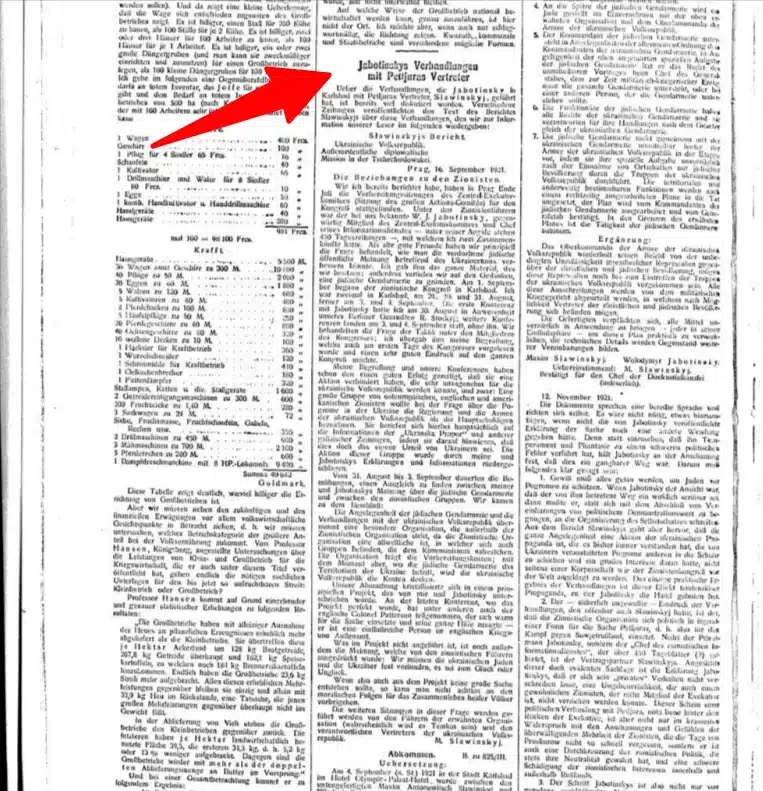
The original issue of the newspaper is now digitized and available in the digital collection of the University of Frankfurt library.
In Jüdische Rundschau No. 102/103 from December 23, 1921, the material is located on newspaper page 732. In the digital PDF, it is the sixth page of the file.
Open the original scan of Jüdische Rundschau from December 23, 1921
We have also preserved a copy of this issue on the NANovosti website:
Jüdische Rundschau No. 102/103 from December 23, 1921 — PDF
The scan shows the beginning of the agreement text:
“Abkommen. Uebersetzung: Am 4. September … 1921 in der Stadt Karlsbad im Hotel Olympic-Palast-Hotel…”
At the end of the document, the names Maxim Slawinskyj and Wolodymyr Jabotinsky are indicated, and between the beginning and the signatures, the points about the future Jewish gendarmerie are published.
This is especially important for the debate about whether such an agreement “existed at all.” Before us is not a modern reconstruction or a retelling of events a hundred years later, but a newspaper publication from December 1921 — the same year the negotiations took place.
But the original original has not yet been found
At the same time, it is necessary to make an important archival note. The German text in Jüdische Rundschau is marked as a translation.
The Ukrainian typewritten copy of the agreement is preserved in the YIVO Institute for Jewish Research in New York. In archival references, it is listed as RG 80/134/10332–10332a. The related copy with Slawinsky’s report from September 16, 1921, is listed as RG 80/134/10333–10333a.
The full text of the academic publication, which includes the Jabotinsky and Slawinsky agreement from September 4, 1921, can be opened here: https://tile.loc.gov/storage-services/master/gdc/gdcebookspublic/20/20/71/91/57/2020719157/2020719157.pdf. (page 142) Below we separately provide the fragment where Document 11 begins — the agreement on the creation of a Jewish gendarmerie in Ukraine, — as well as the YIVO archival references to the preserved Ukrainian typewritten copies of the document.
Here it is:
Researchers suggest that the very first copy of the agreement might have been drafted in Russian or French, but this original text has not yet been found.
A separate array of documents is stored in the Jabotinsky Institute in Israel. There are materials of the negotiations with Slawinsky, documents about the Jewish gendarmerie project, discussions of the agreement in connection with the Karlsbad Congress, press reactions, and materials of subsequent internal union polemics.
Therefore, the history can be verified immediately by several archival traces: the 1921 Jüdische Rundschau publication, YIVO materials, and the Jabotinsky Institute archive.
One can argue about the political meaning of the agreement, Jabotinsky’s motives, the attitude towards Petlyura, the responsibility of the UNR leadership, or the consequences of the pogroms. But the very existence of the document, its date, place of conclusion, names of the signatories, and the main conditions of the future Jewish gendarmerie are verified directly from the 1921 sources.