Citizens of Israel have become the largest foreign group among the owners of jewelry companies in Ukraine. NAnovosti checked 22 active companies and found not only stores and registry records but also production, revenue growth, and a direct connection with the Israeli Diamond Exchange.
When Russian missiles repeatedly strike Kyiv, the jewelry business does not seem like the most obvious place for a foreigner who wants to preserve money. A gold store cannot be moved to another country in a couple of hours. Production, equipment, employees, and diamonds in stock also remain where the war is ongoing.
Therefore, one figure in Ukrainian corporate statistics made us pause: Israel ranked first among the countries of citizenship of foreign beneficiaries of Ukrainian jewelry companies.
Not the USA. Not Germany. Not neighboring Turkey.
Israel.
NAnovosti decided to look into what stands behind this figure. For verification, we used data from August 17, 2026Opendatabot — a Ukrainian platform that collects and systematizes open information from state registers: data on companies, owners, and ultimate beneficiaries, types of activities, financial reporting, and other corporate indicators.
Author R.Verter was born in Ukraine, lives in Israel, and regularly works on topics at the intersection of the two countries. Here, his task was not to prove a preconceived thesis about ‘Israelis’ faith in Ukraine,’ but to check a simpler question: is there a real working business behind the Israeli names in the register, or are they mostly old legal shells?
The answer turned out to be more interesting than the initial statistics.
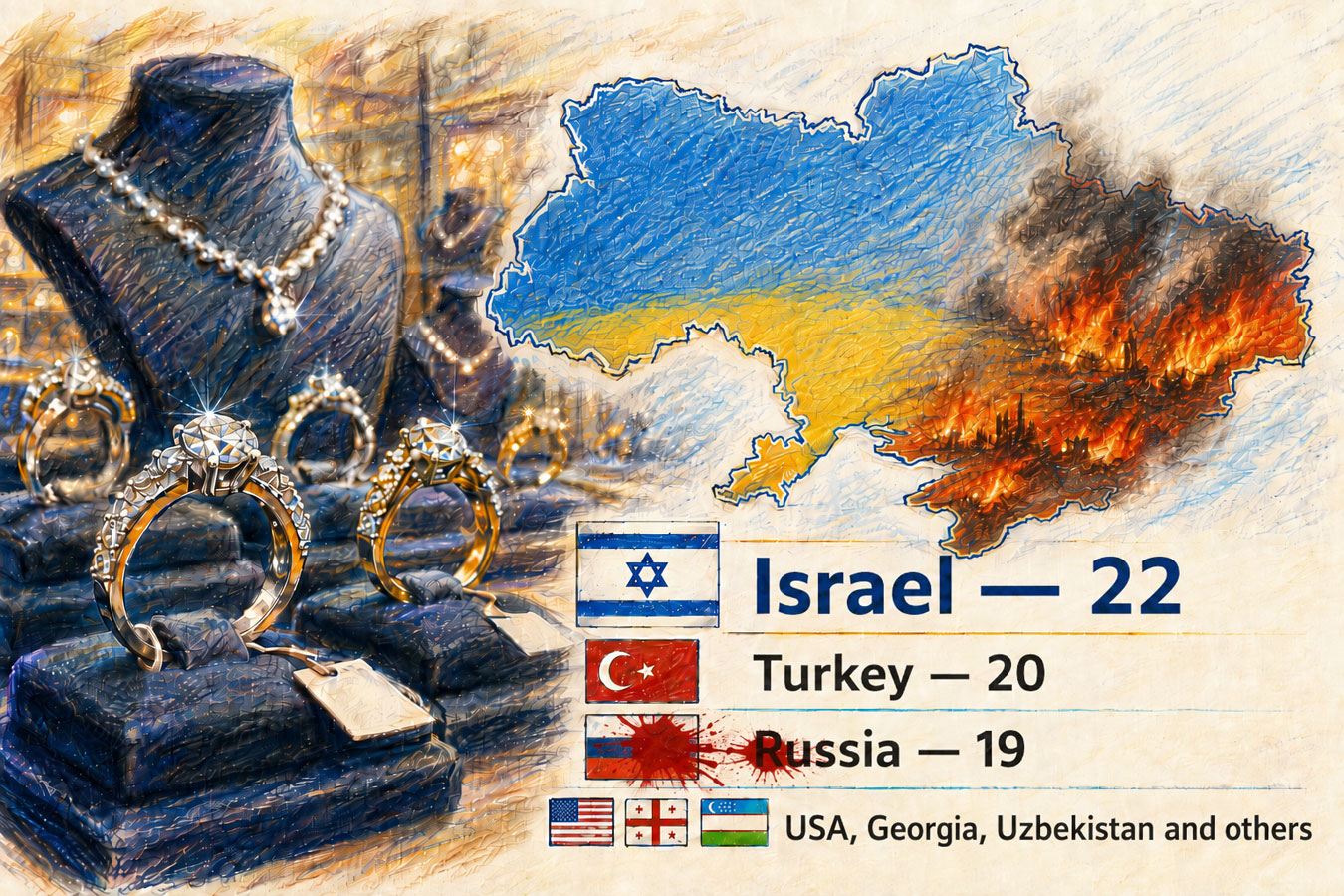
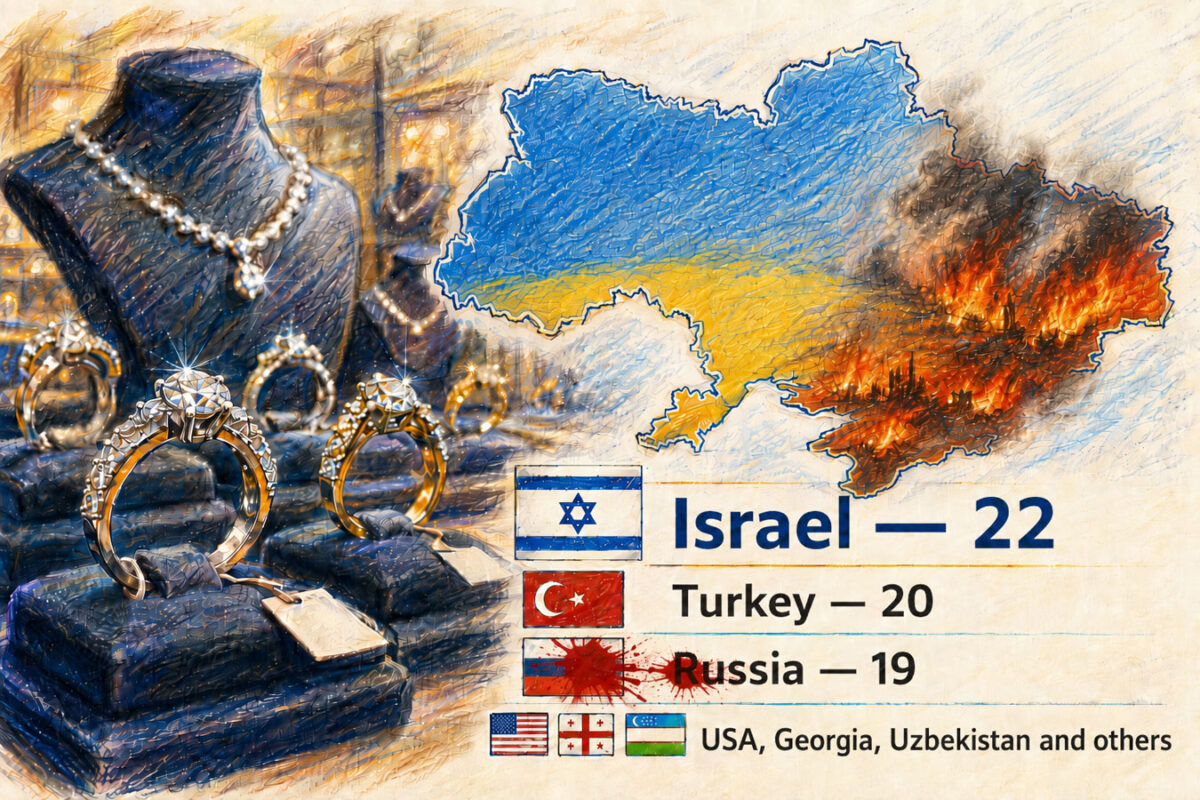
Israel — 22. Turkey — 20. Russia — 19
As of the end of July 2026, Opendatabot counted 7,865 businesses in Ukraine related to the production, sale, and repair of jewelry and watches.
The overwhelming majority, 6,583, operate as sole proprietors. Another 1,282 are companies.
Sole proprietors are individuals conducting business in their own name without creating a separate company. For an Israeli reader, the closest analogy is עצמאי / עוסק: a private entrepreneur running their own business. This is not an exact legal equivalent of Israeli statuses עוסק פטור or עוסק מורשה, but the comparison helps understand the difference between such an entrepreneur and a separate company.
180 companies have foreign citizens among their ultimate beneficiaries. Most often, Israel is encountered: 22 companies.
Turkey has 20 such companies, and Russia has 19.
One company can have owners from several countries, so adding these figures and counting them as the number of foreign enterprises would be incorrect. But for our question, another proportion is important: approximately one in eight Ukrainian jewelry legal entities with a foreign beneficiary has an Israeli citizen among the owners.
At this point, it is easy to write a beautiful phrase about ’22 Israeli investors.’
We chose not to write it.
22 companies do not mean 22 investors. One person can be present in several legal entities. An Israeli may own only a share of the enterprise. The owner’s passport also says nothing about where the money came from, where the raw materials are purchased, and where the finished goods are sold.
Therefore, we had to go further through the cards.
Why a Russian owner may remain in the Ukrainian register
There is an important legal detail: the presence of a Russian citizen among the beneficiaries of a Ukrainian company does not necessarily mean that he freely disposes of this business today.
After the start of the full-scale invasion, Ukraine imposed restrictions on transactions with assets related to the aggressor state. They affect payments to Russian owners, corporate rights, certain banking operations, and the ability to re-register shares.
Because of this, a paradox arose. A company can continue to exist as a Ukrainian legal entity, work with a Ukrainian director, staff, and property, but the Russian share in its ownership structure is effectively restricted or frozen.
Moreover, in 2026, the Ministry of Economy of Ukraine publicly acknowledged another problem: some Ukrainian enterprises would like to completely get rid of Russian co-owners, but the existing restrictions simultaneously complicate the mechanism for buying out or re-registering such a share.
Therefore, the record of a Russian beneficiary sometimes reflects not the ongoing presence of Russian capital in the usual sense, but the legal legacy of a pre-war ownership structure that turned out to be difficult to remove from the register.
This is important to consider when reading any statistics about ‘Russian owners’ in Ukraine. After 2022, the mere presence of a surname in the register no longer indicates how much this person actually controls the company, receives money from it, or can make decisions about its future.
Why during the check we initially found not 22, but 23 companies
Here arose the first detail not included in the overall figure.
If you open the current registry selection of Opendatabot for jewelry activities and Israeli beneficiaries, you can get 23 cards, not 22. An error?
No.
Among them is PP ‘Edendiama Fancy,’ whose owner is listed as Israeli citizen Yaakov Yehoshua. But the company currently has the status ‘in the process of termination.’
After its exclusion, the same 22 active companies remain.
At first glance, a trifle. For us, this is an important check: the figure 22 did not result from mechanically copying a ready-made rating. We tried to understand who exactly is inside it and why the number in the current output initially did not match the analytical slice.
Then another thing was discovered.
These 22 companies are not just stores.
Among them are retail, wholesale structures, and enterprises whose main activity is directly the production of jewelry.
Eleven companies showed money. The picture with Russian owners is completely different
Financial reporting for 2025 is not yet available for the entire market. Of the 1,282 jewelry companies, 358 submitted it.
Among enterprises with foreign beneficiaries, 32 reported. Eleven of them have owners who are Israeli citizens.
This already allows us to separate at least part of the real working business from the registry presence.
NAnovosti separately compiled the available revenue of these 11 companies. It amounted to about 41.47 million UAH for 2025.
The amount itself does not make Israeli capital the largest in the Ukrainian jewelry market. This would be an incorrect conclusion: not all have financial reporting, and the largest Ukrainian companies in the industry have turnovers of hundreds of millions and more than a billion hryvnias.
But within the foreign selection, there is a detail that is hard not to notice.
Russia has almost as many active jewelry companies in the register with corresponding beneficiaries — 19 compared to Israel’s 22. However, Opendatabot reports that of these 19 companies with Russian owners, only one showed revenue in the last two years: the Bila Tserkva Jewelry Plant declared 10.9 thousand UAH for 2023.
This is not proof that the other 18 do nothing at all. The absence of published revenue and the absence of activity are different things.
But the difference is noticeable.
In the Israeli part of the register, we see 11 companies with reporting for 2025, millions of hryvnias in turnover, employees, production, and active trading structures. In the Russian part — almost the same number of legal entities, but a completely different public financial picture.
Two companies take almost the entire turnover
Of the 41.47 million UAH of known revenue, more than half comes from one enterprise — Kyiv’s LLC ‘Diamond Business’.
Its 100% owner and ultimate beneficiary is listed as Israeli citizen Moshe Nanikashvili.
In 2023, the company showed 8.265 million UAH in income. In 2024 — already 17.778 million. In 2025 — 23.873 million UAH.
That is, its revenue almost tripled in two years of full-scale war.
In 2025, the company had 25 employees, and net profit was about 1.65 million UAH. This is already difficult to describe as just a preserved record in the Ukrainian register.
The second major participant is ‘Almaz-Diamant Yu’. Its director, 100% owner, and ultimate beneficiary is listed as Israeli citizen David Ben Nun.
Revenue for 2025 — 9.333 million UAH, net profit — 5.791 million.
These two companies together provided more than 33.2 million UAH, which is about four-fifths of the entire known revenue of the 11 reporting companies from our Israeli selection.
And it is here that the register led us from Ukrainian corporate statistics directly to Ramat Gan.
Diamonds from Israel, cutting in Ukraine
For LLC ‘Diamond Business,’ the trademarks Ukrainian Diamond Center and UDC are registered.
We opened the website of UDC itself.
The company calls itself a member of the Israel Diamond Exchange. The CEO of UDC is the same David Ben Nun, who simultaneously owns ‘Almaz-Diamant Yu.’
But there is an even more specific detail.
In January 2025, UDC published its own material about the Israel Diamond Exchange. There, the company claims that membership allows it to import diamonds directly from Israel without intermediaries, and perform cutting on its own equipment in Ukraine.
Here, the connection between the two countries can no longer be explained by just an Israeli passport in the Ukrainian register.
It turns out to be a quite understandable production chain:
diamonds from Israel → Ukrainian company → cutting in Ukraine → finished diamonds and jewelry → Ukrainian market.
At the same time, it is important to maintain the boundary of what is proven. Statements about direct import, own production, and membership in the exchange come from UDC itself. Customs declarations of specific batches were not studied by NAnovosti as part of this check.
We can confirm that the company publicly describes such a working model. Claiming the volume of supplies from Israel or the cost of imported diamonds without customs statistics would be an unnecessary step.
And this is precisely the case where the limitation makes the story not weaker, but more accurate.
Who else stands behind the Israeli figure
Not the entire list boils down to Nanikashvili and Ben Nun.
For example, in the production company ‘Vinnytsia Crystals’, the 100% owner is listed as Israeli citizen Dov Weintraub. The enterprise showed 2.312 million UAH in revenue for 2025.
In ‘Edendiam’, all capital belongs to two Israeli citizens: Itzhak Yehoshua — 55.71%, Tamar Yehoshua — 44.29%. Revenue for 2025 was 997 thousand UAH.
In the company ‘Keli’, Israeli citizen Shalva Bazov owns 50%. In ‘Golden Leleka’, Alexander Shinkarevsky has 36.23%.
There are also recurring owners.
Chaim Lutin is associated with ‘Ultra-Design,’ ‘Ultra-Plus,’ and ‘Exclusive.’ Svetlana Zolotaryova is present in ‘Fankoni LTD’ and ‘Medium Service.’
Therefore, the phrase ’22 Israeli companies’ is better not used at all. It is more accurate to say: 22 active Ukrainian jewelry companies, among the beneficiaries of which are Israeli citizens.
The difference seems bureaucratic only until you start checking the owners by name.
And now let’s return to the war
In July 2026, according to the UN Human Rights Monitoring Mission, at least 437 civilians were killed in Ukraine, and another 2,610 were injured.
This was the highest monthly civilian death toll since May 2022. The main cause of losses remained long-range missiles and drones, with most victims of such weapons recorded in cities far from the front line.
Kyiv was one of the most affected cities in July.
And it is in Kyiv that the largest companies from our Israeli selection are registered and operate.
That is why the figure 22 is interesting to us not by itself.
The jewelry business is poorly suited for ‘one-button’ evacuation. There are inventory stocks, equipment, premises, security, personnel. If it is about production, machines, specialists, and a technological chain are added.
The risk is not theoretical. It exists right now.
But we see a company with an Israeli owner whose revenue grew from 8.3 million to 23.9 million UAH between 2023 and 2025. We see another company from the same selection with 9.3 million UAH in revenue. We see production in Vinnytsia. We see UDC, which continues to talk about diamond supplies from Israel and cutting in Ukraine.
This no longer allows us to end the material with the phrase ‘the war scared away all foreign entrepreneurs.’
It did not scare everyone away.
Does this mean that Israeli business believes in Ukraine’s victory?
Here, we really want to write an impressive answer: yes.
But we do not have the data for such a statement.
We did not ask Moshe Nanikashvili, David Ben Nun, Dov Weintraub, and other owners why they maintain Ukrainian companies. We do not know which of them invested new money after February 24, 2022, and which continue to use assets created long before the invasion.
Nor do we have a figure that allows us to call 22 companies the size of ‘Israeli investments in Ukraine’s jewelry industry.’ For this, completely different data is needed.
But there is business behavior.
A company can talk as much as it wants about a promising market. It is much more interesting to see where it retains people, assets, and turnover when a full-scale war has been going on in the country for the fourth year.
And in this narrower sense, the Israeli selection indeed looks like a practical signal of confidence that Ukraine has an economic tomorrow.
Not necessarily political faith in a specific victory scenario. Not necessarily an investment declaration.
Just a decision not to disappear.
Why is this important specifically for Israel
The relationship between Israel and Ukraine is usually discussed in terms of presidents, ministers, votes, and military aid. Economic ties are less noticeable, although sometimes they reveal as much about the state of relations as diplomatic formulas.
NAnews has already analyzed how Ukraine proposed to Israel to expand economic cooperation, investments, and participation in the country’s reconstruction. It was about the intentions of the states.
The jewelry story is at a lower level — and therefore more interesting in its own way.
Here, no one signs a memorandum in front of cameras. Israeli citizens simply continue to be owners of Ukrainian companies, and some of these companies show turnover, produce products, and work with Israeli diamond infrastructure.
There is also a reverse movement of goods. NAnews recently showed, using the example of Israel’s purchases of Ukrainian rapeseed meal, how unnoticed the real economic ties between the two countries can be for the average reader. While politicians argue about grand strategy, Ukrainian raw materials are sent to Israel, and Israeli diamonds, according to UDC, are sent for processing in Ukraine.
These stories should not be exaggerated. Jewelry companies with Israeli beneficiaries do not define the Ukrainian economy, and 41.47 million UAH of known revenue is not billion-dollar investments.
But they show the mechanism.
22 companies — this is not proof. It’s a trace.
At first, we had one figure: Israel — 22.
After verification, it broke down into a much more interesting picture.
One company from the current registry issuance is already ceasing, so there are indeed 22 active ones. The same owners may stand behind several legal entities. Financial statements were provided by only 11 companies. Two of them account for about 80% of the known turnover.
However, within this data, a connection was found that can no longer be called formal: Ukrainian Diamond Center, Israeli owner, David Ben Nun, membership in Israel Diamond Exchange, declared direct import of diamonds from Israel and their cutting in Ukraine.
Russian missiles have not yet broken this chain.
Here R.Verter and the editorial team of NAnews — News of Israel are ready to draw their conclusion, but only within the limits allowed by the data.
We do not know who these entrepreneurs vote for or how they describe the outcome of the war. We will not attribute to them the statement “we believe in Ukraine’s victory.”
We see something else.
In a country that Russia is trying to make unsuitable for normal life and business, companies with Israeli owners continue to operate. Some are increasing their turnover. Through the Israel Diamond Exchange, a production connection with Ukraine is maintained.
For us, this is the most interesting part of the story.
Because trust in the country’s future is measured not only by statements.
Sometimes it lies in a safe with diamonds, stands at a cutting machine, and opens a store in Kyiv every morning.
Sources: Opendatabot and open data from Ukrainian state registries; Ukrainian Diamond Center; UN Human Rights Monitoring Mission in Ukraine.