
Israel became the fourth largest buyer of Ukrainian rapeseed meal in the 2025/26 season, purchasing 64.7 thousand tons for $13.2 million. NANovosti explored why this little-known agricultural statistic actually concerns Israeli livestock, feed security, and supply sustainability.
At first glance, the news looks Chinese: China became the world’s largest buyer of Ukrainian rapeseed meal. But if you look at the published figures from Israel, another story emerges.
In one marketing year, Israel increased its purchases of Ukrainian rapeseed meal almost threefold — from 21.8 thousand to 64.7 thousand tons. Now the country is among the top four buyers of this Ukrainian product.
And these are no longer just a few random shipments.
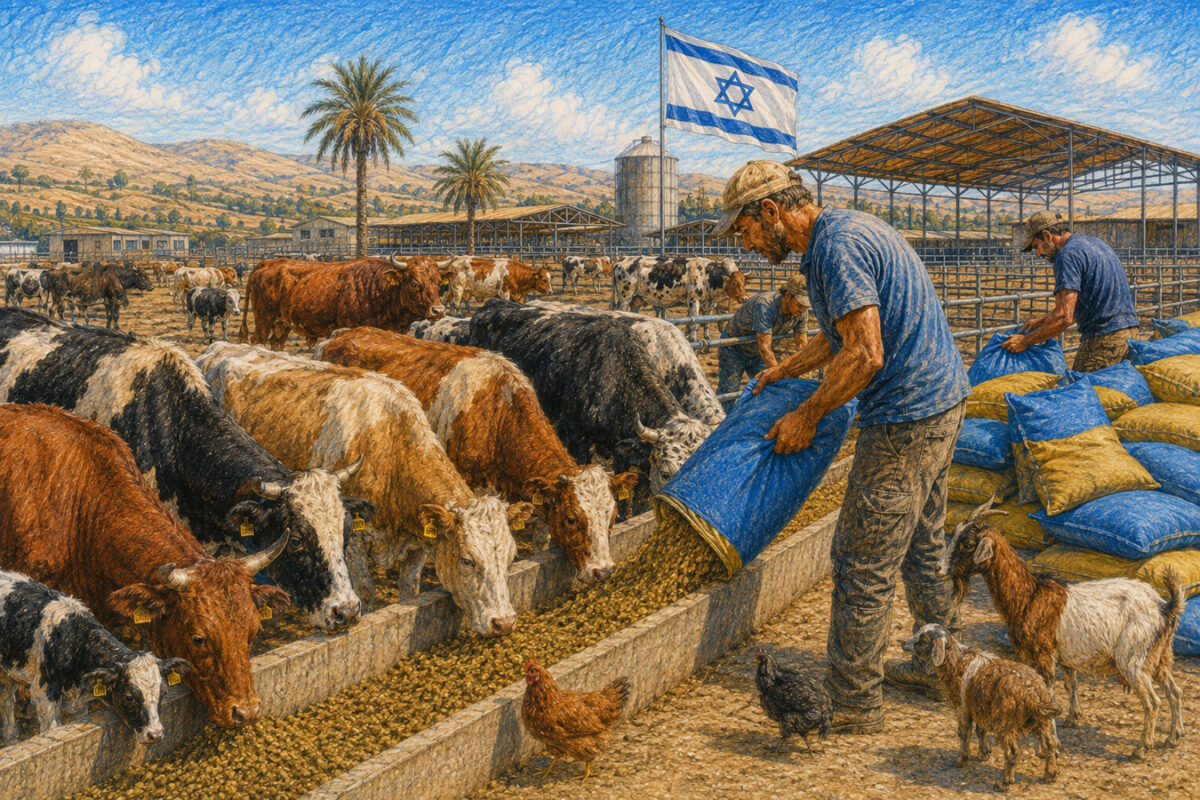
64.7 thousand tons is a volume that makes you look at Ukrainian-Israeli trade not only through wheat, corn, or products that an Israeli sees directly on the supermarket shelf. There is also a less visible feed chain. It is through this that imported agricultural raw materials are transformed into milk, eggs, poultry, and other livestock products within Israel.
Why does Israel buy tens of thousands of tons of a product that most consumers have never heard of? And how integrated is Ukraine into this system?
Why are we looking at this story specifically from Israel
Author NANovosti Anton Pshedinsky is not an agronomist or a specialist in feed formulation. In this material, his task is different: to compare open trade data from Ukraine and Israel, international statistics, and research on Israel’s dependence on imported feed, and then separate confirmed figures from conclusions that these figures do not yet allow.
In July, NANovosti already examined another side of the same system — Ukrainian feed corn. It turned out that Ukraine supplied Israel with 934 thousand tons of corn, and the country itself is almost entirely dependent on corn imports for the feed and starch industry. This material is available here:
https://nikk.agency/79-kukuruzy-v-izraile-iz/
Now there is an opportunity to look at the protein part of the feed ration.
Israel bought 64.7 thousand tons for $13.2 million
The source data is provided by Donbass Center with reference to the information of the association “Ukroliyaprom”:
For the marketing season 2025/26, Ukraine exported 567.2 thousand tons of rapeseed meal for $113 million.
The largest buyers were:
- China — 257.3 thousand tons for $49.8 million;
- Turkey — 84.9 thousand tons for $16.9 million;
- Spain — 69.3 thousand tons for $14.2 million;
- Israel — 64.7 thousand tons for $13.2 million;
- Italy — 23.4 thousand tons for $4.5 million.
Thus, Israel accounted for approximately 11.4% of all Ukrainian rapeseed meal exports in physical volume.
Moreover, Israel was only 4.6 thousand tons away from third place: Spain imported 69.3 thousand tons.
But the position in the ranking is not the most interesting thing here.
In one season, Israeli purchases grew by almost 197%
In the previous marketing year, 2024/25, Ukraine exported 218.5 thousand tons of rapeseed meal. Israel acquired 21.8 thousand tons, which is 9.9% of Ukrainian exports.
Now — 64.7 thousand tons.
The editorial team of NANovosti — News of Israel separately recalculated the dynamics:
64.7 thousand tons versus 21.8 thousand tons means an increase of approximately 2.97 times, or almost 197%.
At the same time, the entire Ukrainian export of rapeseed meal grew from 218.5 thousand to 567.2 thousand tons — approximately by 160%.
It turns out that Israel’s purchases grew even faster than the overall Ukrainian export of this product.
There is another figure. If you divide the declared $13.2 million by 64.7 thousand tons, the average export cost of the volume supplied to Israel is about $204 per ton. The average for all Ukrainian exports of the season is approximately $199 per ton.
This is a calculation based on the total export value, not the price of a specific Israeli contract: the conditions of individual deals are not disclosed in the published data.
What is rapeseed meal and what does it have to do with the Israeli consumer
After processing rapeseed seeds, oil is obtained. The remaining protein mass is rapeseed meal.
For humans, this sounds like a production waste. For livestock, on the contrary, it is a commodity.
Meal is used as a protein-rich ingredient in feed rations and can supplement other sources of plant protein. Such raw materials are especially widely used in the compound feed industry and cattle feeding.
This is where the Israeli side of the story appears.
A study by the Israeli Institute for National Security Studies, dedicated to the sustainability of national supply chains, indicates that in 2022 Israel imported about 5.5 million tons of grain and feed.
More than 75% of this volume was intended for animal feeding, and over 20% was accounted for by seed products, used including as protein sources.
This is a fundamental figure.
The Israeli food system depends not only on the import of ready-made food. A huge flow of imported raw materials first goes to animals and only then is associated with the products that a person buys.
Therefore, Ukrainian 64.7 thousand tons should be considered within a much larger system of feed supplies.
This does not mean that eggs will become cheaper tomorrow because of Ukraine
It is important here not to make a beautiful but incorrect conclusion.
From the published figures, it is impossible to establish which specific Israeli compound feed enterprises received Ukrainian shipments, which specific farms used them, and what share of each feed ration they constituted.
Moreover, you cannot take $204 per ton of Ukrainian meal and directly calculate the change in the price of a liter of milk or a pack of eggs.
The final Israeli price is influenced by dozens of factors: the global raw material market, the cost of alternative protein components, freight, port handling, exchange rates, internal producer expenses, regulation, and trade margins.
But this does not make the import of meal insignificant.
It is significantly earlier in the production chain — where the cost of animal feeding is formed.
Ukraine has long been supplying rapeseed meal to Israel
The current 64.7 thousand tons is a sharp increase, but not the emergence of a completely new route.
According to historical USDA data, back in the 2019/20 season, Ukraine exported 54.6 thousand tons of rapeseed meal to Israel. At that time, the entire Ukrainian export was about 196.6 thousand tons.
That is, Israel took almost 28% of the Ukrainian volume.
Then the trade structure changed.
According to Israeli import statistics for 2023, the country imported a total of 267.1 thousand tons of rapeseed meal. From Ukraine, 46.74 thousand tons for $16.94 million were declared.
This is approximately 17.5% of all Israeli imports of this product in that calendar year. More was supplied by Romania and Russia.
Therefore, Ukrainian rapeseed meal has been a noticeable part of the Israeli market for several years.
The current jump returns the supply volume even above the level of 2019/20.
Ukraine now sells more than just grain to Israel
This is where this story connects with the previous NANovosti study on corn.
Only feed corn Ukraine exported to Israel in the 2025/26 season about 934 thousand tons.
Now this figure can be added to 64.7 thousand tons of Ukrainian rapeseed meal.
It is incorrect to combine these products into one statistical category: they have different purposes, nutritional value, and market structure. But together they show something else — Ukraine is present in several links of Israel’s feed supply.
For NANovosti — News of Israel, this is the main result of data comparison.
Ukraine for Israel is no longer just one of the external suppliers of agricultural products. In certain segments, we are talking about regular and large flows of raw materials that participate in the internal production of food.
Why Ukraine was able to supply so much meal
Changes have also occurred on the Ukrainian side.
According to “Ukroliyaprom”, the production of rapeseed meal in Ukraine in 2025 increased by 79% and reached 540.46 thousand tons.
The processing of rapeseed seeds in the season exceeded 1.3 million tons, which became a record figure. The association links what is happening with the transition from predominantly raw material exports to processing within the country and selling products with higher added value.
For Ukraine, the logic is clear: instead of just sending rapeseed abroad, process it, get oil and meal, and only after that export several products.
For Israel, the result of this Ukrainian industrial restructuring is quite material — an additional supplier of feed protein becomes available on the market.
Why China suddenly became the first — and why Israel is important for Ukraine
China in the 2025/26 season purchased 257.3 thousand tons of Ukrainian rapeseed meal — almost half of all Ukrainian exports.
But there is an important detail around the Chinese market.
In March 2025, China introduced a 100% duty on Canadian canola meal. The Canadian product lost its usual access to the huge market, and alternative suppliers received additional space. Ukraine turned out to be one of the largest beneficiaries of this restructuring.
However, the situation has already changed again.
From March 1, 2026, China suspended the 100% duty on Canadian rapeseed meal at least until the end of 2026. The Canadian government and the Canola Council confirm the restoration of this product’s access to the Chinese market.
Therefore, the current 257.3 thousand tons of Ukrainian supplies to China cannot be automatically transferred to the next season.
The Chinese surge may turn out to be largely the result of a specific trade conjuncture.
And it is against this background that Israel becomes especially interesting for Ukraine.
Israel is smaller than China, but Ukrainian meal has been supplied here long before the Chinese surge: 54.6 thousand tons in 2019/20, tens of thousands of tons in subsequent years, and now 64.7 thousand tons.
This is already a story of a sustainable market, not just an opened tariff window.
Israel simultaneously buys rapeseed meal in the EU
Ukraine is not the only source.
European Commission data shows that in the almost completed 2025/26 season, EU countries exported about 79.5 thousand tons of rapeseed meal to Israel. The previous year, the figure was approximately 86.2 thousand tons.
At first glance, one might say: European supplies slightly decreased, Ukrainian ones sharply increased.
But it is not yet possible to assert that Ukraine directly displaced European producers. For such a conclusion, data on individual contracts, the origin of raw materials, and re-export chains would be required.
But another thing is absolutely clear: Israel buys significant volumes of rapeseed meal from different directions, and Ukraine has become one of the noticeable sources of this feed product.
There is a detail in the statistics that should continue to be checked
The editorial team also compared UN Comtrade/WITS data for the calendar year 2024.
From the Ukrainian side, an export to Israel of 46.67 thousand tons of rapeseed meal worth $11.14 million is declared.
But Israeli import statistics for the same year show 254.98 thousand tons of total imports and list among the largest partners Cyprus, Luxembourg, Romania, Switzerland, and supplies with an unspecified country, while Ukraine does not appear separately in the list.
This is not a reason to deny Ukrainian supplies.
Discrepancies between mirror export and import statistics arise due to accounting methodology, cargo registration time, trade intermediaries, differences between the country of origin and the country of dispatch, and other factors.
But until NANovosti has documents on specific shipments, we will not attribute the discrepancy to one specific reason.
This is one of the questions that makes sense to continue tracking.
What do 64.7 thousand tons mean for Israel
The main conclusion here is not that Israel took fourth place in the Ukrainian ranking.
More importantly,
In one season, Israel almost tripled its purchases of Ukrainian rapeseed meal. The Ukrainian share in the export of this product increased from 9.9% to approximately 11.4%, despite China’s giant surge.
And if you look more broadly, a whole system emerges.
Ukraine supplies Israel with large volumes of feed corn. Now we see tens of thousands of tons of rapeseed meal. Israel itself is recognized by researchers as a country significantly dependent on the import of grain and feed.
It turns out to be a chain that the buyer in the store usually does not see:
Ukrainian field — rapeseed processing in Ukraine — meal — maritime trade — Israeli feed industry — livestock farming — food products.
This does not mean that Israel is exclusively dependent on Ukraine and does not mean that a single Ukrainian supply determines prices for Israeli products.
But 64.7 thousand tons is already too large a volume to consider the Ukrainian direction a statistical trifle.
After the story with 934 thousand tons of Ukrainian corn, the new figure adds another part to the picture: Ukrainian agriculture is increasingly integrated into Israel’s feed chain.
And perhaps it is such connections that best show the real relations between the two countries. Not statements at diplomatic events, but goods that pass through ports every month and become part of the country’s economy.
And is the meat of cows fed with such meal still kosher?
For the Israeli reader, a quite practical question arises here: if a cow is fed Ukrainian rapeseed meal, does it affect the kosher status of its meat?
No. Rapeseed meal itself does not make the animal or its meat non-kosher.
Cattle are considered kosher animals: a cow has split hooves and is a ruminant. The kosher status of meat is primarily determined by how the animal was slaughtered and processed: it requires shechita according to Halacha rules, inspection of the carcass, removal of forbidden parts and blood, and appropriate kashrut supervision.
The fact that the animal received rapeseed meal as part of its diet does not change this status.
There are separate religious restrictions regarding certain types of feed and ingredients, but ordinary plant-based rapeseed meal itself does not belong to such problematic products. Even the status of rapeseed as kitniyot for some Ashkenazi Jews during Passover relates to human consumption of the product and does not turn the meat of an animal that received such feed into non-kosher.
Therefore, the chain may well look like this:
Ukrainian rapeseed → processing in Ukraine → rapeseed meal → feed for Israeli cattle → kosher beef after appropriate shechita and processing.
And this once again shows how far from the store shelf the Israeli food system begins. The buyer sees a piece of kosher beef, milk, or other products, but part of the feed protein for the animal could have traveled from a Ukrainian field to an Israeli farm.
Sources
The main source is Donbass Center, citing data from the association “Ukroliyaprom.”
Additional data used from “Ukroliyaprom,” UN Comtrade/WITS, USDA Foreign Agricultural Service, European Commission, Institute for National Security Studies, Government of Canada, and Canola Council of Canada.
Previous material by NANovosti on the role of Ukrainian corn in Israel’s feed system:
https://nikk.agency/79-kukuruzy-v-izraile-iz/