
In the black-and-white photograph taken on May 1, 1962, in Jerusalem, Golda Meir shakes hands with an elderly woman in a light scarf. This is Maria Babich, a Ukrainian from Rivne, one of the participants in the historic ceremony of opening the Avenue of the Righteous Among the Nations at Yad Vashem. On that day, the first eleven trees were planted on the slope of the Mount of Remembrance in honor of non-Jews who saved Jews during the Holocaust.
Author: Pavel Shveiko, NANews
Jerusalem, May 1, 1962: a meeting captured in a photograph
Golda Meir was then serving as Israel’s Minister of Foreign Affairs. Seven years later, on March 17, 1969, she would become the country’s Prime Minister. And the woman she greeted had previously worked as a nanny in a Jewish family and managed to save a one-year-old girl during the Nazi occupation.
Historian Maksym Hon, a researcher of Ukrainian-Jewish relations, later recounted that the documents recognizing Maria’s merits were personally handed to her by Golda Meir. A photograph of their meeting is preserved in the archival collection of Yad Vashem.
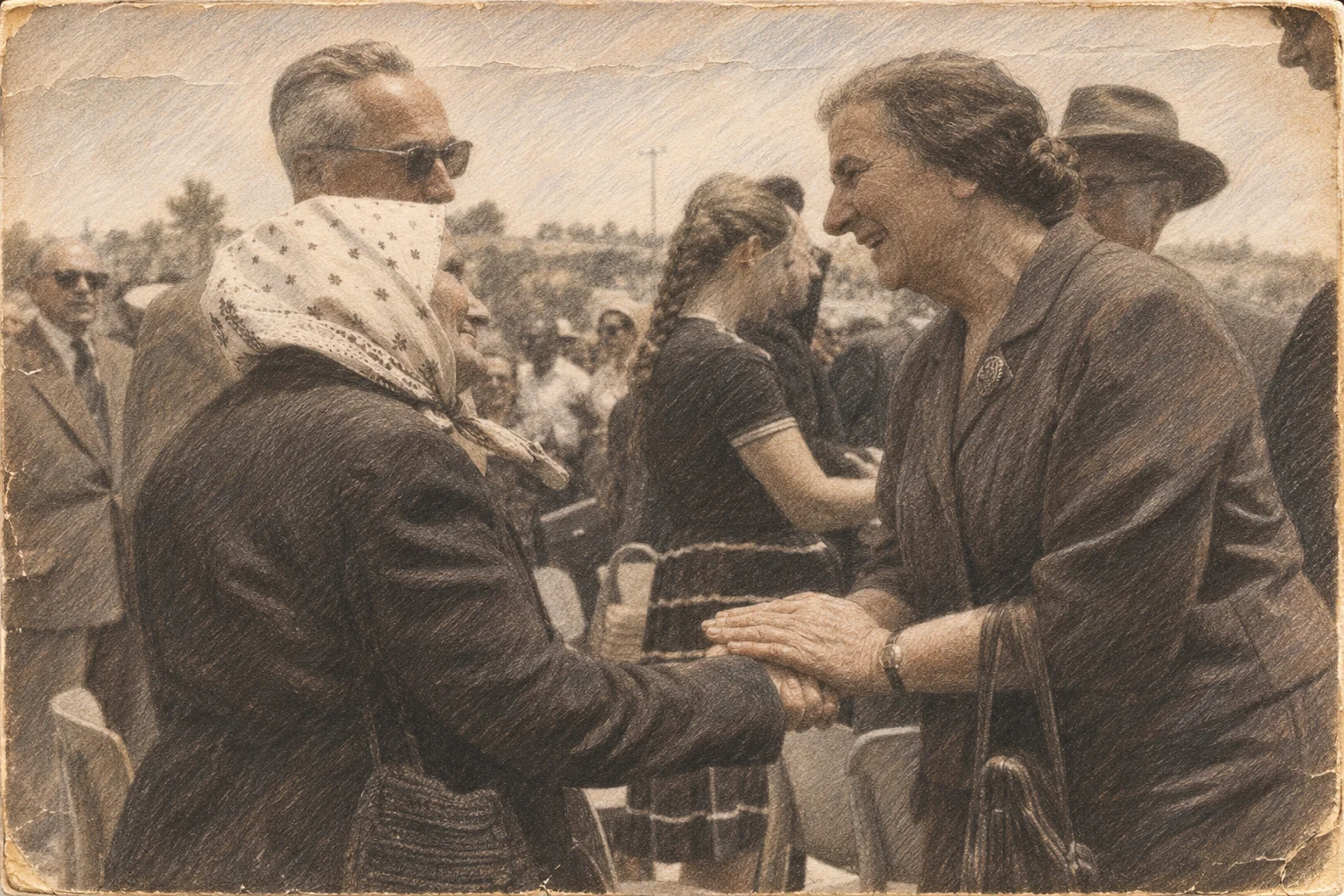
Behind this photograph is the fate of a child whose mother was killed in November 1941, and a woman who not only saved the girl but also stayed with her family after the war, moving to Israel.
In the section “History and Facts“ NANews introduces readers to such human stories. We do not claim to conduct academic research. Our goal is to tell this story based on available documents, memories, and historians’ works so that as many people as possible learn about Maria Babich and the girl she saved, Irit Osipova.
Rivne before the war: the Osipov family and their nanny
Maria Babich was born in 1889. Little information has been preserved about her childhood, parents, and education. It is known that before World War II, she lived in Rivne, working as a domestic helper and nanny for the Jewish Osipov family.
Rivne at that time was a major center of Jewish life in Volhynia. According to the 1931 census, nearly 23,000 people of “Jewish faith” lived there. Synagogues, schools, charitable organizations, and Jewish businesses operated. Polish, Ukrainian, Russian, and Yiddish were spoken on the streets.
Until September 1939, the city was part of Poland, then it became part of the Ukrainian SSR. Today it is Rivne, the regional center of Ukraine. In Israeli family documents, Holocaust survivors’ memories, and memorial books, the former names Równe and Rovno are found.
In the Osipov household, little Irit was growing up. Her parents were named Itzhak and Mina. Maria looked after the girl, did household chores, and was well acquainted with the family.
On June 22, 1941, Germany attacked the Soviet Union. Itzhak Osipov found himself on the front lines with the Red Army. His wife remained in Rivne with their daughter, who was about a year old.
Six days later, on June 28, the city was occupied by German troops.
Sosonki: November, when thousands of city residents disappeared
In the first months of the occupation, the Jews of Rivne were deprived of property, sent to forced labor, subjected to humiliation and murder. By early November 1941, the German authorities had prepared for the mass extermination of a significant part of the Jewish population.
By order of the occupation administration, Jews were instructed to report with their families and personal belongings to an assembly point in the Grabnik area. The order is associated with the German Gebietskommissar Dr. Bayer. A Gebietskommissar was the head of an administrative district in occupied territory.
People were told about resettlement. In reality, they were being directed to the Sosonki ravine outside Rivne, where mass shooting sites had already been prepared.
In historical materials, the main dates of the killings are marked as November 6–9, 1941. The memorial in Sosonki lists 17,500 victims. American historian Jeffrey Burds in his 2013 book Holocaust in Rovno: The Massacre at Sosenki Forest, November 1941 provides a higher estimate — about 23,500 people, including approximately six thousand children.
The difference is related to the counting of victims from two extermination actions and separate groups of the deceased. The circumstances of the mass murder are detailed in Burds’ study “Holocaust in Rivne”.
Among the murdered was Mina Osipova. The Ukrainian Institute of National Memory names November 6, 1941, as the date of her death.
Little Irit did not end up in Sosonki. Shortly before her death, her mother managed to entrust her to Maria Babich.
How Mina Osipova saved her daughter before her own death
Details of how the girl ended up with Maria have been preserved in two versions.
In the “Portrait Bank” of the National Museum of the History of Ukraine in World War II, it is said that Mina, understanding the danger, handed her one-year-old daughter to the nanny and went to the ghetto herself.
Another account is found in Rivne local history publications. According to this version, Mina managed to hand the child over to Maria already when Jews were being gathered for deportation to death. The girl was wrapped in a sheet, and from the outside, the bundle might have looked like ordinary belongings.
It is impossible to establish the exact sequence of events from the published testimonies. The museum version also does not allow, without additional documents, to determine when exactly Mina ended up among the doomed: the known Rivne ghetto was created after the November shootings.
But both versions agree on the main point. Mina left her daughter with a woman she trusted. Irit survived, while her mother perished along with thousands of other Jews in Rivne.
Maria took the child home. To conceal the girl’s origin, she began telling those around her that Irit was her own daughter.
Maria adhered to this decision throughout the occupation.
The woman who unexpectedly had a daughter
In November 1941, Maria was about 52 years old. It is not surprising that the appearance of an infant raised questions among neighbors.
Rivne researcher Svitlana Kalko in a biographical article about Maria Babich provides information about the surrounding people’s mockery: people wondered from whom a woman of such age could have given birth to a child. Babich continued to insist that the girl was her daughter.
Behind this explanation lay mortal danger. The Nazi authorities persecuted Jews who managed to avoid deportation to execution or ghetto imprisonment. Those who sheltered them faced arrest, severe punishment, and death.
Maria had to not only conceal Irit’s origin but also provide her with everything necessary. Under occupation conditions, this meant caring for the child’s food, clothing, shelter, and health while constantly risking exposure.
Local history materials mention that Babich also helped other Jews in Rivne: she delivered food to ghetto prisoners, warned of the danger of raids. The names of these people and the circumstances of each case are not yet fully known.
The remaining Jews after the November shootings were placed in a ghetto by the Germans. In July 1942, it was liquidated, and the prisoners were taken to the Kostopil area and killed.
Meanwhile, Maria continued to raise Irit. The German occupation of Rivne ended on February 2, 1944, but the care for the girl did not cease. The museum biography states that Babich raised her for about four years — until the post-war return of her father.
Itzhak Osipov returns home
After the war ended in 1945, Itzhak Osipov returned to Rivne and found his daughter. She was with Maria.
He had gone to the front, leaving behind his wife and young child. Mina perished, but Irit survived thanks to the woman who raised her for several years as her own daughter.
According to the National Museum of the History of Ukraine in World War II, Irit was the only one among the Osipov relatives remaining in Rivne who survived the Holocaust. Itzhak survived because he was at the front.
After the father’s return, Maria did not leave the family’s life. She continued to live with the Osipovs, becoming a close person to them.
The published materials do not tell how Itzhak’s meeting with his daughter took place, what they said to each other, and how Irit adapted to her returned father. However, the consequence is known: the family maintained a relationship with the woman to whom they owed the child’s salvation.
Later, they left the Soviet Union together.
The road to Israel
According to journalist Olga Musafirova, cited in a publication in “Novaya Gazeta Europe” on September 27, 2025, the Osipov family, along with Maria Babich, emigrated to Israel in 1949. However, this date raises a question: how did they manage to leave the Soviet Union, where under Stalin, emigration for permanent residence abroad was practically impossible?
The strictness of the restrictions is evidenced by a diplomatic document from the US Embassy in Moscow dated June 16, 1949. Special permission from Soviet authorities was required for departure, which was rarely granted to ordinary citizens. Direct Jewish emigration from the USSR to Israel was almost not allowed during that period.
Nevertheless, there was another way — through Poland. Until September 1939, Rivne was on Polish territory, so the Osipovs could have had the right to post-war repatriation. On September 9, 1944, the authorities of the Ukrainian SSR and the Polish Committee of National Liberation concluded an agreement allowing Poles and Jews who had Polish citizenship before September 17, 1939, to relocate from Western Ukraine to Poland.
According to the YIVO Encyclopedia, between 1944 and 1948, about 175,000 Jews relocated from the USSR to Poland under post-war repatriation agreements. Many subsequently went to Palestine and then to Israel.
Theoretically, the Osipovs could have used this route. However, Maria Babich’s situation was more complicated: she was Ukrainian, not related to them, and did not have automatic rights to relocate under the agreement intended for Poles and Jews.
Therefore, it cannot be ruled out that the family left the USSR before 1949, spent some time in Poland or another European country, and only then arrived in Israel. But this is still a hypothesis. Neither the exact date of departure from the USSR, the route, nor the documents that allowed Maria to accompany the Osipovs have been established.
How a Ukrainian woman, who had no family ties with the Jewish family, managed to overcome Soviet restrictions and leave with them remains one of the most intriguing unresolved pages of Maria Babich’s biography.
Israel was just beginning its history as an independent state. It was proclaimed on May 14, 1948, and by the following year, tens of thousands of Jews who survived the Holocaust and repatriates from various countries were arriving. Among them were Itzhak and Irit Osipov, who had lost almost all their relatives in occupied Rivne. But with them came a Ukrainian woman who was not Jewish and was not related to them.
The family settled in Jerusalem. Maria continued to live with the Osipovs, staying close to the girl she once saved. This unusual family story is confirmed by the National Museum of the History of Ukraine in World War II and historical materials from Yad Vashem. It was also recounted by Irena Steinfeldt, who headed the Department of the Righteous Among the Nations, in the Yad Vashem journal in April 2009.
Unlike the story of saving Irit, the first years of Maria’s life in Israel are much less illuminated. No documents have yet been found that would establish the exact date of her arrival, the basis for obtaining the right to reside, and the family’s home address. But it is known that Maria remained in Jerusalem until the end of her life. She died on October 28, 1971, and was buried in the cemetery of the Russian women’s monastery in the Ein Kerem area.
Thirteen years after the supposed relocation, on May 1, 1962, Maria Babich was among the participants in the opening of the Avenue of the Righteous Among the Nations. On that day, she was greeted by Golda Meir, and archival photographers captured the meeting. The woman who hid a Jewish child in occupied Rivne under the guise of her own daughter received recognition in the country she came to with the family she saved.
Golda Meir and the first eleven trees
On May 1, 1962, Israel commemorated Holocaust Remembrance Day. On the Mount of Remembrance in Jerusalem, a ceremony was held to open the Avenue of the Righteous Among the Nations. On the then-open slope, eleven trees were planted along the road to the Hall of Remembrance.
Among the participants was Maria Babich. She was invited as a woman who saved a Jewish child in occupied Ukraine. In the historical account of Yad Vashem about the Righteous program, the tree planted by Maria is mentioned separately.
Golda Meir was present at the ceremony. The archive preserved not only their joint photograph but also pictures of Babich during the tree planting.
Historian Maksym Hon in an interview about the Righteous Among the Nations from Rivne region recounted that the award was personally handed to Maria by Golda Meir. He called Babich one of the first Ukrainian Righteous.
However, there is historical uncertainty associated with the date of the official awarding of the title. In the list of the Righteous Among the Nations from Ukraine, published by Yad Vashem, Maria Babich is listed under case number 314, and the year of recognition is indicated as 1963.
The Ukrainian Institute of National Memory in a material dated May 14, 2025, provides another date — 1978, already after Maria’s death. In some earlier publications, recognition is dated to 1962. This discrepancy between published information does not yet have an unequivocal documentary explanation.
Undoubtedly, Maria was present at the ceremony on May 1, 1962, planted one of the first eleven trees, and was personally introduced to Golda Meir. The moment of document transfer is known from Maksym Hon’s testimony, not from a preserved archival photograph.
What the title of Righteous Among the Nations means
Yad Vashem was established by a Knesset law on August 19, 1953, as Israel’s national memorial to the victims and heroes of the Holocaust. One of its tasks was to commemorate non-Jews who, risking themselves, saved Jews during Nazi persecution.
For recognition as a Righteous Among the Nations, testimonies of the saved, archival documents, and the circumstances of the act are studied. Real help, risk to the rescuer, and the absence of selfish motives are important.
Recognized Righteous are awarded a medal and an honorary diploma, and their names are commemorated at Yad Vashem. This recognition differs from Ukrainian national awards and honorary titles.
Maria Babich was among the first Ukrainians recognized for saving Jews. In several publications, she is called the first Ukrainian Righteous Among the Nations.
In modern Ukraine, these people are commemorated with a separate memorial date. May 14 is observed as the Day of Remembrance of Ukrainians who saved Jews during World War II. The Verkhovna Rada established it by a resolution on February 2, 2021.
NANews has already told about Maria Babich and other Ukrainian rescuers in a publication dedicated to May 14. Another article by the publication is about honoring Ukrainian Righteous at Yad Vashem and the memory of the victims of Babi Yar.
Maria’s last years: Jerusalem, 1971
Maria Babich lived in Israel until the end of her life. According to Svitlana Kalko, she died in Jerusalem in 1971. Her life spans the period from 1889 to 1971.
Israeli reference materials also preserved an indication of her burial place. Maria Babich is mentioned in the list of burial places of the Righteous, posted on the website of the Israeli Ministry of Education. It names the cemetery of the women’s monastery in Ein Kerem, a district of Jerusalem.
This is a significant detail of her Israeli biography. The woman who came from Rivne with the saved family not only received recognition at Yad Vashem but also remained in Jerusalem after her death.
Much less is known about the further life of Irit Osipova. A historical publication from 2000 mentioned that after the war she changed her surname, and the author could not establish her subsequent fate. Reliable publicly available information about her marriage, children, or last years of life is not yet available.
Therefore, it would be wrong to invent a continuation of her biography. But the main events of Irit’s childhood have been restored: the death of her mother in Sosonki, her rescue by Maria, her father’s return, and her move to Israel.
Maria Babich’s name returns to Rivne
In Ukraine, Maria’s story has been preserved thanks to the work of local historians, Holocaust researchers, and museum staff. Her biography was included in the materials of the National Museum of the History of Ukraine in World War II, and photographs from Yad Vashem became known to Ukrainian readers.
In June 2025, the Rivne city commission on street naming supported the initiative to name a new street in the Novyi Dvir area after Maria Babich, near Novodvorska and Petro Hryhorenko streets. This was reported by Rivne local publications citing city authorities.
The city also preserves the memory of the murdered Jews. On December 13, 2019, a memorial sign was installed near the former entrance to the ghetto, at the intersection of Soborna and Doroshenko streets. It was created in the form of a broken wall with a menorah and a suitcase. Some bricks were taken from an old building on the former ghetto territory.
In the Sosonki ravine, there is a memorial to the victims of the mass shootings of November 1941. Among those killed there was Mina Osipova. Her daughter survived thanks to the woman whose name is now being immortalized in her hometown.
The girl who survived
When on May 1, 1962, Golda Meir greeted Maria Babich at Yad Vashem, behind this meeting was a story spanning more than twenty years.
In November 1941, the mother of one-year-old Irit Osipova was among the Jews of Rivne whom the Nazis sent to be exterminated in Sosonki. Maria, who worked as a nanny in their family, took the girl in and began to pass her off as her own child. She raised Irit during the occupation, awaited her father’s return, and stayed with the Osipovs after the war.
In Israel, Maria lived the last years of her life. In Jerusalem, she planted a tree on the Avenue of the Righteous Among the Nations, and her meeting with Golda Meir was preserved in an archival photograph.
Today, not all details of her biography are known, and some recognition dates require further clarification. But the fate of the saved Irit is beyond doubt: thanks to Maria Babich, the girl survived the Holocaust, reunited with her father, and was able to start a new life in Israel.
It is precisely for such stories that the section “History and Facts” of NANews exists. So that behind historical dates and the number of victims, readers can see specific people — including a woman from Rivne who saved a child and lived with his family for the rest of her life.