
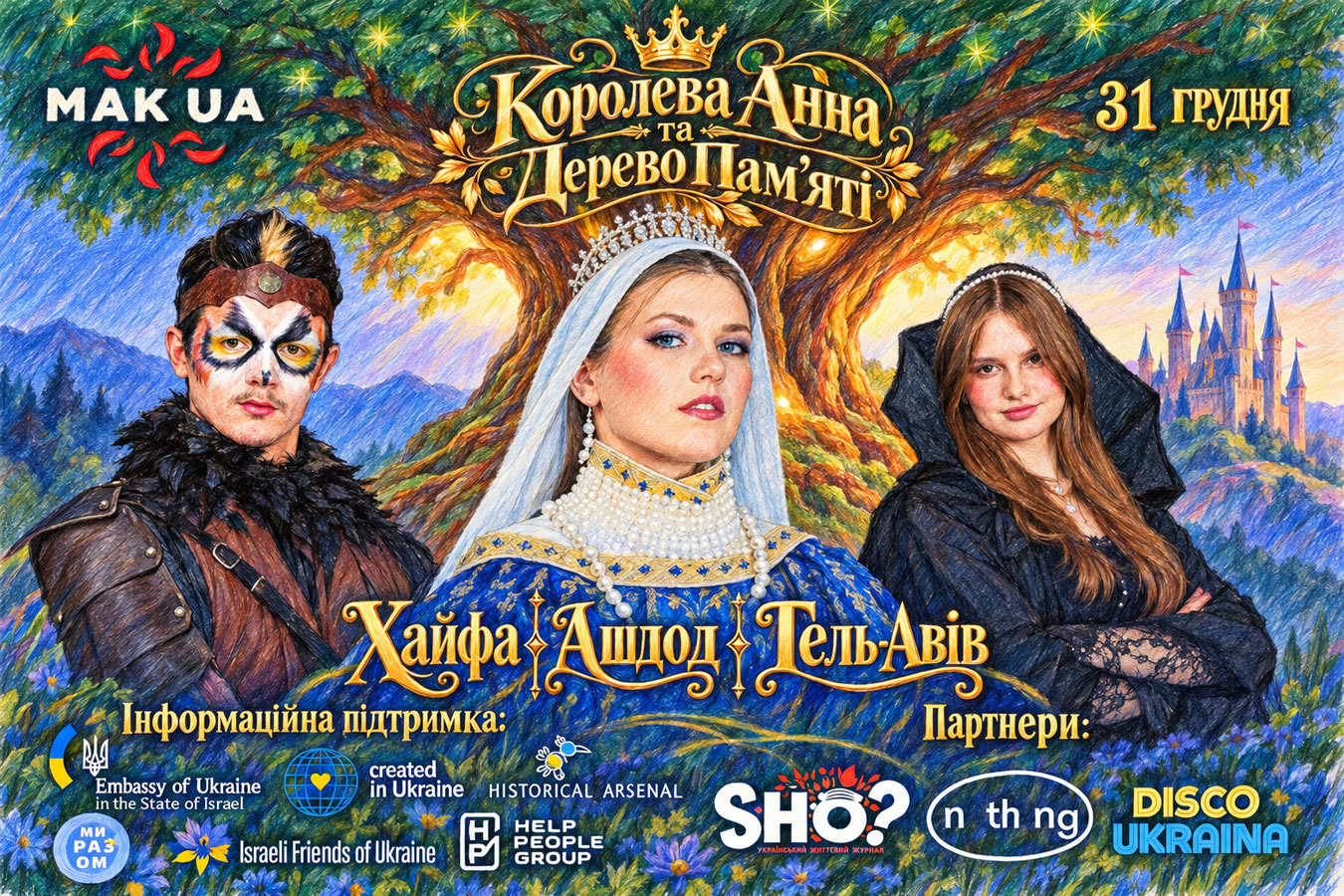
A new Ukrainian theatrical fairy tale is being prepared in Israel, which families will be able to see in several cities across the country. The creative association MAK_UA presented an original fantasy play “Queen Anna and the Tree of Memory”. The festive poster lists Haifa, Ashdod, and Tel Aviv, and in a new announcement, the organizers have already named two exact dates: December 29, 2026, in Haifa and January 2, 2027, in Tel Aviv. A show in Ashdod is also announced, but its date has not yet been published.
Author: Lev Varshavsky
The announcement appeared on the official MAK_UA Facebook page. The organizers address the Ukrainian community in Israel with an invitation to save the dates in their calendars in advance and promise a meeting with the magical “Divosvit” — a fairy-tale world of adventures, unusual heroes, and festive wonders.
Ticket sales are expected to start later. While MAK_UA is gradually revealing the program, viewers have the opportunity to get acquainted with the new project and decide in which city it will be more convenient for them to attend the performance.
Three cities, two announced dates, and festive fairs
Haifa — Tuesday, December 29, 2026. Doors will open at 17:00, a New Year’s fair will start, and the “Rivnovaha” project will prepare entertainment for guests. The performance will begin at 18:00. Thus, the organizers offer not to limit themselves to the theater hall but to spend the whole festive evening together.
Tel Aviv — Saturday, January 2, 2027. Here, guests are also expected from 17:00. Before the performance, there will be a fair, and children will be able to interact with fairy-tale fairies. The performance itself will begin at 18:00. For families with children, this hour before the start of the action can become a separate part of getting to know the characters and the atmosphere of the production.
Ashdod — the city is listed in the official graphic poster of the performance. However, in the latest text announcement from MAK_UA, the exact date, time, and place of the Ashdod show have not yet been specified. Viewers from Ashdod and southern regions of Israel should follow updates on the official page of the organizers, where further details are expected to be published.
The story with the schedule clarification is not accidental. Back in September, NAnovosti reported on the large calendar of MAK_UA events for the second half of 2026. At that time, the New Year’s family fairy tale was tentatively planned for the period from December 15 to 30 in three cities — Haifa, Tel Aviv, and Ashdod. Now specific dates for two shows have appeared, and the Tel Aviv performance will take place after the New Year.
Exact addresses of the halls, ticket prices, performance duration, and age recommendations have not yet been published. The possibility of translation or subtitles for viewers who do not speak Ukrainian is also not specified. The organizers should provide all these details separately.
Who is Queen Anna and what does the Tree of Memory hide
At the center of the new production is Queen Anna. Next to her in the title appears the Tree of Memory, and the promotional poster shows a huge fairy-tale oak, the queen in a festive blue dress, mysterious characters, and a castle against a magical landscape.
In the very combination of the name and title, it is easy to see a historical association with Anna of Kiev, also known as Anna Yaroslavna. In the 11th century, the daughter of the Kyiv prince Yaroslav the Wise became the queen of France by marrying Henry I in 1051. After her husband’s death, she participated in the affairs of the French royal court during the minority of her son Philip I.
For Israeli readers unfamiliar with the history of medieval Eastern Europe, it is useful to explain here: Anna came from Kievan Rus, a state centered in Kyiv that existed long before the formation of modern Ukraine, Russia, and Belarus. In Ukrainian cultural memory, Anna of Kiev occupies a special place as a symbol of the old historical ties between Kyiv and European royal courts.
At the same time, MAK_UA has not yet reported that the heroine of the play is the historical Anna Yaroslavna. The similarity of the name allows for a possible association, but not a confirmed plot. The authors call their work an original fantasy fairy tale, and the details of its story remain unknown.
The meaning of the Tree of Memory is also not revealed. It may become a magical object, a place of action, or an image connecting generations and family memories. But these are only possible interpretations of the title, not information from the published script.
For families where children grow up between Ukrainian and Israeli cultures, the theme of memory sounds especially recognizable. Family stories here often cross several countries, languages, and eras. And although it is not yet known what content the creators have put into their fairy tale, its very title already raises questions that may be of interest to viewers of different generations.
MAK_UA: Ukrainian theater created in Israel
Behind the performance is MAK_UA — Ukrainian Artistic Amateur Forge in Israel. This is a Ukrainian public-artistic association created by Marina Kadatska (Марина Кадацька), a teacher and actress who has lived in Israel for many years.
In an interview with the project “Ukrainian Meetings in Israel,” presented by NAnovosti, Marina talked about her move, the formation of Ukrainian cultural identity, and why there was a need to create a Ukrainian-language theater here in Israel.
At the time of the interview in 2023, MAK_UA was a completely volunteer project. Actors, screenwriters, directors, and representatives of other creative professions united around the idea. The collective conducted workshops, created puppet shows, and worked on children’s performances, including “The Tale of Nicholas” and the interactive “Spring-Meeting Tale.”
Later, new productions, meetings, and educational programs appeared. One of them is “Theater Therapy,” where participants get acquainted with the history of Ukrainian theater through stage exercises, improvisation, and voice work.
In the MAK_UA calendar for October 8, 2026, the sixth meeting of the third season of “Theater Therapy” was planned, dedicated to the development of modern Ukrainian theater. Such classes do not require participants to have professional acting education: the theater here exists not only for spectators but also for people who want to try themselves on stage.
Over several years, the association has become a noticeable part of Ukrainian cultural life in Israel. At the same time, it is not about a touring troupe that came for a few days from Ukraine, but about a creative collective that works within the country itself.
NAnovosti — News of Israel | Nikk.Agency has repeatedly reported on its projects. They are interesting not only for preserving the Ukrainian language: performances become a meeting place for people who were born in Ukraine, have long lived in Israel, or are getting to know Ukrainian culture for the first time thanks to friends and neighbors.
From the adventures of Mykola to Malanka: what fairy tales MAK_UA has already shown
The new “Queen Anna” continues the theatrical tradition that MAK_UA has been forming for several years.
In December 2024, the collective prepared a Ukrainian-language New Year’s fairy tale “The Adventures of Mykola in the Fairy Forest”. The performances were planned in Haifa, Rishon LeZion, and Ashdod. NAnovosti detailed this production, aimed at children and parents.
A year later, a new work appeared — “The Tale of Malanka and the Evil Snake”. It was presented in December 2025 as part of MAK_UA’s winter performances in Tel Aviv, Haifa, and Ashdod.
Malanka is a heroine of Ukrainian winter folk tradition, associated with rituals, songs, disguises, and fun performances. For the Israeli audience, this is not a familiar character from children’s books, but part of a special festive culture preserved in Ukraine for centuries. In the fairy tale, she was opposed by the Snake — a fictional image created in the spirit of Ukrainian folklore.
The performance featured six fairy-tale characters. The design used works by Ukrainian masters of decorative and applied arts, original music by a Ukrainian composer, and elements of Carpathian aesthetics. The Carpathians are a mountain region in western Ukraine and neighboring countries of Central Europe, where rich traditions of folk crafts, music, and festive rituals have developed.
The organizers promised children gifts and photos with the characters after the performance, and the festive program was accompanied by a fair of Ukrainian goods. Part of the proceeds from ticket sales was planned to be directed to support the Armed Forces of Ukraine.
About the production, its plot, and the conditions of attendance can be read in the previous NAnovosti article about the tale of Malanka.
It cannot yet be asserted that all these elements will be repeated in the new “Queen Anna.” Neither gifts, nor the charitable part of ticket sales, nor the number of characters for the 2026–2027 performance have been separately announced. But previous works show how MAK_UA combines stage action with cultural and festive programs.
“Rivnovaha” in Haifa: more than entertainment before the performance
A special role in the Haifa show will be played by the project “Rivnovaha” (“Balance”) — a Ukrainian public-cultural initiative working with children and adults. It is known in Haifa for creative meetings, classes, cultural holidays, and events that help people find communication and emotional support.
One of the participants in organizing such events is Tal Mikhaelenko. Together with the “Rivnovaha” team, she participated in preparing events that combined Ukrainian and Israeli cultural traditions.
In February 2025, NAnovosti reported on the celebration of Tu BiShvat in Haifa, organized with the participation of “Rivnovaha.” Tu BiShvat is the Jewish New Year of Trees, celebrated on the 15th of the month of Shevat. In Israel, it is associated with traditions of planting trees, caring for nature, and introducing children to the plant world of the country.
At that time, the program combined music, creative activities, reading Ukrainian books, games, meditative practices, and children’s gifts. Among the participants was “Pizhamna Bibliotechka” — an initiative introducing children to books through reading and joint creativity.
In May of the same year, “Rivnovaha” held in Haifa “Vyshyvanka Day. Epilogue”. Vyshyvanka is a traditional Ukrainian embroidered shirt, long recognized as a symbol of national culture. The program included music, creative workshops, and separate activities for children.
In the summer of 2026, the children’s direction “Rivnovaha.Dity” participated in organizing the meeting “Picturesque World” — an artistic event for children in Haifa, prepared jointly with “Pizhamna Bibliotechka.”
Therefore, the invitation of “Rivnovaha” to the performance on December 29 looks like a natural continuation of joint cultural work. But the specific set of entertainment before “Queen Anna” has not yet been disclosed by the organizers. It remains to wait for the detailed program of the fair.
Who supports the new production
The graphic poster of “Queen Anna” features not only theatrical characters and cities of the performance but also organizations supporting the project.
In the section of informational support are listed the Embassy of Ukraine in the State of Israel, Created in Ukraine, Historical Arsenal, “We Together,” Israeli Friends of Ukraine, and Help People Group.
Among the partners on the poster are SHO?, n.th.ng, and Disco Ukraina.
Such a composition reflects the participation in Ukrainian cultural life in Israel not only of theatrical collectives but also of public initiatives, volunteer associations, and representatives of local business.
For MAK_UA, this is another way to attract different communities to their projects. Moreover, the support of Ukrainian culture in Israel has long not been limited to organizations with the word “Ukraine” in their names. Events involve people of different origins, united by an interest in theater, history, music, and cultural exchange.
Why Ukrainian fairy tales find their audience in Israel
Israel has its own festive calendar, which does not coincide with the familiar December and January dates for many immigrants from Ukraine. The Jewish New Year, Rosh Hashanah, is celebrated in the fall, and January 1 is not a national holiday.
Nevertheless, for many families who have moved from Ukraine and other European countries, the end of December remains a time for family gatherings, gifts, and children’s performances. And Ukrainian theater is gradually finding its place in this calendar.
The situation with children is especially interesting. Many of them study in Israeli schools, speak Hebrew with friends, watch Israeli shows, and gradually switch to the language of the country they live in. Ukrainian often remains the language of communication with parents, grandparents.
At the performance, everything is arranged differently. Ukrainian is not only spoken at home: fairy-tale characters speak it, joke, sing, and tell stories. For a child, this is an opportunity to see their native language as part of a live cultural event. And for adults, to spend an evening in an environment where family memories do not need to be translated and explained every time.
Equally important, such performances can be interesting to Israelis without Ukrainian roots. Getting to know the culture of neighbors through a children’s fairy tale is sometimes more accessible than official meetings and solemn speeches. However, for families who do not speak Ukrainian, the possibility of attendance will also depend on whether the organizers provide language support.
Tickets, addresses, and updates: what viewers need to know
As of October 12, 2026, MAK_UA has published the name of the performance, named three cities on the poster, and announced exact dates for performances in two of them.
Haifa — December 29, 2026: doors open and New Year’s fair at 17:00, performance at 18:00. The festive program includes the “Rivnovaha” project.
Tel Aviv — January 2, 2027: doors open, fair, and meeting with fairies at 17:00, performance starts at 18:00.
Ashdod — the show is announced on the poster, but the exact date and time have not yet been published. Residents of Ashdod are advised to follow subsequent announcements from the organizers. The date of December 31 indicated on the graphic poster cannot yet be unequivocally linked to this city.
Ticket sales have not yet started. Information on prices, exact venue addresses, duration, and age recommendations should appear additionally.
The main source of updates is the official MAK_UA Facebook page. There, the organizers promise to announce the start of ticket sales and publish further details.
For now, viewers can only choose a convenient city and save the announced dates. And those living in Ashdod should wait a bit: the city has already appeared on the poster of the new fairy tale, it remains to wait for the specific schedule.
MAK_UA still has several months of preparation ahead. The names of the performers, plot details, hall addresses, and ticket links will appear. But one important thing is already known: the Ukrainian theater is once again going to celebrate the New Year with its audience in Israel — and this tradition continues.