
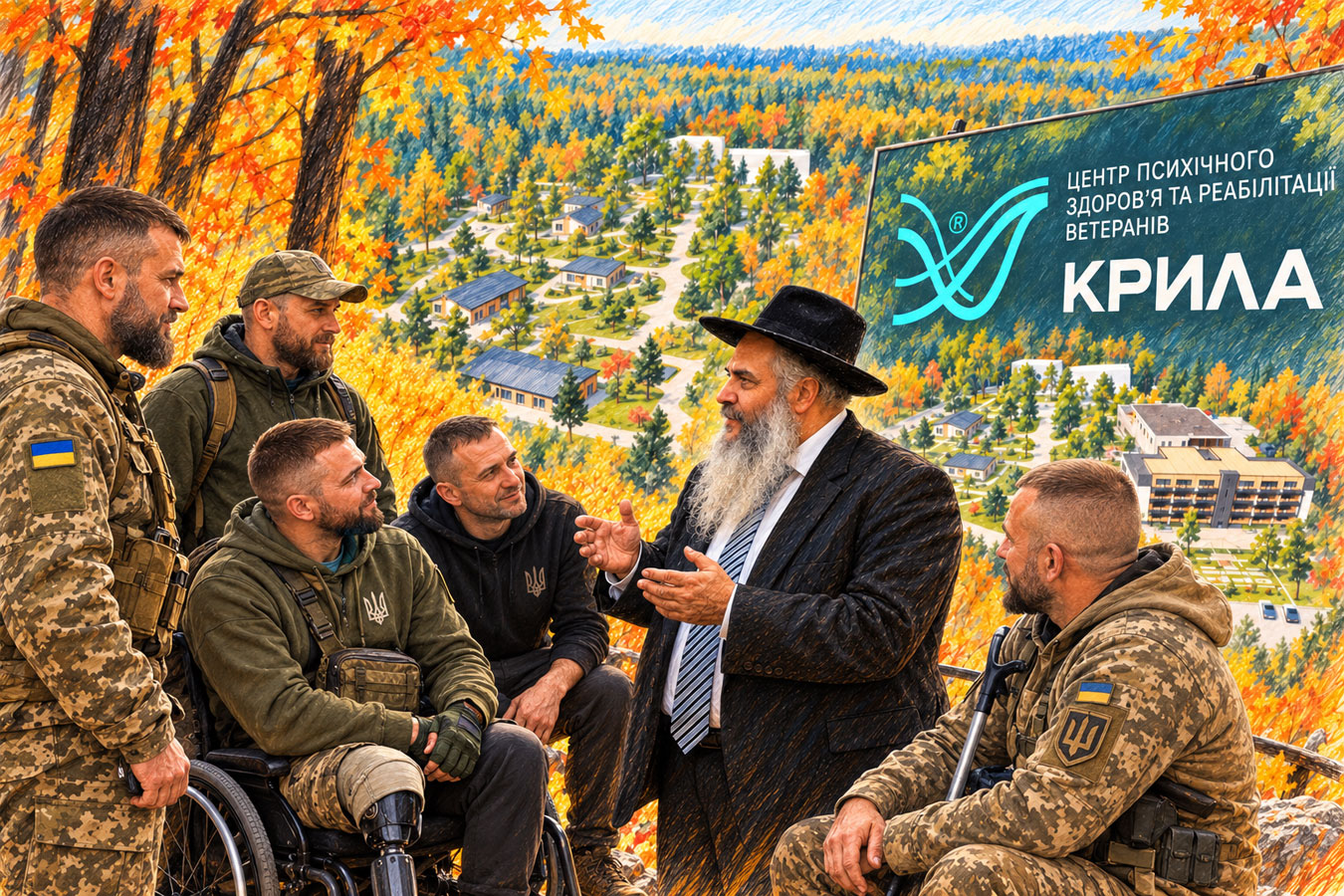
On October 14, 2026, in Khmelnytskyi, the project of the Center for Mental Health and Rehabilitation of Veterans “WINGS” was presented. Soon, the Chief Rabbi of Ukraine Moshe Reuven Asman wrote about his participation in its creation. The future complex is designed for military personnel, their family members, and civilians affected by the war. But the history of the place began long before the current presentation: in 1967, a pioneer camp “Beryozka” was built here, where the author of these lines himself came for summer shifts.
Author: Pavel Shveiko, NANovosti.
The city hospital acquired the old buildings back in 2023. Now the preliminary cost of the entire project is estimated at 825 million hryvnias (about 56.9 million shekels), and the implementation is planned in stages until 2030. We have collected the history of the camp, documents about its sale, the medical concept, information about the team, and what is known about Asman’s role.
What Moshe Asman reported
In his publication, the rabbi said that he had the honor of participating in the creation of “WINGS” in the Khmelnytskyi community — as Ukraine calls the city and surrounding settlements united by local self-government.
“It will be a modern space where veterans, defenders of Ukraine, their family members, as well as civilians affected by the war, can receive psychological help, undergo rehabilitation, and return to a full peaceful life.”
Asman writes that he has been systematically engaged in rehabilitation since 2023: supporting existing medical institutions, transferring equipment, helping the wounded, participating in new initiatives. According to his plan, help in “WINGS” should not be limited to a short course: long-term recovery, social adaptation, and support after discharge are needed.
“Beryozka”: from pioneer shifts to a factory recreation base
The future center will be located in the village of Holovchyntsi in the Khmelnytskyi region, about 40 kilometers from the regional center and 13 kilometers from Letychiv, among forests and oak plantations near the Southern Bug. Here in 1967, a children’s health camp of the Khmelnytskyi transformer substation plant — the future “Ukrelektroapparat” — was built.
The history of the plant itself began in 1957, and it released its first products in 1959. The enterprise produced transformers and complete substations, received the Order of the Red Banner of Labor in 1976, and supplied equipment throughout the USSR and beyond, including to India, Vietnam, and Cuba. Like many large Soviet plants, it maintained social facilities: employees received vouchers for children’s recreation through the trade union.
For me, Pavel Shveiko, “Beryozka” is not just a name in the sale documents. In childhood, I repeatedly vacationed in this pioneer camp, coming every year for one, and sometimes two shifts. Decades have passed since then, and it is unusual to see how a place associated with summer vacations is being prepared for the recovery of people who have survived the war.
The name “Beryozka” is known from the personal memories of a former vacationer; in modern official documents, the object is designated as the former “Ukrelektroapparat” camp. There is no complete factory archive of shifts yet. The exact dates of the last children’s arrivals, the number of children in the shift, and the list of USSR republics or foreign countries from which vacationers could come are not established. The countries of the plant’s product export should not be confused with the geography of children’s vouchers.
The camp area is 4.2 hectares, the total area of capital buildings is 2557.8 m². There was a dormitory building of 803.2 m², a medical building of 639.4 m², a dining room of 287 m², an open pool room of 253 m², a medical isolation ward, showers, residential and utility buildings. Among the trees were two sports grounds, a play area, and a summer event area; the entire complex had a fence and a closed entrance.
In 1994, the enterprise was transformed into a joint-stock company. Later, children’s shifts ceased — the exact date is unknown — but the territory was not abandoned: immediately before the sale, it was used for the recreation and health improvement of factory workers. This was told in October 2023 by the head of the city health department, Boris Tkach. Some buildings needed repair, but the dormitory and medical buildings, dining room, pool, and utility infrastructure remained in satisfactory condition.
The address of the former “Beryozka” is Holovchyntsi, Nova Street, 14/2. These are not the neighboring camps “Burevisnyk” (associated with Khmelnytskyi National University), “Lisova Kazka” (among the founders of which was “Ukrtelecom”), or the operating “Chaika”: they have their own history and owners.
How the city acquired the camp: price, promised help, and the first missed deadline
In 2023, “Ukrelektroapparat” put the former recreation base up for sale through DIM.RIA and OLX. The starting price offer was about 250 thousand dollars (approximately 772 thousand shekels). At this time, the Khmelnytskyi authorities were already looking for a site for the rehabilitation of wounded servicemen, families of the deceased, and affected civilians. The expansion of existing institutions was discussed, but the forest area with old buildings allowed for the creation of a separate complex.
At a press conference on October 31, 2023, Mayor Oleksandr Symchyshyn spoke about negotiations with the plant. According to him, the enterprise offered a 50% discount, but the municipal purchase had to be formalized by independent evaluation. Then another option was discussed: the plant sells the property at the appraised value, and approximately half of the proceeds are used to purchase equipment for the future center. The proposed assistance amounted to about 4.5 million hryvnias (approximately 311 thousand shekels). Documentary confirmation of the transfer of equipment for the entire amount is not yet available.
On November 10, 2023, the Khmelnytskyi City Council by decision No. 20 allowed the municipal enterprise “Khmelnytskyi City Hospital” to purchase 11 buildings and structures for 9,073,482 hryvnias (approximately 626 thousand shekels) from the hospital’s own funds. Among the objects are the aforementioned buildings, dining room, and pool. The decision was signed by Symchyshyn, and control was entrusted to Deputy Mayor Vasyl Novachok and relevant commissions. The original municipal decision records the parties, the amount, and the composition of the property. At the same time, it concerns buildings: the legal regime of the land plot needs to be considered separately.
Initially, the center was promised to open by the end of 2024. This did not happen. In June 2024, the hospital ordered project documentation for 1,045,742 hryvnias (approximately 72 thousand shekels); the contract was awarded to the company “Energo-Technichni Rishennia” from Ivano-Frankivsk. Information about the procurement is published in Prozorro — the Ukrainian state electronic public procurement system.
The task provided for more than cosmetic repairs: the dormitory building was to be extended to three floors, equipped with an external elevator and separate accessible restrooms. In the medical building — to open psychotherapy offices, physical therapy and occupational therapy halls, i.e., restoration of everyday skills after injuries. The open pool was proposed to be turned into a closed rehabilitation one, with lifts for patients with limited mobility. In the basement premises, a conference hall, cinema hall, group therapy rooms, and shelter in case of an air raid were planned; additionally — a chapel, autonomous boiler room, backup power supply, and updating of engineering networks. In the early plan, the reconstruction was attributed to 2024–2027.
825 million hryvnias and three stages until 2030
By the presentation on October 14, 2026, the plan expanded. According to the investment map of Khmelnytskyi, the preliminary estimate of the project is 825 million hryvnias (approximately 56.9 million shekels). This is the estimated cost, not already spent money. The card also features an approximate investment duration of 24 months, while the development of the entire complex is divided into stages until 2030 in municipal plans.
For 2026, the city program separately provides 10.955 million hryvnias (approximately 756 thousand shekels) for construction and related works, including design and estimate documentation. This is budget planning, not confirmation of the actual expenditure of the full amount.
The first stage, 2026–2027, is basic infrastructure, a medical building for 60 places, and team formation. In 2028–2029, they plan to increase capacity to 120 places and develop inpatient rehabilitation. By 2030, the entire complex, educational unit, and methodological platform for training specialists should be operational.
Symchyshyn says that the main part of the construction and future maintenance is expected to be paid from the city budget. Five formats of participation have been prepared for businesses and philanthropists — from separate programs to infrastructure facilities. The concept has already been presented to foreign partners; interest has been reported, but no specific amounts of commitments. In the investment card, the main participant is named as the city hospital, partners — the health department and the Khmelnytskyi Development Agency.
Nearby operates the “Shore of Hope” recreational center for about 60 places, where military personnel and civilians are already recovering. The new complex is designed for 120 inpatient places, day hospital, and outpatient reception — that is, treatment without permanent residence. On the former camp territory, a therapeutic garden, greenhouse, art therapy and physical activity areas, walking routes, recreation and family communication zones are being designed. According to the mayor’s explanation, the forest environment will allow creating a place unlike a typical hospital. So far, this is a project, not a center open to patients.
What help is planned to be provided
The “WINGS” plan includes early diagnosis and consultations, a short recovery program for 7–10 days, and comprehensive courses lasting 3–6 weeks. Psychological and psychiatric help, physiotherapy, work with the consequences of captivity and torture, depression, anxiety states, addictions, chronic diseases, and combat injuries are provided.
A separate task is post-traumatic stress disorder (PTSD), which can occur after experiencing combat actions and violence. Assistance is also planned to be provided to spouses, children, and parents of military personnel, families of the deceased. The program includes family therapy, legal support, professional training, return to work, and the principle of “veteran for veteran,” where a person with military experience supports another on the path to recovery. Organizers also talk about help after discharge: treatment does not end at the hospital door.
Who is working on “WINGS”
The municipal organizer is the Khmelnytskyi community headed by Mayor Oleksandr Symchyshyn. The property and medical part is connected with the city hospital, headed by Valeriy Harbuzuk. On June 23, 2026, a competition for the project manager was announced: candidates were required to have managerial experience, coordination of construction, team, and partners; documents were accepted until July 7. Already on October 15, TV channel TV7+ presented Natalia Semenets as the head of “WINGS”.
Psychologist Tatyana Sirenko, who participated in the work on the “Lisova Polyana” centers in Pushcha-Vodytsia near Kyiv and in Odesa, was involved in creating the medical concept. She advocates for an environment that takes into account the trauma experienced in everything — from staff communication to layout and regime. Oksana Kolyada, Minister for Veterans Affairs of Ukraine in 2019–2020, now head of the Coalition of Veteran Spaces, also spoke at the presentation: her topics are the need for rehabilitation, families, and specialist training.
Veteran Dmytro Chernomazyuk, captain of the “Podilski Vovky” amputee football team — football for people with amputations; wounded serviceman Serhiy Zhukovsky, who opened his own business after recovery; and Natalia Frolova, who survived Russian captivity and continued service, shared their experiences.
The ambassador of “WINGS” became singer and bandura player Marina Krut (KRUT). The bandura is a Ukrainian multi-stringed instrument. The artist spoke about severe depression after the death in May 2024 of her friend, combat medic Iryna Tsybukh, and the long professional help she herself needed. She intends to represent the center during a trip to the USA, addressing, among other things, the Ukrainian diaspora.
Asman and Khmelnytskyi: contacts long before the current project
The appearance of the rabbi in this story is not limited to one October message. On September 16, 2009, Moshe Asman visited Khmelnytskyi for the opening of the restored craftsmen’s synagogue — an important event for the local Jewish community and the “Hesed Besht” foundation.
In February 2019, he participated in commemorative events for the centenary of the Proskuriv pogrom. Proskuriv is the former name of Khmelnytskyi; in February 1919, there was a mass massacre of Jewish residents there. The rabbi prayed at the monument to the victims and on February 21 wrote to Mayor Symchyshyn with a proposal to commemorate Ukrainians who defended Jews. Among those named was Trofim Verkholya, who tried to stop the killings, help the wounded, and save the city’s residents.
In September 2023, Asman and the Chief Rabbi of Khmelnytskyi Yosef Teitelbaum participated in a meeting of President Volodymyr Zelensky with Jewish clergy before Rosh Hashanah — the Jewish New Year. These meetings confirm long-standing ties with the city and its Jewish community, but by themselves do not prove who exactly invited Asman to “WINGS”.
From treating the wounded in Israel to the center in Anatevka
After repatriating from the Soviet Union, Asman lived and studied in Israel, served in the IDF — the Israel Defense Forces, and then connected his activities with Jewish communities in Ukraine. In 2014, he helped organize treatment in Israel for ten wounded participants of the Maidan — the mass Ukrainian protests of 2013–2014.
In 2019, a three-story rehabilitation building opened in the Jewish settlement Anatevka founded by him near Kyiv: medical offices, dining room, halls, and recreation rooms. According to Asman’s story to “Ukrainska Pravda”, help for children with cerebral palsy was also planned. The settlement itself arose as a place of support for families who left their homes due to war and persecution. Its name reminds of the Jewish shtetl from Sholem Aleichem’s stories about Tevye the Dairyman — the literary basis of “Fiddler on the Roof”.
At the Kyiv Jewish Forum in February 2023, Asman spoke about applying Israeli experience in treating the wounded and psychological adaptation in Ukraine. On February 7, 2025, he handed over medical instruments, bandages, and equipment to the “Volunteer Hundred” for helping military and civilians. This was already reported by NANovosti — News of Israel | Nikk.Agency in the material about medical and volunteer assistance to Ukrainian defenders.
Matityahu: the war entered the rabbi’s family
In July 2024, Asman’s adopted son Matityahu (Anton Samborsky), whom the rabbi’s family adopted in childhood, died at the front. Later, he became a Ukrainian serviceman and went to defend the country from the Russian invasion. Shortly before being sent to the front, he had a daughter.
On September 12, 2024, the farewell took place at the Central Synagogue in Kyiv, attended by Israeli Ambassador Michael Brodsky. NANovosti published a report on the farewell and a material on a documentary film by Hromadske dedicated to Matityahu. In 2025, the family was awarded his posthumous Order “For Courage”.
On August 26, 2025, the “House of Matityahu” — a residential complex for families who lost their homes due to the war — opened in Anatevka. The ceremony was attended by Israeli Minister of Religious Affairs Michael Malkieli, Brodsky, American pastor Mark Burns, Ukrainian servicemen, and representatives of religious communities. The construction was supported by the “Keren Yael” fund, private donors, and friends of the Jewish community; the first families moved in on the opening day. For Asman, the topic of helping families of the deceased has a personal dimension.
Israeli experience — and the question of the rabbi’s specific role
After the Hamas attack on October 7, 2023 and subsequent hostilities, Israel faced a growing need for long-term physical and psychological rehabilitation of wounded military and civilians. One example is the Gandel Center of the Jerusalem “Hadassah” hospital on Mount Scopus, whose phased opening began in January 2024. It combines physiotherapy, occupational therapy, neurological assistance, and psychological recovery. This is a comparison of models, not an indication of a financial connection between “Hadassah” and “WINGS”.
Asman has Israeli and American contacts. NANovosti previously wrote about how he connected international ties to efforts to free Ukrainian prisoners of war, including defenders of Mariupol. International partnership could be useful for the rehabilitation center, where the municipal budget is planned to be supplemented with charitable funds.
But here lies an important boundary between what is established and what is not yet disclosed. Asman publicly confirmed his participation in the creation of “WINGS”, but available documents do not name the date of his joining, the person who invited him, and the specific area of work — financing, partner search, medical programs, or equipment provision. It is also not confirmed that funds for the center were allocated by the Israeli government, hospital, or a specific foreign organization at the rabbi’s initiative.
The initiator of the property transaction and the customer of the design was the city hospital; operational management of the project is publicly associated with Natalia Semenets. Asman’s long-standing contacts with Khmelnytskyi explain why cooperation is possible, but do not allow attributing to him the foundation of the municipal project or payment for the camp purchase. The specifics should be clarified by the participants themselves and future partnership agreements.
What will happen next
From the pioneer camp “Beryozka”, where children spent summer shifts, the former factory base is turning into a space designed to help those who have survived the war. Now the path from the prepared concept to the functioning center depends on reconstruction, specialists, financing, and the opening of the first medical building. Only with the appearance of patients will it become clear how large-scale plans work in everyday life.
The official project website is kryla.center, the organizers’ channel is @kryla_veterans.
Editor’s note: the equivalents in shekels are rounded for Israeli readers according to the approximate conversion adopted in the material on October 16, 2026; this is not the rate on the date of historical transactions.