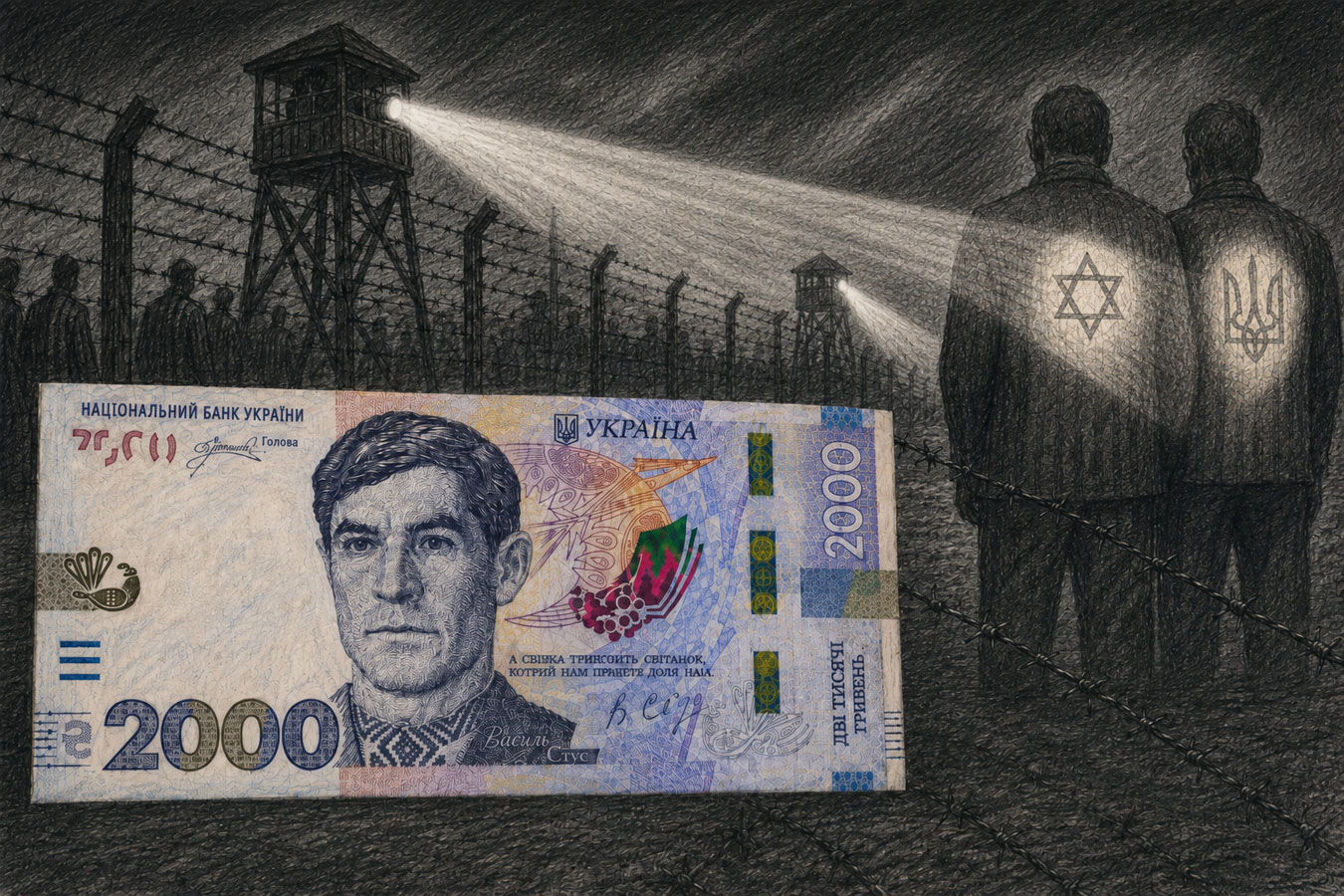
On September 4, 2026, Ukraine introduces a new banknote with a denomination of 2000 hryvnias (approximately 130 shekels). It will feature Vasyl Stus — one of the greatest Ukrainian poets of the 20th century, dissident, human rights activist, and Soviet political prisoner who died in a camp in 1985.
The most obvious discussion around the new banknote has already begun: inflation, rising prices, why a 2000 hryvnia denomination was needed at all, and why now. But if we focus only on the money, we will miss one of the most unusual parts of this story.
When Stus’s notebook with poems was taken away in a Soviet camp and he was told it was destroyed, some of the texts remained in the memory of another prisoner. His name was Mikhail Heifetz. He was a Jew, a Leningrad writer, and a political prisoner. Later, Heifetz repatriated to Israel, lived in Jerusalem, and continued to write about the people he met behind barbed wire.
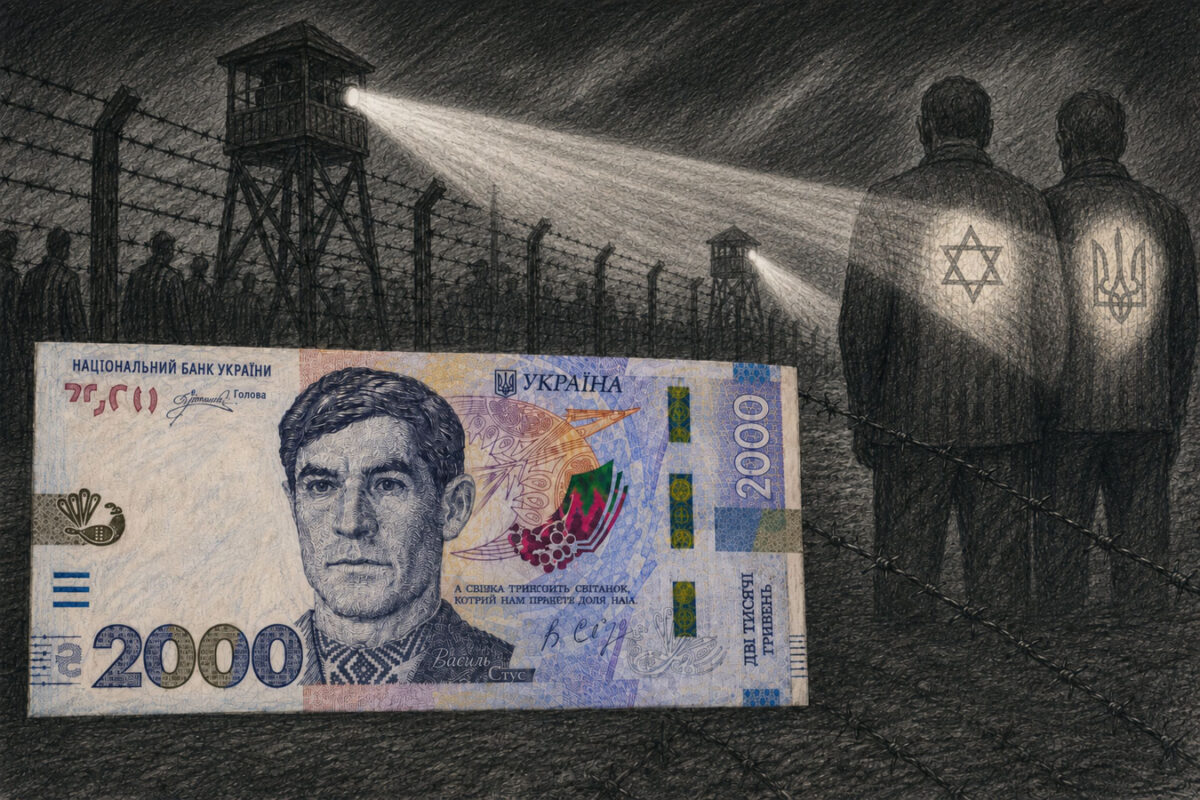
Thus, the new Ukrainian banknote gains an Israeli story that is not directly on the banknote.
Why Ukraine needed 2000 hryvnias
The economic part should not be overlooked here. Since the introduction of the 1000 hryvnia banknote in 2019, the average salary in Ukraine, according to the calculations of the National Bank, has increased approximately threefold, and the overall price level — approximately twofold.
The amount of cash has also changed significantly. If in 2019 there were about 390 billion hryvnias in circulation, by July 1, 2026, it was already more than 970 billion.
There is an even more indicative figure. Banknotes with a denomination of 1000 hryvnias now account for over 55% of the total value of all Ukrainian banknotes in circulation.
Therefore, the appearance of the next large denomination does not come as a surprise. Yes, inflation matters here, and the NBU itself directly points to rising prices. But the formula “the hryvnia depreciated, so they just printed 2000” is too simplistic.
The new denomination itself does not increase the money supply. The banknotes will enter circulation instead of part of the existing cash or be issued against non-cash funds.
There is also the Ukrainian reality of wartime. A bank card works perfectly as long as there is electricity and communication. After Russian strikes, they may disappear. Cash at this moment again becomes the simplest reserve method of payment.
At the same time, Ukraine remains an extremely cashless country: according to the NBU, about 96 out of every 100 transactions with payment cards are conducted without using cash.
But the choice of the new banknote is not explained by the economy. Because the question here is also about whom the state decided to place on the highest denomination of its currency.
Who is Vasyl Stus
Vasyl Stus was born on January 6, 1938, in Vinnytsia region, and spent his childhood and youth in Donbas. He studied at the historical-philological faculty of the pedagogical institute in Stalino — now Donetsk — worked as a teacher, literary editor, and translated Rilke, Goethe, and other European authors.
But in Ukrainian history, Stus remained not only as a poet.
He belonged to the generation of the Sixtiers — Ukrainian intellectuals and cultural figures who, during the relative Khrushchev “thaw,” tried to return space to the Ukrainian language, literature, and historical memory, which was gradually being destroyed by the Soviet system.
On September 4, 1965, Stus was among the participants of one of the most famous public protests of the Ukrainian intelligentsia of the Soviet era. During the premiere of Sergei Parajanov’s film “Shadows of Forgotten Ancestors” at the Kyiv cinema “Ukraine,” Ivan Dziuba informed the audience about a new wave of political arrests. Vyacheslav Chornovil and Stus supported the protest.
After this, a completely different life began for Stus.
He was expelled from graduate school, restricted in his ability to publish and work in his profession. In 1972, he was arrested and convicted for “anti-Soviet agitation and propaganda.” After the camp and exile, he returned to Kyiv, joined the Ukrainian Helsinki Group, and was soon arrested again.
In 1980, Stus received ten years in a special regime camp and five years of exile. He did not survive the second term.
On September 4, 1985, Vasyl Stus died in camp VS-389/36-1 in the Perm region. He was 47 years old.
After the collapse of the USSR, his literary heritage returned to Ukrainian culture officially. Stus became one of the key figures of the Ukrainian dissident movement and a symbol of resistance to Soviet Russification and political repression.
Now his face appears on Ukrainian money.
Why the NBU chose Stus
In preparing the new denomination, the National Bank consulted with historians, the Ministry of Culture, the Ukrainian Institute of National Memory, and the Institute of History of Ukraine of the NAS.
Stus’s candidacy appeared in proposals from several parties. The NBU board ultimately supported it unanimously.
The symbolism began even before the appearance of the banknote. The decision to develop it was made on January 6, 2026 — Stus’s birthday.
The release date was also chosen intentionally.
September 4, 1965 — protest in the “Ukraine” cinema.
September 4, 1985 — death in a Soviet camp.
And exactly on September 4, 2026, the banknote with his portrait is to enter circulation.
It turns out to be almost a completed biographical arc: a public stand against the system, death in the system, and a return already in the symbolism of an independent state.
What the new 2000 hryvnia banknote looks like
The banknote is noticeably different from existing Ukrainian denominations not only in number.
Its main color is blue, size — 75 × 166 mm. It will become the largest denomination of modern Ukraine.
On the front side is a portrait of Vasyl Stus. The design around him uses motifs of Ukrainian modernism and the art of the Sixtiers.
One of the most notable artistic sources is the work of Alla Horska, an artist and participant in the dissident environment. The design includes motifs of her mosaics, including the image of a kestrel bird. The NBU interprets this image as a metaphor for the ability to withstand a strong headwind — practically a visual characteristic of Stus’s fate.
The banknote features a line from a poem he wrote in prison:
“A candle flickers with the dawn, which our great-grandchild will call day”.
In certain design elements, motifs of Heorhiy Narbut are also used — an artist who created the visual language of Ukrainian state money during the Ukrainian People’s Republic.
Thus, on one banknote, the NBU connected several different eras: the statehood of the early 20th century, the generation of the Sixtiers, and modern Ukraine.
On the reverse side is depicted the building of the philological faculty of Donetsk National University — the educational institution where Stus received his education.
This is also a fundamental detail. A person closely connected with Donetsk long before the Russian occupation of the city appears on Ukrainian money. Stus’s biography does not fit well into the Russian propagandist construct of Donbas as a territory supposedly lacking Ukrainian cultural tradition.
More than 20 security elements
The 2000 hryvnia banknote also received a separate complex system of protection against counterfeiting.
The paper includes a multi-tone watermark with a portrait of Vasyl Stus and an additional light element indicating the denomination.
There are embossed images and special elements that can be identified by touch. This is important, including for people with visual impairments.
An optically variable element SPARK is used: when the angle of inclination changes, it creates a motion effect and changes color — from purple to golden-green.
There are microtexts, combined images, elements for checking in ultraviolet and infrared ranges, and other features primarily intended for banking equipment.
But the main technological element the NBU calls the new blue-yellow window security thread Anima Colour.
Part of the thread comes to the surface of the paper. When tilted, an animated effect occurs: the image of the Ukrainian trident changes to the hryvnia sign and back.
According to the National Bank, the 2000 hryvnia banknote will become the first banknote in the world to use a polychrome animated security thread Anima Colour of this type.
In total, the NBU mentions more than 20 security elements.
Therefore, the banknote was shown long before September 4. Banks, cash register equipment manufacturers, ATM operators, and other companies need to train equipment to recognize the new currency.
Even the font on the banknote managed to cause a scandal
Before serial production, the design had to be slightly changed.
After the presentation, Ukrainian font specialists noticed the similarity of one of the elements of the denomination writing with an unofficial Cyrillic adaptation of a font associated with a Russian designer.
The NBU explained that a ready-made third-party file was not used in creating the banknote: the bank’s artists independently drew the necessary elements in a closed system.
From a legal point of view, the regulator also did not see a problem.
But that was not enough.
NBU head Andriy Pyshny stated that on a banknote dedicated to Vasyl Stus, even a visual association with the work of a citizen of the aggressor state is unacceptable. Therefore, the design was decided to be changed even before the start of mass production.
The release date — September 4 — is not postponed because of this.
It turned out to be an almost absurd historical contrast. The Soviet authorities persecuted Stus for defending Ukrainian culture. Four decades later, independent Ukraine is arguing even about the origin of several letters next to his portrait.
Stus wrote directly about anti-Semitism
For the Israeli reader, another part of his biography begins here.
Modern discussions about the Ukrainian national movement of the 20th century often try to reduce it to two convenient extremes. Either the entire history is declared anti-Semitic, or unpleasant pages are simply erased.
In the case of Stus, there is an opportunity not to guess about his attitude.
He wrote about it himself.
In a letter to the first secretary of the Central Committee of the Communist Party of Ukraine Petro Shelest, Stus spoke about the need to fight within the Ukrainian environment against “self-love, anti-Semitism, provincial narrow-mindedness”.
But in the same logic, he demanded respect for Ukrainians. Stus spoke about the need for Russians, Jews, and representatives of other peoples to treat the Ukrainian language, culture, and history with respect.
For him, there was no contradiction here.
One can defend the right of Ukrainians to remain Ukrainians and at the same time consider anti-Semitism unacceptable.
Soon this position received a completely practical continuation. Ukrainian and Jewish dissidents began to meet not in literary discussions.
They met in Soviet camps.
“Friendship of the trident with the Star of David”
In the Mordovian and Perm political camps of the USSR, Ukrainian dissidents, representatives of national movements of other Soviet republics, and Jewish activists found themselves side by side.
Among the latter were people seeking the right to leave the Soviet Union and move to Israel.
This did not automatically mean friendship.
In the memoirs of former prisoners, mutual stereotypes are honestly discussed. Ukrainians had their own ideas about Jews, and Soviet Jews had their own about “bourgeois Ukrainian nationalists.”
The camp forced them to get to know each other personally.
Jewish prisoners wore embroidered Stars of David on their camp clothes, some observed religious rules. Ukrainian political prisoners told them about their history, language, and reasons for resisting the Soviet system.
One of the former prisoners later called the relationships that arose “the friendship of the trident with the Star of David”.
There is no need to embellish this story. The political goals of the two movements differed. Ukrainians sought national rights and ultimately their own statehood. Jews already had a state — Israel, and for many, the main goal was to achieve the possibility of moving there.
But in the camp, a much more practical commonality was discovered: the same regime persecuted them for trying to decide for themselves who they should be.
And here appears Mikhail Heifetz.
Mikhail Heifetz and the notebook of Stus that no longer existed
Heifetz was a Leningrad writer. In 1974, he was arrested and sentenced to four years in prison and two years in exile under the article on “anti-Soviet agitation and propaganda.”
In the camp, he met Stus.
Vasyl Ovsiienko later recalled an episode that is difficult to replace with any official biography.
During a camp search, Stus’s notebook with his new poems was confiscated. Later, the prisoners were told that the manuscript was destroyed as allegedly having no value.
But it turned out that the texts disappeared only from the paper.
Heifetz had a very good memory. He brought Ovsiienko notes and then began to dictate the poems he remembered.
He was able to restore about two dozen of Stus’s works from memory.
Heifetz did not have perfect command of Ukrainian. Therefore, it turned into almost a home literary workshop inside the camp: a Jew from Leningrad dictates memorized Ukrainian poems, a Ukrainian writes them down and simultaneously corrects the language.
The administration could confiscate the notebook.
Conducting a search in another prisoner’s head turned out to be more difficult.
Heifetz preserved not only the poems
After meeting Stus, Heifetz began writing about the Ukrainian political prisoners themselves.
He left literary portraits of Vasyl Stus, Vyacheslav Chornovil, Mykola Rudenko, and other representatives of Ukrainian resistance. Later, these texts were included in his ‘Ukrainian Silhouettes.’
Ovsiienko years later quite accurately formulated the significance of this work: Ukrainians have experienced a lot, but they have not managed to write about everything themselves.
His short phrase about Kheifets sounded like this:
“Thanks to the Jew Kheifets” (“Gratitude to the Jew Kheifets”).
And here Ukrainian history unexpectedly shifts to Israel.
From the camp — to Israel
In 1980, Mikhail Kheifets finished his exile and soon repatriated to Israel.
Here he continued to write, engage in the history of Soviet dissent, and work on the topic of Eastern European Jewry. In the 1980s, Kheifets was a research fellow at the Center for the Study and Documentation of Eastern European Jewry at the Hebrew University in Jerusalem.
The Ukrainian theme did not disappear for him after leaving the USSR.
Kheifets was among the participants in initiatives related to the Public Committee for Jewish-Ukrainian Cooperation in Israel. It turns out that the acquaintance with Ukrainian dissidents, which began in the Soviet camp, continued here.
Kheifets died in Jerusalem in 2019.
This was not the only similar route. Many Jewish activists who went through Soviet camps and the struggle for the right to emigrate later became part of the public and political life of Israel.
NANews — News of Israel detailed the story of Natan Sharansky — a native of Donetsk, a Soviet political prisoner, and a future Israeli politician. We also wrote about how his book ‘Fear No Evil’ was published in Ukrainian and presented simultaneously in Kyiv and Jerusalem.
These biographies cannot be combined into one beautiful legend. The Ukrainian dissident and Jewish national movements had different goals.
But people within them often knew each other personally.
Stus was not an ‘Israeli hero’ — and there is no need to invent this.
For a catchy headline, one could stretch the connection much further and call Stus almost a participant in the struggle of Soviet Jews for Israel.
That would be untrue.
Stus was not a Zionist activist. His struggle was Ukrainian: language, culture, human dignity, the right of the country and society not to dissolve in the Soviet system.
The connection with Israel follows a different route.
Jewish dissidents sat with him. One of them preserved his poems, wrote a lot about him, and after the camp ended up in Jerusalem.
And this connection is actually more interesting than an artificially invented one.