
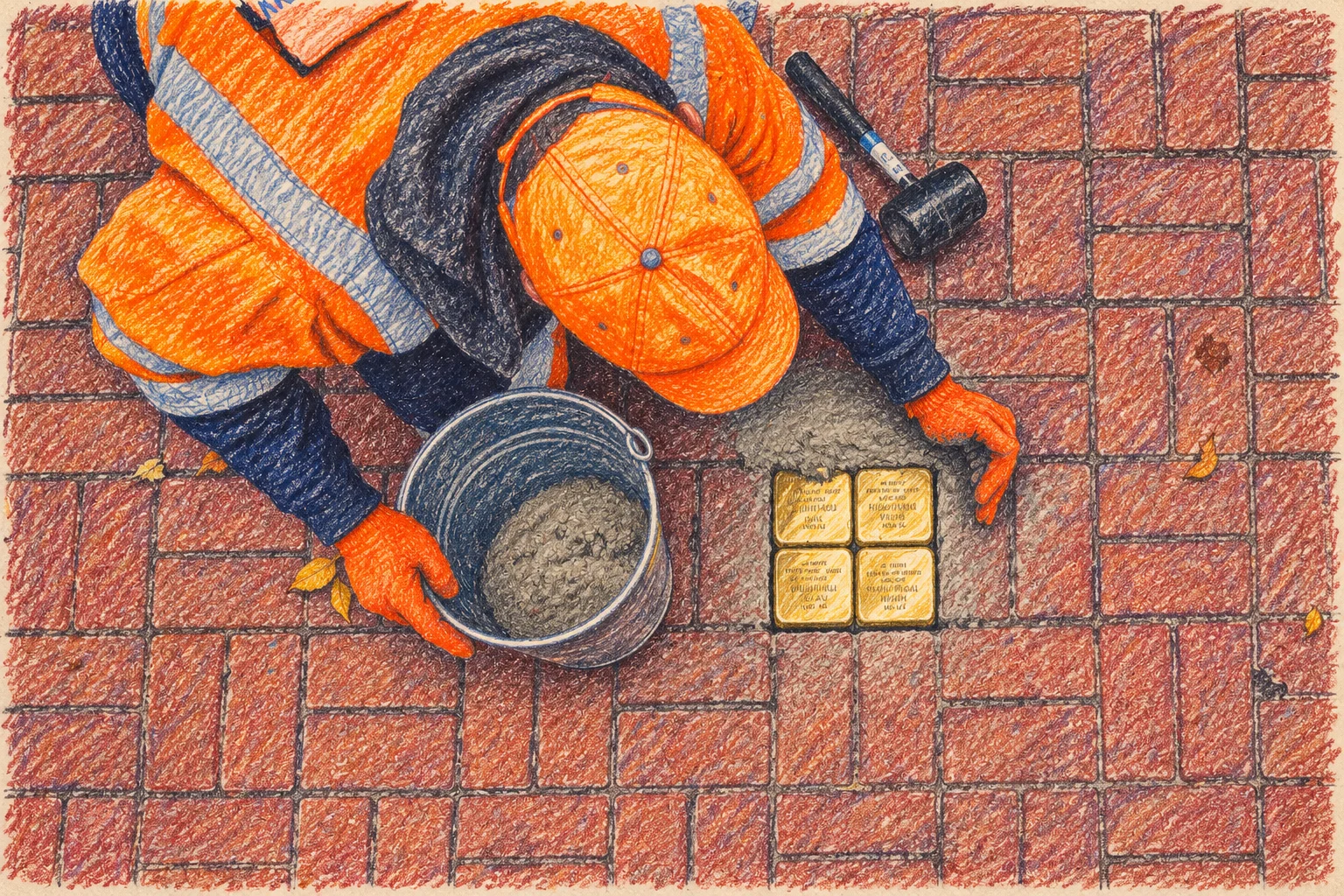
On October 26, 2026, four small memorial plaques were installed in Kyiv in memory of the Jewish Hornstein family, destroyed by the Nazis in Babyn Yar in September 1941. The ceremony on Pankivska Street became another event of the international project Stolpersteine — “Stumbling Stones”, which has been operating in Ukraine for seventeen years and continues to develop during the full-scale Russian war.
For NAnews — Israel News | Nikk.Agency this is an occasion to talk about the project itself, its creator, Ukrainian participants, and the people whose biographies have been restored. In our “History and Facts” section we turn to documents and events linking the history of Ukraine, the Jewish people, and Israel. Stolpersteine is interesting because behind a small plaque in the sidewalk lies a separate study, and sometimes years of work to find evidence of a long-lost family.
Author: The NAnews editorial team
How a German artist invented a memorial that does not rise above people
The Stolpersteine project originated in Germany in the early 1990s. Its author is artist Gunter Demnig, who conceived an unusual form of memory for the victims of National Socialism. The first memorial plaques appeared in Cologne in 1992. Instead of a huge monument or museum exhibition, Demnig proposed installing small memorial blocks directly into city sidewalks.
Each “Stumbling Stone” is a concrete cube approximately 10 by 10 centimeters with a brass plate. It indicates the person’s name, year of birth, and known circumstances of their persecution, deportation, or death. Usually, the plaque is placed near the last voluntarily chosen place of residence, sometimes work or study.
The German word Stolpersteine literally translates as “stumbling stones” or “stones to stumble over.” However, physically stumbling is not required: the plate is flush with the sidewalk. It is assumed that a passerby will notice the inscription, stop, and read the name. For this, there is no need to specifically visit a museum or attend a memorial ceremony.
The project is not exclusively dedicated to Jews who perished during the Holocaust. Among those commemorated are Roma, members of the anti-Nazi resistance, people with disabilities, representatives of persecuted religious communities, political prisoners, homosexuals, and other victims of the National Socialist regime. Separate plaques tell about those who survived the persecutions.
According to the official Stolpersteine website, about 116,000 stones have been installed in more than 1,860 localities in 31 European countries as part of the project. International publications in 2026 also cite higher estimates, exceeding 126,000. The project is considered the largest decentralized memorial in the world. The plates are handmade, and local historians, relatives, schools, and public organizations participate in the search for biographies.
Ukraine joined in 2009: Pereyaslav, Rivne, and Chernivtsi
The first Ukrainian participants were not Kyiv or Lviv, but Pereyaslav — an ancient city about a hundred kilometers east of the capital, which was then called Pereyaslav-Khmelnytsky.
In 2009, the local branch of the international foundation “Understanding and Tolerance” organized the installation of four stones together with German partners. The initiative arose after contacts between Ukrainian and German public organizations in 2008. Research was conducted in city archives, schoolchildren were involved in the work, and funds for the first plaques were collected by participants in youth projects in Germany.
The first four memorial plaques were dedicated to Esther Dikinshtain, the director of a Jewish school killed during the occupation; Efrosinya Pasatskaya and Tatyana Trokhimenko, who died in forced labor in Germany; and teacher Maria Yakovets, tortured for her connection with partisans.
In November 2011, two more stones appeared — in memory of school teacher Yakov Beloshitsky and underground doctor Grigory Belyaev. According to materials from the Pereyaslav City Council, Belyaev issued fictitious medical documents that helped residents avoid being sent to forced labor in Germany. Historical materials cite a figure of almost two thousand such certificates.
In July 2017, three new plaques were installed near the building of the former synagogue — for Leyvik Gechtman, Maria Falkovskaya, and Iosif Livshits, born in 1941. In total, from 2009 to 2017, nine stones appeared in Pereyaslav. Local researchers, together with German youth groups, also worked on restoring the territory of the mass execution site where the Nazis killed about 800 Jews.
The next important city was Rivne. On July 26, 2018, five plaques were installed here with the participation of Gunter Demnig himself. They are dedicated to the Jewish poetess Zuzanna Ginczanka, Orthodox priest Vladimir Mysechko, who refused to cooperate with the occupiers, Righteous Among the Nations Yakov Sukhenko, who saved Jews, as well as Yakov and Racheli Krulik, father and daughter who perished during Nazi persecutions.
The Rivne initiative was supported by the public scientific and pedagogical center “Mnemonics” and German partners. The participation of residents, historians, and city authorities made it possible to link the installation sites with specific pre-war addresses. Each memorial plaque became part of a previously existing urban space that the war irreversibly changed.
A special variant of the project appeared in Chernivtsi. On July 6, 2021, Stolperschwelle — “Threshold of Stumbling” was opened there. Unlike a personal stone, this is an elongated metal plate dedicated to a group of people or a historical event. The Chernivtsi memorial is associated with the deportations of Jews who were gathered at the former Maccabi stadium in 1942 before being sent to Transnistria — a territory then under Romanian occupation.
Among those deported through this place were people connected with well-known Jewish families of Bukovina. The project was prepared with the participation of the Museum of the History and Culture of Bukovina Jews and its director Nikolai Kushnir. For Israelis, the name “Maccabi” is well known for the sports movement, but in pre-war Chernivtsi, it also denoted a Jewish public space that the occupiers turned into a tool of deportation.
Kyiv: 80 stones, Babyn Yar, and school research
In the Ukrainian capital, the project began in 2021, on the 80th anniversary of the Babyn Yar tragedy. The program was named “One Stone — One Life: 80 Stumbling Stones for Kyiv.” The initiative was launched by the German Embassy, and the executor was the Ukrainian Center for Holocaust Studies with the support of the Kyiv City State Administration, KCSA.
From September 30 to October 8, 2021, the first ten Kyiv stones were installed. Among those commemorated are Dina Levina, Yakov Vinokur, Lyudmila Tkach, Rakhil Kozyra, and Ida Tseitlin, who perished as a result of Nazi terror. Other plaques were dedicated to those who survived the persecutions, such as Dina Pronicheva, Vasily Mikhailovsky, and Raisa Maistrenko, as well as people who helped save Jews.
Dina Pronicheva holds a special place in the history of Babyn Yar: she survived the mass shootings and left testimonies about the crimes committed there. Such biographies allow the tragedy to be told not only through documents of Nazi units but also through the memories of people who were directly at the site of the killings.
The name “80 stones” denotes the goal of the program, not the number of memorials already opened. Kyiv organizers create research teams from schoolchildren, students, teachers, and representatives of public organizations. Participants study biographies, family photographs, address directories, and archival documents, after which they prepare materials for the memorial plaque and participate in its unveiling.
This is work that cannot always be completed quickly. Some biographies are restored from family memories, others require verification of archival documents and clarification of pre-war addresses. Sometimes surnames were transmitted differently in Russian, Ukrainian, Polish, German, or Yiddish. Changes in street names and the disappearance of old buildings further complicate the search.
NAnews publications have already raised the issue of disappearing local memory. In the article “Why the history of the Holocaust in Ukrainian cities remains little known”, the situation was discussed where schoolchildren know about Babyn Yar but have heard almost nothing about the Jews of their own city who were destroyed. The Kyiv program offers a practical way to change this: schoolchildren themselves work with documents about people who lived nearby.
New stones during the war: what happened in 2025–2026
After the full-scale Russian invasion in February 2022, conducting research and public ceremonies became more difficult. Nevertheless, the work continued, and in the fall of 2025, the installation of memorial plaques resumed in Kyiv.
On September 23, 2025, a stone was unveiled in honor of Petro Chetverikov, a member of the underground and savior of Jews, known as the Righteous of Babyn Yar. It was installed on Brest Avenue near the Taras Shevchenko Children’s Library. In October, plaques were unveiled in memory of Klavdia Vinokurova and Serafima Kozachinskaya — the thirteenth Kyiv stone was unveiled on October 16 on Ivan Mazepa Street.
On October 24, 2025, a stone was installed in the Ivan Kramsky Park in honor of Maria Rozhnovskaya, Righteous Among the Nations. This title is awarded by the Israeli memorial institute Yad Vashem to non-Jews who saved Jews during the Holocaust at the risk of their own lives. It should be distinguished from the local honorary title “Righteous of Babyn Yar.”
On June 3, 2026, the sixteenth stone was unveiled in Kyiv — in memory of Lia Bubnova, a Jewish pharmacist, wife, and mother who perished in Babyn Yar in 1941. On June 9, a final meeting of research groups took place: six teams and dozens of young participants presented the results of their work. The organizers continued the educational program, not limited to installing ready-made plaques.
On October 5, 2026, a new plaque appeared on Chikalenko Street in memory of Ilya Galant — a historian, archivist, and researcher of Jewish heritage in Ukraine, killed in Babyn Yar. His biography was studied by a team from Kyiv Lyceum No. 173. The opening was attended by German Minister of Education Karin Prin, representatives of the Ukrainian Institute of National Memory, and city institutions.
The director of the Ukrainian Center for Holocaust Studies Anatoliy Podolsky expressed hope in June 2026 that one day there will be so many stones installed in Kyiv and other cities that they will no longer be counted individually. However, the exact confirmed total number of plaques in the Ukrainian capital as of November 1, 2026, is not provided in the studied publications. The program of 80 stones has not yet been declared completed.
October 26, 2026: four stones for the Hornstein family
On October 26, 2026, on Pankivska Street, 27/78, in Kyiv, for the first time within the program, four stones were simultaneously installed for one Jewish family — Natan Hornstein (1894), his wife Buza (1900), daughter Bella (1921), and niece Riva (1922), killed by the Nazis on September 29 or 30, 1941, in Babyn Yar.
The family came from the village of Krasne in the Vinnytsia region, then moved to Kyiv on Zhilyanskaya Street, 66; Natan worked at a mill, Buza managed the household, and Bella and Riva studied in higher educational institutions.
The biographies were restored by students of Lyceum No. 141 “ORT” under the guidance of teacher Svetlana Simonenko, and the ceremony was attended by the relatives of the deceased Grigory and Anna Kolodach, director of the Babyn Yar reserve Roza Tapanova, representatives of the German embassy, the Ukrainian Center for Holocaust Studies, and city authorities.
Why the history of Ukrainian “Stumbling Stones” is important for Israel
For the Israeli reader, there are several levels to this story. Babyn Yar is one of the main places of memory of the Shoah, the catastrophe of European Jewry. According to a German operational report, 33,771 Jews were shot here on September 29–30, 1941. Mass killings in the Babyn Yar area continued later, and among the victims of the Nazi regime were also Roma, Soviet prisoners of war, and other groups of people.
After the war, Soviet authorities avoided separate public recognition of the Jewish victims of the tragedy for a long time. The history of this policy, censorship, and resistance to oblivion is detailed in Anatoly Kuznetsov’s book. In 2026, NAnews reported on a new Ukrainian edition of “Babyn Yar”, prepared with illustrations by Matvey Weisberg and a foreword by Roza Tapanova.
Modern memorial work in Ukraine is carried out by several independent organizations. The State National Historical and Memorial Reserve “Babyn Yar” is responsible for the historical space and memorial objects. The Ukrainian Center for Holocaust Studies is engaged in research and education. The Babyn Yar Holocaust Memorial Center develops its own archival and museum programs. Their activities should not be mixed, although they all work with the legacy of one tragedy.
For example, the Holocaust Memorial Center is involved in returning the names of the deceased and digitizing documents. In the NAnews article “29 thousand returned names and almost 10 million documents”, the work of the center and the participation of Natan Sharansky, an Israeli public figure, native of Donetsk, who heads its supervisory board, was discussed. Archival projects and Stolpersteine operate separately, but both forms of memory rely on the restoration of biographies and documentary evidence.
Israel also has its own experience working with the fates of people who survived Nazi persecutions or helped others escape. On September 29, 2026, a memorial ceremony for the victims of Babyn Yar was held at Yad Vashem with the participation of Ukrainian diplomats and Israeli public figures. As reported by NAnews in the material about the ceremony, the Israeli title of Righteous Among the Nations was awarded to more than 2,700 rescuers of Jews from Ukraine.
Meanwhile, the study of the Jewish heritage of Ukrainian cities is not limited to memorial plaques. Israeli and Ukrainian specialists study synagogues, cemeteries, old quarters, and archives. In August 2026, researchers from the Hebrew University in Jerusalem, together with Ukrainian partners, surveyed more than 30 historical synagogues in Podolia. This work helps to understand where communities existed that were destroyed during World War II and what traces of their lives have been preserved.
For the descendants of Ukrainian Jews living in Israel today, such research can have quite personal significance. A family surname, an old address, a school photograph, or a record of a relative’s profession sometimes allows documents stored in different countries to be connected. Not every biography ends with the installation of a stone, but every found document makes the history of a specific person more accessible to their descendants and the residents of the city where they once lived.
In Pereyaslav, memorial plaques are supported by local educational institutions, in Rivne their installation was the result of the work of public researchers, in Chernivtsi the memorial is associated with the history of deportations, and in Kyiv new groups of schoolchildren continue to work on biographies. Seventeen years of Ukrainian Stolpersteine history show that the project has long ceased to be a separate ceremony brought from Germany. It has become part of the activities of local historians, teachers, and city communities — activities that did not stop even during the war.
If it is important for you to see how world events affect Israel and Ukraine, add NAnews to Google and follow our publications.