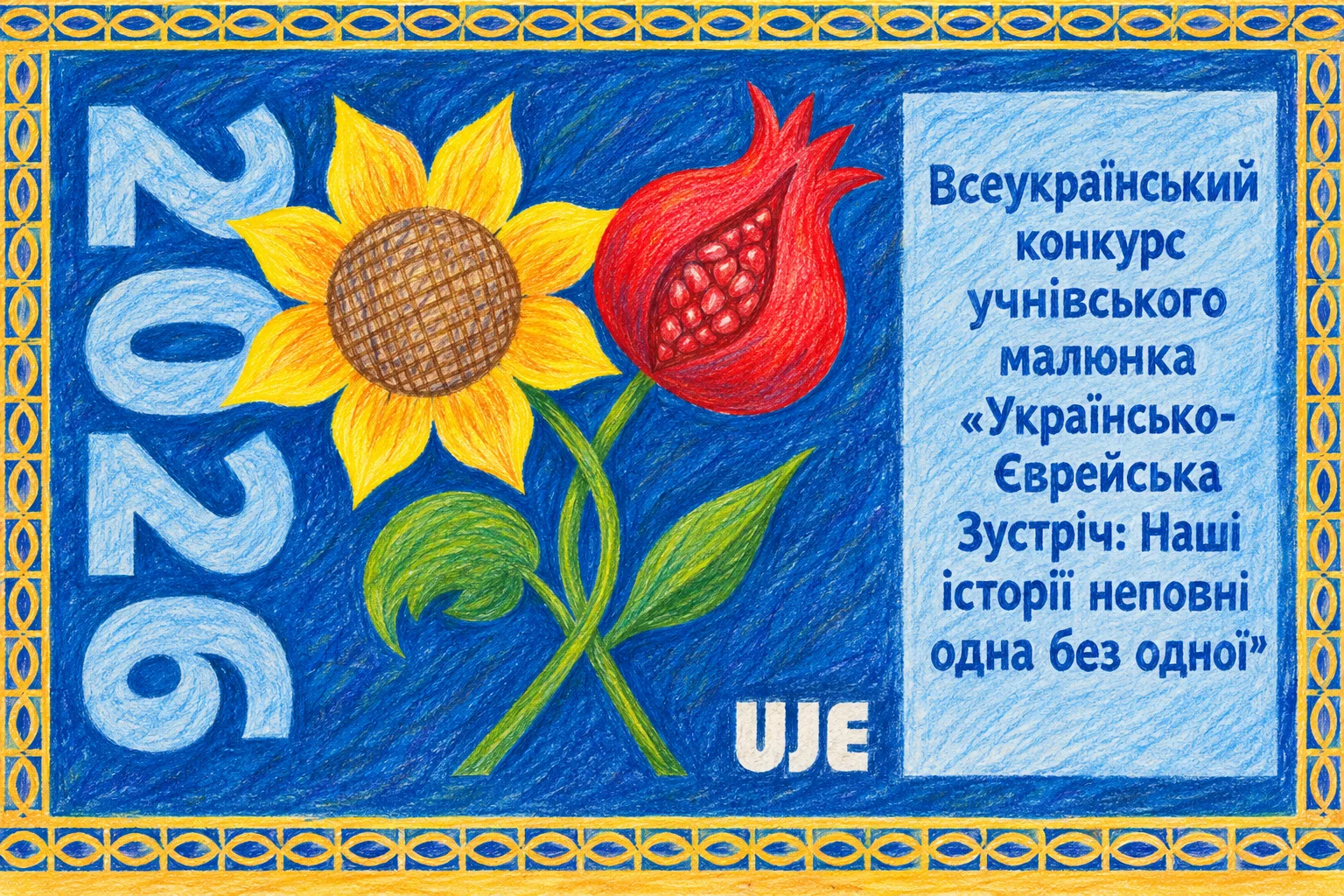
In Lviv on September 11, 2026, the all-Ukrainian school drawing competition “Ukrainian-Jewish Encounter: Our Stories Are Incomplete Without Each Other” was presented. Among the works of past years are memories of the Holocaust, ancient synagogues, Jewish and Ukrainian symbols, biographies of famous Israelis born in Ukraine. There is also a drawing created based on a family story about saving a person during World War II.
Author: Elena Gunko
Details of the meeting were published by the organizers, Ukrainian Jewish Encounter (UJE), on October 29, 2026. The competition is still open: drawings are accepted until December 1, 2026, and the winners will be announced in January 2027. The prize fund is 36 thousand hryvnias.
For Israeli families whose parents, grandmothers, or grandfathers come from Ukraine, such drawings may be unexpectedly close. Schoolchildren depict the history of cities where numerous Jewish communities once existed and where the ancestors of today’s Israeli citizens lived.
The story of the saved grandfather and school drawings about the Holocaust
The presentation took place at the Lviv Regional Library for Children on Volodymyr Vynnychenko Street, 1, as part of the 33rd BookForum — an annual major book forum that gathers publishers, writers, researchers, and readers. The meeting began on September 11 at 12:00 and was primarily aimed at schoolchildren and teachers.
Graphic artist and librarian Veronika Koshiv opened the event with a story about the centuries-old coexistence of Ukrainians and Jews.
UJE’s regional manager in Ukraine, Vladyslav Hrynkevych, presented the competition conditions and the album-catalog of children’s drawings from 2021–2022. Among the stories shown, the work “Hide” attracted special attention.
Its author used the memories of a grandfather who was hidden in a cellar by a Ukrainian woman during World War II. The organizers did not disclose the names of the saved person and his savior, nor the locality where the events took place.
This plot is close to the stories explored by the Israeli memorial complex Yad Vashem. However, recognizing a person as a Righteous Among the Nations requires a separate verification of the circumstances of the rescue. There is no information about such recognition of the woman from the family story.
Hrynkevych noted that school programs often focus on the tragic pages of Ukrainian-Jewish relations. The competition offers to also seek evidence of cultural interaction, mutual assistance, and everyday coexistence.
With artist, art historian, and art therapist Darina Nadashkevych, participants discussed the drawings of winners from different years. She has been working on the competition jury for six years. The meeting reviewed watercolor, gouache, graphics, collages, diptychs, and symbols of the two cultures: the menorah, pomegranate, red poppy, vyshyvanka, and vytynanka.
Vytynanka is the traditional art of cutting paper patterns. It is known in Ukrainian culture but also has an independent Jewish tradition. In Jewish decorative art, such works could contain religious symbols, inscriptions in Hebrew, and temple symbolism.
Nadashkevych explained that professional training is not required for participants. The international jury reviews drawings without indicating the author’s identity, and places are determined by the average score. She suggested that schoolchildren ask older relatives about their childhood and transfer family memories to paper.
Winner from Poltava drew the connection between Ukraine and Israel
Varvara Medonchak from Poltava, a finalist of the 2023 competition and the winner of 2024 among 10–11 grade students, came to the meeting. Her prize-winning work was called “Connected Stories”.
In her drawings, Medonchak used ornaments of Jewish vytynanka, images of synagogues, a plot from Sholem Aleichem’s work “Tevye the Dairyman,” and images of famous Israeli figures born in Ukraine.
Sholem Aleichem was born in 1859 in Pereyaslav. His works in Yiddish became part of world Jewish literature, and the story of Tevye is known thanks to theatrical productions and film adaptations, including the musical “Fiddler on the Roof”.
Ukrainian origin is also shared by a number of important figures in Israeli history. Poet Chaim Nachman Bialik was born in the territory of present-day Zhytomyr region, Ze’ev Jabotinsky in Odesa, and the second president of Israel, Yitzhak Ben-Zvi, in Poltava.
The stories of these people connect Ukrainian cities with literature in Hebrew, the Zionist movement, and the formation of Israel.
The 2024 competition produced several notable works. Among 8–9 grade students, first place went to Sofia Tkachenko from Zhytomyr for “Tree of Memory of Holocaust Victims.” Second place was taken by Yulia Borogan from Oleksandrivka, Odesa region, with “Symbols of Unity,” and third place by Zlata Ivushkina from Kryukivshchyna, Kyiv region, with the drawing “Unbroken Nations: Meeting Through the Years.”
In the senior category, second place went to Kyiv resident Nika Sosenko for “War Destroys,” and third place to Natalia Stepchuk from Petropavlivka, Mykolaiv region, for the work “Our Future is in Our Hands.”
The results were announced on January 28, 2025. The ceremony was held on February 8 at the Sholem Aleichem Museum in Kyiv. The museum director, Iryna Klymova, who chaired the international jury, presented an artistic analysis of the competition works. The exhibition was curated by Svitlana Hrynkevych.
The Sholem Aleichem Museum is located in Kyiv and is dedicated to the life of the writer and Jewish culture. It is a Ukrainian museum institution, not a branch of the Israeli Yad Vashem.
In 2024, the organizers expanded the competition by adding a separate age category for 8–9 grades. Previously, only 10–11 grade students participated. Among the contestants of past years were children from various regions of Ukraine and from abroad.
On February 7, 2026, the award ceremony for the 2025 competition was held at the same museum, and the drawing exhibition was scheduled until February 27.
How to participate in the 2026 competition and how much winners are paid
The competition is organized by the Ukrainian public organization “Ukrainian-Jewish Encounter” under the patronage of the Canadian non-governmental Ukrainian Jewish Encounter. It is a cultural and educational initiative, not a state competition of Israel or Ukraine.
The current set was announced for the first time on April 14, 2026. Students of Ukrainian schools, gymnasiums, and lyceums who study or studied in grades 8–11 in 2026 are invited. According to the Israeli system, this approximately corresponds to the age of 13–17 years, although the exact age depends on the date of birth and school program.
There are two age categories and six cash prizes. The total prize fund is 36 thousand hryvnias — approximately 2500 Israeli shekels.
For 8–9 grade students: first place — 6000 hryvnias (about 417 shekels), second — 4000 hryvnias (278 shekels), third — 2000 hryvnias (139 shekels).
For 10–11 grade students: first place — 12,000 hryvnias (about 834 shekels), second — 8000 hryvnias (556 shekels), third — 4000 hryvnias (278 shekels).
Amounts in shekels are approximate based on the exchange rate on October 31, 2026: 1 hryvnia — about 0.0695 shekels. The actual rate at the time of prize payment may differ.
All participants must receive diplomas and thematic literature, winners — additional awards and cash prizes.
The work can be done with pencils, watercolor, oil, acrylic, gouache, or another artistic technique. A paper sheet A3 without a frame is required. The author’s name and surname are indicated on the back.
A completed questionnaire with personal data and a brief description of the idea in Ukrainian must be attached to the drawing. Works previously exhibited, publicly demonstrated, or participated in other competitions are not accepted.
The original must be sent by courier delivery at one’s own expense: Kyiv, Khreshchatyk Street, 29, office 50, “Ukrainian-Jewish Encounter.” Contact person — Svitlana Hrynkevych.
Submitted drawings are not reviewed and not returned. A special condition of the regulations is the participant’s consent to the processing of personal data and the transfer of the material original and exclusive property copyright to the organizer. Parents of minor artists should read this point before submitting the work.
Winners are to be announced in January 2027. According to the practice of previous years, the award ceremony is accompanied by an exhibition in Kyiv, where the drawings are exhibited for about a month. However, the specific date of the future ceremony has not yet been announced by the organizers.
Why this competition matters for Israel
The issues of Ukrainian-Jewish history remain complex. Large Jewish communities existed on the territory of modern Ukraine, Yiddish literature, religious schools, theaters, publishers, and synagogues developed. Anti-Semitic pogroms also took place here, and during the Nazi occupation, hundreds of thousands of Jews were exterminated.
The history includes cooperation of part of the local population with the occupiers and participation in persecutions, but also help to Jews, sometimes associated with mortal risk for the rescuers. These circumstances cannot be mixed or used to deny each other.
For NANews — News of Israel | Nikk.Agency, this topic is also related to today’s relations between Israel and Ukraine. Many Israeli families keep photographs of relatives from Odesa, Kyiv, Lviv, Poltava, and small Ukrainian towns where Jewish life was destroyed during the Holocaust.
Now Ukrainian teenagers turn to the same past through drawings and family conversations. The competition continues during the full-scale Russian war against Ukraine, when schools and cultural institutions operate under constant security threats.
It is unknown how many works have already been submitted for the 2026 competition. The organizers have not yet published the final number of participants or future winners.
However, the story of the drawing “Hide,” which was heard again in Lviv, is known. The grandson preserved on paper the story of the grandfather about a woman who sheltered him during the war. For those trying to restore their family’s history in Israel or Ukraine, such testimonies may become a reason to search for documents, ask relatives, and find out the fates of people whose names have not yet been preserved in public archives.
If it is important for you to see how world events affect Israel and Ukraine, add NANews to Google and follow our publications.