
On October 30, 2026, a new DISCO UKRAЇNA party will take place in Tel Aviv — this time under the name “Velesova Night”. The organizers have announced it as a modern Ukrainian interpretation of Halloween: with Ukrainian music, images of the Carpathians, mavkas and witches, costumes, mystical stories, stand-up, and dancing until two in the morning.
Author: Pavel Shveiko
They meet on Friday, October 30, 2026, at CALLAS TLV, Menachem Begin Rd 37, Tel Aviv-Yafo. Doors will open at 19:00, the main program will start at 20:00, and after midnight there will be two more hours for the afterparty.
Tickets are already available at https://selector.org.il/e/Pcy-i4HGkP2
The evening will be held in Ukrainian, but the event is open to everyone. Knowing Ukrainian folklore, coming in an embroidered shirt, or understanding who mavkas are is not necessary. You can simply come to the party, listen to music, and get acquainted with another part of modern Ukrainian cultural life in Israel.
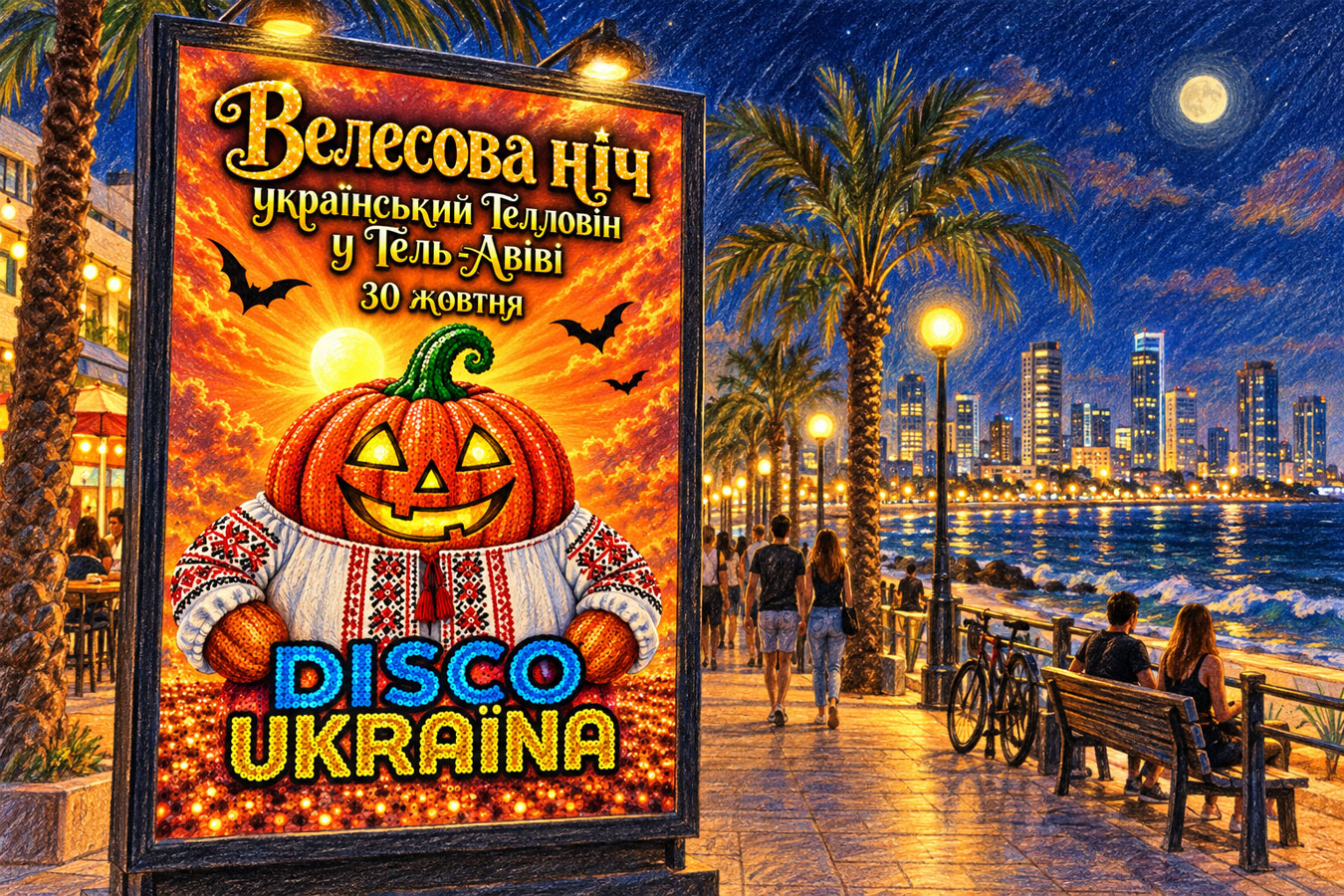
What is “Velesova Night” and who are its characters
For the Israeli reader, it is better to immediately separate two things here.
Veles is indeed an ancient Slavic deity, known from written sources for over a thousand years. And “Velesova Night” from October 31 to November 1 in its current Ukrainian form is a modern cultural tradition that became noticeable in Ukraine already in the 21st century.
Veles, or Volos, is mentioned in chronicle stories about the treaties of Rus with Byzantium in 907 and 971. He was called the “god of cattle” and was associated with livestock, household, prosperity, and material well-being. So Veles himself is not a modern character invented for autumn festivals or Halloween: his name is indeed known from the sources of the times of Kievan Rus.
But a separate annual holiday called “Velesova Night” exactly on October 31 is not recorded in Ukrainian ethnographic records of the 19th and 20th centuries. However, Ukrainian folk culture did indeed know many stories about ancestors, divination, witches, forest creatures, evil spirits, and special days when the boundary between the ordinary and the otherworldly seemed to become less clear. Historically, all these ideas did not constitute a single holiday under today’s name.
In the Ukrainian information space, the name “Velesova Night” becomes noticeable around 2017. The night from October 31 to November 1 begins to be described as a Ukrainian interpretation of Halloween, adding its own folk and literary images. In the 2020s, it is no longer just an internet topic: under the name “Velesova Night,” cultural programs, folklore meetings, festivals, and themed parties are held in Ukraine.
For example, in 2025 in Poltava, an ethnographic evening “Velesova Night: Rites of Ukrainian Halloween” took place. At the same time, the modern form of the holiday is considered more as a new reinterpretation of old folklore motifs rather than a literal restoration of one ancient rite.
Hence the characters that appear today around “Velesova Night.” For the Ukrainian audience, many of them are familiar from childhood, from school, literature, theater, or modern mass culture. For an Israeli, the words “Konotop witch” or “Carpathian mavka” require separate explanation.
Konotop witch is primarily one of the most famous images of Ukrainian literature of the 19th century. Konotop is a real city in the current Sumy region. In 1833, Ukrainian writer Hryhorii Kvitka-Osnovianenko wrote a satirical-fantastic story “Konotopska vidma”, published in 1837. At the center of the story is a witch hunt, magic, superstitions, and the witch Yavdokha Zubikha, and behind all this is quite a harsh satire on local officials, ignorance, and human stupidity.
Almost two centuries later, the “Konotop witch” has once again become part of modern Ukrainian culture. In 2023, director Ivan Uryvsky staged a play of the same name at the Ivan Franko National Theater in Kyiv. The production became one of Ukraine’s notable theatrical hits, fragments of the play spread across social networks, and the image of the Konotop witch once again found itself in mass culture. Therefore, today it is both a character from old literature and quite a modern Ukrainian cultural symbol.
Mavka is an image of much older folklore origin. In Ukrainian folk beliefs, it is a female supernatural being associated with the forest and wild nature. Especially many stories about mavkas were recorded in the Carpathians, Volyn, and Podillia in the 19th–20th centuries. Usually, a mavka was imagined as a young beautiful girl, but she belongs to the non-human world and in old stories is not always safe for the person who meets her.
The image of Mavka became especially well-known throughout Ukraine thanks to Lesya Ukrainka, who in 1911 wrote the drama-fairy tale “Lisova pisnya”. Her Mavka became one of the most recognizable characters in Ukrainian literature. In the 21st century, the image received another wave of popularity thanks to modern culture, including the Ukrainian animated film “Mavka. Lisova pisnya”, released in 2023.
Therefore, the expression “Carpathian mavka” for a Ukrainian usually evokes a fairly understandable set of associations: mountains, forest, long hair, nature, beauty, and at the same time something non-human and a little dangerous.
Witches in general occupy a large place in Ukrainian folklore. In records of the 19th–20th centuries, they were attributed the ability to influence crops, livestock, weather, people’s health, and family life. At the same time, the Ukrainian folk witch did not necessarily look like a Western European Halloween witch in a black hat with a broom. In stories, it could be a completely ordinary woman whom those around her considered capable of witchcraft.
Alongside witches in folk stories were sorcerers, healers, and “knowing people”. Some treated with herbs, others used spells, and still others were attributed the ability to see or do what was inaccessible to an ordinary person. The boundary between folk medicine, faith, superstitions, and magic in such stories was very fluid.
The Carpathians also appear in the modern “Velesova Night” not by chance. It is the Ukrainian Carpathians that are especially strongly associated in the mass imagination with mountain folklore, forest creatures, healers, charms, and numerous legends. Therefore, the mist over the Carpathians, mavkas, and witches have today become almost a ready visual language of the Ukrainian mystical theme.
But the pumpkin with a carved face already primarily relates to the modern international culture of Halloween. In Ukrainian life, the pumpkin has been known for centuries and even received its symbolic meaning: the expression “dati harbuza” means to refuse a person during matchmaking. But turning a pumpkin into a lantern with a face is not an ancient Ukrainian custom of “Velesova Night,” but an element of Halloween that in the 21st century has calmly mixed with the Ukrainian theme.
Therefore, the modern Ukrainian “Velesova Night” looks exactly like such a cultural blend. 907 and 971 years give us real written mentions of Veles; 19th–20th centuries — a huge layer of recorded Ukrainian folklore about witches, mavkas, healers, and the otherworldly; 1833 and 1837 years — the appearance of the “Konotop witch” in Ukrainian literature; 1911 year — “Lisova pisnya” by Lesya Ukrainka and the famous Mavka; approximately since 2017 the name “Velesova Night” noticeably spreads in the Ukrainian information space; and in the 2020s it turns into a recognizable modern format of cultural events and parties.
Therefore, when today Veles, Konotop witches, Carpathian mavkas, sorcerers, and pumpkins are nearby, it is not a list of characters from one ancient rite. It is a modern Ukrainian interpretation, in which the ancient name of Veles, real Ukrainian folklore, classical literature of the 19th–20th centuries, and today’s Halloween culture have merged.
What is “Velesova Night” in this case
The organizers are not trying to turn the club into an ethnographic museum and themselves quite accurately explain their idea: “modern interpretation of Ukrainian Halloween”.
In modern Ukraine, the name “Velesova Night” has become a recognizable autumn mystical format, where Ukrainian folk motifs, stories about witches, mavkas, the Carpathians, the otherworldly, and the already familiar Halloween culture are combined. At the DISCO UKRAЇNA party, they decided not just to write this theme on the poster, but to integrate it into the evening program.
That is why Marina Kadatska will appear here, representing MAK UA — “Ukrainian Art Amateur Forge in Israel”. She will tell guests about the symbols, images, and mystical world of “Velesova Night.” The organizers immediately warn: there will be no historical test. After all, people came to dance.
For the Israeli reader, it is easiest to imagine the format like this: it is a Ukrainian-themed Halloween party, only instead of the standard set of Western pop culture, the organizers take Ukrainian images and add them to the modern club scene of Tel Aviv.
Four DJs and the premiere of a new Serdyuchka
On October 30, the music will be provided by DOMINIC, LOUTIQUE, SAMSO, and ROMAN ZOTS.
After the previous party, the team conducted a survey among guests and says that the music program was compiled taking into account the feedback received. Therefore, they promise not to go exclusively in one direction: there will be modern Ukrainian music, famous songs of past years, original versions of compositions, new remixes, and international dance tracks.
Moreover, two DJs are preparing their own premieres for the evening — DOMINIC and LOUTIQUE.
LOUTIQUE will have another separate number: a new remix of “Dancing Lasha Tumbai” by Verka Serdyuchka. There is still time until the 20th anniversary of the song — Serdyuchka performed it at Eurovision in 2007 — so this is precisely about the premiere on the eve of the anniversary. The organizers promise to play the new version for the first time at DISCO UKRAЇNA.
For the project, such musical experiments are no longer news. At the previous big party “NEZALEZHNA 2026”, held in August at the same CALLAS TLV venue, LOUTIQUE prepared a separate remix of a song by Iryna Bilyk. Then DJ LUMARE from Lviv also joined the team. Our material about that meeting can be read here: “NEZALEZHNA 2026” in Tel Aviv.
Witch at the entrance, Olya Yarosh, and mystical stand-up
Acquaintance with the theme of the evening will begin literally from the door. Guests will be greeted by Vita, whom the organizers present as “the first encounter with mysticism.”
The host will once again be Olya Yarosh. She will handle contests, interactives, and the connection between different parts of the program.
And Anton Shevchenko is preparing a separate stand-up with a mystical twist for “Velesova Night.” After the performance, the program will return to the dance floor.
For NAnovosti — News of Israel | Nikk.Agency, the evolution of DISCO UKRAЇNA is also interesting here. In the spring, the project held a White Party at PHI GARDEN, and now after the August “NEZALEZHNA 2026,” it remains at the larger CALLAS venue and builds a fully themed evening with a host, stand-up, cultural part, and separate activities. We talked about the May party in the material “DISCO UKRAЇNA in Tel Aviv — Ukrainian White Party”.
1,000 shekels for the best costume
Costumes this time are not just for photos. The main prize of the contest is 1,000 ₪.
The organizers suggest recalling Konotop witches, Carpathian mavkas, sorcerers, pumpkins, or coming up with your own image. The winner will be chosen jointly by guests and the jury. Who will be on the jury will be announced closer to the party.
But no one is obliged to come in costume. The dress code is formulated quite broadly: festive, cocktail, themed, or with a Ukrainian accent.
There is only one restriction, and it is quite understandable for Israel now. The team asks to refrain from excessively bloody and violent images — considering what people are going through in Ukraine and Israel. As much mysticism as you want. The organizers do not want to see bloody horror that evening.
There will also be a Wheel of Fortune with gifts. The list of prizes is not yet disclosed — it is promised to be published closer to October 30.
How the evening will go
At 19:00 the doors will open. At this time, music will already be playing, the bar will be open, you can meet friends, order food, or have a drink before the program starts.
From 20:00 to midnight — the main part: DJ sets, new remixes, a story about “Velesova Night,” stand-up, contests, Wheel of Fortune, and dancing.
From 00:00 to 02:00 there will be an afterparty. As the organizers themselves put it: the main program will end, the party will not.
The cost of any ticket already includes one drink of choice — beer or a glass of wine. CALLAS will also have a bar with special prices, you can order food. Everything beyond the included drink is paid separately.
Entrance — only 18+.
There are several parking lots near CALLAS. More detailed information about parking and other practical details the team promises to send to guests before the event.
Tickets: from 99 shekels
A promotional price is currently in effect.
A regular promotional ticket costs 99 ₪ + service fee. The option 119 ₪ + fee includes the same conditions and an additional 20 shekels to support discounted tickets for Ukrainian refugees. A ticket with transfer costs 149 ₪ + fee. The full ticket price when purchased directly at the entrance is 199 ₪ + fee.
Tickets are sold through Selector: DISCO UKRAЇNA “Velesova Night” page.
Ukrainian refugees in Israel
The social part of DISCO UKRAЇNA is preserved in the new edition. When purchasing a ticket, you can add 20 shekels, which will be directed to funding discounted tickets for Ukrainian refugees currently in Israel due to the war.
Ukrainians who need such a ticket are offered to contact Hanna on WhatsApp at +972-55-318-0875. She represents ASSAF, an Israeli organization working with refugees and asylum seekers. This contact is intended specifically for questions about discounted tickets; for the party itself, organizers ask to write to them directly.
Such a scheme has already been used by DISCO UKRAЇNA before. For example, at the February Be My Valentine party and the May White Party, the additional 20 shekels collection also went to tickets for Ukrainians who found themselves in Israel due to the war. More about the first such event was told by NAnovosti here: “Support for Ukrainian refugees in Israel: DISCO UKRAЇNA”.
In addition, part of the evening’s income organizers promise to donate to support volunteer initiatives in Ukraine and the Ukrainian community in Israel.
Who organizes DISCO UKRAЇNA
In the event card, the organizer is listed as DISCO UKRAINA, contact email — nezalezhna.il@gmail.com. The project is associated with the team “Nezalezhna — Ukrainian Party”, which holds Ukrainian musical and public events in Israel. In previous announcements of this series, the organizer was also indicated as “Nezalezhna.”
You can follow the team’s news through Nezalezhna.il on Facebook and Instagram. At the same time, the party itself remains Ukrainian in language and content, but the invitation is addressed not only to Ukrainians: the organizers are waiting for community friends, Israelis, and generally everyone who wants to spend a Friday evening with Ukrainian music and a slightly unusual mysticism for Tel Aviv.
DISCO UKRAЇNA: “Velesova Night” will take place on October 30 at CALLAS TLV, Menachem Begin Rd 37.
Doors — at 19:00, main program — from 20:00, afterparty — until 02:00.
And you can leave the costume at home. Although with a prize of a thousand shekels, it might be worth considering.
Tickets are already available at https://selector.org.il/e/Pcy-i4HGkP2