20 different editions, stories about friendship, family memory, Jewish holidays, and even about how to cope with losing a home. The Ukrainian center “Mi razom!” in Haifa received children’s books in Ukrainian from the international program PJ Library. We tell you what this library is, which works have been given to children, and where else in Israel you can get Ukrainian books for free.
Author: Alexander Khmelnitsky
On September 29, 2026, it became known about a new arrival of children’s literature at the Ukrainian cultural and developmental center “Mi razom!” (“We are together!”) in Haifa. The center received books in Ukrainian for free from the international Jewish educational program PJ Library, also known as the “Pajama Library.”
In the published announcement, the center addressed parents with joyful news: now you can get children’s books in Ukrainian for free from PJ Library. Organizers describe them as bright, kind, and meaningful stories for children of different ages — about friendship, family, mutual help, traditions, holidays, courage, love, and important life values.
It is especially emphasized that this is not just about free literature, but about the opportunity to preserve the Ukrainian language in families living in Israel today.
“Let the Ukrainian book live in our homes, help children preserve their native language, and bring pleasant moments of family reading,” says the center’s message.
The organizers expressed special gratitude to Olga and the “Pajama Library” for the books provided free of charge, attention to Ukrainian families, and support.
“For us, these are not just books — it’s an opportunity to give children even more warmth, knowledge, interesting stories, and a love for reading,” emphasized the “We are together!” center.
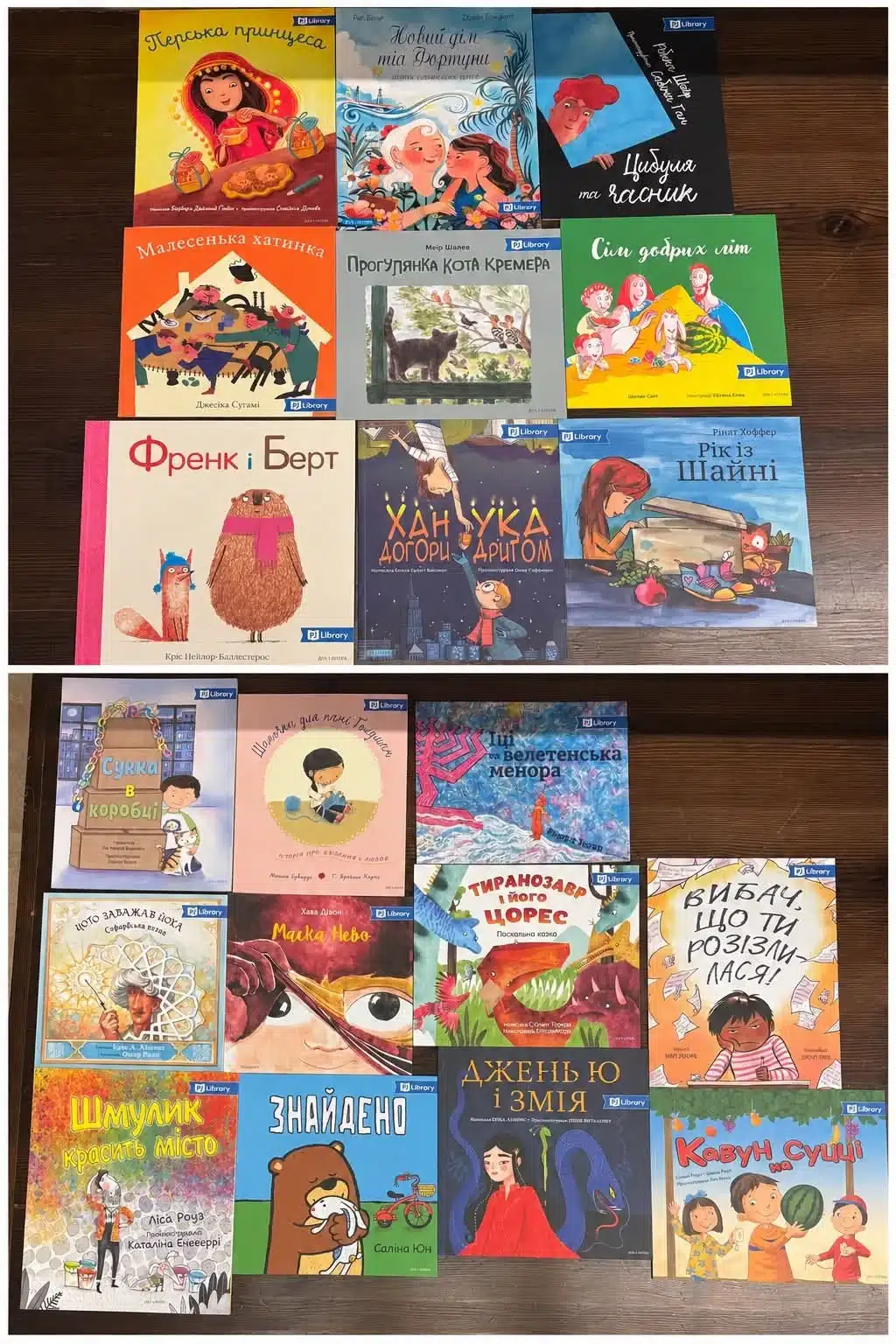
In the photo accompanying the message, you can see 20 different editions. This is not necessarily the entire volume of the transferred batch — the center does not specify the number of copies. However, it is now known what exactly is offered to young readers.
And the selection turned out to be interesting. Next to each other are tales about Hanukkah and Purim, works by modern Israeli writers, stories about friendship, responsibility, family traditions. There is also a book about a woman who has to leave her home again.
For Ukrainian children who found themselves in Israel after the start of the full-scale Russian invasion, some plots may be especially close.
What is PJ Library and why does it publish books in Ukrainian
PJ Library appeared in 2005 thanks to American Jewish philanthropist Harold Grinspoon. It all started with two hundred American families receiving children’s literature for free.
Gradually, the program became international. Its task is to introduce children to Jewish history, holidays, culture, and values through literary works that parents can read with them.
In Israel, the project is known as “Sifriyat Pajama” (ספריית פיג’מה) – https://www.pjisrael.org/. This program operates in kindergartens in cooperation with the Israeli Ministry of Education. Children receive books, take them home, and read them with their parents.
In Ukraine – https://pjlibrary.ua/ – the program appeared even before the big war: family registration began in March 2019, and the first book shipments — in April. Initially, Kyiv, Dnipropetrovsk, and Odessa regions participated, later the project spread throughout the country.
The target audience of the Ukrainian “Pajama Library” is mainly children from two to eight years old.
A fundamental feature is that the books are published in Ukrainian. These are full-fledged literary editions with illustrations, translations, and additional materials for parents and educators.
What books appeared in Haifa: all 20 editions
Let’s start with the most unusual. Children are offered not only an introduction to traditional holidays but also a journey through the Jewish world — from Persia and Eastern Europe to China and modern America.
Hanukkah, Purim, Sukkot, and even dinosaurs
“The Persian Princess” by Barbara Diamond Goldin tells about a girl named Raya from a family of Iranian Jews. Together with her grandmother, she prepares for Purim: baking traditional cookies, collecting sweets for neighbors, trying on a costume, and participating in a festive performance.
“Hanukkah Upside Down” — a story about relatives living on different ends of the world. For one, Hanukkah is associated with snow, for the other — with the summer heat of New Zealand. Both are surprised by each other’s customs, but gradually understand: the tradition remains common, even if celebrated in completely different ways.
“Itzi and the Giant Menorah” by Richard Ungar refers to the folklore of Eastern European Jews. The action takes place in the legendary Chelm — a town whose residents are famous for their rather peculiar logic. When the townspeople receive a huge menorah, the most reasonable solution to the difficult situation is unexpectedly found by a little boy.
For the Israeli reader, there is an additional detail: the real Polish city of Chelm existed long before these tales appeared, but it was Jewish folklore that turned it into a kind of capital of good-natured eccentrics.
Another Hanukkah story — “A Year with Shaini“. The girl receives new shoes on Rosh Hashanah, the Jewish New Year, and the shoe box accompanies her throughout the year. Through children’s adventures, the reader gets acquainted with the Jewish holiday calendar.
Two books are dedicated to Sukkot. “Sukkah in a Box” tells about the construction of a temporary festive dwelling, and “Watermelon on the Sukkah” — about children who decided to decorate their sukkah with a huge watermelon. The problem arises when it turns out that hanging such a weight under a roof of branches is not so easy.
There is also “Nebo’s Mask” — a story about Purim disguises and hidden miracles.
And in the book “Tyrannosaurus and His Tsoris” a dinosaur prepares a festive Passover seder, but guests are afraid to come to him. What if the host decides to have them for dinner?
Seder — a family ritual meal at the beginning of Passover, the holiday of the exodus of Jews from Egypt. And the word “tsoris” comes from Yiddish and means troubles, worries. In general, the dinosaur really has problems.
Friendship, kindness, and the ability to admit mistakes
Another part of the selection does not require familiarity with Jewish traditions to interest a child.
In the book “Frank and Bert” a little fox notices that his friend, a bear cub, is bad at playing hide and seek. He has to choose: continue to win or help his friend feel happy.
“A Hat for Mrs. Goldman” — a story about a woman who constantly knits warm hats for others, forgetting about herself. Little Sophia decides to correct this injustice.
Here children are explained the concept of mitzvah: it is not only a religious commandment but also a good deed done for another person.
“Sorry You’re Angry!” is dedicated to a completely different problem. A boy tries to apologize to a classmate but gradually realizes that true apologies are not an attempt to shift responsibility onto the offended person.
“Found” by Salina Yoon tells about a bear who finds a lost toy. He becomes attached to it, but now he needs to find the real owner.
“The Little House” — a retelling of a famous Jewish folk tale about a man who constantly feels that his house is too cramped. A wise relative’s advice makes him look at his usual life in a completely different way.
And “Kremer’s Cat Walk” by the famous Israeli writer Meir Shalev helps talk to children about offenses, stubbornness, friendship, and the consequences of one’s own behavior.
NANews — News of Israel | Nikk.Agency has already reported on the work of the Haifa center with children. In May 2024, its pupils participated in the international campaign “Children’s Hands for Peace”, sending symbolic messages of support to Ukrainian peers.
Stories about family memory, relocation, and the Jewish world
The book by Ruth Behar “The New Home of Tia Fortuna” stands out especially.
Its main character is an elderly woman from a family of Sephardic Jews who has to leave her home in Miami. Little Estrella helps her beloved aunt pack, and through this simple activity, the history of several generations forced to leave familiar places gradually unfolds.
Sephardim are a historical community of Jews whose ancestors lived on the Iberian Peninsula and, after being expelled at the end of the 15th century, settled in different countries.
Fortuna is left with family recipes, photographs, memories, words from different languages. A home can be lost. But traditions of a family continue to live with a person.
In this story, it is hard not to notice the parallel with the fate of Ukrainian families who packed their suitcases and went into the unknown after February 2022.
“Jin Yu and the Snake” takes the young reader to medieval Chinese Kaifeng, where a Jewish community existed. The plot is based on a Talmudic story about a good deed that unexpectedly changed a person’s fate.
“The Seven Good Years” refers to the Jewish literary tradition. A poor man is offered seven years of prosperity. But how to manage wealth? And what will remain with the family when the appointed time ends?
“What Yocha Wished For” — a humorous tale about wishes and the consequences of thoughtless requests. Magic here works quite differently than the main character expects.
“Onions and Garlic” — another folk plot. Familiar vegetables turn out to be an unexpected treasure where people have never seen them before.
And in “Shmulik Paints the Town” an Israeli artist is tasked with painting a park wall for Israel’s Independence Day. Inspiration does not come, but his dog Ezra discovers his own creative abilities.
All these stories are united not by the place of action and not even by the genre. They show the child how diverse the Jewish world is — its languages, geography, traditions, and people.
You can familiarize yourself with the works and materials for family reading in the official PJ Library catalog.
How the Ukrainian “Pajama Library” survived the start of the big war
Before the full-scale Russian invasion, the Ukrainian program had more than 3,200 subscribers. Families regularly received children’s books at home.
After February 24, 2022, the usual delivery system stopped working.
Organizers had to restore access to the book warehouse in Ukraine, find a new printing house and translator, negotiate with partner organizations about book distribution.
The international PJ Library network helped. As a result, distribution points appeared not only in Ukraine but also in Israel and European countries where Ukrainian families arrived.
By September 2022, some children who were forced to leave their homes began receiving Ukrainian books again. This was reported by the Harold Grinspoon Foundation in December 2022.
Notably, the program is not limited to transferring literature. For many works, additional activities, coloring books, creative tasks, and topics for family conversations are prepared.
Thus, a book can become the basis for a small home lesson, even if parents themselves are not very familiar with the described Jewish traditions.
Where in Israel you can get Ukrainian books for free
According to the official PJ Library list, distribution points for Ukrainian books are declared in Haifa, Kiryat Yam, Bat Yam, Be’er Sheva, Jerusalem, Netanya, Tel Aviv, Karmiel, and Holon.
Addresses, book availability, and conditions for obtaining them need to be clarified in advance (the date on the page is 2022) on the official Ukrainian page of PJ Library in Israel.
Ukrainian center “We are together!” in Haifa
The new arrival of books was confirmed by the Ukrainian cultural and developmental center “Mi razom!” (“We are together!”). Parents can get children’s literature in Ukrainian for free here. The center separately thanked Olga and the “Pajama Library” team for the provided editions.
The current address of the center is Haifa, Derech Atzmaut, 60. You can follow announcements, event schedules, and clarify the conditions for obtaining books through the official “Mi razom!” Facebook page.
But the center’s activities have long gone beyond humanitarian aid to Ukrainians who arrived in Israel after the start of the full-scale Russian invasion. Today it is a meeting place for the Ukrainian community, where they try to solve two tasks simultaneously: helping people adapt to Israeli life and maintaining a connection with the Ukrainian language, history, and culture.
Here they conduct Hebrew classes, family workshops, children’s events, historical lectures, and cultural meetings. In July 2026, for example, the center prepared a separate summer program with educational activities, communication, and acquaintance with Israel.
There are also their own thematic cycles. As part of the program “Israeli Panorama: From History to Modernity,” a lecture “Jewish Cosmos. Who Taught Yuri Gagarin to Fly?” was held in July — about the contribution of Jewish scientists and engineers to the development of aviation and space exploration.
To the 35th anniversary of Ukraine’s independence, the center organized a meeting with law professor Boris Svirsky, dedicated to little-known pages of Ukrainian statehood. More about this was told by NANews in the article “Independence Day of Ukraine in Haifa: Unknown Pages of State History”.
Special attention is paid to children here. Back in May 2024, the center participated in the international campaign “Children’s Hands for Peace”. Young participants left handprints on a common canvas, sending symbolic messages of support to Ukrainian peers.
The new batch of books from PJ Library continues this work. For a child, it is an opportunity to read in their native language, get acquainted with Jewish traditions, and discuss what they have read with their parents. For adults, it is another reason to come to the center, meet other Ukrainian families, and engage in community life.
It is this combination of humanitarian, educational, and cultural activities that gradually turns “We are together!” from a point of assistance to displaced persons into a permanent Ukrainian public space in Haifa.
Two cultures, one children’s bookshelf
Here is an interesting detail.
Ukrainian children in Israel receive books in their native language about the history of Jewish communities, Israeli holidays, family traditions, fairy-tale heroes, and the most ordinary children’s experiences.
In one bookshelf, there are an Iranian Jewish family, Chinese Kaifeng, the legendary Eastern European Chelm, modern Israel, and the story of a woman who had to leave her home again.
There is no need to choose between preserving the Ukrainian language and getting acquainted with the culture of the country you live in today. One can quite help the other.
And for this, sometimes it is enough just to open a children’s book.
Source of the news: publication of the Ukrainian cultural and developmental center “Mi razom!” in the group of humanitarian aid to refugees from Ukraine in Haifa and northern Israel, September 2026. The list of editions is compiled from a photo of the transferred books; information about their content is based on PJ Library materials.
