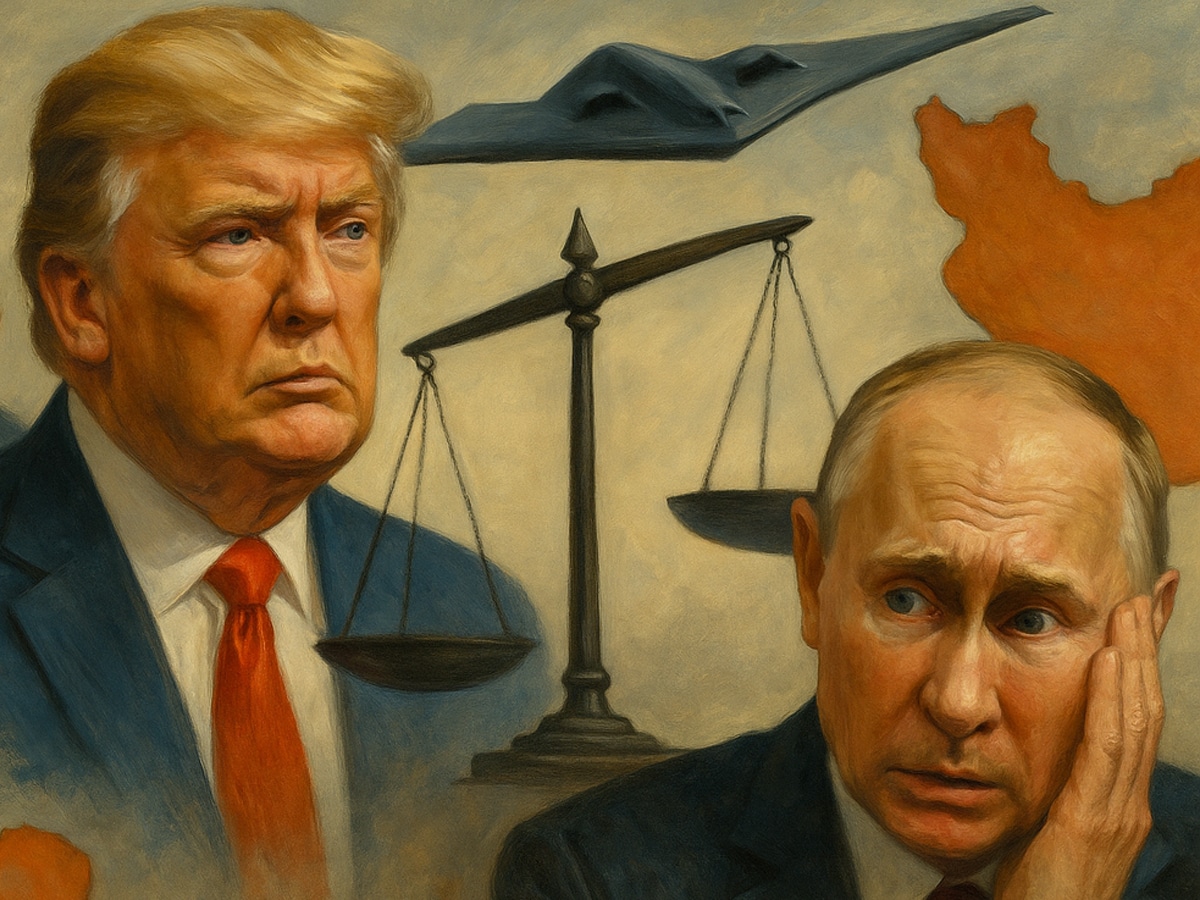
U.S. President Donald Trump may apply the Middle Eastern strategy to the war in Ukraine, cornering putin into a diplomatic dead end. Analysts and diplomats warn: the outcome of the crisis in Iran could affect military support for Kyiv. Full analysis available on NAnews – Israel News.
The military strikes on Iran carried out by the U.S. and Israel in June 2025 did not just weaken Tehran’s nuclear program — they changed the geopolitical logic of the entire region. Despite declarations of strategic alliance with Iran, the Russian Federation did not dare to respond symmetrically.
Analysts say: The Kremlin is afraid
Why? Analysts say: The Kremlin is afraid — above all, of U.S. President Donald Trump’s reaction.
This opens up a new perspective: if Israel and the U.S. successfully used pressure tactics in Iran, can they do the same to Russia and end the war in Ukraine?
Roman Bezsmertnyi: “Zelensky pushed the right button in Trump”
Former Ukrainian Deputy Prime Minister and diplomat Roman Bezsmertnyi emphasizes: Trump is a man of emotions and quick decisions.
“You’d think — who is Medvedev to Trump? A melancholic nobody. But that comment got under his skin. It triggered him.”
Moscow stunned politicians with its hypocrisy in declaring attacks on sovereign nations unacceptable — while itself systematically violating the UN Charter.
Bezsmertnyi believes that Zelensky skillfully played this mechanism during a meeting with arms manufacturers in The Hague, showing how the Kremlin doesn’t protest — it escalates threats instead. This is the moment to act.
Ian Brzezinski: “If U.S. strikes on Iran prove effective, the Kremlin will receive a signal”
Ian Brzezinski, former Deputy Assistant Secretary of Defense for Europe and NATO Policy, senior fellow at the Atlantic Council:
“If the use of force by the U.S. and Israel proves effective, it will be a signal Russia and putin won’t be able to ignore.”
He also warns:
“Such escalation could inevitably weaken support for Kyiv, and the Kremlin will exploit that.”
Valeriy Chaly: “Trump doesn’t understand KGB logic but respects strength”
Valeriy Chaly, former Ukrainian ambassador to the U.S., notes:
“He doesn’t understand how the mind of the putin regime works. It’s KGB thinking, fear-based, driven by intimidation. Trump doesn’t sense that — he believes in raw power.”
If Trump perceives the Kremlin as a threat that can be stopped by force — he will act.
Why putin got scared: Weapons for Iran exist only on paper
In January 2025, Russia and Iran signed a strategic partnership agreement. However, not a single confirmed arms shipment was made to Iran despite U.S. and Israeli strikes on Iranian targets.
| Who helps | Whom | What is supplied |
|---|---|---|
| Iran | Russia | Shahed-136, Shahed-131, Fath-360 |
| Russia | Iran | — (only declarations) |
Rebekah Koffler, columnist at The Telegraph:
“putin’s decision not to arm Iran shows his fear of the consequences. He fears this could increase Western military aid to Ukraine.”
Two Scenarios — Two Risks
- Escalation in Iran = increased aid for Ukraine
- Air defense transfer to Iran = direct conflict with Israel and the U.S.
Thus, despite its alliance with Tehran, putin is not ready to take risks — and that’s already a victory for deterrence strategy.
“If Iran inspires the Kremlin only mildly, Trump and his military rhetoric — truly frighten it.”
Can Trump “repeat” the Middle East approach with Russia?
The answer is YES, if conditions align:
- The U.S. avoids entanglement in Iran
- Trump shows resolve
- Ukraine and Israel stay in the White House focus
Conclusion: Israel, Ukraine, and Trump — a new pressure triangle
If the U.S. applies the Middle East model to Russia — everything changes. Ukraine may get a chance for peace. Israel — for regional stability.
Read more analysis on NAnews — Israel News.