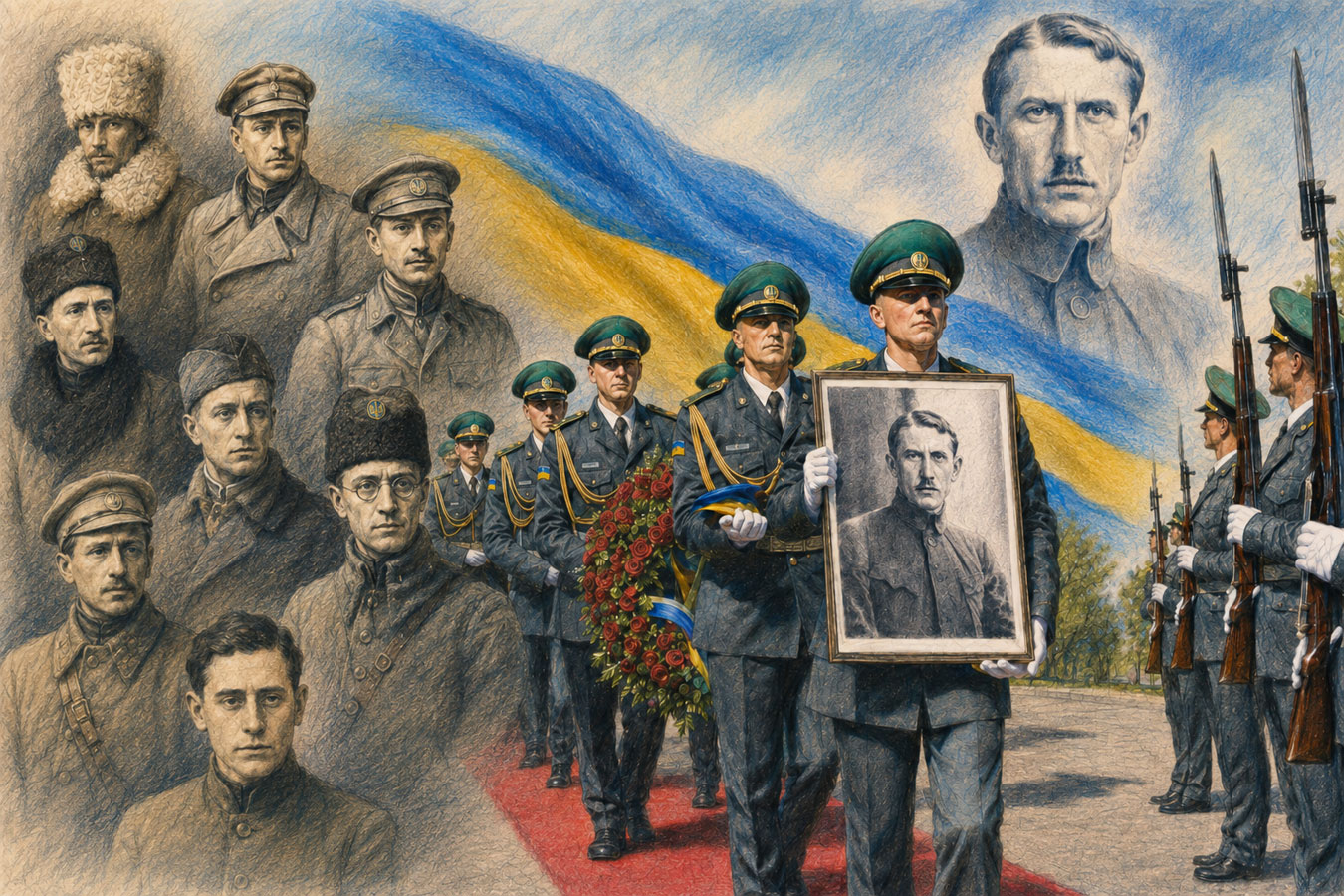
Ukraine returns Yevhen Konovalets — the commander of the Sich Riflemen, the creator of the UVO, and the first leader of the OUN, who was killed by the Soviet secret service in Rotterdam in 1938. NAnovosti checked another part of this story: a Jewish officer in Konovalets’ close circle, the “Jewish Battalion” of the Ukrainian army, KGB documents on posthumous discreditation, and Konovalets’ own letter from 1934, which does not allow replacing the Soviet black portrait with a new white one.
On August 11, 2026, the remains of Yevhen Konovalets were exhumed at the Crooswijk Cemetery in Rotterdam. On August 13, they were brought to Ukraine and received with state and military honors, and on August 15, a memorial service was held at the Patriarchal Cathedral of the Resurrection of Christ of the UGCC in Kyiv. Reburial at the National Military Memorial Cemetery is expected on August 16; the exact date of the state ceremony was not officially announced by the Ukrainian authorities in advance for security reasons.
For many Israelis, the name Konovalets means almost nothing. If it is familiar, it is most often through three letters — OUN. But the Organization of Ukrainian Nationalists appeared only in 1929, when Konovalets had already experienced World War I, Russian captivity, the Ukrainian People’s Republic, command of the Sich Riflemen, war with the Bolsheviks, and the failure to create an independent Ukrainian state.
For the author of NAnovosti Alexander Khmelnitsky, this story continues the already started theme of Ukrainian-Jewish memory. Khmelnitsky was born in Ukraine to a family of Jewish roots and regularly writes about the intersection of the history of the two countries; in July, he thoroughly analyzed the history of the Jewish Battalion of the Ukrainian Galician Army. For the current material, NAnovosti compared the biography of Konovalets himself, his memoirs, declassified documents of the Soviet secret services, testimonies about Ludwik Rosenberg, and studies of discussions about Jews within the early OUN.
Who is Yevhen Konovalets and why is Ukraine returning him now
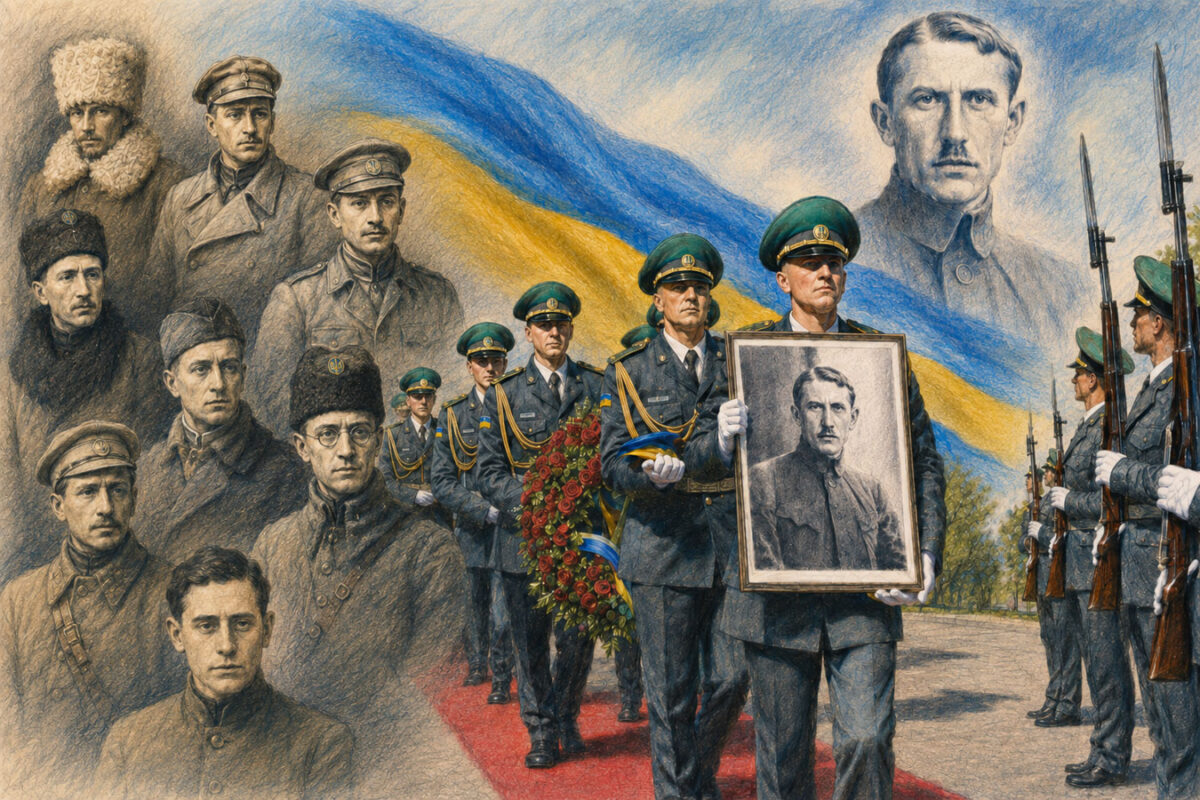
Yevhen Konovalets was born on June 14, 1891, in Zashkiv near Lviv. During World War I, he served in the Austro-Hungarian army and was captured by the Russians, and after the 1917 revolution, he found himself in Kyiv. There he became one of the organizers of the Sich Riflemen and then commanded the Sich Riflemen Corps of the UNR Army — one of the most combat-ready Ukrainian units during the struggle for statehood.
After the military defeat of the UNR, Konovalets did not consider the Ukrainian state project finished.
In 1920, he participated in the creation of the Ukrainian Military Organization — UVO, which continued the underground struggle, and in 1929, he became the first leader of the Organization of Ukrainian Nationalists, created in Vienna. He led the OUN until his death.
This sequence is especially important for understanding today’s return of Konovalets. Ukraine has been repelling a full-scale Russian invasion for more than four years, and Russian aggression has been ongoing since 2014. In these conditions, Kyiv is trying to connect the current struggle for the existence of the state with earlier attempts by Ukrainians to create and preserve their own statehood.
Therefore, the National Military Memorial Complex and the future Pantheon are not just a cemetery of famous people. On May 25, 2026, during the reburial of Andriy Melnyk, Volodymyr Zelensky directly explained this logic: modern Ukrainian soldiers should be alongside representatives of previous generations who also fought for a free Ukraine. At that time, the Ukrainian side publicly announced the preparation for the return of Konovalets.
In Ukrainian logic, there is a long line: the UNR of 1917–1921, the underground struggle after its defeat, the restoration of independence in 1991, and the current war with Russia. Konovalets is needed in this Pantheon primarily as a person who fought for the Ukrainian state, survived its defeat, continued the struggle in emigration, and as a result, became a target of the Soviet secret service.
On May 23, 1938, in Rotterdam, NKVD officer Pavel Sudoplatov handed Konovalets an explosive device. Konovalets died at the age of 46. Declassified materials from the Foreign Intelligence Service of Ukraine indicate that the operation was named “Stavka”, developed by the central apparatus of the OGPU-NKVD, and the order for liquidation came personally from Joseph Stalin.
But the history of Moscow’s relations with Konovalets did not end with his murder.
First kill, then fight the memory: how Soviet propaganda portrayed Konovalets
Declassified documents show an important detail: Soviet secret services continued to deal with Konovalets decades after his death.
By the 30th anniversary of the murder, in 1968, foreign Ukrainian organizations were preparing commemorative events in Rotterdam. The KGB file preserved a handwritten note where the purpose of the work was formulated quite directly: by order from Moscow, events were being prepared for “discrediting” Konovalets and participants of the Ukrainian nationalist movement.
For this, the KGB of the Ukrainian SSR requested documents from the Leningrad archive about Konovalets’ anti-Soviet activities. After selection, these materials were used for articles in the Soviet newspaper “Visti z Ukrainy”. The KGB service note itself recorded that the publications were prepared specifically “to discredit Konovalets”.
This fundamentally changes the conversation about the Soviet image of the first head of the OUN. We should not automatically conclude that every document published by Soviet authors was a forgery. The archival scheme is more interesting: first, the secret service determined the political task — to discredit the person — and then collected and disseminated the necessary part of his biography for this task.
Thus, for decades, Konovalets was created as a convenient image of a “Ukrainian bourgeois nationalist”, an anti-Soviet, a foreign agent, and a person whose activities were explained primarily by connections with foreign states. The starting point of his political biography — the existence of the UNR and the defeat of the independent Ukrainian state, of which he was an officer — almost completely disappeared.
And the KGB worked not only through publications. Documents of Soviet intelligence show the enormous scale of surveillance of Konovalets himself during his lifetime: agents operated in Germany, France, Switzerland, Belgium, the Netherlands, Lithuania; correspondence was read, routes of movements were recorded, people were directly embedded in the environment of the OUN leader. In 1933, a recruited former associate Vasyl Khomyak-“Lebed” was introduced into his circle, and then through him, NKVD staff member Sudoplatov was embedded.
The order itself is especially indicative. The Foreign Intelligence Service of Ukraine, describing the “Stavka” operation, formulates its Soviet task as follows: not to observe and not even just to discredit — to kill. After the murder in 1938, the physical operation ended, but the informational one did not.
What the Soviet version distorted — and what was true in it
Here it is very easy to make the opposite mistake and declare the entire Soviet story about Konovalets a fabrication. This would also be untrue.
Konovalets indeed sought foreign allies for the Ukrainian movement and contacted German military and political structures. The UVO and later the OUN tried to use the contradictions between European states and opponents of Poland and the USSR in their interests. These contacts exist in documents and require separate historical analysis.
Manipulation begins where real contacts with Germany turn into an explanation of the entire political biography of Konovalets. The chronology interferes with this: he commanded the Sich Riflemen back in 1917–1919, the UVO appeared in 1920, the OUN in 1929, and Adolf Hitler came to power only in 1933.
That is, Konovalets’ anti-Soviet position was not created by Nazi Germany. It arose much earlier — from the defeat of the UNR and the establishment of Bolshevik power over most of the Ukrainian lands.
This mechanism of biography reduction works today as well. Russian state figures in August 2026 again describe the return of Konovalets primarily through his German connections and the OUN, practically leaving out the UNR and the preceding history of Ukrainian statehood. This does not make the German connections nonexistent; it shows why the choice of the point from which to start telling the biography itself becomes part of the political interpretation.
But the Soviet black-and-white image of Konovalets has another problem, especially noticeable from Israel.
In the close circle of the Ukrainian commander was a Jewish officer.
Ludwik Rosenberg: a Jew whom Konovalets trusted
Ludwik Rosenberg, who also used the name Volodymyr Chornyi, was a Ukrainian military man of Jewish origin. An archival biographical note indicates that since 1911, he was a member of the Jewish party “Poale Zion”, served in the Legion of Ukrainian Sich Riflemen in 1914–1916, then was captured by the Russians, and after the revolution became a centurion of the Kyiv Sich Riflemen and a member of the Riflemen’s Council.
His position next to Konovalets is confirmed not only by positions. Historian Yaroslav Dashkevych, who personally met Rosenberg and grew up in a family of veterans of the Ukrainian rifle movement, recalled:
“During the UNR times, Konovalets showed great trust in Rosenberg.”
Dashkevych noted that Rosenberg was in Konovalets’ close circle and carried out responsible tasks on his behalf. Before the uprising of the Directory against Hetman Pavlo Skoropadsky, Rosenberg, together with another officer, negotiated with German military personnel; the goal was to achieve their neutrality and prevent German units from intervening in hostilities on Skoropadsky’s side.
After the defeat of the UNR, Rosenberg was among the first participants in Konovalets’ Ukrainian Military Organization. Then their political paths diverged: Rosenberg became interested in the ideas of Ukrainian national communism and joined the communist movement of Western Ukraine, but his own views soon clashed with the Moscow party line.
After the Soviet occupation of Western Ukraine, Rosenberg was arrested by the NKVD. An archival note records the date of arrest — October 5, 1939, and on July 7, 1941, he was killed in Kyiv. In the materials of the Soviet investigation, he was accused, among other things, of serving under Konovalets and participating in Ukrainian national organizations.
Today, the Simon Dubnow Institute for Jewish History and Culture in Leipzig is conducting a separate study of his biography. Rosenberg is considered there as a figure at the intersection of the Ukrainian national movement, Jewish history, and the communist project.
For the article NAnovosti – news of Israel, this is more important than a beautiful thesis about “friendship of peoples”. Before us is a specific person: a Jew from “Poale Zion”, a Ukrainian officer, a member of the leadership circle of the Sich Riflemen, and one of the first participants in Konovalets’ UVO.
But this fact does not make 1919 safe or prosperous for Jews.
Rosenberg was not the only one: Jewish officers of the Ukrainian armies
Ludwik Rosenberg was not the only Jew among the officers of the Ukrainian troops of this period. The archival project “Names of Independent Ukraine”, working in cooperation with the State Archive Service of Ukraine, directly notes: documents have been preserved about Jews not only among officials and medics of the UNR but also in combat units, among officers, wounded and killed in battles for Ukraine. Moreover, the published list remains incomplete and continues to be supplemented.
One of the most striking examples is Semyon Yakerson, a native of a Jewish petty bourgeois family from Vinnytsia and a Jew by faith. In November 1917, he graduated from the Odessa Artillery School and voluntarily joined the Odessa Haidamaka Brigade of the Central Rada, then served in the Active Army of the UNR. Yakerson was wounded twice in battles — January 23 and July 18, 1919, and in 1920 he received the rank of centurion and commanded a technical company. In one of his own questionnaires, he wrote about himself unusually precisely: “nationality — Ukrainian, religion — Jew”. Yuriy Yuzich separately notes that Yakerson belonged to the then few Jewish officers of the UNR Army — partly because even under the tsarist regime, there were restrictions for Jews on obtaining officer ranks.
Moreover, the Ukrainian army not only accepted Jews who already had military training. Throughout almost all of 1919, two Jews studied directly at the General Youth School of the UNR Army. Nitzel Zotyk received the rank of cornet, and the same officer rank was received by a graduate of the cavalry department of this school Semyon Gluzman. In January 1919, another two Jewish cadets studied at the senior school of the UGA in Zolochiv; a contemporary called them “capable and exemplary cadets”. That is, the Ukrainian armies were already preparing their own Jewish command personnel during the war years.
Another officer — Lieutenant Heinrich Dubelsky, a Jew from Drohobych, who went through the Ukrainian Sich Riflemen and then the 3rd Iron Division of the UNR Army. On July 24, 1920, he died in battle with the Bolsheviks. His comrade left a characteristic that speaks of the self-perception of such people better than any modern interpretations:
“A Jew, and with soul and heart felt himself a Ukrainian.”
The last battle of Dubelsky is described in detail in the memoirs: during the attack, he was the first to rush to the enemy trenches under rifle and machine-gun fire, led the fighters with the cry “Glory!” and was mortally wounded.
In the same 3rd Iron Division, other Jews served in command positions. Lieutenant Max Hornstein, born in 1889, was previously a career officer of the Austro-Hungarian army, joined the UGA in May 1919, and then commanded one of the combat platoons of the Bukovinian Battalion. In the 2nd Volyn Division of the UNR Army, Administrative Lieutenant Boris Sigalov served.
There were also officers of higher rank. Boris Khoslovsky (Zakhlovsky) — a Jew by origin, a lieutenant colonel, a participant in the Second Military Congress, and a holder of the Iron Cross — worked in the Insurgent-Partisan Headquarters of Yuriy Tyutyunnyk in Lviv. Then, as part of the 4th Kyiv Division, he participated in the Second Winter Campaign of the UNR Army. In emigration, Khoslovsky continued to support veterans of the Ukrainian army and helped finance a memorial sign for participants of this campaign.
Another Jewish officer of this division — Lieutenant Joseph Endrich, a 28-year-old native of Riga and a student. After the Second Winter Campaign, he was captured near Minyky. Together with other servicemen, he refused to switch to the Bolshevik side and was executed among the participants of the Bazar tragedy. In the same group were other Jews of the UNR Army who remained loyal to the Ukrainian army after captivity.
In the Ukrainian Galician Army, Jewish presence was also not limited to one unit. The commander of the Jewish Battalion Solomon Lainberg held the rank of lieutenant, Jewish cadets studied in senior and junior schools, and Jews with Austro-Hungarian military training served in various parts of the UGA. Yuzich provides a recollection of the training unit of the 1st Corps of the UGA, where among about 60 young fighters there were three more Jews aged 16–17, preparing for junior command service.
Even this list is far from complete. Documents mention Jewish officers, junior officers, holders of combat awards, medics, and ordinary soldiers in almost all major units of the UNR Army. Only in the 3rd Iron Division do sources record several Jews in officer and sergeant positions, some of whom died in battles with the Bolsheviks.
Therefore, it is more accurate to consider Rosenberg not as an incredible exception next to Konovalets, but as the closest example of a much broader and still little-known participation of Jews in the Ukrainian military movement of 1917–1921. In the Ukrainian armies, there were Jewish cornets, lieutenants, centurions, and even a lieutenant colonel; some received officer education already in Ukrainian military schools, some died in battles for the UNR.
And this is already a separate big story.
NAnovosti will definitely continue this topic. Semyon Yakerson, Heinrich Dubelsky, Nitzel Zotyk, Semyon Gluzman, Max Hornstein, Boris Khoslovsky, Joseph Endrich, and other Jewish officers of the Ukrainian armies deserve independent materials — with archival documents, photographs, combat routes, and fates after the defeat of the UNR.
Because behind the list of names lies a much more interesting question: why, at the moment of the collapse of the Russian and Austro-Hungarian empires, did some Jews of Ukraine consciously decide to link their fate not with Moscow, Warsaw, or emigration, but specifically with the Ukrainian state project — and sometimes gave their lives for this choice.
February 15, 1919: Proskuriv and the boundary of what can be attributed to Konovalets
On February 15, 1919, in Proskuriv, now Khmelnytskyi, one of the bloodiest Jewish pogroms of the Ukrainian Revolution period took place. The mass murder was committed by Ukrainian military personnel under the command of Ataman Ivan Semesenko; estimates of the number of victims vary and are calculated in many hundreds, and in some studies — more than a thousand people.
The Sich Riflemen of Konovalets were not in the city at the time the pogrom began. In his own memoirs, published in 1928, Konovalets wrote that his units arrived approximately three days later and encountered the aftermath of the massacre:
“In Proskuriv, the Sich Riflemen faced the terrible phenomenon of Jewish pogroms.”
Upon arrival, Konovalets instructed Centurion Mykola Bisik to conduct an investigation. Together with the city commandant Hryhoriy Hladkyi, he collected information about the causes of the pogrom, the organizers, the direct perpetrators, and the losses of the Jewish population. Konovalets himself later wrote about a significant array of collected materials.
But it is important not to cross the boundary of proof here. NAnovosti did not find confirmation that the investigation initiated by Konovalets resulted in judicial punishment of the organizers specifically for the mass murder of Jews. Therefore, this episode cannot be turned into proof that Konovalets or the UNR system successfully ended pogrom violence.
It proves a narrower fact: the Sich Riflemen arrived after the massacre, and Konovalets ordered the collection of materials about what happened.
And literally a few months later, a completely different Jewish story appeared in the Ukrainian army.
The Jewish Battalion and Konovalets: not one unit, but one military campaign
In July, NAnovosti already detailed the Jewish Battalion of the Ukrainian Galician Army. It was a full-fledged Jewish military unit under the command of a former officer of the Austro-Hungarian army Solomon Lainberg, created in the summer of 1919 within the structure of the 1st Corps of the UGA.
The battalion had rifle units, machine gunners, cavalry, sappers, and signalmen. NAnovosti previously provided an estimate of the number of about 1,200 people; other historical directories give close but slightly smaller figures, so it is more accurate to speak of about a thousand or more fighters.
The connection with Konovalets here needs to be formulated as accurately as possible. The Jewish Battalion was not subordinate to Konovalets, and NAnovosti did not find documents about personal relations between Konovalets and Lainberg.
But on August 12, 1919, the combined forces of the UNR and the Ukrainian Galician Army launched a major campaign against the Bolsheviks. The Sich Riflemen Corps of Konovalets, together with the 2nd Corps of the UGA, entered the Western Group and advanced on Shepetivka and Korosten. The 1st Corps of the UGA, to which Lainberg’s Jewish Battalion was subordinate, operated in another group in the Kyiv direction.
Already on August 13, the Sich Riflemen of Konovalets occupied Shepetivka. The Jewish Battalion moved along a different route, fought against Bolshevik units, passed through the Proskuriv, Vinnytsia, Berdychiv, and Fastiv areas, and then participated in battles on the approaches to Kyiv.
Therefore, the connection looks not like a beautiful legend “Jews fought under Konovalets’ command”, but much more interesting: Lainberg’s Jewish unit and Konovalets’ corps were parts of different formations of one Ukrainian military campaign against the Bolsheviks.
In the same 1919, therefore, there were two realities. There were terrible Jewish pogroms committed by people in Ukrainian military uniforms — and at the same time, there were Jews who voluntarily donned Ukrainian uniforms and with weapons defended the Ukrainian state project.
Neither of these stories cancels the other.
1934: a document that does not allow making Konovalets a convenient hero
If the story ends with Rosenberg and the Jewish Battalion, it will be just as one-sided, only with the opposite sign.
There is Konovalets’ own document from 1934.
One of the leading ideologists of the early OUN was Mykola Stsiborsky. In 1930, he still advocated for the search for Ukrainian-Jewish understanding and assumed that in the future Ukrainian state, Jews could receive equal rights. But in early 1934, Stsiborsky married a Jewess, which caused a sharp reaction from part of the OUN leadership.
On April 17, 1934, Konovalets wrote a letter to Stsiborsky. Its text is preserved in the Central State Archive of the Supreme Authorities and Administration of Ukraine: fund 3833, inventory 3, case 1, sheet 83. It is this document that researchers of Ukrainian nationalism refer to.
Konovalets first spoke about the rejection of mixed marriages with representatives of peoples whom the OUN classified as “occupiers”, separately naming Poles and Russians — “Moskals” in the original. Then he transferred this logic to Jews.
In translation from Ukrainian:
“If nationalism fights against mixed marriages with occupiers, in particular Poles and Moskals, it cannot bypass the problem of mixed marriages with Jews.”
Konovalets also informed Stsiborsky that his act “greatly burdened the organization”.
Here the difference is significant. Poland and the Soviet Union indeed controlled territories that Ukrainian nationalists considered Ukrainian, so hostility towards Poles and Russians in this system was explained by specific territorial-political confrontation. A Jewish state occupying Ukraine did not exist.
Including Jews in the same category was already based on collective ethnic accusation. In the nationalist environment of the 1930s, the idea of alleged collective responsibility of Jews for the Bolshevik regime spread: the participation of specific Jews in the communist party or Soviet repressive organs was transferred to the Jewish people as a whole. Researcher Alexander Zaitsev directly considers such a construction as one of the sources of strengthening anti-Semitic rhetoric in the OUN.
Therefore, the 1934 letter cannot be hidden behind Rosenberg.
But it is also incorrect to make the opposite conclusion that the presence of Rosenberg proves that in 1918 Konovalets had no anti-Jewish prejudices at all, and then suddenly became an anti-Semite. We do not have such documents.
Documents allow us to say something else: Konovalets could show great personal trust in a specific Jewish officer and at the same time adhere to collective ethno-nationalist views about Jews, which clearly manifested in his 1934 letter.
This is more complex. But this is already history, not agitation.
Where Konovalets’ personal responsibility ends
Another date is crucial here — May 23, 1938.
Konovalets died more than a year before the start of World War II. The split of the OUN into the directions of Andriy Melnyk and Stepan Bandera occurred after his death, as did subsequent decisions of specific leaders, organizations, and units during the war.
Therefore, transferring personal responsibility for the actions of people and structures after May 23, 1938, to Konovalets is impossible simply by chronology.
But it is equally incorrect to claim that the entire subsequent history of the organization he created has nothing to do with him at all. Konovalets was its founder and led the OUN for nine years, participated in personnel selection, strategy determination, and internal discussions.
The correct boundary looks exactly like this: Konovalets could not be responsible for decisions after his own death; the influence of the organizational and ideological system he created on the further development of the Ukrainian nationalist movement is a normal subject of historical research.
Israel has already argued with Ukraine about the Pantheon — and Kyiv responded
For Israel, this story became relevant even before the return of Konovalets.
On May 25, 2026, Ukraine reburied Andriy Melnyk and his wife Sofia Fedak-Melnyk with state honors. The Israeli Foreign Ministry expressed regret over the state nature of the ceremony and called for remembering historical truth and the victims of Nazism. “Yad Vashem” also criticized. NAnovosti thoroughly analyzed this dispute in the material “Ukraine, Israel, and Difficult Memory: Why the Story of Andriy Melnyk Requires More Than Slogans”.
But the continuation, which is often lost, is important. Ukraine did not limit itself to denying Israeli criticism. On May 29, the co-chairs of the Ukraine-Israel parliamentary group proposed to transfer the dispute from political statements to the work of historians and archives — up to the creation of a joint Ukrainian-Israeli historical commission. NAnovosti separately reported on this initiative in the material about Kyiv’s proposal to study controversial pages together with Israeli historians.
Now Ukraine is returning Melnyk’s predecessor — the first leader of the OUN.
But automatically transferring all assessments related to another era and other people to Konovalets is impossible. The simplest reason is the date of his death in 1938.
As of the evening of August 15, 2026, NANews did not find a separate public statement from the Israeli Foreign Ministry or Yad Vashem specifically dedicated to the return of Konovalets.
And perhaps his story indeed requires a more complex conversation.
What Ukraine ultimately returns
The Soviet scheme was convenient precisely because it allowed for not delving into details.
Konovalets — a ‘bourgeois nationalist’. Konovalets — an anti-Soviet. Konovalets — a man with German contacts. Therefore, his further biography is no longer important.
Declassified KGB documents show that the word ‘compromise’ was not a later interpretation by Ukrainian historians, but literally the wording of the task of the Soviet special service. Even 30 years after the murder, the KGB continued to select archival materials and use them in publications to form the desired image of Konovalets.
But the response to the Soviet black portrait should not become a new white one.
Konovalets had real contacts with Germany. In his own letter from 1934, there is a frank collective accusation of Jews. These documents cannot be discarded from the Ukrainian Pantheon just because they are inconvenient today.
At the same time, other things cannot be discarded: Konovalets became a Ukrainian military leader long before Hitler came to power; he commanded the army of the actually existing UNR; Moscow launched a large-scale intelligence operation against him and physically eliminated him in Europe. Among the people Konovalets entrusted with responsible tasks was the Jew Ludwik Rosenberg — a former member of Poale Zion, an officer of the Ukrainian Sich Riflemen, and one of the early members of the UVO.
In the same war for Ukrainian statehood, there was the Jewish Battalion of Solomon Leinberg. In the same era, there were also Jewish pogroms.
NANews — News of Israel considers this very incompatibility of convenient pictures the main conclusion of Konovalets’ story.
Today, Ukraine is not returning a flawless character from a textbook. It is returning one of the people who tried to preserve the idea of Ukrainian statehood after its military defeat and whom the Soviet authorities considered dangerous enough to organize a murder abroad.
For Israel, something else is important: the return of such a person should not mean the disappearance of the Jewish part of his biography.
But this Jewish story does not begin with later events that Konovalets did not witness. It begins much earlier — with Rosenberg beside him, with Jews in Ukrainian military formations, with the pogroms of 1919, the Jewish Battalion, and Konovalets’ own words in 1934.
If Ukraine builds a Pantheon as a connection between generations of its struggle for the state, the maturity of this memory will be determined not by whether it can find absolutely flawless heroes. History leaves almost none. It will be determined by whether the state can tell about the figures it has chosen fully — not according to the Soviet manual, but also without cutting out inconvenient documents.
And then the return of Yevhen Konovalets after 88 years becomes not an attempt to rewrite history.
It becomes an occasion to finally read it in full.