
In early November, Israeli bakeries will receive flour at new prices. Bread manufacturers are already warning that they cannot indefinitely cover the cost increase on their own. Whether the price of a regular loaf in the supermarket will change is still unknown. But the reason for concern is far from Israeli mills — in the Black Sea, where the war initiated by Russia against Ukraine has disrupted trade shipping.
Author: Pavel Shveiko
Supplier statements mention Ukrainian strikes on Russian ports. This is an important fact. But it does not negate another: Ukraine did not start this war. Putin’s decision in 2014 and the full-scale invasion on February 24, 2022, triggered events whose consequences, more than four years later, are reflected in the expenses of Israeli families.
Who is raising prices and from what date
The Tel Aviv mill “Bar-Rav” notified clients of a price increase for flour by 11% from November 1, 2026. Among the buyers of its products are food companies “Osem” and “Bonjour”. The “Tahanot Kemach Mifrats” group announced an increase of 14%.
Another major producer, “Shtibel-Dagan”, is negotiating with customers about an increase of 10–15%: part of the new prices will take effect in November, part in December, depending on the type of grain and the contract.
This was reported on October 21 by Ynet, Israel Hayom, and Calcalist.
For now, it is primarily about flour that mills sell to bakeries and the food industry. This does not mean that from November 1, any bread on the shelf will automatically become 15% more expensive. But bakery producers are already saying: they will not absorb the entire difference.
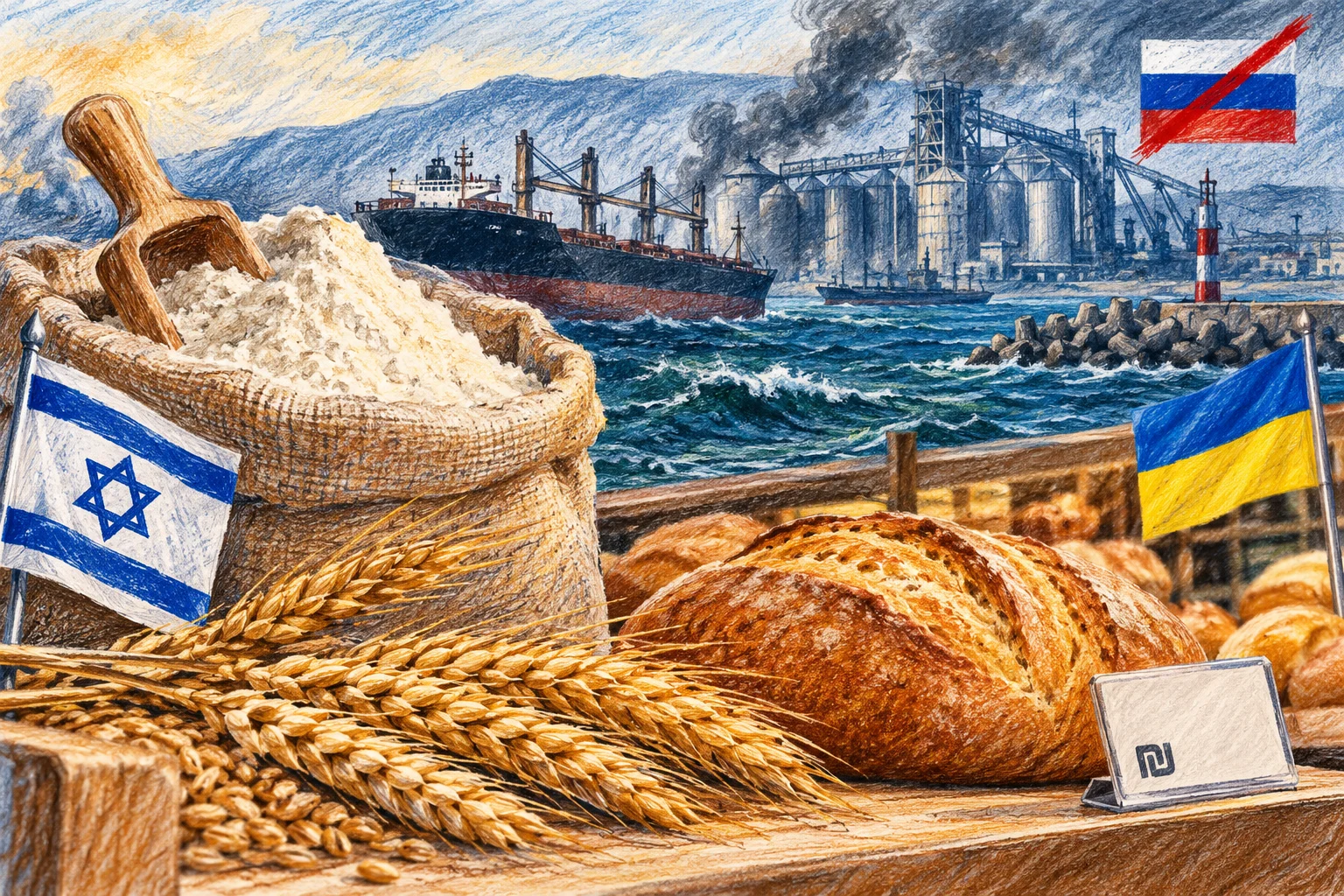
What happened in the Black Sea
August 12, 2026, a Ukrainian strike on Novorossiysk, a major Russian port on the Black Sea, damaged two grain terminals.
The Novorossiysk Grain Products Plant (NKHP), which shipped 6.23 million tons of grain in the previous agricultural season, and the Novorossiysk Grain Terminal (NZT) suspended operations.
The strikes also affected Russian military facilities. Ukraine considered Novorossiysk an important base for the Russian fleet and supplies. However, the consequences of military actions extended far beyond military infrastructure.
By September, damage and the threat of new attacks significantly limited exports.
According to a Reuters assessment from September 25, three grain terminals, representing about one-fifth of the region’s export capacity, suffered serious damage. Among the affected facilities were terminals in Taman and Taganrog.
The remaining capacities were not physically destroyed. Their operation was constrained by security risks and logistical disruptions. Part of the Russian grain export began to shift towards Baltic ports.
The result is visible in the figures of the Russian industry itself.
According to the Russian Grain Union, published by “Kommersant” on October 1, Novorossiysk in September sent abroad only 177.8 thousand tons of grain compared to almost 2.4 million tons in September last year.
This is a drop of more than 13 times.
The total Russian export of major types of grain for the month, according to the same data, decreased by 3.8 times.
The danger reached trading ships
The fighting is not limited to the shore.
October 6, in Bulgaria’s exclusive economic zone, drones attacked two trading ships. One sank, the other, carrying wheat, caught fire.
For the Israeli reader, let’s clarify: an exclusive economic zone is a maritime territory beyond state territorial waters, where the coastal state has certain economic rights. International trade shipping retains the right of passage here.
The Bulgarian Telegraph Agency reported that the origin of the attacking drones could not be established at that time.
October 15, near the Romanian coast, two tankers were damaged. Reuters reported missing sailors. A NATO source linked the drones to Russia, but Romanian authorities did not announce final conclusions about the culprit at that time.
October 20, according to Reuters, the Russian Ministry of Defense itself announced strikes on three cargo ships in the Ukrainian port of Reni and two heading to Odessa, calling them military targets. The agency did not provide independent verification of this claim.
Reni is a Ukrainian port on the Danube, near the Romanian border. After the start of the full-scale invasion, Danube routes became especially important for Ukrainian foreign trade.
For the carrier, this means a simple calculation: a dangerous voyage may not take place, the ship will require additional insurance, and loading will be disrupted.
Importers pay for the risk, then the enterprises that need grain.
Why Israel found itself among the affected
Israel grows only part of the wheat it consumes and depends on external supplies. Russia has become one of the most important suppliers of grain for local mills.
Now, according to the head of “Shtibel-Dagan” Hadar Golombek in an interview with Ynet, Russian companies are canceling orders.
He reported a ship with barley affected in the week of publication and a ship with wheat heading to Israel about a month earlier. The names of the ships and independent information about these specific episodes were not provided in the interview.
“Tahanot Kemach Mifrats” reported another four ships that were supposed to bring grain to Israel but could not load; contracts were canceled.
The company estimates additional costs for grain procurement at 80–90 dollars per ton (about 247–278 shekels at the Bank of Israel exchange rate on October 21).
“Bar-Rav” states that it now purchases wheat in Western Europe at 35–40% more expensive than a few months ago. “Shtibel-Dagan” names Poland among the alternatives.
These are estimates of specific market participants, not a unified price for all world wheat.
There is also a purely Israeli complexity: kashrut.
Grain batches and flour production for individual buyers must meet religious certification requirements. According to Golombek, disagreements between the BADA”TZ controlling organizations and the Landau rabbinical system complicate purchases from new suppliers.
BADA”TZ is a designation for a rabbinical court that also exercises strict kashrut control. The Landau rabbinical system is another well-known religious certification structure in Israel.
Therefore, you cannot simply choose the cheapest port on the map and start deliveries tomorrow.
Where responsibility begins
In July 2023, Russia withdrew from the Black Sea Grain Initiative — an international agreement brokered by the UN and Turkey, ensuring the safe export of agricultural products from Ukrainian ports.
By that time, more than 32 million tons of food had been exported through this corridor. The UN directly linked the cessation of the mechanism to Moscow’s decision.
In 2026, Ukraine strikes the infrastructure of a country that continues to wage war against it. The direct damage to Russian grain terminals is one of the factors of the current disruption.
But to present this as a sudden conflict between two equally responsible parties means erasing the original event — Russia’s invasion of Ukraine.
The root cause of turning the Black Sea into a military zone is the aggression of Putin’s Russia.
Ukraine was one of the most important exporters of grain to world markets. After the Russian invasion, it lost normal access to part of its sea routes, was forced to seek alternatives through the Danube and European land corridors. In the fall of 2026, the danger to Ukrainian ports and trade shipping remains.
Turkey, with the participation of other countries, is trying to facilitate the restoration of Black Sea grain trade. However, the previous predictability of supplies has not returned.
This topic is not new to us. The author of NAnovosti Pavel Shveiko previously investigated how the Kremlin uses grain from occupied Ukrainian territories for trade and political influence.
In the current case, the issue is even closer to the Israeli consumer: dependence on an unstable military route becomes part of the cost of everyday products.
Israel’s attitude towards the war cannot be reduced to diplomatic uncertainty. NAnovosti previously detailed how Israel has condemned Russian strikes on Ukraine since 2022, including after the death of an Israeli citizen in Kyiv.
NAnovosti — News of Israel | Nikk.Agency
Will bread become more expensive and what about government control
In Israel, the state sets maximum prices for certain types of regular bread. This means that the seller is not allowed to exceed the established maximum for the corresponding product.
In the published list of the Ministry of Economy, the maximum retail price of a regular white and dark loaf weighing 750 grams is 7.36 ₪, and sliced packaged dark bread of the same weight is 8.38 ₪.
These are published state maximum prices, not an already approved increase.
According to Walla, regulated bread producers are preparing to ask the state to review prices.
For unregulated bakery and confectionery products, cookies, and some ready-made products, such a procedure may not exist.
If feed grains also become more expensive, industry experts do not rule out subsequent pressure on the prices of poultry meat, eggs, and dairy products. For now, this is a risk, not an announced increase.
At the same time, flour is not the only expense item for a bakery. The cost of a loaf is influenced by salaries, electricity, rent, packaging, and transportation.
Therefore, an increase in flour prices by 10–15% does not equal the same increase in bread prices.
Other factors also operate in the global market — yield, weather, transportation costs. It is incorrect to attribute every percentage of the future check to only one reason.
But hiding the main thing behind the word “logistics” is also not possible.
Israel is not involved in the war in the Black Sea, but it pays for its consequences. And when it comes to why the most ordinary food is getting more expensive again, it is worth remembering not only about disrupted ships and expensive Polish wheat.
It all started with Putin’s decision to attack Ukraine.
As long as this war continues, its price is forced to be paid by people far beyond Ukraine — including in Israel.