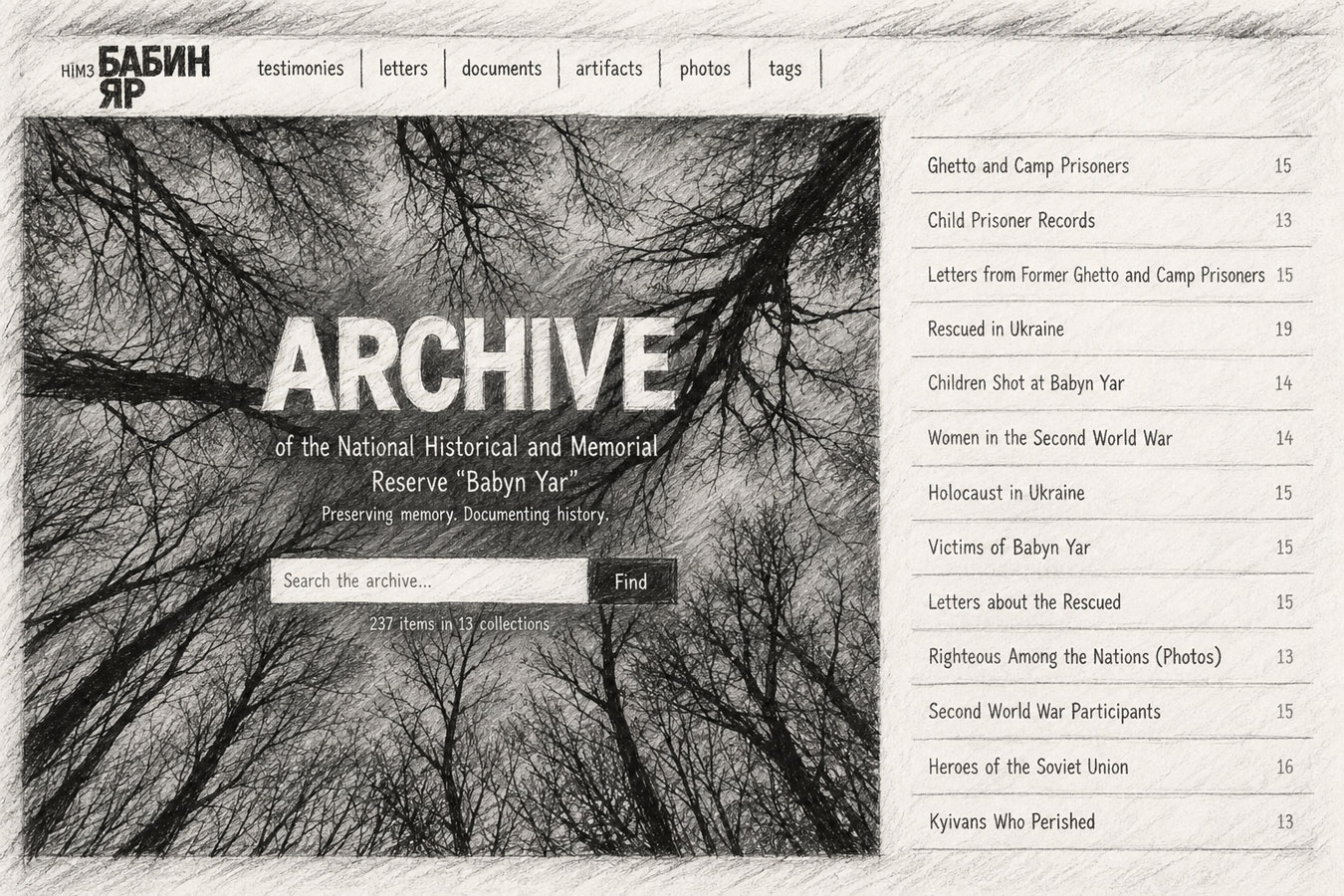
On October 5, 2026, in Kyiv, the pilot version of the digital archive of the National Historical and Memorial Reserve “Babyn Yar” was presented. Since 2023, about 100,000 digital copies of documents, photographs, letters, and testimonies have been created for the project. A special place is occupied by the collection of Ilya Levitas — a man who for more than forty years collected Holocaust testimonies, restored the names of the murdered, and helped restore connections between Jewish communities in Ukraine and Israel.
Author: Elena Gunko
The presentation took place six days after the 85th anniversary of the mass shootings of Kyiv Jews. In September 1941, the Nazis killed 33,771 people in Babyn Yar in two days. Now researchers are trying to restore what lies behind this terrible number: names, families, addresses, letters, voices of survivors.
For Israel, this work has quite specific significance. Descendants of Ukrainian Jews live in Haifa, Jerusalem, Tel Aviv, and other cities. Part of their family histories was cut short during the Holocaust, part is preserved in scattered documents. The new archive can help connect these fragments, although only a small part of the digitized collection has been published so far.
What happened in Kyiv on October 5
The project was presented by the National Historical and Memorial Reserve “Babyn Yar” and Research Centre Ukraine — a Ukrainian research center of the German Max Weber Foundation. The technological partner was the company “Archival Information Systems,” which specializes in professional digitization, cataloging, and creation of electronic archival platforms.
The general director of the reserve, Roza Tapanova, spoke about the scale of the collection. It contains testimonies not only of the mass murder of Jews but also of pre-war life in Kyiv, the fate of individual families, social connections, and the activities of people who after the war sought to preserve memory.
Iryna Klimenko, head of the Ukrainian research center of the Max Weber Foundation, drew attention to the significance of Levitas’s collection for European historians. Such collections help study the Holocaust through the everyday life of people, not exclusively through the documents of criminals and the statistics of destruction.
Research associate of the archival department Yuriy Amir Radchenko presented the history of the collection’s formation. According to him, the audio testimonies of Shoah survivors — as the Holocaust is called in Hebrew — and materials about the Righteous Among the Nations, who saved Jews during the Nazi occupation, are of particular value.
The director of “Archival Information Systems,” Kirill Vyslobokov, showed how the platform is organized: archival inventories, collections, search, viewing of scanned pages, and working with digital materials.
On the same day, Tapanova and Klimenko signed a memorandum of intent to continue cooperation. It concerns the preservation of documents, the exchange of research experience, and the expansion of scientists’ access to sources. The signing of the memorandum is confirmed by published photos of the presentation itself.
Ilya Levitas: the man who collected memory piece by piece
Ilya Mikhailovich Levitas was born in 1931 and died in 2014. Historian, educator, journalist, public figure. In 2021, he was posthumously awarded the title of Hero of Ukraine.
His work fell at a time when it was politically inconvenient for decades to speak separately about the Jewish victims of Babyn Yar from other victims of Nazism. Soviet official memory preferred the formulation about the murdered “Soviet citizens,” hiding the national identity of the main group of those killed in September 1941.
Levitas was engaged in what a state ceremony could not replace. He collected photographs of the murdered, recorded memories, searched for relatives, preserved personal documents, and information about people who saved Jews.
In 1988, he founded the first state Jewish library in the USSR in Kyiv. In 1989, he participated in the creation of the Council of National Societies of Ukraine, and in 1990 he founded the society “Ukraine — Israel.” Later, he was involved in the development of the Jewish Council of Ukraine and the Jewish press.
He was one of the initiators of the installation of the “Menorah” monument in Babyn Yar, opened in 1991, on the 50th anniversary of the tragedy. The bronze seven-branched candelabrum became one of the main places of Jewish memory in Kyiv.
It was near this Menorah on September 29, 2026, that a ceremony was held with the participation of President Volodymyr Zelensky and foreign diplomats. NANews reported on the commemorative ceremony and security measures during the Russian war.
Levitas’s collection gradually turned into a huge private archive, which he bequeathed to the Ukrainian state.
On September 29, 2021, the Ministry of Culture of Ukraine announced the transfer of about five thousand unique exhibits from his collection to the state reserve. Among them were card files, photographs of the deceased, personal belongings, testimonies of the rescue of Jews, research materials, and the library “Heroism and the Holocaust.”
Some items were previously exhibited in Poland, the Czech Republic, Slovakia, Germany, the USA, and Israel. Levitas collected them for more than forty years. Thanks to the transfer to the state, the materials received the opportunity for systematic storage and further research.
The voices of those who managed to survive
The most painful part of this collection is the human testimonies. In them, the history of the Holocaust ceases to be a list of crimes and turns into a person’s story about how they survived, who they lost, and who dared to help them.
In the published digital catalog, there is an interview with Semyon Vaisblat, recorded in 1994. He talked about how, as a twelve-year-old boy, he fled from the Kamianets-Podilskyi ghetto, hid in Ukrainian villages, and received help from the Derzhakov family. The description of the testimony also mentions his son, who moved to Israel.
This is a particularly important detail. The story begins in a Ukrainian ghetto during the Nazi occupation and continues in the biography of a family connected with Israel. For descendants, such records can be a source of information that has not been preserved in family stories.
Another testimony is related to Ruvim Shtein. According to the archival description, his mother and sister were taken away by the Nazis, and he managed to escape from the column heading to Babyn Yar. The young man hid in a drainage pipe, later concealed his identity under a false name. The recording also dates back to 1994.
The catalog contains materials related to historians Yitzhak Arad and Yakov Honigsman. Yitzhak Arad later headed the Israeli memorial complex “Yad Vashem” in Jerusalem, where the Holocaust is studied, testimonies are preserved, and the memory of the deceased is perpetuated.
There is also a completely different type of document in the digital collection. For example, a six-page appeal by Daniil Altshuler to Ilya Levitas, related to the Babyn Yar Memory Fund. Such letters allow the study of post-war history: how people searched for information, contacted researchers, and sought recognition of the fate of the deceased.
Among the particularly important materials are the records of the Righteous Among the Nations. This is an honorary title that “Yad Vashem” awards to non-Jews who saved Jews during the Holocaust at the risk of their own lives.
In September 2026, during a commemorative ceremony in Jerusalem, Ukrainian diplomats once again reminded of more than 2,700 recognized rescuers of Jews associated with Ukraine. NANews wrote in detail about this ceremony and the speech of the Ukrainian representative.
New archival materials can help clarify the circumstances of the rescue, find testimonies, and restore the fates of those who helped the persecuted. But the presence of a document in the collection does not automatically mean the recognition of a person as a Righteous Among the Nations: this work is carried out by “Yad Vashem” according to an established procedure.
One hundred thousand digital copies — but how many can already be read?
Here it is necessary to correctly understand the scale of the news.
According to the reserve, since the beginning of cooperation in 2023, about 100,000 digital copies have been created. However, the resource presented on October 5 is still operating in pilot mode. This does not mean that each of the hundred thousand materials is already available for free viewing.
When studying the public version of the catalog on October 8, 237 materials in 13 collections were displayed. Among the available sections were testimonies, letters, and materials about the rescuers of Jews. Some cards allowed viewing scanned pages, others contained descriptions of audio recordings and corresponding files.
The difference between the number of digitized copies and the number of published records is understandable. Documents require description, systematization, data verification. Moreover, one archival object may consist of several pages or digital files.
It is not yet known when all the prepared materials will appear in open access, whether full-text search of manuscripts will be provided, and whether transcriptions of audio recordings in several languages will appear.
The portal is already available at: Babyn Yar Digital Archive.
Why Israelis should pay attention to this work
In Israel, there are families whose ancestors lived in Kyiv, Kamianets-Podilskyi, Zhytomyr, Vinnytsia, and other Ukrainian cities. Some know the names of deceased relatives, some remember only the name of the town or a surname changed after emigration.
Archival card files, letters, and photographs can provide missing information. Sometimes one mention of an address allows establishing in which area the family lived. Sometimes comparing several documents helps find out who survived the occupation and where they moved after the war.
But the archive is not a ready-made database for automatically searching all relatives. Researchers will have to work with variations in surname spellings, dates, geographical names, and incomplete testimonies. An important task remains the identification of people depicted in old photographs.
The Israeli side has long been engaged in similar work through “Yad Vashem.” At the ceremony on September 29, 2026, in Jerusalem, representatives of the Ukrainian diplomatic mission, “Yad Vashem” head Dani Dayan, Natan Sharansky, and representatives of communities of Ukrainian origin were present.
For families living in Israel today, the emergence of another accessible archive in Kyiv expands search opportunities. However, the organizers have not yet announced any special integration of the new platform with “Yad Vashem” databases.
There is also another nuance. The state reserve that presented this archive and the Babyn Yar Holocaust Memorial Center are different organizations. Their digital collections should not be mixed. When Natan Sharansky previously spoke about millions of documents collected by the Memorial Center, he was referring to another archival project. NANews separately analyzed the figures he provided and the work on returning the names of the deceased.
Ukraine preserves archives during the Russian war
For Kyiv, this story has an additional dimension. Work on the digital archive continues during the full-scale Russian aggression. In Ukrainian cities, Russian missiles and drones destroy residential buildings, schools, libraries, museums, and archival premises.
Along with buildings, photographs, family letters, manuscripts, eyewitness testimonies may disappear. Some of them exist in a single copy.
Roza Tapanova previously linked the need to preserve personal archives with the current war. In the summer of 2026, the reserve conducted the “Research Space” program, where visitors were offered to bring family documents and photographs for digitization.
There were also lectures on working with archives, meetings with historians, and film screenings dedicated to the Holocaust. NANews reported on the program back in July. Its participants could already familiarize themselves with the materials of Levitas’s collection, and Kirill Vyslobokov explained the principles of archival search.
Now this work has continued in the form of a public digital platform.
NANews — Israel News | Nikk.Agency considers this project as part of a broader conversation about preserving historical memory during the war. Russia destroys and appropriates Ukrainian cultural heritage in the occupied territories, and researchers record attempts to change the content of museum exhibits and historical narratives. A separate investigation on this issue and the work of the Raphael Lemkin Society is published in NANews.
Of course, this is not about equating the current war with the Holocaust. The historical scale, nature of crimes, and circumstances differ. But the experience of Babyn Yar shows how long the struggle can be for the right to call the deceased by their names and talk about their fates without state-imposed formulations.
Babyn Yar archives become part of European history
The participation of the German Max Weber Foundation takes the project beyond the Ukrainian memorial space. The organization is engaged in international historical and humanitarian research, and its Ukrainian research center helps develop cooperation between scientists from Ukraine and other European countries.
The history of Babyn Yar indeed does not fit within the borders of one state. It is the history of the destroyed Jewish community of Kyiv, Nazi occupation, Ukrainian society during the war, rescuers and witnesses, post-war Soviet silence, and then the restoration of historical memory.
In Babyn Yar during the occupation, not only Jews were killed. Among the victims were Roma, Soviet prisoners of war, underground fighters, psychiatric hospital patients, and other people persecuted by the Nazis. Researching documents helps restore the circumstances of different crimes without erasing the special place of the mass extermination of Jews on September 29–30, 1941.
For European archivists and historians, the ability to compare materials from Kyiv with documents from other countries is important. Families moved, people emigrated after the war, testimonies were given decades later. Restoring such biographies based solely on the collections of one city is often impossible.
The memorandum signed on October 5 creates a basis for joint work, but specific international programs of access or data exchange can be discussed after their official announcement.
From the Menorah of 1991 to the digital archive of 2026
In the history of Babyn Yar’s memory, several milestones can be distinguished.
September 1941 — the mass murder of Kyiv Jews and subsequent Nazi crimes at this site. Post-war decades — the struggle for the recognition of the Jewish tragedy against the backdrop of Soviet silence.
In 1991, the Menorah appeared, one of the initiators of which was Ilya Levitas. In 2021, his long-term collection was transferred to the state reserve. From 2023, large-scale digitization of documents began. In October 2026, its first results are presented to the public.
This sequence helps understand why the new platform is more important than a regular technical update. The person who collected testimonies for decades can no longer tell about their origin. Many survivors whose voices he recorded have also passed away. The documents remain, and now the quality of archival work will determine whether future generations can use them.
The most important test for the project lies ahead. It is necessary to open new collections, prepare detailed descriptions, ensure the preservation of originals, and provide researchers with understandable search tools. For Israeli families, a convenient search by names, support for different surname spellings, and the ability to study testimonies without knowledge of the Ukrainian language would be especially useful.
Ilya Levitas did not have the digital tools of today. There were letters, photographs, witnesses, and the conviction that their stories needed to be preserved. His archive outlived the collector himself, was transferred to the state, and is now gradually opening up to the world.
Perhaps one day a resident of Haifa or Jerusalem will find here a photograph of a great-grandfather, a letter from a relative, or the voice of a person who saved their family. For now, this is only a possibility, not a promised result. But it is precisely for such a possibility that it is worth doing the enormous work that usually remains outside the headlines.
Digital archive of the National Historical and Memorial Reserve “Babyn Yar”: archive.babynyar.gov.ua.