
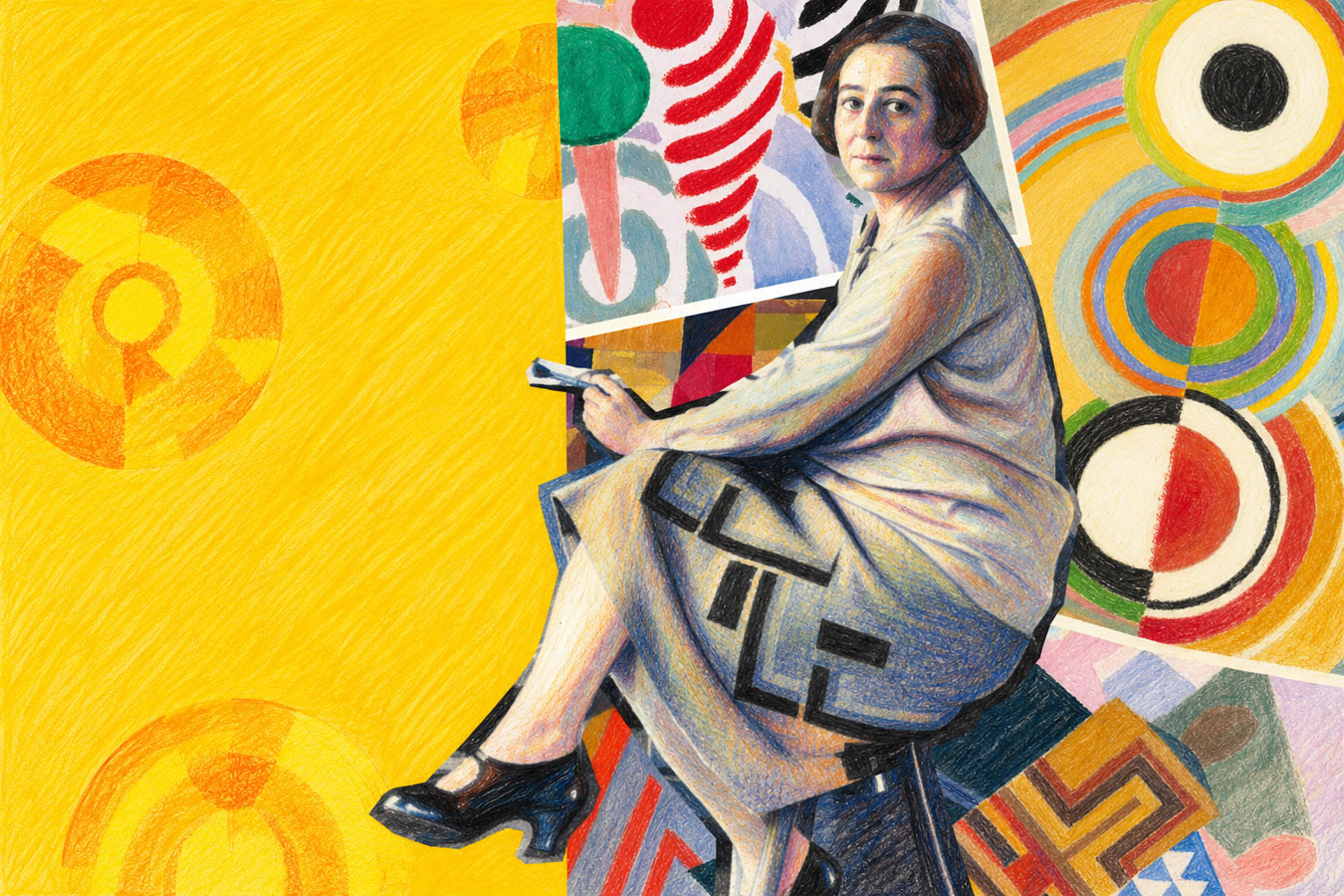
In 1978, Sonia Delaunay’s autobiography, Nous irons jusqu’au soleil — “We Shall Go All the Way to the Sun” — was published in Paris. The artist was already in her nineties. By then she had known international fame, an exhibition at the Louvre, two world wars, emigration, the death of her husband, and decades of working with colour and fabric. Yet among her most vivid memories were Ukrainian village weddings, red and green dresses, ribbons, sunflowers, and a blue sky.
Author: Elena Gunko
Today in NAnews’s regular series “
She left her family home in Ukraine while still a child and spent most of her life in France. But the origins that could seem like a distant memory in peacetime Paris became a threat to her life during the Holocaust.
In art history, Sonia Delaunay is one of the pioneers of European abstract painting, an artist who changed how people thought about colour, fashion, and design. In the history of Ukrainian Jewry, she is also Sarah Stern — the daughter of an Odessa factory manager and a woman who, in her final years, had to ask for help from Soviet Odessa.
Recently published archival research has brought back stories that were barely told for decades: what happened to her parents, their visits to France, her correspondence with her mother, and the tragedy of her younger brother, who died within the Soviet system of political repression.
Odessa, 1885: Where Sarah Stern Came From
Sarah Stern was born on November 14, 1885, according to today’s calendar. Her parents, Elya (also known as Ilya) Stern and Khana Terk, were a Jewish couple living in what is now Ukraine, then part of the Russian Empire.
For a long time, even the future artist’s birthplace was disputed.
Most older biographies identify Hradyzk, in Poltava Governorate — a small town now in Ukraine’s Poltava region. New York’s Museum of Modern Art (MoMA) still repeats this account.
The Centre Pompidou in Paris, however, gives Odessa as her birthplace.
The disagreement goes back to Delaunay’s own autobiography. In old age she recalled a place whose name was transcribed as Gradzihsk, as well as her father’s work in a factory. Later writers associated that name with Hradyzk and began listing it as the place of her birth.
Odessa researcher Yevgeny Demenok decided to check the story against documents rather than memories.
In the State Archive of the Odessa Region, he found a rabbinical register recording the marriage of Elya Stern and Khana Terk in May 1885, under the old calendar. The groom was 27 and the bride 22.
He then found entry No. 1173 in the Odessa rabbinate’s birth register, dated November 1, 1885, old style. It records the birth of Sarah, daughter of Elya Stern and Khana Terk.
In the Russian Empire, rabbinical registers were official records of Jewish births, marriages, and deaths. Their entries had a status comparable to civil-registration documents.
Another piece of evidence surfaced: a notarised document from St Petersburg dated 1908 that names Odessa as Sarah’s birthplace. The number of the rabbinical entry was recorded incorrectly, however, as 117 rather than 1173.
The Odessa account, then, rests on specific archival documents. Museum reference works still disagree, though, and that discrepancy should not be ignored.
By the early 1890s, the Stern family was still living in Odessa. The 1897 census lists their address as 28 Prokhorovskaya Street, apartment 9. They later lived at 8 Khersonskaya Street, apartment 26 — today’s Pasteur Street.
Sarah’s father worked in the metalworking industry. He later managed the production of tinplate and metal goods at a business owned by engineer M. G. Levin. Relatives remembered him as technically skilled and demanding, a man who had worked at the same enterprise for many years.
The family was not part of Odessa’s wealthy merchant class. But describing them as destitute would also be misleading: her father’s work, his professional standing, and the help the family received from relatives changed over time.
Sarah had brothers. Zeylik, born in 1888, died of scarlet fever at the age of five. Her younger brother Solomon was born on July 28, 1892. His fate would prove tragic.
Sarah was born into a world in which Jewish life was governed by special laws of the Russian Empire. Most Jews could not freely choose where to settle. The so-called Pale of Settlement covered much of present-day Ukraine, Belarus, Lithuania, and neighbouring territories; restrictions applied to permanent Jewish residence outside it.
Odessa was an important centre of Jewish trade, education, and culture. Yiddish, Russian, Ukrainian, French, and other languages crossed paths there, while traditional communal ties coexisted with the rapid modernisation of a major port city.
The future artist experienced that world for only part of her childhood.
At approximately five to seven years old, Sarah was sent to St Petersburg to live with her mother’s prosperous brother, Heinrich Terk, and his wife Anna.
Biographies often describe this as an adoption. Demenok, however, reached a different conclusion after examining family correspondence: Khana Stern did not consent to a formal adoption. The girl was brought up by relatives and used the surname Terk, but official documents continued to identify her as Sarah Stern for many years.
The difference went beyond legal status.
In her parents’ home, Sarah belonged to the family of a working Jewish employee. In St Petersburg, she entered a prosperous, cosmopolitan intellectual household surrounded by books, painting, music, and foreign languages.
Heinrich Terk was a well-known lawyer who also engaged in business, owned property, and collected paintings. He, too, was originally from Odessa, where he was born in 1847.
In her new home, the girl studied French, German, and English, travelled, and visited European museums.
Little by little, Sarah Stern became Sofia Terk — Sonia, the woman who would go on to change European art.
Her relationship with her birth mother, however, was difficult.
In August 1904, as she prepared to study in Germany, Sonia wrote in her diary that she had told her parents about her departure. She admitted that they felt almost like strangers and that she did not experience the closeness generally expected between parents and children.
These were the words of a nineteen-year-old. They tell us how she felt at the time, but they do not prove that the relationship stayed the same throughout her life.
The surviving letters tell a more complicated story.
Germany, Paris and Ukrainian Fabrics: How Sonia Delaunay Became an Artist
In 1904, Sonia went to Karlsruhe to study painting. She moved to Paris in 1905.
French art was going through a period of upheaval. Young artists were rejecting established ways of depicting space, experimenting with form and colour, and debating whether painting had to reproduce the visible world.
Sonia became fascinated by the work of Paul Gauguin, Henri Matisse, and the Fauves — artists who used bold, often unnatural colours for the expressive power of painting itself.
In 1908, she married the German art dealer Wilhelm Uhde. It was a marriage of mutual convenience that allowed her to maintain her independence in France. They later divorced.
By 1909, Sonia had grown close to the young French painter Robert Delaunay. They married in November 1910, and their son Charles was born on January 18, 1911.
The couple were looking for a new way to convey movement, light, and rhythm through colour.
A turning point came through an object that people do not usually think of as a masterpiece of the avant-garde.
Sonia stitched a patchwork blanket for her newborn son.
She later remembered seeing similar combinations of fabric scraps in Ukrainian peasant homes. Rectangles of different colours formed a composition unexpectedly close to the abstract experiments of European artists.
That blanket, known as Couverture de berceau, is held in the collection of the National Museum of Modern Art in Paris.
Both museum scholarship and Delaunay herself attest to its importance. Still, the folk patchwork blanket should not be treated as the sole source of her artistic breakthrough.
Alongside her Ukrainian memories, she drew on Cubism, French theories of colour contrast, her own observations, and her work with Robert.
Together, the Delaunays developed an approach known as Simultanism. Its basic idea can be explained without specialist art-history language: colours placed next to one another affect each other, changing how we perceive brightness, movement, and space.
Red beside green seems more intense; contrasting colours create visual tension. For Delaunay, a painting no longer had to be a still representation of an object.
In 1913, the poet and art critic Guillaume Apollinaire used the term “Orphism” for a new type of abstract painting in which colour played a role of its own.
The name came from Orpheus, the figure from Greek mythology associated with music. The artists sought to achieve with colour something like what music achieves with sound.
That same year, Sonia and the poet Blaise Cendrars created an unusual book, “Prose of the Trans-Siberian and of Little Jehanne of France.”
A long sheet folding like an accordion combined poetry with a colourful composition. Readers did not simply follow the poem: their eyes took in the words, shapes, and movement of the coloured forms at the same time.
In 1914, Delaunay painted one of her best-known works, “Electric Prisms.” Its multicoloured circles, intersections, and arcs suggested the movement of light in a modern city.
Ukraine had not disappeared from her artistic world.
In her autobiography, Sonia recalled the bright clothes worn at village weddings, red and green fabrics, ribbons, sunflowers, and a blue sky. She associated these images with her earliest sense of pure colour.
The connection is also recognised by New York’s Museum of Modern Art — MoMA, which has examined her work in detail.
In Paris, Alexandra Exter — an artist closely associated with Kyiv and the Ukrainian avant-garde — also entered the Delaunays’ circle.
Exter travelled regularly between France and Ukrainian cities, took part in art exhibitions, and introduced fellow artists to new European movements.
Her contacts with the Delaunays became part of a wider exchange of artistic ideas between Paris and Kyiv.
Later, Sonia’s art moved far beyond painting.
She designed fabrics, dresses, theatre costumes, book covers, furniture, and interiors. Geometric compositions moved from canvases onto everyday objects.
This mattered enormously to the development of modern design. In practice, Sonia argued that art could exist outside a museum, too.
Letters Between Odessa and Paris: Family, Revolution and Helping Her Mother
For years, the story of Sonia Delaunay’s relationship with her birth family was told incorrectly.
Older publications claimed that after moving to St Petersburg, she never saw her mother again and had almost no contact with her father.
The archives tell a different story.
In early 1909, her younger brother Solomon came to Paris. He remained in France until the summer of 1911, saw his sister, worked, and corresponded with relatives.
Letters from their Aunt Anna ask how often Sonia visited her brother, how he was settling in, and what he intended to do. The correspondence suggests that Sonia even considered painting his portrait.
In 1910, her mother, Khana Stern, travelled to France.
A surviving letter from Solomon told his sister that their mother was coming and asked Sonia to join them. Other family documents confirm that Sonia did meet Khana on that occasion.
Her father, Elya Stern, also visited Paris in 1914. He met his daughter, Robert Delaunay, and their son Charles.
This fact came to light through a later archival discovery, published by Yevgeny Demenok in the Odessa almanac “Deribasovskaya — Rishelyevskaya” in 2026.
The family, then, did not exist only in the artist’s memories. Her parents visited her, knew her husband and son, and followed her successes.
The First World War changed the Delaunay family’s usual geography.
In 1914, Sonia and Robert were on the Iberian Peninsula. They spent most of the war years in Spain and Portugal.
Her father continued to write to her from Odessa. He asked about the family’s health, photographs of his grandson, and Sonia’s latest work.
In January 1917, he wrote that relatives had heard of an article about her in a Portuguese newspaper but had been unable to obtain a copy. In the same letter, he described Solomon’s military service and his award of the St George Cross, First Class, which made him a recipient of all four classes of the decoration.
The St George Cross was an award of the Russian Empire for personal bravery in military service. There were four classes for enlisted men and non-commissioned officers, and receiving all four was a major distinction.
The letters show that Sonia’s artistic achievements were discussed in her parents’ Odessa home while her brother was serving through the First World War.
Then came the Revolution of 1917.
After the Bolsheviks seized power and political conditions changed, Sonia lost income from property in St Petersburg that she had inherited.
There is no proof here that all her property was confiscated. What the documents establish is the end of the regular payments that had helped support the family in France.
Sonia began working more actively in commercial design.
In Madrid, she opened Casa Sonia, a business offering clothing, fabrics, and interior decoration. That experience would later help her establish her own business in Paris.
In October 1917, her father reported that he, too, was struggling financially and could no longer help his daughter.
It was the last letter from him preserved in the family archive.
Elya Stern died in Odessa in the spring of 1919. Details of his death only came to light through a letter from a woman who knew the family — someone we will return to later.
Regular correspondence between France and Odessa then broke off for several years.
Contact resumed in 1925. This time, Sonia’s main correspondent was her mother.
Khana Stern was now a widow. Life under Soviet rule had become difficult for her: money was short, her health was deteriorating, and assistance was hard to obtain.
A letter dated October 5, 1925, records a specific sum. Khana thanked Sonia for 18 rubles passed to her through an intermediary in Leningrad. The letter also states that the transfer was equivalent to 250 French francs at the time.
These sums cannot simply be converted into present-day shekels: currencies, purchasing power, and economic conditions have changed profoundly over the past century.
Khana explained that after Solomon’s arrest, a search of her home had resulted in the seizure of a letter from her daughter, taking Sonia’s Paris address with it. She had to ask acquaintances for help to re-establish contact.
She wrote of selling household possessions — pillows, chairs, whatever remained.
In November of that year, Khana received photographs of Sonia, Robert, and Charles. She studied her grandson’s face, saw a resemblance to the young daughter she remembered, and thanked Sonia for the money.
These family letters are more revealing than many later biographies.
Khana did not discuss her daughter’s importance to avant-garde painting. She wanted to know whether Sonia was well, what her grandson looked like, and whether another transfer might be possible.
In February 1928, Khana thanked her for 20 rubles. In the same letter, she described a serious heart attack.
In October 1929, Sonia sent ten dollars. Khana asked her to be more careful in future when writing the recipient’s name, because collecting the money had proved difficult.
Food parcels were also sent, but some were returned because Khana could not pay the Soviet customs duties.
Her illnesses grew more serious.
Doctors at an Odessa clinic wrote to Sonia about Khana’s heart problems, her inability to pay for treatment, shortness of breath, and generally poor condition.
By 1931, she could not always write her own letters.
One of the last letters, written by someone else at her request, said that she had broken her arm, suffered heart attacks, and had almost no access to treatment.
Her address was still the same: 8 Pasteur Street.
This is the last reliably traceable point in their correspondence. The available materials do not establish the exact date of Khana Stern’s death.
Researchers have not found Sonia’s replies, which may once have been kept in Odessa. We therefore know what her mother asked for and thanked her for, but cannot reconstruct the entire correspondence from both sides.
Khana’s story matters particularly because accounts of Jewish emigration tend to focus on the achievements of those who became famous.
Behind one person’s success, a family often remained in very different circumstances.
Sonia was building an international career, while her mother in Odessa sold her last belongings and waited for money from abroad.
Solomon Stern: The Famous Artist’s Brother Who Died in a Soviet Prison
Sonia’s younger brother Solomon was born in Odessa on July 28, 1892.
Yevgeny Demenok and researcher Anatoly Belogorsky reconstructed his biography by comparing family correspondence with records from the Soviet agencies responsible for political repression.
Before their work, so little was known about Solomon that some biographies of Sonia even described the members of her birth family incorrectly.
As a young man, Solomon lived and worked in France and became interested in political ideas.
After returning to Odessa, he served in the First World War. His military service earned him four St George Crosses.
But the revolution placed him on the opposite side from the Bolsheviks.
Solomon was associated with the Socialist Revolutionary Party, or SRs. It had been a major party in the Russian Empire, advocating agricultural reform and a socialist transformation of society. After the Bolsheviks took power, the SRs were gradually pushed out of legal politics and then subjected to repression.
On September 28, 1922, Solomon was arrested in Kyiv.
Imprisonment, exile, new restrictions, and new accusations followed. The record of his life includes the Solovetsky camp, northern regions of the Soviet Union, and Krasnoyarsk Krai.
Solovki is a group of islands in the White Sea, where one of the best-known early Soviet prison camps operated in the 1920s. Its history became part of the development of the later Gulag system.
Khana Stern’s letters show that she was deeply worried by her son’s arrests and received very little news of him.
Sometimes she referred to his “illness.” The archival context suggests that such language may have concealed another imprisonment or exile, matters that could have been dangerous to describe openly.
Solomon’s final years can be established much more precisely.
Researchers found his name in records of the victims of political repression in Krasnoyarsk Krai.
According to his investigative case file, Solomon Ilyich Stern died on September 19, 1937, in the prison hospital of the NKVD administration for Krasnoyarsk Krai.
The NKVD was the Soviet People’s Commissariat for Internal Affairs, an agency that also served as the political police. It was central to the mass arrests and repression of the Stalin era.
The documents give heart paralysis as the cause of death. Nothing in the available case file indicates that Solomon was executed by shooting. The accurate description is that he died in custody, after years of persecution and exile.
The circumstances of his death are grave enough in themselves. There is no need to invent a death by firing squad when the documented story is already tragic.
Solomon left a wife and daughter. Their later lives require separate research.
We do not know when Sonia learned of her brother’s death or whether she ever had access to records of his imprisonment.
Two members of one family saw their lives diverge sharply after the revolution.
The sister designed dresses for Paris and appeared at international exhibitions. The brother, decorated for bravery in the First World War, died in a Soviet prison hospital.
For readers in Israel, this is a story familiar from many family histories of people from Eastern Europe: emigration sometimes saved one branch of a family, while relatives who remained in the USSR endured wars, arrests, and years of separation.
Historical upheavals of comparable scale appear elsewhere in our “Jews from Ukraine” series. One example is the biography of Haim Kahane, a Jew from Galicia who took part in Ukrainian fighting for Lviv, lived through the Second World War, and later helped organise Israel’s first paratrooper units.
These are different lives, but they belong to a generation for whom state borders, armies, and political regimes changed faster than family memory.
The Holocaust in France: Why Sonia Delaunay Had to Conceal Her Origins
When German forces advanced on Paris in 1940, Sonia and Robert Delaunay left the capital for southern France.
Before the war, their home had been a well-known gathering place in the art world. Their acquaintances included members of the French avant-garde, Jewish artists and writers, and emigrants from Eastern Europe.
The war changed the position of many of them.
The American collector and philanthropist Solomon Guggenheim tried to help the Delaunays move to the United States. Robert’s health, however, deteriorated so badly that they could not make the journey.
Robert died of cancer in Montpellier on October 25, 1941.
Sonia was now a widow, and her Jewish origins placed her in particular danger.
After France’s defeat in 1940, the country was governed in part by the Vichy regime — the authoritarian government of Marshal Philippe Pétain, which collaborated with Nazi Germany. It pursued its own antisemitic policies, restricting Jewish rights, helping register Jews and strip them of property, and ultimately facilitating deportations.
Southern France was not initially under direct German occupation, but that did not make it safe for Jews. In November 1942, German forces occupied this territory as well.
After her husband’s death, Sonia lived in Grasse, a town in southern France best known today for its perfume industry.
Her friends included the artists Jean Arp, Sophie Taeuber-Arp, and Alberto Magnelli. They continued to work, making drawings and paintings together.
It would be wrong to describe Grasse simply as the site of Sonia’s years-long secret confinement. She remained among artists, moved around, and worked. Yet the danger arising from her background was real.
American scholar Gail Levin explores this period in detail in her article Threading Jewish Identity: The Sara Stern in Sonia Delaunay, published in the Journal of Modern Jewish Studies in 2016.
Levin cites accounts showing that people around Sonia knew she was Jewish. This made her fear persecution and the possible loss of her artworks.
One particularly dramatic episode dates to July 1944.
According to a biographical account by Axel Madsen, retold by Levin, Sonia was travelling through Toulouse towards Spain when she unexpectedly met her former husband Wilhelm Uhde in a café.
Both were stopped by officers of the Gestapo, Nazi Germany’s secret state police.
During the questioning, Sonia claimed to be a Russian Orthodox Christian. The officers asked her questions about Kyiv and Kharkiv to test how well she knew the region she came from.
What makes this account so striking is that Sonia’s Ukrainian background — something she remembered as a source of colour and artistic inspiration — could now become grounds for dangerous suspicion.
According to the biography, she managed to avoid arrest.
Wilhelm Uhde helped her find refuge with acquaintances near Grisolles, not far from Toulouse, where Jean Cassou and the poet Tristan Tzara were staying. Some of the people in this circle were involved in the French Resistance. Sonia’s son Charles Delaunay was also connected to the Resistance.
The document check should be described with a qualification: we know it from a published biography and scholarly work, not from a surviving Gestapo report.
Nor is there documentary evidence that Sonia had already received a deportation order.
But for a Jewish woman in France under Nazi threat, the risk was entirely real.
The fate of an artist she knew, Vladimir Baranoff-Rossiné, shows how terrible the outcome could be.
Born in Kherson, in what is now Ukraine, he came from a Jewish family, worked in Paris, and was associated with the Delaunays’ artistic circle.
The Nazis arrested him in November 1943. He was later deported to Auschwitz, where he died in 1944.
Auschwitz, or Auschwitz-Birkenau, was a Nazi complex of concentration and extermination camps in occupied Poland and became one of the defining symbols of the Holocaust.
Baranoff-Rossiné and Sonia Delaunay belonged to a European artistic world where national and cultural boundaries were crossed freely. Nazi policy, however, determined people’s fates by their origins.
After the liberation of France, Sonia was able to return to an active working life.
What she had lived through did not turn her art into a direct visual chronicle of the Holocaust. She continued to work with abstraction, colour, and design.
It would therefore be wrong to call all her geometric compositions “a coded history of Jewish suffering.”
But it would be just as wrong to separate her artistic biography from the persecution she faced as a Jew.
NAnews — Israel News | Nikk.Agency continues to tell the stories of people whose lives do not fit neatly within the borders of any single modern state in our “Jews from Ukraine” series. Delaunay’s life illustrates this especially clearly: a Ukrainian childhood, a Jewish family history, and French culture were joined in one life — including years when a question about a person’s origins could determine whether they survived.
The Louvre, Israel and the Last Letter About Odessa: Sonia Delaunay’s Legacy
After the war, Sonia continued working while also preserving Robert’s artistic legacy.
She took part in exhibitions, made graphic art and textiles, supported younger artists, and donated works to museum collections.
In 1964, an event took place that became one of the major recognitions of her work.
The Louvre hosted an exhibition connected with the donation of works by Sonia and Robert Delaunay to the French state.
Sonia is often described as the first woman artist to receive a retrospective at the Louvre during her lifetime. Major art museums have also characterised the event in those terms.
It is important to remember, however, that the 1964 exhibition involved the legacy of both husband and wife. Calling it “the first separate solo exhibition by a woman at the Louvre,” without qualification, would therefore be inaccurate.
In 1967, a major retrospective of Sonia’s work was held at the National Museum of Modern Art in Paris.
Her recognition was not merely an extension of her husband’s fame. Sonia held an independent place in the history of painting, fashion, and design. She outlived Robert by almost four decades, continuing to work and develop her own artistic language.
Her ties to Jewish culture also remained.
Gail Levin cites a recollection by art dealer Alex Rosenberg, who knew the elderly Sonia in Paris.
In the late 1960s, he was preparing to travel to Israel. Hearing this, Sonia unexpectedly spoke to him in Yiddish and asked him to bring back an Israeli perfume called “Chutzpah.”
Yiddish is the language historically spoken by many Eastern European Jews, especially before the Second World War. The word “chutzpah,” also familiar in modern Hebrew, can mean audacity, cheek, or bold determination, depending on the context.
When Rosenberg asked why she had switched to Yiddish, Sonia explained that she did not want her housekeeper to understand the request and ask for the same perfume.
But the woman understood Yiddish too. According to her, Sonia had hired her many years earlier precisely because she was Jewish.
This is one person’s recollection, recorded by a scholar, not proof of Delaunay’s particular religious beliefs.
Nevertheless, it suggests that Jewish culture remained part of her personal life even after decades in France.
The artist also had concrete connections with Israel.
In 1960, her works were exhibited at the Nora Gallery in Jerusalem. The event is mentioned in Levin’s study and in exhibition chronologies.
Her art later entered the collection of the Israel Museum in Jerusalem.
From July 9 to October 22, 2002, the museum held Sonia Delaunay: Works on Paper, an exhibition devoted to her works on paper.
The Israel Museum’s official exhibition archive explicitly describes her as an artist of Jewish origin born in Ukraine. Most of the exhibited works entered the museum in 1997 through a gift from collector Kay Merrill Hillman.
For Israeli art history, this is a tangible connection: it is not only about where the artist came from, but also about her works being part of a Jerusalem museum collection.
In the same NAnews series, we previously told the story of Mordechai Shenhavi, born in the Ukrainian town of Volochysk, who initiated the creation of Yad Vashem. Shenhavi’s and Delaunay’s lives were very different, yet both show how people from Ukraine’s Jewish communities helped shape culture and historical memory far beyond their birthplaces.
In her final years, however, Sonia found another way back to her Odessa family.
In June 1970, she received a letter from New York from Renée Raggio, a woman who had lived in Odessa in her youth and known Sonia’s father.
Researcher Valeria Dorogova discovered the letter in the Sonia and Robert Delaunay collection at the Kandinsky Library of the Centre Pompidou. In 2026, Yevgeny Demenok published the results of his examination of the document in an article titled “Sonia Delaunay’s Odessa Roots: Her Father’s Fate.”
Renée wrote that Elya Stern had worked at a factory for many years, handled demanding technical responsibilities, and enjoyed the owners’ trust.
She remembered that he developed a severe form of tuberculosis, was sent to a sanatorium near Odessa, and died in the spring of 1919.
Renée remembered one of her final meetings with him.
One spring day, shortly before his death, she and her husband visited the sanatorium. Elya was sitting in the garden, calm and talking with his visitors. Soon afterwards, Renée left the area; when she returned to Odessa, she learned that he had died.
For historians, this is rare testimony about the final months of a man whose life had received almost no attention in earlier biographies of his famous daughter.
For Sonia herself, the letter offered a chance to learn more about her father more than half a century after his death.
Some of these recollections also found their way into her 1978 autobiography.
The book Nous irons jusqu’au soleil, prepared with the participation of Jacques Damase and Patrick Raynaud, appeared a year before the artist’s death.
In it, Sonia returned to her origins, childhood, parents, and earliest visual impressions.
She remembered Ukraine’s bright colours, festive clothes, village weddings, and the colours of nature that had stayed with her.
Sonia Delaunay died in Paris on December 5, 1979. She was 94.
A substantial body of documents relating to her life and work entered museum and library collections in France. She gave materials from her early years, including family correspondence, to researcher Jean-Claude Marcadé.
Decades later, those letters enabled Yevgeny Demenok and his colleagues to reconstruct many previously unknown chapters in the Stern family’s history.
Interest in the artist continues to grow in Ukraine.
In 2019, Odessa hosted an exhibition titled “Sonia Delaunay: In Search of Identity,” devoted to her origins and art.
In November 2025, the Odessa Museum of Modern Art launched the “Ode to Sonia” programme to mark the 140th anniversary of her birth.
In 2026, the programme continued with exhibitions, research, and a project titled “Sonia Delaunay — A Simultaneous World,” connecting Odessa and Lviv.
The Odessa Museum of Modern Art, the Andrey Sheptytsky National Museum in Lviv, and the National Art Museum of Ukraine participated in organising the events. The National Art Museum of Ukraine provided seven original works by Delaunay for the Lviv exhibition.
These events show that Delaunay’s return to Ukraine’s cultural history is taking place not just in biographical articles, but through actual museum collections and exhibitions.
At the same time, her biography should not become a competition over national identity.
Sonia Delaunay was a French artist of Jewish origin, born in what is now Ukraine. St Petersburg, Germany, Spain, and Portugal also helped shape her life and education.
Certain facts, however, cannot be erased from her story.
Sarah Stern’s birth was recorded in the Odessa rabbinate’s register. Her parents lived in Odessa for decades. Her mother sent letters to Rue Saint-Simon in Paris and received money from her daughter. Her younger brother endured Soviet camps. During the Holocaust, Sonia herself had to conceal her Jewish origins.
And in her final years, she returned in memory to her childhood in Ukraine.
Sonia Delaunay’s famous colour circles belong to the history of world art. Alongside them, however, ordinary family letters have survived — letters in which a mother asks her daughter to write more often, asks about her grandson, and thanks her for help.
Without those letters, the artist’s biography would be incomplete.
NAnews. “Jews from Ukraine” series.
Documentary sources: research by Yevgeny Demenok and Anatoly Belogorsky; the Stern family correspondence; Gail Levin’s article “Threading Jewish Identity”; museum materials from the Centre Pompidou, MoMA, and the Israel Museum; studies of the Ukrainian avant-garde; and publications of the Odessa Museum of Modern Art.