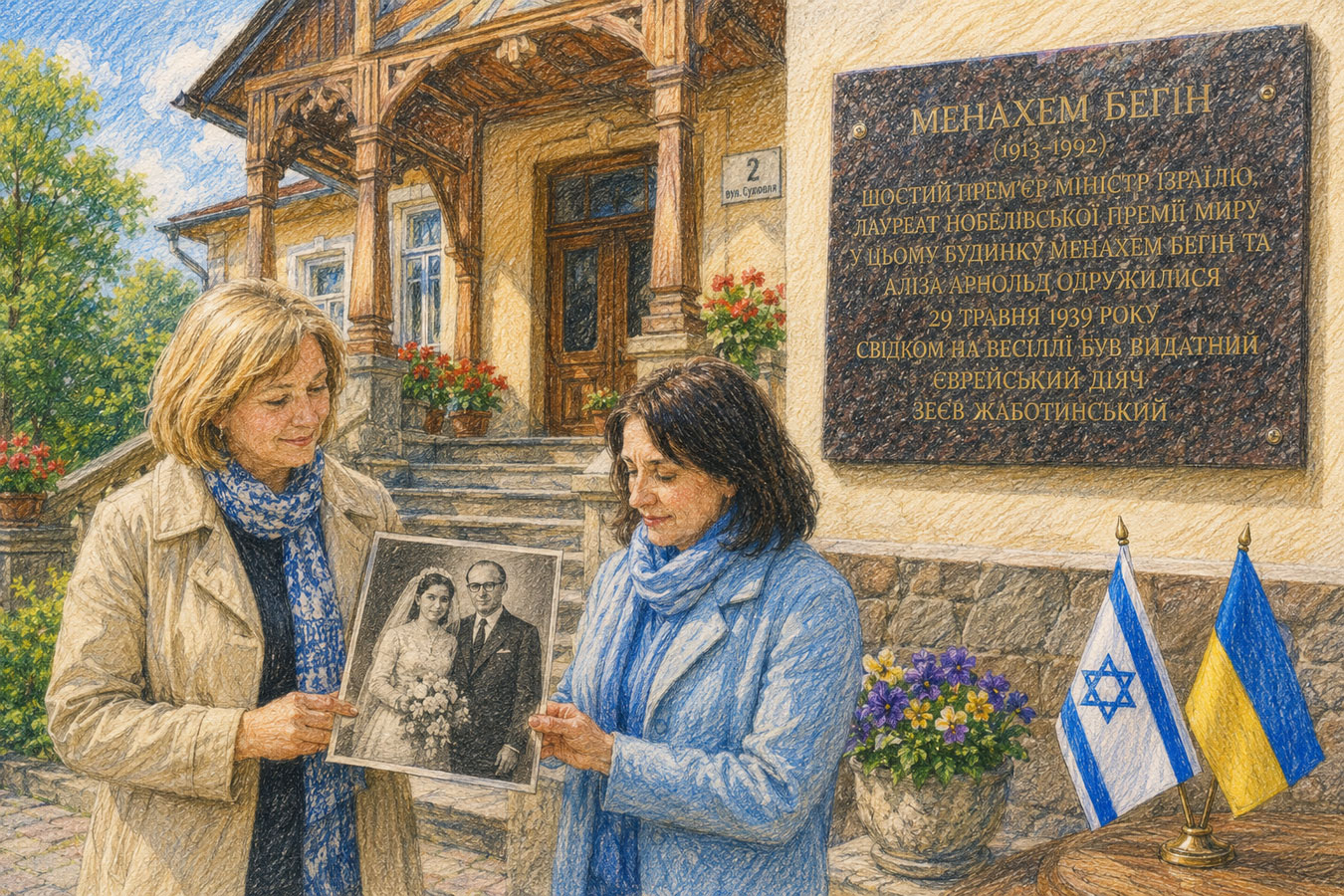
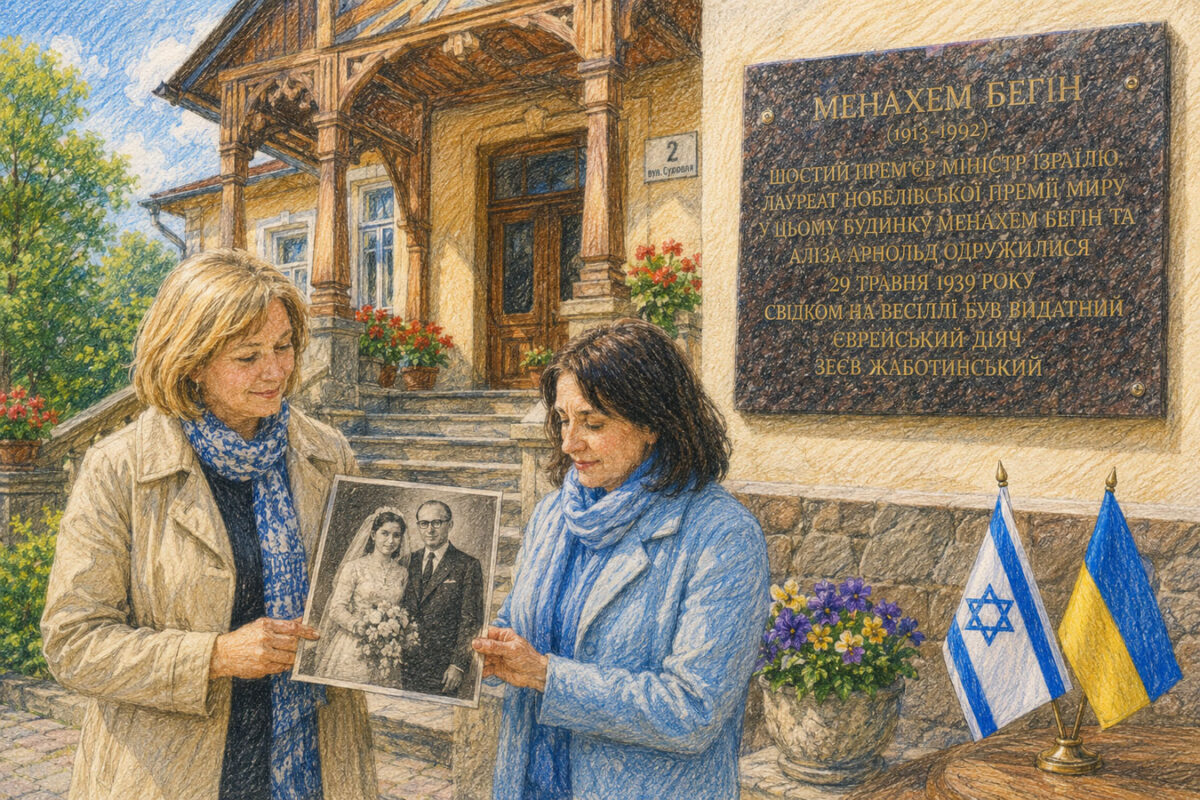
In Ukrainian Truskavets, on August 12, a commemorative plaque was unveiled in honor of Menachem Begin, the sixth Prime Minister of Israel and Nobel Peace Prize laureate. The memorial sign appeared on the historic villa associated with the wedding of Begin and Aliza Arnold in May 1939.
Menachem Begin’s wedding in Truskavets: Jabotinsky attended the ceremony
Menachem Begin and Aliza Arnold came to their wedding about two years after meeting. When Begin first saw Aliza at her parents’ house in Drohobych, she was 17 years old. He decided to wait for her to come of age, and in the spring of 1939, 26-year-old Menachem and 19-year-old Aliza got married.
On May 29, 1939, the wedding was celebrated in Truskavets, at the villa ‘Eden’ — it was on this building that a memorial plaque appeared 87 years later. Today, the former villa is known as the ‘Rafael’ hotel.
The new plaque now literally engraves this story in stone:
“In this house, Menachem Begin and Aliza Arnold were married on May 29, 1939. The witness at the wedding was the outstanding Jewish figure Ze’ev Jabotinsky.”
Jabotinsky’s presence turned the family celebration into an event within the then Zionist movement. For the young Begin, Jabotinsky was not just a famous guest: the founder of Revisionist Zionism and leader of ‘Beitar’ was his political mentor. According to biographical materials about the Begin family, Jabotinsky specifically came to the wedding from Paris.
The religious ceremony itself is associated with Rabbi Yaakov Avigdor, one of the well-known rabbis of Drohobych and Boryslav. Jabotinsky, as indicated by the text on the now-installed memorial plaque, acted as a witness at the wedding.
After the celebration, the young couple stayed in Truskavets for a short honeymoon. A photograph of Menachem and Aliza on the staircase of the building has been preserved. This shot is especially important today: before us are not yet the Prime Minister of Israel and a Nobel laureate, but newlyweds in the first days of their married life. Biographical material about Aliza Begin describes their Truskavets honeymoon as very short.
Even then, Begin did not promise his young wife a calm or prosperous life. His conversation with Aliza about the future has been preserved in memories: ahead, he warned, there would be a lack of money, troubles, and possibly even prison — the price of the struggle for the creation of a Jewish state. For someone who knows Begin’s further biography, these words seem almost prophetic: there was just over a year left until his arrest by the NKVD.
There is another detail that makes the wedding date especially symbolic. A week before it, Britain published the 1939 White Paper, sharply limiting Jewish immigration to Mandatory Palestine just as the situation for European Jews was becoming increasingly dangerous. For Begin, the fight against British restrictions was already ceasing to be theoretical politics.
And there were only three months left until the start of World War II.
In the spring of 1939, Menachem and Aliza stood on the staircase of the Truskavets villa with friends and wedding guests. On September 1, Germany attacked Poland. Very soon, instead of a honeymoon and plans for family life, there was flight, Soviet occupation, the NKVD, a camp, and separation. Families left in Europe would later be destroyed by the Holocaust.
Two granddaughters of the Israeli politician and his great-granddaughter came to the ceremony in August 2026.
At first glance, the news seems local: a Ukrainian resort town commemorated a foreign statesman. But in the case of Begin, Truskavets is not a random point on the map. It is here that one of the last preserved settings of his European life before World War II, the Holocaust, Soviet imprisonment, and the move to Eretz Israel is located.
Stas Shifer writes for NAnovosti about events at the intersection of Ukrainian, Jewish, and Israeli history. He was born in Ukraine and lives in Israel, and in his publications, he addresses, among other things, the historical and cultural ties between the two countries. In this article, the author does not act as an academic historian: his task is to compare published data, restore chronology, and explain to the Israeli reader why today’s news from Truskavets is directly related to the history of Israel.
How it became known about the unveiling of the plaque
The event on August 12 was reported by the Truskavets City Council. According to the published information, the commemorative plaque was installed on the villa, which in 1939 was called ‘Eden’, later known as ‘Old Vienna’, and today is the ‘Rafael’ hotel.
The plaque is made in Ukrainian and English. Two granddaughters of Menachem Begin and his great-granddaughter came to the historic villa and performed a song there in memory of the event that happened 87 years ago.
This is an important detail. The memory of Begin returned to Truskavets not only through the official memorial inscription but also through his own family.
Why Truskavets
On May 29, 1939, Menachem Begin and Aliza Arnold got married in Truskavets. This date and city are indicated not only by the current Ukrainian publication but also by the Menachem Begin Heritage Center in Jerusalem.
Thus, the Ukrainian resort turned out to be connected with one of the future leaders of Israel long before the state itself emerged.
To understand why Begin ended up here at all, one needs to move about two years back and about ten kilometers towards Drohobych.
Aliza Arnold from Drohobych
Aliza Arnold was born in Drohobych in 1920. She grew up in a Jewish family connected with the Zionist movement, studied Hebrew, and in her teenage years joined ‘Beitar’.
Menachem Begin came to this region in 1937 as one of the activists of ‘Beitar’. During his stay in Drohobych, he stayed with the Arnold family and met Aliza, who was then 17 years old. Later, Begin recalled that he liked the girl literally from the first meeting and immediately thought about marriage.
Therefore, the Ukrainian component of this story is not an artificial attachment that appeared decades later. The family life of the future Prime Minister of Israel began near Drohobych, Boryslav, and Truskavets, in the environment of Eastern European Jewry, from which many future figures of the Zionist movement emerged.
This same political environment was associated with Vladimir Ze’ev Jabotinsky — a native of Odessa, leader of Revisionist Zionism, and one of the people who most strongly influenced the young Begin. NAnovosti — News of Israel recently reported on the decision to install a monument to Jabotinsky in Odessa and separately examined his place in the history of Israel and Ukrainian Jewry in the project ‘Jews from Ukraine: Vladimir Ze’ev Jabotinsky’.
The wedding — and three months until the war
In Truskavets, a photograph of the young Menachem and Aliza on the staircase of the villa ‘Eden’ has been preserved. The picture does not yet show a state leader, head of government, or Nobel laureate. There is a young man next to a woman with whom he is to spend almost the rest of his life.
The date makes this photograph an especially strong historical document. The wedding took place at the end of May 1939, and on September 1, Germany’s attack on Poland marked the beginning of World War II.
That is, only a few months passed between the family photograph in resort Truskavets and the destruction of the Begin’s familiar life.
Instead of family life — flight, the NKVD, and a camp
After the start of the war, Menachem and Aliza tried to escape from the advancing Nazis. Their route passed through Drohobych and the west of modern Ukraine, and then led to Vilnius.
In September 1940, Begin was arrested by the NKVD. He was accused of Zionist activities, and on April 1, 1941, he was sentenced to eight years in camps and sent to the north of the Soviet Union. After the Sikorski-Mayski agreement, he was released and joined the Polish army of General Władysław Anders.
Meanwhile, Aliza managed to go to Mandatory Palestine. Upon arrival, she was detained by the British authorities. Menachem and Aliza met again only in May 1942 — already in Jerusalem.
Thus, between the photograph on the Truskavets staircase and their joint life in future Israel, there were war, Soviet prison, a camp, forced separation, and several state borders.
The Holocaust destroyed families left in Europe
There is another layer, without which today’s memorial plaque would be just a commemorative sign to a famous politician.
The Nazis destroyed Menachem Begin’s parents and brother in Brest. Aliza’s parents and her sister were killed in Drohobych. Both spouses lost their families during the Holocaust, who remained in Europe.
Therefore, the preserved villa in Truskavets is not only a place from the personal biography of the future Israeli premier. It also belongs to the vanished world of Eastern European Jewry, a huge part of which was destroyed a few years after that wedding photograph.
For NAnovosti — News of Israel, this is where the main meaning of today’s news lies. Ukraine today preserves a physical place that allows connecting the history of Israel not with an abstract ‘Eastern Europe’, but with specific cities, houses, and families.
How the person from the photograph became the Prime Minister of Israel
After arriving in Eretz Israel, Begin headed the Irgun — a Jewish underground organization fighting against the British mandate. After the establishment of the State of Israel, he moved into parliamentary politics and became the leader of ‘Herut’, and then one of the central figures of the Israeli right-wing camp.
For almost three decades, Begin remained in opposition. The turning point came in 1977: the victory of the right-wing camp led to the historic ‘Mahapach’, and Menachem Begin became the sixth Prime Minister of Israel. His tenure as head of government lasted until 1983.
Interestingly, Begin’s name has already appeared in NAnovosti precisely in the Ukrainian-Israeli historical context. In the material about the call of Ukrainian parliamentarians for joint work of historians, Begin’s figure was separately examined as a former commander of the Irgun, who later became Prime Minister and Nobel laureate — this material can be read here.
Thus, the new publication does not exist separately from the previous ones. It continues the same line: how the biographies of people connected with Ukraine and Ukrainian-Jewish history become part of the political and state history of Israel.
From Truskavets to Camp David
The most famous international chapter of Begin’s premiership is associated with Egypt. In 1978, with the mediation of US President Jimmy Carter, negotiations between Menachem Begin and Egyptian President Anwar Sadat led to the Camp David Accords.
In the same year, Begin and Sadat jointly received the Nobel Peace Prize for negotiations between Egypt and Israel. In 1979, the countries signed a peace treaty, becoming Israel’s first peace agreement with an Arab state.
There is also a lesser-known family detail in this story. The Begin Heritage Center reports that the monetary part of the Nobel Prize was directed by the spouses to a fund to help needy children and students. Aliza, meanwhile, tried to avoid publicity even after becoming the wife of the head of government.
And therefore, the line ‘Truskavets — Camp David’ works not as a beautiful journalistic exaggeration. Between these two points truly lies the life of one person: from the young leader of ‘Beitar’, who came to the family of his beloved girl, to the Prime Minister signing an agreement that changed Israel’s relations with the largest Arab country.
Aliza remained part of this story until the end
Aliza Begin died in November 1982, when her husband was on a visit to the United States. After the news of her death, he refused to continue the trip program and returned to Israel.
In September 1983, Menachem Begin left the post of Prime Minister and practically withdrew from public life. He died on March 9, 1992. Begin was buried on the Mount of Olives in Jerusalem next to Aliza.
An unusual geography of one family emerged: Drohobych and Boryslav, Truskavets, war and Vilnius, Soviet camp, Jerusalem, the White House and Camp David — and back to Jerusalem.
Now Truskavets has reappeared in this geography.
What NAnovosti saw in this story
One could end the news by reporting that a memorial plaque to a foreign premier was installed on a Ukrainian villa. But then almost the entire meaning of the event disappears.
Truskavets shows how much the history of the State of Israel is connected with the cities of present-day Ukraine not only through the birthplaces of famous Jews. Sometimes the connection goes through family, political movements, meetings, weddings, escape routes, and people later destroyed by the Holocaust.
In the case of Menachem Begin, this connection is especially noticeable. He was not born on the territory of modern Ukraine, but it was here that he met the woman who became his wife for life; her family lived here; a place associated with their wedding has been preserved here; from here began the family history of a man who would become the Prime Minister of Israel 38 years later.
This is the editorial value of this story for NAnovosti: not just to report on a new memorial plaque, but to place it on the map of the already existing Ukrainian-Israeli historical array.
87 years later, the family returned to the same villa
On August 12, 2026, the circle truly closed. Two granddaughters of Menachem Begin and his great-granddaughter came to Truskavets to the villa, where the memory of the family history of 1939 is preserved.
In the spring of that year, Menachem and Aliza could not yet know that in a few months Europe would plunge into war, their families would be destroyed by the Holocaust, Begin would go through a Soviet camp, and decades later become the head of the government of an independent Jewish state.
Today, the building can bear his title and years of life. But the villa itself tells more: here is preserved evidence of Menachem Begin before he became a historical figure.
That is why the unveiling of a commemorative plaque in Ukrainian Truskavets is important not only for local history. It is another restored point of connection between modern Ukraine, the vanished Jewish world of Eastern Europe, and the State of Israel.
Main source: publication from August 12, 2026; message from the Truskavets City Council.
Additional verification and historical context: Menachem Begin Heritage Center, Knesset of Israel, Nobel Prize, Ukrainian Jewish Encounter.