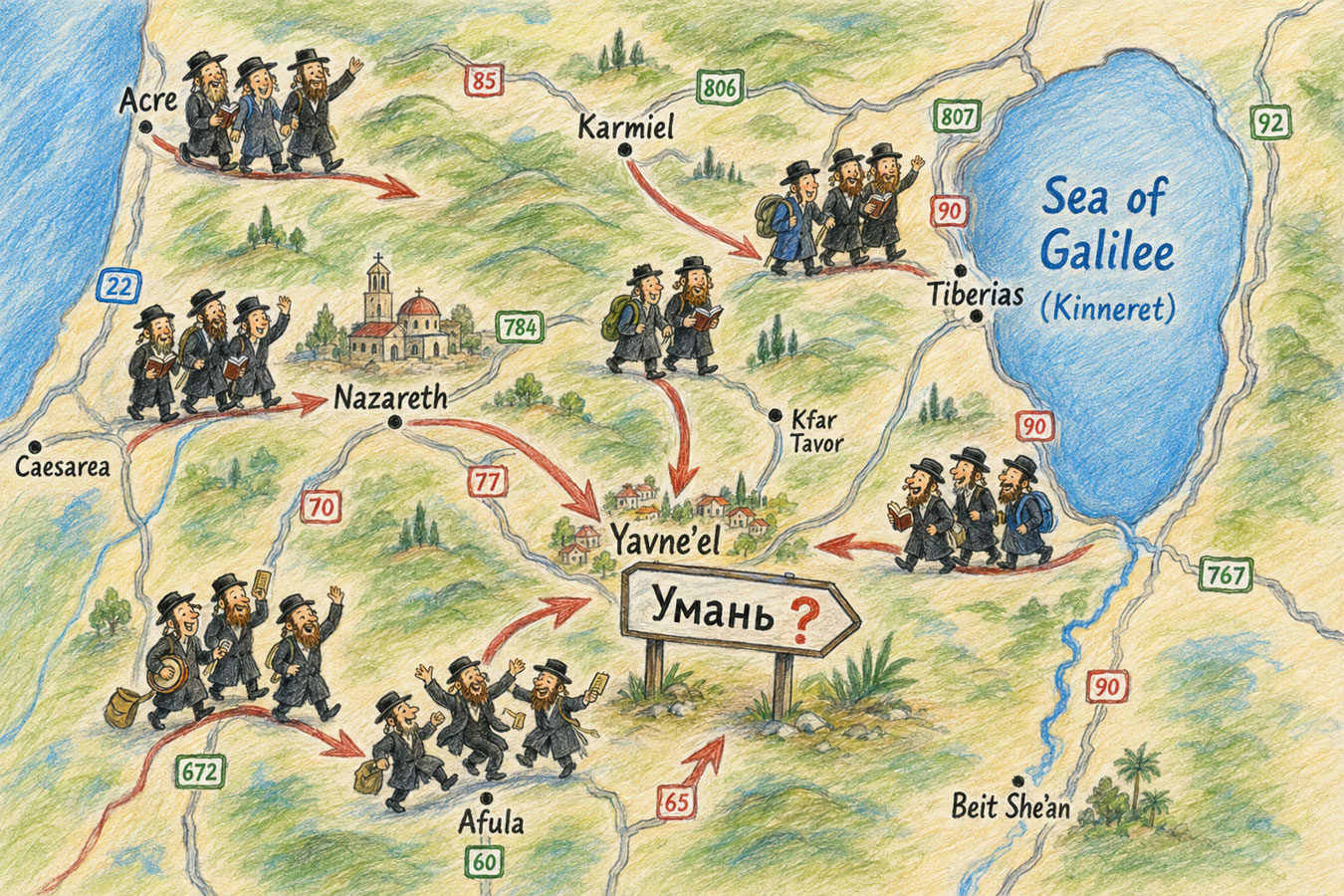
Hundreds of Breslov Hasidim are gathering to celebrate Rosh Hashanah 5787 not in Uman, Ukraine, but in northern Israel — at the ‘Adama VeShamaim’ farm in Yavne’el, near the Kinneret. There, tents, guest houses, and large accommodations are being prepared, and the schedule of prayers, festive meals, songs, and Tashlich is being synchronized as much as possible with what will be happening at the same time near Rabbi Nachman’s grave in Ukraine. This was reported by Ynet on August 12, 2026.
But calling the event simply ‘Uman for those who cannot leave Israel’ would be incorrect.
Organizers emphasize that the event is being held for the second year, intended for a wide audience and families, and most participants, according to the farm, ‘have served in the military or are active reservists.’ Simultaneously, Ynet directly links the growing interest in the Israeli format to another reality: some young men from the Haredi community are afraid to travel abroad due to issues with draft status and the risk of detention.
For me, this story is a continuation of a topic I already covered on NANovosti a year ago. In September 2025, I wrote about pilgrims from Israel who, after the closure of Ukrainian airspace, had to reach Uman through Romania and other countries. At that time, the main question was: how to get to Uman during the war? Now another question has been added: can some pilgrims even leave Israel?
It is at the intersection of Israel and Ukraine that this story looks different than in a regular note about a religious event. Here, a two-hundred-year-old Hasidic tradition, the Russian full-scale invasion of Ukraine, the service of Israeli reservists, and one of Israel’s most painful internal disputes — who should serve in the IDF and what happens to those who do not respond to the draft — all converge.
What exactly are they planning to do near the Kinneret
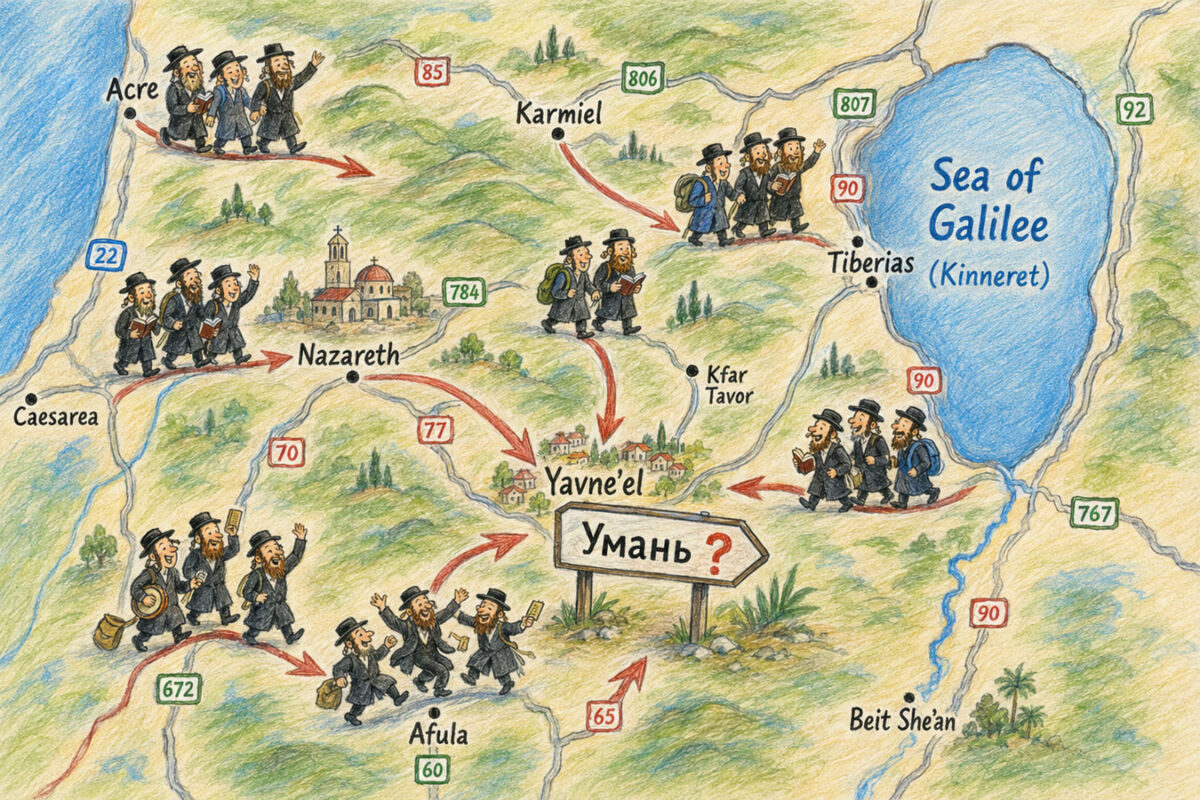
One of the initiators of the project, Ynet names Nachman Ravani, who is organizing it together with Rikdusha Productions. At the ‘Adama VeShamaim’ farm, they are preparing not just a festive prayer for a few hours, but a full-fledged multi-day space with sleep, food, and a general program.
Ravani uses the word ‘kibbutz,’ but here it does not relate to the familiar Israeli agricultural settlement. In the Breslov tradition, ‘Rosh Hashanah kibbutz’ is a gathering of Rabbi Nachman’s followers for the holiday.
The idea in Yavne’el is quite literal: when a certain prayer begins in Uman, they pray in Israel; when meals and songs take place there, a similar rhythm is maintained near the Kinneret. Even Tashlich is intended to be conducted within the same festive schedule.
So it’s not just a simple formula of ‘stayed home and went to the nearest synagogue.’ A parallel festive space is being created, consciously reproducing the familiar rhythm of Uman.
Yanki Zilberman: between Uman, Kyiv, and the IDF reserve
One of the most interesting people in this story is Rabbi Yaakov, or Yanki, Zilberman. According to Ynet, for about 20 years he was the cantor of festive prayers in Uman and performed there before the shofar blowing. For almost two decades, Zilberman also worked as the director of the Jewish community in Kyiv.
But in 2026, he is not going to Ukraine not because he is hiding from the army. The reason is almost the opposite.
Zilberman is an IDF reservist. He told Ynet that in the previous period he was on reserve duty in Gaza, completed the current cycle just a few days before the interview, and after Yom Kippur, he is to return to reserve duty — this time in Lebanon. Therefore, this Rosh Hashanah he will spend with a group in Yavne’el.
And here the simple scheme of ‘Israeli Uman for draft dodgers’ breaks down. In the same place, there may be a person who finds it difficult to leave due to draft status, a family whose father went to Uman, and a reservist who stays in Israel precisely because of service.
This is perhaps one of the most illustrative paradoxes of the whole story.
Yavne’el does not declare war on Uman
Zilberman specifically clarifies: he is not going to persuade people to give up the trip to Rabbi Nachman. On the contrary, he speaks of the value of the effort a person makes to get to Uman, especially now when the route has become significantly more complicated.
Therefore, it is more correct to speak not of ‘Uman instead of Uman,’ but of an alternative for those who, for various reasons, remain in Israel.
This difference is fundamental. So far, none of the organizers claim that Rabbi Nachman’s grave has lost its significance or that Yavne’el should replace the Ukrainian city.
However, the very fact of the emergence of such a detailed reproducible format raises another question: if such a gathering is held for the second year, gathers hundreds of people, and continues to exist further, will it remain just a temporary replacement?
Why do they go to Uman at all
Without the story of Rabbi Nachman, it is impossible to understand the scale of this question.
Rabbi Nachman of Breslov was born in 1772 and was the great-grandson of the founder of Hasidism, the Baal Shem Tov. He created his own direction, today known as Breslov or Breslov Hasidism. The last months of Rabbi Nachman’s life were spent in Uman, where he died in 1810 and was buried.
Rosh Hashanah held a special place in his teachings even during his lifetime. Students gathered around their mentor for the Jewish New Year, and after his death, they continued to come to his grave. Thus arose the ‘Rosh Hashanah kibbutz,’ which over time turned into a massive international pilgrimage.
Breslov has another feature: after Rabbi Nachman’s death, he was not replaced by a new rebbe in the usual dynastic sense. His followers continued to study his teachings, and the connection with Rabbi Nachman himself retained central importance for the movement.
Therefore, the phrase ‘couldn’t come — you can pray elsewhere’ sounds much more complex to someone within this tradition than to an outside observer.
The Soviet regime did not destroy the tradition — but made it almost inaccessible
After the establishment of Soviet power, mass pilgrimage to Uman became extremely difficult. Religious life was restricted, international travel for Soviet citizens was practically inaccessible, and it was incomparably more difficult for a foreign pilgrim to reach the grave than it is today.
After the collapse of the USSR, the situation changed. Ukraine became an independent state, borders opened, and the trip to Uman gradually turned into an annual mass event, attracting tens of thousands of people from Israel, the USA, Europe, and other countries.
By the beginning of the 21st century, the journey itself ceased to seem the main obstacle. A flight from Israel, a few hours of ground transport — and the pilgrim is in Uman.
Then this familiar scheme began to break down.
2020: for the first time, the border was literally closed to pilgrims
The first major modern blow was the COVID-19 pandemic.
It is important not to repeat a common mistake here: the problem with closing the Ukrainian border to pilgrims arose in 2020, not in 2019. In September 2020, thousands of Hasidim tried to enter Ukraine despite coronavirus restrictions; about two thousand people were blocked at the Belarusian-Ukrainian border. Reuters then described this situation in detail.
For a generation of pilgrims accustomed to considering the trip to Uman almost guaranteed, this was an important psychological precedent. Rosh Hashanah comes according to the calendar, the tradition does not disappear — but physically being near the grave is impossible.
Two years later, the reason became much more frightening.
2022: Russia closed Ukrainian skies with missiles
On February 24, 2022, Russia launched a full-scale invasion of Ukraine. Ukrainian airspace for civilian aviation was closed, and the direct familiar route from Israel disappeared.
Pilgrimage did not stop, however. People began flying to Moldova, Romania, Poland, Hungary, and other countries, then continued their journey by buses, cars, and trains.
In 2025, NANovosti already showed in detail how Israeli pilgrims reached Uman through Romania: the flight became only the beginning of the journey, followed by long hours of travel and crossing the Ukrainian border.
In 2026, the situation has not fundamentally changed. Ukraine continues to live under Russian missile and drone attacks, and civilian flights to the country are not being conducted.
On July 29, 2026, the Ministry of Foreign Affairs of Ukraine again recommended pilgrims to refrain from traveling to Rosh Hashanah 2026. NANovosti analyzed this warning separately: it is not about a ban for Jews or closing Uman, but about the inability to guarantee the safety of tens of thousands of people during the full-scale Russian aggression.
Ukrainian structures are simultaneously preparing to receive those who will still come. This is not a contradiction: the state warns of the risk but understands that for some believers, the significance of the trip is so great that they will not give it up even during the war. Breslov representatives in August separately thanked Ukraine for organizing the pilgrimage under such conditions.
And then an obstacle appeared within Israel itself
Until recently, the problem sounded something like this: how can a person from Israel get to Uman if Ukraine is at war?
Now for some men, the question begins earlier: will they even be allowed to leave Ben Gurion Airport?
On June 25, 2024, the High Court of Justice ruled that the state has no legal basis to continue the previous system of mass non-conscription of Haredi yeshiva students. In the court’s decision, the history of exemption traces from the first approximately 400 yeshiva students whom David Ben-Gurion exempted from service in the early years of the state, to a system that already covers tens of thousands of people.
After October 7, the dispute took on a completely different public tone. While some reservists are repeatedly called up for months of service, the state has to explain why tens of thousands of other men of draft age continue to remain outside the army.
NANovosti — News of Israel already analyzed the High Court’s decision on the need to apply sanctions to Haredim who do not meet draft requirements. The court decisions themselves did not close the dispute — they made it even sharper.
Uman-2025 became the place where two crises collided
Before Rosh Hashanah 2025, the religious dispute came directly to Ben Gurion Airport.
Shas leader Aryeh Deri tried to achieve a decision that would allow men with travel restrictions due to draft status to go to Uman. The government’s legal advisor, on the other hand, warned that a special exemption scheme for pilgrimage would be illegal.
On September 15, Ynet reported the detention of about 30 young Haredim at the airport. Checks showed that there were arrest warrants against them for failing to appear on military orders; many were planning to fly specifically to Uman.
And here arose a public conflict that cannot be reduced to the slogan of one side.
For a Breslov believer, Rosh Hashanah at Rabbi Nachman is not a trip to a resort and not an ordinary vacation. But for a reservist who repeatedly leaves work and family for service, it is equally difficult to accept the idea that a religious trip should automatically cancel the legal requirements that apply to other citizens.
Both these realities exist simultaneously.
In 2026, the dispute has not disappeared
On July 14, 2026, the Knesset, by a vote of 58 to 54, passed a temporary law limiting arrests and criminal prosecution of Haredim avoiding the draft. Less than a day later, the High Court froze its effect, and on July 28, a panel of nine judges maintained the freeze until a final decision.
As of August 12, NANovosti did not find a published final decision on these petitions; the last available court position is that the law remains frozen. Therefore, it cannot be written that there is now a general law in Israel protecting all Haredim from detention.
Moreover, the legal situation varies among different people. The obligation to appear for the draft, the status of a draft dodger, an arrest warrant, and a travel ban are not the same. Therefore, the formula ‘all Haredi draft dodgers are not allowed to leave Israel’ would also be too crude.
But the practical consequence is very real: for some young men, the airport before Rosh Hashanah is no longer just the beginning of a journey.
One stays because of the army. Another — because of problems with the army
It is here that returning to Yanki Zilberman makes the story of Yavne’el particularly illustrative.
Two people can pray side by side.
One did not go because he has an unresolved draft status and fears detention.
The other — because he has already served another reserve and is preparing for the next one.
For both, the organizers offer the same cantor, the same melodies, a similar prayer schedule, Tashlich, and the feeling of a large Breslov gathering.
Thus, two completely opposite consequences of the Israeli military crisis unexpectedly bring people to one point near the Kinneret.
So where is the ‘Uman’ itself located?
In an interview with Ynet, Zilberman tells another story, and here it is important to clearly separate his words from established historical fact.
According to him, in the early 2000s, several rabbis studied old maps and concluded that the exact historical location of Rabbi Nachman’s grave might not fully coincide with the point that pilgrims visit today. Zilberman provides a religious answer he heard then: if Jews came to this place, believed, prayed, cried, and addressed their rebbe, the spiritual connection already exists there.
NANovosti did not find sufficient independent confirmation of this specific story with the maps, so it cannot be presented as a proven archaeological or historical fact.
But what is important is — how Zilberman himself applies this thought to Yavne’el.
If hundreds of Jews gather together on the Holy Land, pray, and believe that Rabbi Nachman is with them spiritually, he says, then this connection exists here too.
This is already much more than a technical replacement for a canceled plane ticket.
The Land of Israel ceases to be just a backup site
Zilberman separately emphasizes the significance of Eretz Yisrael in Rabbi Nachman’s teachings. In his argumentation, being in the Land of Israel is not a disadvantage compared to Uman that has to be endured, but an independent spiritual value.
While the organizers do not propose a new doctrine and do not declare Yavne’el the new center of Breslov, the language is already changing.
First, a person says: ‘I couldn’t get to Uman, so I stayed in Israel.’
Then: ‘We pray here at the same time and in the same way.’
And the next step sounds different: ‘We are in the Land of Israel, and this also has its own meaning.’
If the event continues to grow, this transition may be more important than tents, catering, and the number of participants.
Why this is not a closed event for one group
The second interesting detail of the original Ynet is that the organizers are clearly trying to expand the audience.
Zilberman invites people he himself calls open and liberal, those who enjoy music, joint singing, festive meals, and the atmosphere of Rosh Hashanah. The farm in its comment also speaks of families ‘of all shades of society,’ children’s events, workshops, and a festive program.
This already looks little like a closed reserve synagogue for a group of men prohibited from crossing the border.
If such a concept takes hold, a separate Israeli format of celebrating Rosh Hashanah around the Breslov tradition may form near the Kinneret — more family-oriented and open than the classic male mass pilgrimage to Uman.
For now, this is a possibility, not an established fact. The second year of the event’s existence does not yet make it a new historical tradition.
But this is precisely what should be observed now.
The real Uman has not disappeared
It is important not to lose sight of a simple thing amid all the Israeli politics: in September 2026, tens of thousands of people will again try to come specifically to Ukraine.
Rosh Hashanah 5787 will begin on the evening of September 11, 2026 and end on the evening of September 13. Ukraine warns of Russian strikes, limited shelter capabilities, curfews, and strain on medical infrastructure, but simultaneously prepares the border, police, and organizational system for the arrival of pilgrims.
So Yavne’el appears not instead of a vanished Uman.
It appears alongside a living Uman.
And that is much more interesting.
From a forced decision to a new tradition — the distance is sometimes shorter than it seems
For two hundred years, the history of Breslov Rosh Hashanah was built around one direction of movement: believers tried to reach Rabbi Nachman. Soviet prohibitions, borders, expensive travel, COVID, and even the Russian invasion did not destroy this aspiration.
Now two new processes are simultaneously at work.
Russia has made the physical route to Ukraine more dangerous, longer, and more expensive. The Israeli draft crisis has made leaving the country legally risky for some people.
But Yavne’el shows something else: circumstances are no longer just hindering the old tradition — they are beginning to create a parallel one.
This is only the second year. The organizers themselves say they are not competing with Uman. The grave of Rabbi Nachman in Ukraine remains the center to which tens of thousands of people strive annually.
However, there is a simple question that cannot be answered today.
If hundreds of people meet Rosh Hashanah near the Kinneret for five years in a row — will they still consider it a temporary replacement? And in ten years?
And here the story stops being just news about draft dodgers, reservists, or complex flight routes.
Sometimes new religious habits are born not because someone decided to change the tradition. First, the border simply closes. Then a war begins. Then another obstacle appears. People find a solution — and repeat it the next year.
And a generation later, you have to explain how it all started.
NANews — Israel News will follow not only how many pilgrims reach Uman in September but also how many people choose Yavne’el. Because it is the comparison of these two routes over the years that will show: was this a temporary reaction to the crisis — or the moment of birth of a separate Israeli tradition.