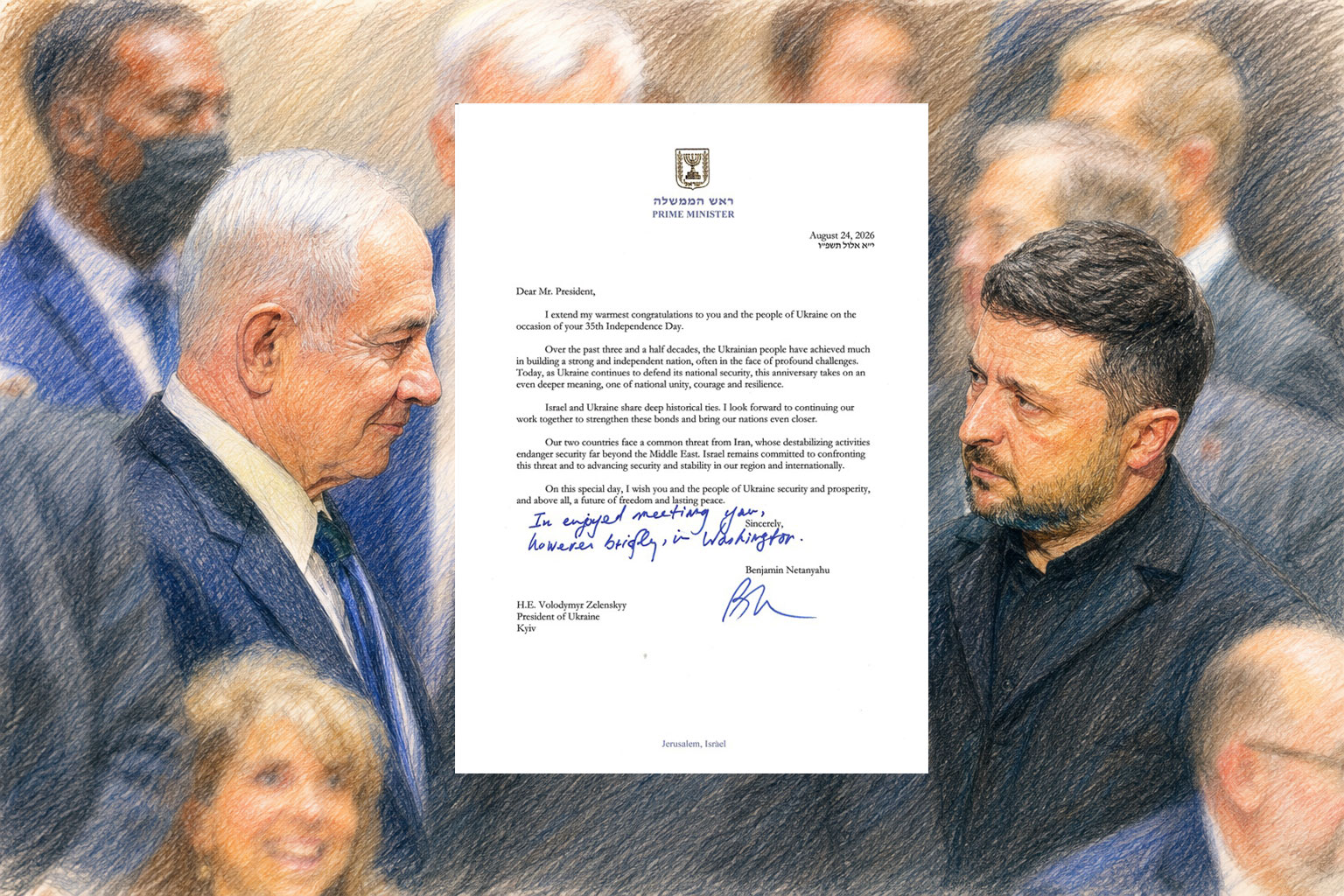
Benjamin Netanyahu wrote to Volodymyr Zelenskyy on the 35th anniversary of Ukraine’s independence on August 24, but the document became public only on the evening of the 26th, when the Ukrainian president himself showed it. The letter contains two details that go far beyond a protocol congratulation: a direct definition of Iran as a common threat and a handwritten line about a brief meeting between the two leaders in Washington. Netanyahu’s office had not reported the congratulation until that time.
Author: Stas Shifer
Jerusalem, Israel — August 27, 2026.
If you are looking for “Netanyahu congratulated Ukraine,” “Netanyahu’s letter to Zelenskyy,” or “Iran is a common threat to Israel and Ukraine,” two dates are immediately important here. The letter from the Israeli Prime Minister’s office is dated August 24, 2026, Ukraine’s Independence Day, but Volodymyr Zelenskyy published it on X only on August 26 at 17:43. It was only after this publication that the document entered the open information field.
I received warm congratulations for the people of Ukraine from Prime Minister @netanyahu of Israel. Our countries share deep bonds – between our people in the first place, but also in the economy, culture, and other areas. It is therefore good to hear of Israel’s desire to… pic.twitter.com/WjhLg37ai6
— Volodymyr Zelenskyy / Володимир Зеленський (@ZelenskyyUa) August 26, 2026
In the letter, Netanyahu congratulates Zelenskyy and Ukrainians on the 35th anniversary of independence, talks about building a strong independent state in the face of serious challenges, notes Ukraine’s national unity, courage, and resilience, and wishes the country a “future of freedom and lasting peace”. But the most politically substantive phrase is not in the final wish: the Israeli Prime Minister directly writes that Israel and Ukraine face a “common threat from Iran”.
I separately checked the public Israeli side of this story. As of the preparation of the material on August 27, I did not find a separate publication with this letter among the available messages from the Prime Minister’s office on gov.il, in Netanyahu’s official Telegram, or in the available output of his official X. This does not prove that the document was deliberately not published: such a conclusion would require an explanation from the office itself. But the available public chronology looks exactly like this — the letter is dated August 24, and Zelenskyy made it publicly available on the evening of the 26th.
For NANews — News of Israel | Nikk.Agency this changes the angle of the story. We are not just looking at another festive address to Kyiv, but a document that the Ukrainian side decided to make public itself — and in which Netanyahu connects relations with Ukraine to the central theme of Israeli security, Iran.
And what happened in previous years: did Netanyahu congratulate Ukraine at all?
I separately looked at previous Ukrainian Independence Days — and Netanyahu’s current letter looks even more interesting.
In 2025, among the officially listed congratulations from world leaders from Israel was President Isaac Herzog. In the list published on August 25 by the Office of the President of Ukraine, Netanyahu is not mentioned. This does not prove that there was no non-public letter, but I did not find a public congratulation from the Prime Minister.
In 2024, the situation was similar. I also did not find a public congratulation from Netanyahu on Independence Day. However, a few days later, on August 28, Netanyahu himself called Zelenskyy. The conversation already concerned the war, the situation in the Middle East, and support for Ukraine’s sovereignty and territorial integrity. Moreover, The Times of Israel separately noted an interesting detail: the Israeli side did not publish its own message about this conversation at all — Kyiv reported it.
So the current story with the letter, which we learn about from Zelenskyy, already has some parallel.
But 2023 is especially indicative.
Then, around the absence of a personal congratulation from Netanyahu, there was real irritation in Kyiv. Israeli Hebrew-language media retold a message from the public broadcaster Kan: an unnamed Ukrainian official complained that Netanyahu did not personally congratulate Ukraine on Independence Day.
According to this source, a message from the official account of the Prime Minister’s office appeared late in the evening, but the Ukrainian side perceived it quite differently:
“A tweet from the Prime Minister’s office account late at night is not a congratulation from a friend”.
The story then developed against the backdrop of another painful issue — the annual trip of tens of thousands of Israeli Hasidim to Uman for Rosh Hashanah. Kyiv discussed possible restrictions for Israelis, and dissatisfaction with Netanyahu’s government’s attitude was cited as one of the reasons for the tension.
2022: Netanyahu is not the Prime Minister — Israel is led by Yair Lapid. And he congratulates Zelenskyy on Independence Day only on September 1, after the holiday. Moreover, this was their first phone conversation after Lapid took office as Prime Minister.
It turns out to be almost a mirror image.
2023: in Kyiv, they ask — why didn’t Netanyahu personally congratulate Zelenskyy?
2024: I do not find a public congratulation; a few days later, Netanyahu calls Zelenskyy, and the Ukrainian side is the first to report the conversation.
2025: Herzog publicly congratulates Ukraine, Netanyahu is absent from the official Ukrainian list of congratulating leaders.
2026: Netanyahu not only congratulates. He writes a personal letter, talks about Ukraine’s courage, wishes it freedom and lasting peace, calls Iran a common threat to Israel and Ukraine, and even personally adds a line about meeting Zelenskyy in Washington.
And yet the familiar oddity arises again: the Israeli side itself does not publicly show the letter — we see it only on August 26, when Zelenskyy publishes the document.
For comparison: when in 2021 Naftali Bennett was the Prime Minister of Israel, there was no mystery with the timing. On August 24, he personally called Zelenskyy and congratulated Ukraine on the 30th anniversary of independence. The Office of the President of Ukraine reported this on the same day at 14:14.
Therefore, the current question becomes broader than just “where did the letter wander for two days?”
I am more interested in another: why, after several years when Netanyahu’s personal public congratulation was either absent or at least not a noticeable part of public communication, in 2026 he writes such a warm and politically substantive letter — but again does not publish it himself?
Coincidence? A feature of the office’s work? Changed attitude towards Ukraine? Internal Israeli politics before the elections? New significance of Ukrainian experience for Israel after the war with Iran?
There is no answer yet.
But now we at least see that the two-day pause in 2026 is not the only oddity in the history of Netanyahu’s congratulations to Zelenskyy.
The letter from August 24 appeared with Zelenskyy only on the 26th
The chronology is important because congratulations from the leadership of Israel did not come in one package. On August 24, Israeli Foreign Minister Gideon Sa’ar publicly congratulated Zelenskyy, his Ukrainian colleague Andriy Sybiha, and the Ukrainian people. NANews has already analyzed this address by Sa’ar: the minister spoke about the resilience of Ukrainians, freedom, and lasting peace, but did not directly mention Russia in the congratulation.
The next day, Zelenskyy separately thanked Israeli President Isaac Herzog. He wrote about solidarity, trade, ties between people, and the upcoming 35th anniversary of diplomatic relations. This story was also analyzed separately by NANews.
It is easy to confuse two anniversaries here. On August 24, 2026, Ukraine celebrated 35 years of Independence. And the 35th anniversary of diplomatic relations between Israel and Ukraine will only come in December: Israel recognized Ukraine’s independence on December 25, 1991, and diplomatic relations were established the next day.
And only in the evening of August 26 did Zelenskyy show Netanyahu’s letter.
Therefore, the wording “Netanyahu congratulated Ukraine on August 27” would be incorrect. The congratulation is dated the 24th. But for the general public, the document itself became visible two days later.
Why did this happen?
I do not find grounds to invent an answer. The letter could have been ordinary diplomatic correspondence that was not initially intended to be published immediately. A political decision not to bring the Ukrainian topic into the Prime Minister’s communication on August 24 is also possible. But there is no confirmation of any of these versions in open sources now.
This is exactly the boundary where fact ends and hypothesis begins.
What Netanyahu actually said — and what is not in the letter
The document itself is short, but its composition is more interesting than a standard congratulation.
First, Netanyahu talks about three and a half decades of Ukrainian independence and building a strong state despite severe trials. Then he links the current anniversary to Ukraine’s continued defense of its national security and speaks of national unity, courage, and resilience.
After this, Israel appears: historical ties, the desire to continue joint work and make the two countries even closer.
And only then — Iran.
Netanyahu writes:
“Our two countries face a common threat from Iran”.
The Prime Minister then explains his thought: Tehran’s destabilizing activities, he says, threaten security far beyond the Middle East, and Israel intends to continue countering this threat and achieving greater stability.
This is a strong political formulation.
But turning it into a headline “Israel and Ukraine created an alliance against Iran” would be wrong. The letter does not announce a military agreement, arms supplies to Ukraine, intelligence sharing, a joint air defense system, weapons production, or a new sanctions package.
There is not even a date for the next full meeting between Netanyahu and Zelenskyy.
It turns out to be an interesting construction: the political formula has become stronger, practical commitments — not yet.
In Zelenskyy’s response, there is another detail. The Ukrainian president thanked Netanyahu, wrote about the deep ties between the peoples, the economy, culture, and Israel’s desire to strengthen relations, and concluded with hope for fruitful joint work for greater security.
But the word “Iran” Zelenskyy did not repeat in his own text.
I would not turn this into a sign of disagreement. There is no basis for such a conclusion. It is merely a difference between two public formulations — and that is why it should be preserved, not smoothed over by retelling.
The phrase about Iran did not arise out of nowhere
For an Israeli who does not follow Ukrainian politics daily, the very construction “common Iranian threat to Israel and Ukraine” may initially seem strange.
Ukraine is in Europe and is at war against Russia. Israel builds a significant part of its security strategy around Iran’s nuclear program, missiles, drones, and Tehran-supported armed structures in the Middle East.
But between these two wars, there has long been a technological bridge.
Shahed — a family of Iranian-developed one-way attack drones: the device carries explosives and itself becomes part of the munition. Russia began to massively use such drones against Ukraine in the fall of 2022, and then deployed the production of its own Russian versions.
Therefore, for Ukrainians, the word Shahed became part of the everyday air war long before the current stage of the confrontation between Israel and Iran. Reuters noted that Russian forces launched thousands of such devices at Ukraine, and Russian production gradually became independent.
But the political rapprochement between Kyiv and Jerusalem on this topic also did not begin yesterday.
On July 23, 2025, Foreign Ministers Gideon Sa’ar and Andriy Sybiha in Kyiv officially agreed to start a strategic dialogue between Israel and Ukraine on the Iranian threat. Sybiha is Ukraine’s Foreign Minister, that is, Sa’ar’s direct Ukrainian counterpart. During the same negotiations, the parties discussed security, cyberspace, defense technologies, medicine, energy, agriculture, and trade.
In February 2026, after a conversation between Zelenskyy and Herzog, the official website of the President of Ukraine again directly linked Iran with the Russian war. Kyiv reminded that the Iranian regime supported Russia and supplied it with Shahed for attacks against Ukrainians.
In the spring, the connection became even more complex. Zelenskyy publicly claimed that now Russia was helping Iran, including supplying Russian versions of Shahed and transferring intelligence information. Reuters reported these statements. Here a caveat is required: the Ukrainian president’s statement about a specific current transfer of equipment or intelligence does not equal independent confirmation of each individual operation.
At the same time, the strategic cooperation between Moscow and Tehran is no longer an assumption. In January 2025, Russia and Iran signed a 20-year strategic partnership agreement, providing for closer cooperation in defense and security, military-technical sphere, joint exercises, and interaction of special services. It is also important to clarify the opposite: the agreement does not automatically obligate to enter the war on the partner’s side.
That is why I would not turn Russia and Iran into a formal unified military bloc modeled on NATO.
NANews recently analyzed this link between Russia, Iran, Israel, and Ukraine separately. Netanyahu’s letter adds a new detail to the already existing picture: the formula of a common Iranian threat now comes not only from Ukrainian diplomats.
The handwritten line returns us to Washington
At the bottom of the official letter, there is something that is usually not in diplomatic documents of this kind.
Netanyahu added in blue pen:
“I enjoyed meeting you, however briefly, in Washington”.
That is: “I enjoyed meeting you in Washington, albeit very briefly”.
This small note returns the story to July 28, 2026.
Then Zelenskyy and Netanyahu were simultaneously in Washington. Their teams tried to organize a full bilateral meeting, but in the end, it did not take place. The Times of Israel initially reported attempts to coordinate negotiations, and later — about a short personal conversation and handshake between the two leaders before the farewell ceremony for American Senator Lindsey Graham.
Before that, Netanyahu and Zelenskyy had not met in person since September 2023 and, according to the Israeli publication, had not spoken by phone since January 2025. Therefore, the words however briefly here acquire additional meaning: the Israeli Prime Minister himself decided to note even this very short contact.
NANews wrote about the Washington day when Trump separately received Zelenskyy and Netanyahu. In the White House, the Ukrainian president discussed his own war and Ukraine’s defense, the Israeli Prime Minister — primarily Iran. There was no full-fledged trilateral negotiation format.
But nearby, an episode occurred that was not planned as a separate diplomatic summit: Zelenskyy and Netanyahu talked personally.
On the same day, Sa’ar called Sybiha and again discussed the Iranian threat with him. The Ukrainian minister also accepted an invitation to visit Israel. The Times of Israel noted both details in its chronicle of that day.
If you put the events in the correct order, there is no sudden “turn of Israel towards Ukraine” on August 24.
Another sequence emerges: the strategic dialogue on Iran was launched back in 2025; in 2026, the topic became much more practical due to the development of the war around Iran; in July, ministerial contacts revived, and a short personal conversation between Netanyahu and Zelenskyy took place; now the formula of a common threat appeared directly in the Prime Minister’s letter.
Russia makes this formula less abstract for Israel
There is a simple way to verify Netanyahu’s diplomatic formulation: look not at the congratulatory card, but at the events around it.
On the night of August 27, already after Zelenskyy’s publication, Russia conducted another large-scale air attack against Ukraine. Reuters, citing Ukrainian authorities, reported 258 drones, as well as ballistic and other missiles. Strikes and falling debris affected several regions, infrastructure facilities, a school, and a medical institution.
However, here one cannot make the reverse mistake and automatically sign all 258 devices with the word “Iranian”.
Russia has long been producing its own derivatives of Shahed. Moreover, different types of drones, including decoys, can be used in a specific mixed attack. Therefore, the correct connection looks like this: Iranian technology has become one of the most important elements of the Russian air war, not “Iran personally launches every Russian drone at Ukraine”.
It is in this difference that the real value of Ukrainian experience for Israel appears.
Reuters in March 2026 visited the production of Ukrainian interceptor drones — cheap devices that were created specifically to destroy attacking drones. Against the backdrop of the war around Iran, Ukrainian companies reported interest from the US and Middle Eastern countries. One of the manufacturers estimated the ability to produce up to 50,000 interceptors per month, with part of the production capacity potentially being used for export without reducing Ukrainian needs.
The cost also changes the military math. According to Reuters, individual Ukrainian interceptors cost about several thousand dollars or even around a thousand dollars, while a PAC-3 missile for Patriot can cost about $4 million. These are not interchangeable means: Patriot is also intended for much more complex targets, including ballistic missiles. But against cheap attack drones, the economics of interception becomes a separate strategic issue.
For Israel, it is here that the words “common threat” cease to be a diplomatic metaphor.
Ukraine has accumulated a mass of combat experience in detecting low-flying targets, organizing mobile fire groups, using cheap interceptors, protecting energy, and distributing air defense means. Israel has accumulated its own experience in countering Iranian missiles and drones.
This is not yet a joint system.
But it is already an understandable area where the two countries have something to talk about besides congratulations.
What the letter changes — and what will have to be checked further
After the events of August 24–26, relations look warmer, but I would not yet announce a new Israeli policy towards Ukraine.
Sa’ar publicly congratulated Ukraine. Herzog received Zelenskyy’s gratitude and the wording about the “friendly people of Israel.” Netanyahu in his letter took another step in the security sphere and called Iran a common threat.
These are three different levels of communication, not one collective decision of the Israeli government.
But there is still a shift.
Previously, it was the Ukrainian side that especially persistently proved to Israel that Russian-Iranian cooperation links two wars through drones, missiles, technologies, and exchange of experience. Now a similar logic is used in his own formulation by the Prime Minister of Israel.
This does not mean that Netanyahu agreed with Ukraine’s demands for weapons. It does not mean that Israel has changed its policy towards Russia. Nor does it mean the emergence of a common Israel-Ukraine front.
But it is no longer just a Ukrainian argument.
For NAnews — News of Israel | Nikk.Agency the next check will therefore be very specific. Will Sibiga’s visit to Israel take place? Will the strategic dialogue on Iran receive a permanent working format? Will there be projects to counter drones, civil defense, infrastructure protection, or exchange of technological experience? Will these issues be raised in December when Israel and Ukraine will already celebrate the 35th anniversary of diplomatic relations?
And there remains one more question in today’s story: why did a letter with such substantive wording about Iran not appear on Ukraine’s Independence Day in Netanyahu’s public communication?
I deliberately do not turn the absence of the found publication into proof of political intent.
But this detail cannot be discarded.
As of August 27, 2026, the established sequence looks like this: the letter was signed by Netanyahu on August 24; Zelensky published it on August 26 at 17:43; in the document, the Prime Minister of Israel called Iran a common threat to both countries and personally reminded of the brief meeting with the Ukrainian president in Washington.
Therefore, this story no longer fits into the standard three lines of a festive greeting.
Behind one letter are almost three years of rare personal contacts between Netanyahu and Zelensky, the dialogue on Iran launched back in 2025, Russian-Iranian military-technical cooperation, Ukraine’s experience of war with Shahed, and the still unanswered main question: will the convergence of interests between Israel and Ukraine turn into concrete cooperation or remain a strong diplomatic formula on paper.