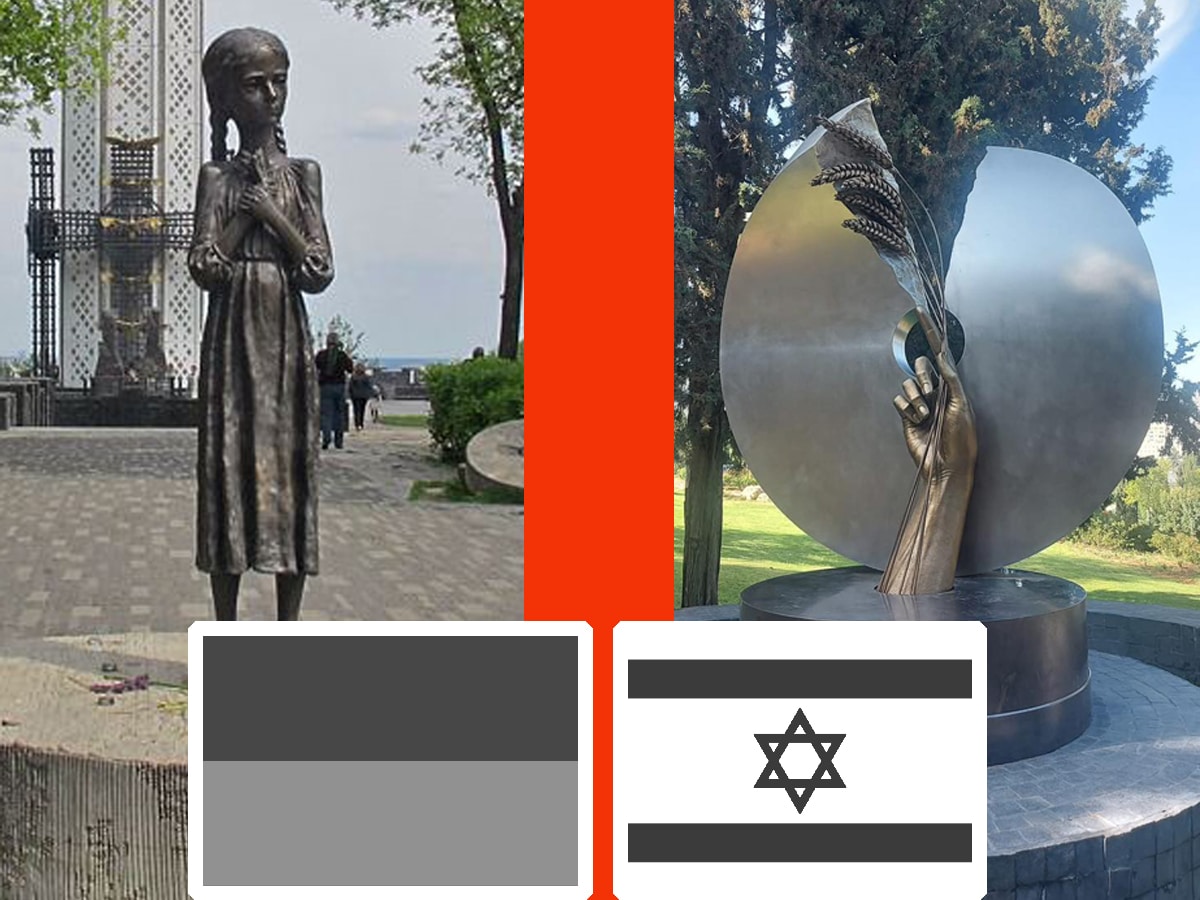
In April 2025, in Jerusalem, in the Wohl Rose Garden (Wohl Rose Garden), between the Knesset and the Supreme Court, the first monument to the victims of the 1932-1933 Ukrainian Holodomor was installed in Israel.
The Holodomor of 1932-1933 in Ukraine was a tragic event in history, during which an artificially created famine organized by the Soviet government led to the death of a massive number of people. It was part of Stalin’s policy of collectivization and forced grain seizures, which resulted in mass starvation in Ukraine.
According to various sources, the number of victims varies, but the most frequently cited figures range from 3 to 7 million deaths. This was an act of brutal repression of the Ukrainian population, including peasants who resisted collectivization and lost their land.
The Holodomor became one of the largest humanitarian catastrophes in history, and in recent decades, the question of recognizing the Holodomor as a genocide of the Ukrainian people has been actively discussed on the international stage.
In November 2024, the Ministry of Foreign Affairs of Ukraine announced that 38 countries and international organizations have recognized the Holodomor as a genocide of the Ukrainian people.
Ukraine annually honors the memory of the victims of these tragic events on the fourth Saturday of November.
On May 15, 2003, the Verkhovna Rada of Ukraine in an official address to the people of Ukraine recognized the Holodomor as an act of genocide.
On November 28, 2006, the Verkhovna Rada of Ukraine passed the law «On the Holodomor of 1932-1933 in Ukraine», interpreting the events of 1932-1933 as the genocide of the Ukrainian people.
Despite individual initiatives and calls, Israel still has not officially recognized the Holodomor of 1932–1933 in Ukraine as an act of genocide.
Let’s briefly recall the history of this issue.
2007–2008: First Calls and Israel’s Rejection
In the late 2000s, Ukraine launched a campaign for the international recognition of the 1932–33 Holodomor as genocide. President Viktor Yushchenko appealed to world leaders, including Israel, asking them to politically assess this tragedy. However, Israel’s official position at the time was negative. The Israeli Ambassador to Ukraine, Zina Kalay-Klaytman stated in 2008 that, while recognizing the Holodomor as the greatest tragedy of the Ukrainian people, Israel “cannot recognize the 1932-1933 famine as an act of ethnic genocide”.
In other words, Jerusalem did not consider that the famine was directed solely against Ukrainians. Israeli analysts noted that such statements reflected the views in the Israeli Foreign Ministry and were not the final position of the state, however, no steps towards recognition were taken.
Israel maintained a neutral line at that time, avoiding official declarations on the Holodomor, partly considering the “delicate nature of the topic” for relations with Russia and the unique status of the term “genocide” (primarily associated with the Shoah) in the country’s domestic politics.
2016: The Holodomor Issue on the Knesset’s Agenda
Almost a decade later, after the Revolution of Dignity and in connection with the 75th anniversary of the Babyn Yar tragedy, the topic of the Holodomor once again came to the forefront of bilateral relations.
In 2016, a group of Ukrainian public figures submitted an appeal to the Knesset for the recognition of the Holodomor as genocide.
For the first time in the history of Israeli-Ukrainian relations, Knesset members officially addressed this issue: in September 2016, a delegation from the Verkhovna Rada visited Israel, and then a reciprocal visit took place in Kyiv. As part of the events commemorating the 75th anniversary of Babyn Yar, Israel’s honorary consul in Western Ukraine, Oleg Vishnyakov organized a visit by Israeli parliamentarians to the National Holodomor Memorial Museum.
The delegation, which included Knesset vice-speakers Tali Ploskov and Nava Boker, MP Yehi’el Bar, coalition leader David Bitan, and Knesset director-general Albert Sakharovich, was deeply moved by the exhibition.
The result of this visit was the first attempt at official recognition of the Holodomor in Israel.
In November 2016, the Knesset presidium introduced a resolution on the recognition of the Holodomor as an act of genocide against the Ukrainian people, at the suggestion of MP Nava Boker (Likud party).
“For many years, the Knesset refused to discuss the Holodomor… It is time to change that,” – said Boker at the time.
The resolution sought to officially recognize that the Stalinist regime deliberately caused mass starvation against Ukrainians and condemn these actions as genocide. However, despite its inclusion on the agenda, the consideration of the matter was postponed. The Knesset never voted on this resolution in 2016, partly due to the political sensitivity of the issue.
The head of the Vaad of Ukraine (Association of Jewish Organizations of Ukraine) Yosef Zissels then noted, that for a positive decision, extensive explanatory work with Israeli society and elites was necessary – “the memory of the Holodomor was insufficiently known in Israel, and there was a need to overcome skepticism and ignorance”.
2017: Position of Israeli Authorities and Diplomats
In 2017, official Jerusalem continued to maintain a cautious stance.
Israeli leaders made it clear that the likelihood of recognizing the Holodomor as genocide was extremely low.
Thus, the Minister for Jerusalem Affairs and Environmental Protection Zeev Elkin in August 2017 stated that the chances of the Knesset passing a resolution recognizing the Holodomor as genocide against the Ukrainian people “are extremely low”. According to him, Israel is very cautious on such matters and is not rushing to make historical-political statements.
The reasons for this stance were both political and conceptual. On one hand, Israel sought to avoid spoiling relations with Russia – a key player in the Middle East. Observers noted that the Israeli government took into account Moscow’s influence in Syria and other regions.
On the other hand, Israeli diplomats pointed to the nature of the Holodomor itself. The Israeli Ambassador to Ukraine Joel Lion noted, that during the famine, many Jews and representatives of other nationalities also perished, which is why in Israel, some historians tend to view this tragedy not as an exclusively ethnic genocide but as part of a broader repressive policy – a sort of “sociocide” against the peasantry.
“It is very hard for us to say that this [Holodomor] was directed against the Ukrainian people,” – openly admitted Ambassador Lion, explaining why Israel does not officially use the term “genocide” in this case. Thus, the state’s position remained: recognize the scale and tragedy of the Holodomor but avoid the legal term “genocide”.
2018: Akram Khason’s Bill and Public Response
Nevertheless, in 2018, Israel made another attempt to revise its previous approach.
Knesset member Akram Khason (the “Kulanu” party), representing the Druze community, after a trip to Ukraine, decided to push for the recognition of the Holodomor at the legislative level.
On February 7, 2018, Khason submitted a bill to the Knessetthat proposed declaring December 6 as the Day of Remembrance for the Victims of the Holodomor in Ukraine and officially recognizing the Holodomor as an act of genocide against the Ukrainian people.
In the explanatory note it was noted that “the famine of 1932–33 was planned by the Soviet authorities with the aim of striking the Ukrainian people and its national identity”.
The deputy himself explained that the idea arose after visiting the Holodomor Museum in Kyiv in December 2017: he was the only one from the Israeli delegation to visit the museum and was shocked by what he saw.
After studying historical research (including the works of Raphael Lemkin and conclusions from Ukrainian and Western historians), Khason came to the conclusion that the Stalinist regime deliberately caused mass famine as a weapon against the population of Ukraine, which fully fits the definition of genocide.
He emphasized that he was acting out of moral considerations: as a citizen of Israel, raised on the memory of the Holocaust, he considered it his country’s moral duty to recognize this tragedy as genocide.
Khason, not being Ukrainian or Jewish, claimed his impartiality:
“No one can accuse me of having a vested interest… But my upbringing does not allow me to calmly approach such horrible things.”
“I don’t understand how anyone could be angry about this, and I am not obliged to please anyone,” he said. “I work in the Israeli parliament – a democratic state with human values, founded after genocide. Why shouldn’t we recognize this genocide?”
Khason’s bill attracted significant attention, both in Israeli media in Russian and Hebrew, and in Ukraine. His initiative received support from the Ukrainian diaspora and diplomats but faced resistance from within the Israeli establishment.
Netanyahu’s government was cool to the idea: the bill was not approved by the coalition and was never brought to a vote.
At that time, Defense Minister Avigdor Lieberman publicly called Khason’s initiative “nonsense”.
According to Reuters, the ruling coalition strongly resisted the bill, and it was “far from ratification”.
The Russian Federation also reacted immediately: the Deputy Ambassador of the Russian Federation in Tel Aviv, Leonid Frolov warned Israel, saying in an interview with Army Radio of Israel that discussing such a law is “a bad step” and “not the best time” for it.
The transparent hint was that Moscow would perceive the recognition of the Holodomor as a hostile gesture.
However, Akram Khason stood his ground and rejected accusations of politicization: he emphasized that he was acting not to please or harm anyone, but based on the values of Israeli democracy. “I am not obliged to please anyone… Why shouldn’t we, a state founded after genocide, recognize this genocide?” – said Khason.
According to him, the reluctance to call things by their name only casts a shadow on Israel’s moral image. He also pointed out that attempts to “please Putin” do not bring Israel honor, reminding that neither Erdogan nor the Russian leadership show such delicacy toward Israel.
Despite these arguments, Khason’s initiative did not progress beyond the initial stage: the Knesset did not have time to consider it before its dissolution (in late 2018, Israel began a series of early elections). Thus, the 2018 attempt at the legislative level was unsuccessful, but it significantly raised awareness of the Holodomor within Israeli society and elites.
Diapora and Social Organizations (2018)
In parallel with the parliamentary efforts, the Ukrainian diaspora in Israel and related organizations intensified their efforts to honor the victims of the Holodomor and raise public attention. In 2018, for the 85th anniversary of the tragedy, an international campaign “Запали свічку пам’яті!” (“Light a Candle of Remembrance!”) took place in Israel.
On November 1, 2018, at the Greek Catholic Church of the Annunciation in Tel Aviv a memorial service was held for those who perished during the Holodomor.
The memorial event was organized by the Embassy of Ukraine in Israel in collaboration with the local Ukrainian community and UGCC. Ukrainian Ambassador Gennady Nadolenko in his speech talked about the consequences of the Holodomor and stressed the need to preserve the memory of the Stalinist regime’s crime. He particularly emphasized the importance of supporting the Ukrainian community on the issue of Israel recognizing the Holodomor as an act of genocide. Participants of the event – members of the diaspora and diplomats – read the names of 85 children who died in 1932–33 and lit memorial candles.
In addition to religious and memorial events, activists attracted wide public attention. For instance, in December 2018, in Israel they held an unusual event titled “Uncounted since 1932” – simultaneously in 30 different locations in the country, volunteers offered passersby to try “soup made from needles, bark, and pine cones”, simulating food from the famine era.
This performance campaign was organized by students of the Ukrainian Leadership Academy, aimed at evoking an emotional response from Israelis and educating them about the millions who died from artificial famine.
In December 2018, the NGO Israeli Friends of Ukraine, with support from the Canadian Ukrainian-Jewish Dialogue Fund (UJE), held an open forum in Tel Aviv on the topic of “Saviors and Executioners: Ukrainian-Jewish Dialogue in the Context of the Holocaust and the Holodomor”.
2019: Ukraine’s Leadership Appeals to Israel
In 2019, Ukraine’s leadership continued to insist on the recognition of the Holodomor, attempting to convince Israel to reconsider its position.
On January 21, 2019, during an official visit to Israel, President Petro Poroshenko raised the issue at a meeting with Knesset Speaker Yuli Edelstein. He expressed hope that the Israeli parliament would still recognize the Holodomor as genocide against the Ukrainian people.
Poroshenko reminded of the common tragic experience of the two nations – the Holodomor and the Holocaust – and emphasized that historical justice requires the recognition of all the unprecedented tragedies that have befallen humanity.
Earlier, in 2018, with a similar appeal to the Knesset, Andriy Parubiy, the Speaker of the Verkhovna Rada, made the same call.
Although the Israeli side listened to these appeals, no official response in the form of a policy change followed – Speaker Edelstein diplomatically noted the importance of remembering the victims but did not make any commitments.
That summer, the new Ukrainian leadership joined the dialogue.
On August 19, 2019, Israeli Prime Minister Benjamin Netanyahu arrived in Kyiv for his first visit in 20 years. During the talks, President Volodymyr Zelensky personally urged the Israeli prime minister to recognize the Holodomor as an act of genocide of the Ukrainian people.
“I appealed to the Israeli side with a call to recognize the Holodomor as an act of genocide of the Ukrainian people,” – Zelensky said after the meeting.
On the same day, Zelensky and Netanyahu jointly visited Babyn Yar and honored the memory of the victims of the shootings and the Holocaust, symbolically highlighting mutual understanding on the issue of 20th-century tragedies.
However, Netanyahu did not publicly respond to the call regarding the Holodomor. Observers noted that the Israeli leader’s visit was largely election-oriented (Netanyahu sought to gain support from Soviet immigrants in Israel) and preferred to avoid overly sensitive topics. As a result, neither in 2019 nor in the following couple of years did Israel take official steps to recognize the Holodomor, despite the personal appeals of two Ukrainian presidents. Nevertheless, these high-level contacts gradually expanded Israel’s understanding of the Holodomor issue and its importance for Ukraine.
2021: The Memory of the Holodomor at the Highest Level
A significant event was the participation of the Israeli President in honoring the memory of the victims of the Holodomor. In October 2021, President of Israel Isaac Herzog visited Ukraine (for events commemorating the 80th anniversary of the Babyn Yar tragedy) and, as part of the visit, laid a wreath at the Holodomor memorial in Kyiv.
This was the first time that such a high Israeli leader publicly honored the memory of the victims of the Ukrainian Famine of 1932–33. In his speech, Herzog noted that he was deeply moved by the visit to the Holodomor Memorial. This gesture, although not accompanied by a formal recognition, had great symbolic significance and was highly appreciated by the Ukrainian side as a step forward. President Zelensky thanked Herzog for his participation in preserving the memory of the Holodomor.
At the same time, Israeli officials continued to clarify the unchanged position of the state. In an interview in 2021 (before leaving Ukraine), Ambassador Joel Lion reaffirmed, that Israel does not intend to recognize the Holodomor as genocide in a legal sense. He reiterated the argument that the victims of the famine were of different nationalities, and for Israel, the word “genocide” carries a specific meaning of targeted extermination based on nationality.
However, between the lines, it could be read that Israel recognizes the immense scale of the tragedy. One could say that by 2021, the position had evolved to the formula: we remember and mourn, but do not formulate a specific resolution. President Herzog’s participation in the ceremony, as well as the regular involvement of the Israeli Embassy in Ukraine in the annual Days of Remembrance for the victims of the Holodomor, testified to the respect for the memory of those who perished.
But neither the Knesset nor the government has made official statements on the genocidal nature of the Holodomor.
2022: New Focus Amidst the War
The full-scale Russian invasion of Ukraine in February 2022 brought new relevance to the topic of the Holodomor. The mass killings of Ukrainians by the modern Russian regime (Bucha, Izium, etc.) led many to draw historical parallels.
Ukraine began to push even more actively for the recognition of the Holodomor as genocide by the international community, especially since 2022 marked the 90th anniversary of the start of the famine. By the end of 2022, a number of countries (Germany, Romania, Ireland, etc.) adopted resolutions recognizing the Holodomor as genocide. In this context, the question once again arose: Will Israel change its long-standing position?
In November 2022 – on the eve of the Day of Remembrance for the Victims of the Holodomors (observed in Ukraine on the last Saturday of November) – President Isaac Herzog sent a letter to Volodymyr Zelensky.
In it, he wrote: “It is important to perpetuate the memory of the victims of the Holodomor“, reminding how he was moved by the wreath-laying ceremony the year before. Herzog emphasized that the world must learn from history, especially as Ukraine once again faces a threat to its food security due to the war.
These words were spoken against the backdrop of Russia intentionally destroying infrastructure and blocking grain exports, effectively using “famine” as a weapon once again – in the 21st century. Ukrainian officials received Herzog’s letter with enthusiasm, with some even interpreting it as a step toward recognizing the genocide. However, the office of the Israeli President quickly clarified the situation: it was about respect for memory, not an official political recognition. Herzog deliberately did not use the word “genocide.” Israeli media noted that the president stopped “a step away from calling the Holodomor genocide,” even though the tone of the letter was unprecedentedly warm.
Earlier, in August 2022, Israel’s new ambassador to Ukraine Michael Brodsky clearly outlined his position. In an interview with the publication Glavcom, he explained that the tragedy of the Holocaust has a special status in Israel, and the state of Israel does not practice the official recognition or non-recognition of national tragedies.
In other words, Israel does not have a standard procedure for parliamentary declarations on historical events that happened abroad.
Brodsky confirmed that Israel does not officially call the Holodomor genocide, but this does not mean indifference: he reminded that the Israeli Ministry of Foreign Affairs condemned the war crimes in Bucha and that Israelis cannot remain indifferent to such tragedies, including the Holodomor.. Thus, the ambassador drew a clear line: in Israeli diplomatic practice, there is no precedent for recognition (for example, Israel has not yet officially recognized the Armenian genocide in the Ottoman Empire), and the government is not ready to make an exception for the Holodomor. At the same time, Israel expresses moral support for Ukraine in its struggle for historical truth – even at the level of words about compassion and memory.
It is important to note that by 2022, public awareness of the Holodomor in Israeli society has significantly increased. Thanks to the efforts of the diaspora and media coverage of the war, the topic of Soviet terror against Ukrainians became closer to Israelis.
By the end of 2022, materials about the Holodomor appeared on popular Israeli resources, with film screenings and lectures held. However, this did not have a significant impact on official policy. Israel continued to try to balance sympathy for Ukraine with strategic interests: it was taken into account that a sharp move (such as recognizing the Holodomor as genocide) could provoke a negative reaction from Moscow, which remained important for Israel’s security (Syria, Iran).
Therefore, on the state level, in 2022, the position formally remained unchanged: the State of Israel did not recognize the Holodomor as genocide against Ukrainians. Nevertheless, symbolic gestures (Herzog’s letter, the ambassador’s statements of sympathy, the participation of the Israeli delegation in the global food security summit “Grain from Ukraine”, etc.) indicated that the topic is no longer being silenced and is being openly discussed.
The Ukrainian diaspora and diplomats in 2022 continued their memorial work. Annual memorial events took place even in the conditions of war – Ukrainians in Israel lit candles of remembrance, organized exhibitions. Although Israeli officials (except for the embassy in Kyiv) usually do not attend these ceremonies, the Ukrainian community in Israel felt the support of Israeli civil society.
For example, Israeli media (including Russian-language ones) published articles about the anniversary of the Holodomor, President Herzog made a public gesture, and Israeli analysts drew parallels between the Holodomor and the current aggression by the Russian Federation.
All of this indicates an evolution in public perception: from almost complete ignorance of the topic in the 1990s to its recognition as an important part of 20th-century history.
2025: The First Holodomor Memorial in Israel
A new phase of symbolic recognition came with the commemoration of the Holodomor in Israeli soil. In early 2025, the first-ever Holodomor Memorial was installed in Israel in Jerusalem. The monument was erected in the Wohl Rose Garden (near the Knesset and the Supreme Court) by the initiative of the Ukrainian diaspora and with the support of city authorities. The monument was designed by the Canadian artist of Ukrainian descent, Ludmila Temertey; sculptor David Robinson also participated in the creation.
The project was supported by several organizations, including the Temertey Foundation, the World Congress of Ukrainians, the Holodomor Memorial Center in Kyiv, the Embassy of Ukraine in Israel, and the Jerusalem Municipality. Volunteer Martin Danichev, living in Petah Tikva, was one of the coordinators of the project and first announced the installation of the monument on social media.
Read more about this – The first Holodomor memorial in Israel has been installed in Jerusalem – what is known?
Israeli officials have not yet commented.
The state’s principled position remains unchanged: as Ambassador Brodsky noted in 2022, Israel refrains from making formal political decisions on national tragedies of other peoples.
Thus, as of early 2025, Israel de facto recognizes the Holodomor as a great tragedy and commemorates its memory (through educational exchanges, memorial events, and the installation of the monument), but de jure (in terms of parliamentary resolution or government statement) it still has not recognized it as an act of genocide against the Ukrainian people.
Evolution of the Attitude
Over the last few decades, Israel’s attitude toward the Holodomor has undergone significant changes.
In the 1990s to early 2000s, this topic was almost absent from the public space in Israel, but by the 2020s, more and more people are aware of and discussing it. Israel has moved from a complete reluctance to discuss (the position being “it’s not our issue, the tragedy happened, but we do not interfere”) to a state where the topic is openly debated in parliament and society. There were several attempts for official recognition – in 2016, 2018 – initiated by individual deputies and supported by the Ukrainian side, though none of them resulted in the adoption of a resolution.
The official position of the Israeli government under different cabinets (both under Prime Minister Netanyahu and his opponents) remained cautious: Israel sympathizes with Ukraine, mourns the victims of the Holodomor, but refrains from using the word “genocide.” The motivation for this position combines diplomatic considerations (not wanting to complicate relations with Russia, the Israelis avoided steps that Moscow would consider anti-Russian) and historical-ideological nuances (in Israeli memory, the Holocaust holds a central place; also, Israeli historians point out that the 1930s famine took the lives of Jews, Russians, and Kazakhs, not just ethnic Ukrainians).
Nevertheless, there is a gradual humanization and convergence of positions: Israeli leaders now participate in memorial events, openly acknowledge that the Holodomor was intentional mass murder (though not calling it genocide in official documents). As President Herzog emphasized, “We must never forget that in famine, as in war, the innocent suffer the most.” These words, as well as the installed memorial in Jerusalem, bring the Ukrainian and Israeli peoples closer in understanding historical tragedies.
Thus, Israel is evolving from silence to remembrance: today, it keeps the memory of the Holodomor and allows the Ukrainian community to commemorate the victims on Israeli soil, though legally, it has not yet joined the dozens of countries that have recognized the Holodomor as genocide.
The Ukrainian diaspora and diplomats will continue their work, hoping that over time, historical justice will prevail, and the Knesset will pass the corresponding decision. In any case, the dynamics of recent years show that the Holodomor topic has taken a firm place in the Ukrainian-Israeli dialogue of memory, becoming another bridge of mutual understanding between the two nations.
NAnews – current information and news about the history of Ukraine-Israel relations and analysis.