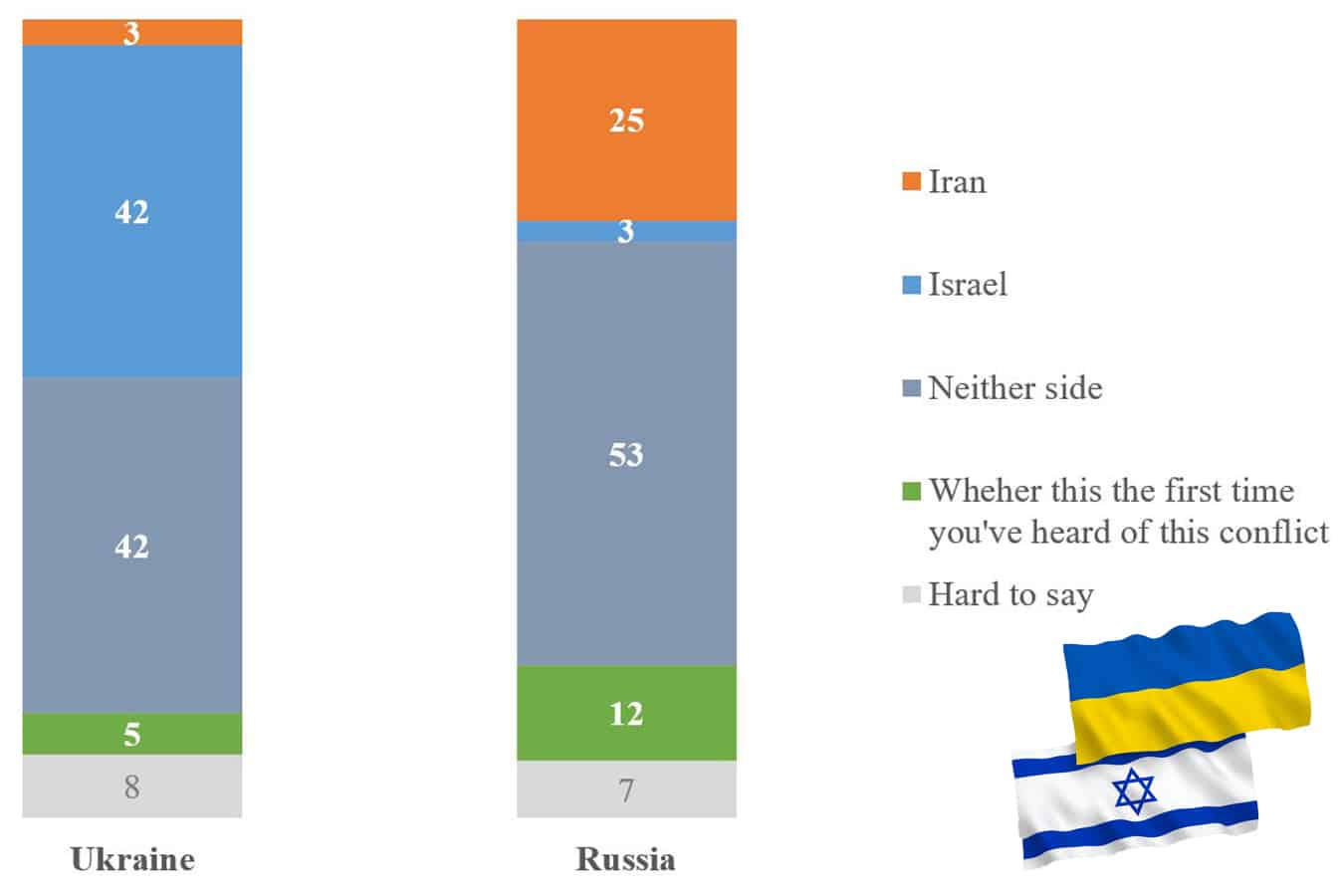
“Significantly more Ukrainians sympathize specifically with Israel. Thus, 42% sympathize with Israel and only 3% – with Iran. 42% do not sympathize with either side“, – stated in the report on the results of the study.
Fresh KMIS data record a stable advantage of sympathies towards Israel in the confrontation with Iran. The trend opens a window of opportunity for practical cooperation between Kyiv and Jerusalem — from security to humanitarian programs.
Who Ukrainians sympathize with and why it matters
The June 12-day war between Israel and Iran was a test not only for the military but also for public opinion. Against this background, the Kyiv International Institute of Sociology (KMIS) conducted a nationwide survey by telephone interview method (CATI): 1,022 interviews with citizens aged 18+, July 23 — August 4, 2025, only in territories controlled by Ukraine.
The survey was published on August 8, 2025.
To the direct question “Who do Ukrainians sympathize with in the Israel-Iran conflict?” the answer was clear: 42% — on Israel’s side, 3% — on Iran’s side, another 42% prefer to remain “for neither”.
How attitudes have changed
It is noted that Ukrainians have previously expressed support for Israel in surveys.
To see the movement, you need to compare data from different years:
- December 2021: 54% — “for neither”, 28% — for Israel, 1% — for Iran.
- January 2023 (against the backdrop of Iranian weapons with the Russian Federation): 64% — for Israel, 1% — for Iran, 18% — for neither.
- December 2023 (after October 7): 69% supported Israel in the conflict with Palestine.
The summer of 2025 does not break the line: the share of “neutrals” is noticeable, but among those who have decided, the balance is consistently in favor of Israel.
Geography of sympathies
A breakdown by macro-regions shows the same logic: in all regions of Ukraine, sympathies lean towards Israel, with maximum values in the Central macro-region. This is not a local spike in one city or region, but a nationwide pattern that crosses language and confessional differences.

KMIS Executive Director Anton Hrushetskyi, commenting on the survey results, noted that Ukrainians understand the need for peaceful and mutually respectful coexistence regardless of religion, but at the same time understand the importance of long-term security.
“The official attitude of the Iranian leadership or Hamas terrorists (here we must emphasize that we are not talking about ordinary Iranians or Palestinians) towards Israel cannot but recall the open calls of Russians (both in power and among the general population) for the liquidation of the Ukrainian nation.
Such rhetoric leaves little room for action other than to resist, and therefore for many Ukrainians the parallels between Israel and Ukraine are obvious. The statement of the legendary G. Meir “It is impossible to negotiate peace with those who came to kill you” illustrates the situation in both Israel and Ukraine,” he noted.
Survey methodology
- Method: CATI — telephone interviews on a random sample of mobile numbers with subsequent statistical weighting.
- Sample: 1,022 respondents aged 18+; part of IDPs included; residents of temporarily occupied territories and citizens who left after 24.02.2022 excluded.
- Margin of error: with a confidence probability of 0.95 and a design effect of 1.3 — up to 4.1% for shares around 50%; 3.5% — around 25%; 2.5% — around 10%; 1.8% — around 5%.
- Wartime: KMIS warns of the risk of systematic deviations, but emphasizes the high representativeness of estimates.
For readers of “NAnews – News of Israel” this means that the data can be compared across years and track real trends.
Comparison with Russia
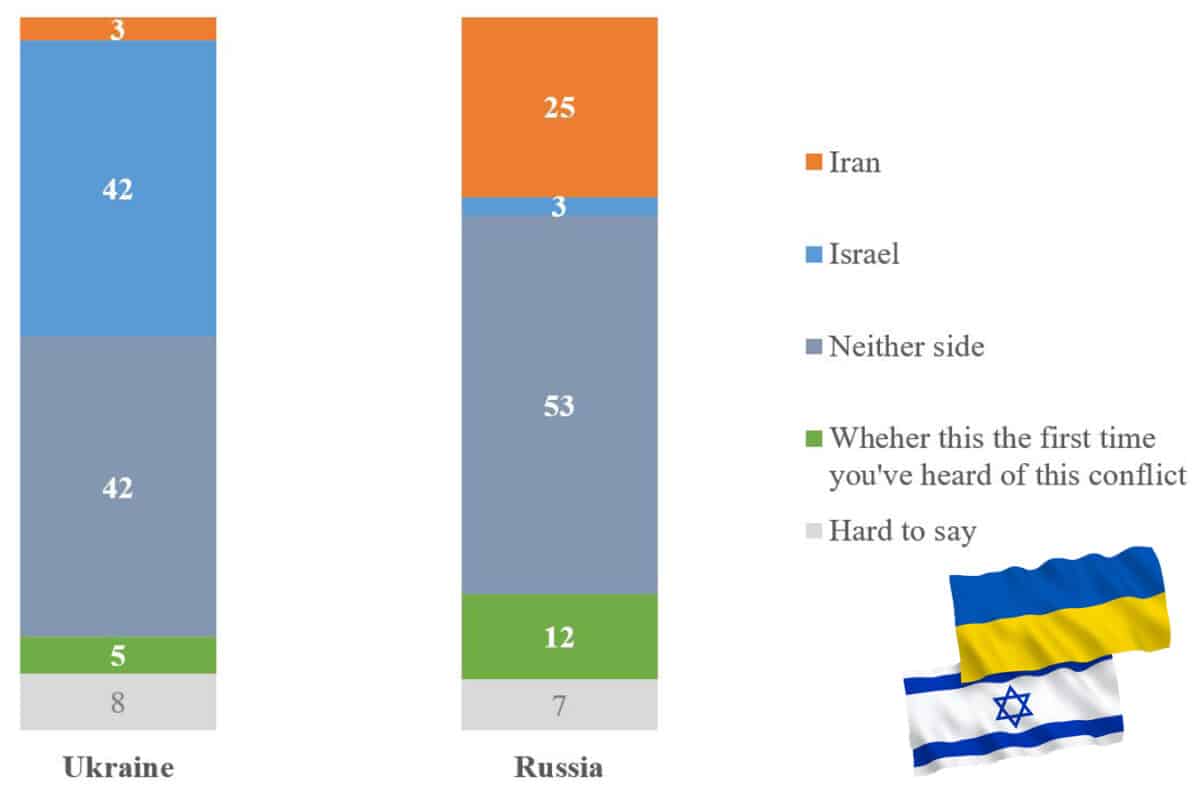
Ukrainian data were compared with the results of the Levada Center in the Russian Federation. In Russia — a different picture: 3% sympathize with Israel and 25% — with Iran.
In Ukraine — the opposite: 42% for Israel and 3% for Iran. For Israeli diplomacy, this is a direct signal: Ukrainians are natural allies of Israel in the matter of containing Iran; the Russian public atmosphere is much more favorable to Tehran.
What is behind the numbers
KMIS Executive Director Anton Hrushetskyi describes a process familiar to Israelis: during the war, an inclusive Ukrainian political nation is being formed, where Jews, Muslims, Christians and atheists act side by side. Mentioned alongside are Chief Rabbi of Ukraine Moshe Reuven Asman (whose son died defending the country) and Said Ismagilov, the spiritual leader of Muslims, who joined the Armed Forces of Ukraine in 2022 as a combat medic.
Against this background, the rhetoric of Iran and Hamas terrorists is perceived in Ukraine as a threat of the same order as Russian calls to destroy Ukrainian identity.
Hence — empathy for Israel while maintaining criticism of certain decisions of Israeli politicians.
“Although this, of course, is superimposed on the feeling of many Ukrainians that the leadership of Israel provides insufficient support to Ukraine, despite the similarity of the situation in which the countries found themselves. In addition, many Ukrainians are concerned about the situation in the Gaza Strip and in general about the fate of the Palestinians”.
Practical conclusions
- Security and technology: protection of critical infrastructure, air defense, EW, medical equipment.
- Direct communication: fewer intermediaries, more targeted programs for society, municipalities and expert platforms.
- Diasporas as a bridge: the Ukrainian community in Israel and the Jewish community of Ukraine are a resource of trust; educational and memorial initiatives work better than protocol statements.
- Media and analytics: transparent methodology turns public sympathies into a stable agenda, not into an emotional wave.
Briefly
- 42% of Ukrainians — on Israel’s side; 3% — on Iran’s side; 42% — for neither.
- Support for Israel is higher in all regions, maximum — in the Center.
- In Russia: 3% — for Israel, 25% — for Iran (by comparable wording).
- n=1022, CATI, 23.07–04.08.2025; design effect 1.3; margin of error up to 4.1% at 50%.
Why the topic will not disappear
“In any case, we hope that our results in Ukraine and the results of the survey in Russia will prove to the leadership and people of Israel that it is Ukrainians (and not Russians) who are natural allies of Israel and that Israeli-Ukrainian cooperation has strong potential for both sides,” summarized KMIS Executive Director Anton Hrushetskyi.
This is not a plot about diplomatic courtesies. It is about the right to security and the price societies pay under constant threat. Israel and Ukraine have long spoken a common language of risks, and the KMIS survey makes this visible in numbers. The next step is to turn public chemistry into practical partnership.
Kyiv International Institute of Sociology (KMIS) — is a Ukrainian independent research organization specializing in sociological and marketing research.
Founded in the 1990s, headquarters — in Kyiv. KMIS is known as one of the most authoritative polling centers in Ukraine. They conduct:
- national and regional public opinion polls;
- political and electoral research;
- marketing and media sociology projects.
Methods — telephone and personal interviews, online surveys, focus groups. KMIS is often cited by Ukrainian and international media, and its data are used in scientific and analytical materials.
From the editors of NAnews – News of Israel:
For us, as a publication that writes daily about the ties between Israel and Ukraine, the results of this KMIS survey are yet another confirmation that our countries and peoples see each other as allies in matters of security and survival. Ukrainians, despite all the difficulties and ambiguous moments in politics, continue to share with Israelis the experience of fighting for the right to exist. We will continue to follow such research, because it helps to understand what a strong partnership between Jerusalem and Kyiv can be built on — not only at the level of politicians, but also in the hearts of people.