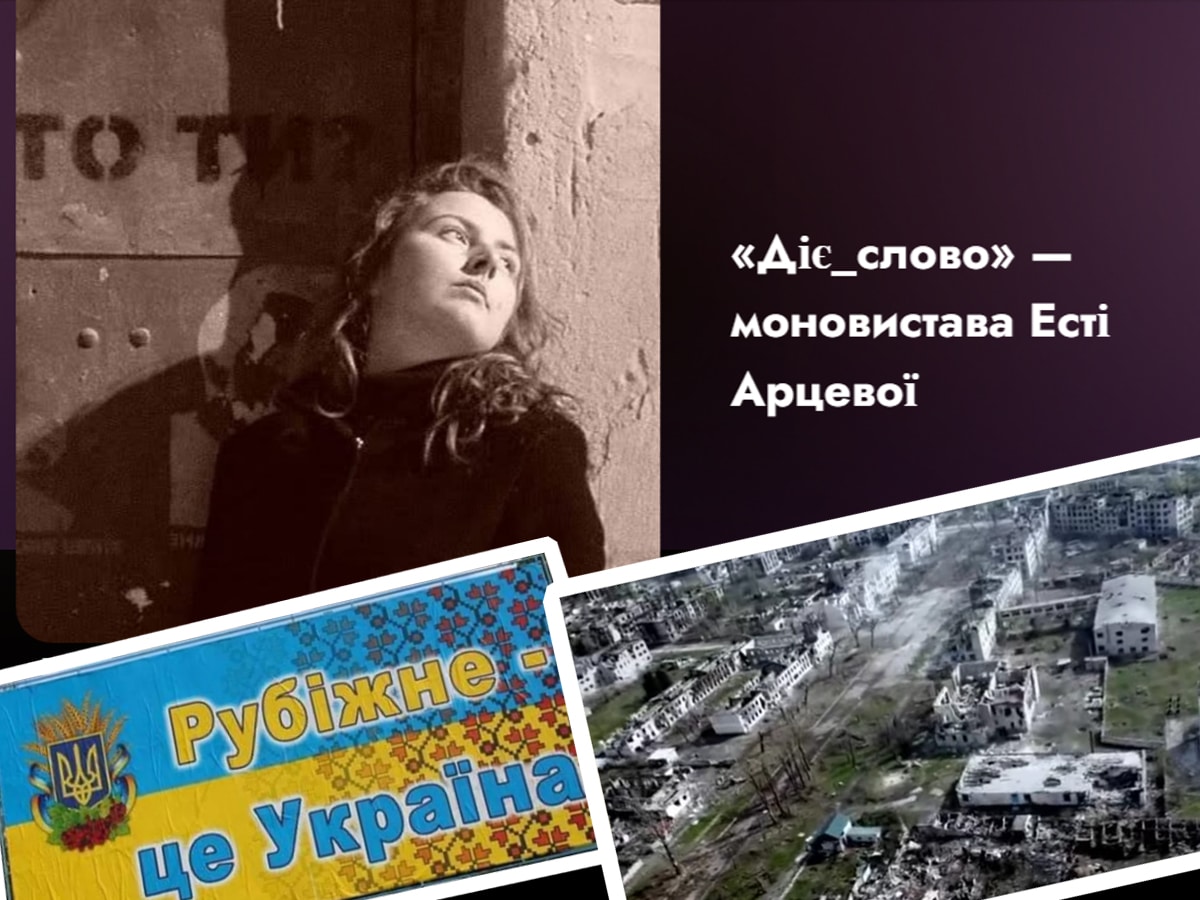
Rubizhne
49°02′00″ N 38°22′19″ E
Have you ever heard of this city?
Have you seen it on a map, have you ever been there?
- What does a city feel when it’s caught in armed conflict?
- What does an immobile grandmother say, who still remembers the war with the Nazis as a child?
- What goes through the minds of a mother and her children fleeing on the last evacuation train?
- What stirs in the soul of a Ukrainian soldier born in a nearby village, now forced to retreat?
- What does a Wagnerite dream of an hour before death?
- And what occupies the swarm of angels of life and death hovering over the city?
Questions you will witness with your own eyes — through monologues, poetry, and raw emotion.
This performance contains real memories of Rubizhne residents — friends, relatives, and acquaintances of the author.
“The City That No Longer Exists”: A Monodrama About Ukrainian Rubizhne Premieres in Jaffa
This is a monodrama by Esti Artseva, based on real events.
On May 29, 2025, an extraordinary theatrical performance will take place in Jaffa, uniting poetic expression, living memory, and the raw truth of the pain Ukraine continues to endure. “DІЄ_СЛОВО” (“Verb_Action”) is a monodrama written and performed by poet and cultural activist Esti Artseva, based on real testimonies from residents of the Ukrainian city of Rubizhne, destroyed by Russian occupation forces.
The performance will take place at Nothing (HaTsorfim 29, Jaffa).
Event Organizer
Anastasia Esti Artseva — poet, actress, and public figure who actively defends Ukrainian memory and cultural identity in Israel. Her family roots are closely tied to Eastern Ukraine. Her brother is currently serving in the Ukrainian Armed Forces, and part of her personal history is deeply connected with Rubizhne.
She runs the poetic Telegram channel “Чуєш?” (“Do You Hear?”) and regularly participates in solidarity events for Ukraine in Israel, including poetry readings and public actions in Haifa and Tel Aviv.
What is the performance about?
“DІЄ_СЛОВО” is more than a theater piece. It is a confession, stitched from the lived experiences of Esti Artseva’s friends, family, and acquaintances — people whose lives were shattered by war.
This is a polyphony of voices:
Living testimonies.
Uninvented destinies.
The voices of Rubizhne — of the living and the dead.
Come and listen.
This monodrama is based entirely on real events.
“And this is your contribution to remembering all occupied cities of Ukraine.”
Format: Q&A session after the performance
More from the author:
https://www.facebook.com/events/s/монодрама-діє_слово/2794910717564404/
Audience Information
| Date | May 29, 2025 (Thursday) |
|---|---|
| Time | 20:00–22:30 |
| Venue | Nothing, HaTsorfim 29, Jaffa |
| Duration | 1 hour 10 minutes + Q&A |
| Age | 18+ |
| Languages | Ukrainian and Russian |
Tickets:
https://web.vibez.io/events/vystava
Part of the proceeds will go toward supporting the Armed Forces of Ukraine.
Why You Should Come
- To hear the real stories of those whose voices were nearly silenced.
- To preserve the names of Ukrainian cities erased by war.
- To express solidarity and resistance through culture.
- To remember that Ukraine’s pain is also our shared human memory.
Israel is home to thousands of Ukrainian-origin citizens. Their tragedies resonate here.
NAnews – Israel News supports cultural initiatives that strengthen the bond between the Ukrainian and Jewish peoples through memory, truth, and cultural connection.
Rubizhne: A Ukrainian City Erased by Putin’s Occupiers
Rubizhne is a Ukrainian city in the Luhansk region, formerly an industrial hub with a population of around 56,000. Located along the Siverskyi Donets River, it was part of the Severodonetsk urban agglomeration. Chemical plants, a cardboard packaging plant, a rail station — all formed the backbone of a functioning working-class city.
Since 2014 – A Ukrainian Stronghold
After Russia’s hybrid invasion in 2014, when much of Luhansk was occupied, Rubizhne remained under Ukrainian control. It became a refuge for internally displaced people from occupied cities. Despite its proximity to the frontline, the city functioned — schools, hospitals, and civic life continued.
2022: A City No Longer There
With the full-scale invasion, Rubizhne became a frontline target. Between March and May 2022, the city was relentlessly shelled and bombed by Russian forces. Civilians lived in basements without food, water, or medical care. Evacuation became nearly impossible. Entire families perished.
Scorched Earth
Over 80% of the city was destroyed. Residential blocks, schools, hospitals — leveled. Satellite imagery reveals total obliteration. Many survivors were forcibly deported to Russia. Children were taken to “camps” or adopted into Russian families. Rubizhne became a symbol of the Kremlin’s war on life itself.
Memory that Can’t Be Erased
Unlike Mariupol or Bakhmut, Rubizhne’s destruction received less global attention. But that’s why it must be remembered. This city deserves to be named, mourned, honored. Esti Artseva’s monodrama revives its memory — not through propaganda or statistics, but through the human voice.
A Silent Tragedy — Given Voice on Stage
Rubizhne is more than a dot on the map. It is a story we must hold onto. A testimony we must share. On May 29 in Jaffa, it will be spoken aloud — in poetry, in pain, and in resistance.
Tickets:
https://web.vibez.io/events/vystava
More from the author:
https://www.facebook.com/events/s/монодрама-діє_слово/2794910717564404/