On January 27, 1945, Soviet soldiers entered one of the children’s barracks of the Nazi camp Auschwitz. Seeing people in military uniforms, two children were frightened and shouted: “We are not Jews!”
They were Jews. But the children did not yet know that they were facing liberators. They feared that the arriving soldiers might be Nazis and send them to the gas chamber. In the camp, belonging to the Jewish people meant a constant threat of death for them.
This episode was recounted sixty years later to American journalists by Anatoly Shapiro — a Jew from Ukrainian Konstantinograd, a major in the Red Army, and a participant in the liberation of Auschwitz. He was 92 years old at the time. Behind him were several years of war, heavy battles, and injuries. But what he saw in January 1945 continued to return to him in nightmares.
Author: Elena Gunko
Before the war, Shapiro was an engineer, a deputy of the Zaporizhzhia City Council, and the head of the city’s planning body. In the fall of 1941, he voluntarily went to the front. In January 1945, he participated in the liberation of Auschwitz — a camp complex on the territory of occupied Poland, where the Nazis exterminated about 1.1 million people, mostly Jews.
After the war, he participated in the restoration of the DniproHES and the construction of power plants, and in 1992 he emigrated to the USA. He died on October 8, 2005, in New York. Eleven months later, President Viktor Yushchenko posthumously awarded him the title of Hero of Ukraine.
This material was prepared for the popular science section of NAnovosti “JeJews from Ukraineical research or provide a final resolution of scientific disputes. Our task is to tell a wide audience about little-known pages of the common Ukrainian-Jewish history, to introduce readers to people, events, and documents. Some information is interpreted differently by historians. For those who want to study the topic deeper, we suggest referring to the sources mentioned in the article.
Anschel Faytelovich from Konstantinograd
Anatoly Shapiro was born on January 18, 1913, in Konstantinograd, Poltava province of the Russian Empire. Today it is Berestyn in the Kharkiv region of Ukraine, until 2024 — Krasnograd.
At birth, the boy was named Anschel Faytelovich Shapiro. His father was Faytel Mordukhovich, and his mother was Sarah Anshlevna. Biographical publications link information about the family with a record in the local rabbi’s metric book. Such books, in which Jewish communities registered births, marriages, and deaths, remain important sources on the history of Jews in Ukraine today.
Later, Anschel became known as Anatoly Pavlovich. In 1934, he graduated from the Zaporizhzhia Engineering and Pedagogical Institute. A year later, he received the rank of junior reserve lieutenant, and in 1937–1939 he worked at a technical school at the Dneprospetsstal metallurgical plant.
In 1939, Shapiro was elected a deputy of the Zaporizhzhia City Council. Then he headed the city planning body of the executive committee, responsible for economic development and industry issues.
When Germany attacked the Soviet Union, the 28-year-old engineer held a managerial position. According to biographical evidence, he could have expected evacuation due to his service, but in October 1941, he went to the front as a volunteer.
Four years of war: from Tuapse to Auschwitz
Shapiro began his frontline service in 1941. He fought as part of the 76th Marine Rifle Brigade, commanding a separate battalion. He participated in battles in the Kuban, near Tuapse, Rostov-on-Don, Taganrog, and on the Mius River, where German troops created a powerful defensive line.
His military biography also included the Battle of Kursk, an injury near Prokhorovka, and the crossing of the Dnieper. In 1943, he performed staff duties, including in the operational department of the 43rd Army.
By early 1945, Major Shapiro served in the 106th Rifle Corps of the 60th Army of the 1st Ukrainian Front. For Israeli readers, we clarify: this was a formation of the Red Army, not a separate national Ukrainian army. Representatives of different peoples of the Soviet Union served in its units.
In January 1945, Soviet troops were advancing on the territory of Poland. On the path of the 60th Army was the city of Oswiecim, the German name — Auschwitz.
January 27, 1945: the liberation of Auschwitz
Ten days before the arrival of Soviet troops, the Nazis began evacuating prisoners. From January 17 to 21, about 56–60 thousand people were taken out of the camp complex and driven west. People walked in winter weather, exhausted by hunger and disease. Those who lagged behind were shot. These marches went down in history as “death marches.”
At the same time, the SS destroyed documents, blew up gas chambers and crematoria, trying to hide the traces of mass murders. The last crematorium in Birkenau was blown up on January 26.
On January 27, units of the 60th Army of the 1st Ukrainian Front liberated Auschwitz. The camp complex included several large camps — Auschwitz I, Auschwitz II — Birkenau, Auschwitz III — Monowitz — and many sub-camps. Therefore, its liberation cannot be reduced to a single storming of the gates.
In the battles for Oswiecim and the camp facilities, more than 230 Soviet servicemen were killed.
In the three main camps, Soviet soldiers found about seven thousand living prisoners, including hundreds of children. Many were in critical condition. About five hundred more people were liberated in sub-camps shortly before or soon after January 27.
“We are not Jews!” — testimony of Anatoly Shapiro
On March 6, 2005, the New York Daily News published an interview with 92-year-old Shapiro by journalist Walter Ruby. The conversation took place in the veteran’s apartment in the Coney Island area of New York.
Shapiro recalled people in striped camp clothing standing in the snow. They were so emaciated that they could barely move. Some wrapped their feet in rags instead of shoes. Hearing that liberators had come, the prisoners did not immediately believe it. They approached the soldiers, touched their clothes and hands, trying to convince themselves that what was happening was real.
Shapiro quoted the soldiers: “The Red Army has come to liberate you.”
In the barracks, soldiers found the living next to the dead. Shapiro described the heavy smell, dirt, blood, and people no longer able to rise from the bunks on their own.
He especially remembered two children.
In one of the rooms marked Kinder — “children” in German — soldiers found two living children. Seeing people in military uniforms, they began to scream that they were not Jews. According to Shapiro, the children were Jews but feared they would be sent to the gas chamber.
Military medics took them to be washed and fed. The names of the children were not mentioned in the published interview, nor is their further fate known. Shapiro did not claim that they had previously been taken to the gas chamber.
The condition of the other survivors was no less severe. Many had starved for so long that regular food could be dangerous for them. Medical assistance, gradual restoration of nutrition, and treatment of infectious diseases were required. After liberation, measures were taken to clean the barracks and prevent epidemics.
Later, assistance to the prisoners was provided by Soviet medical services and the Polish Red Cross. Thousands of former prisoners, including hundreds of children, received treatment in a hospital organized by Polish medics.
Even sixty years later, Shapiro told journalists that what he saw in the camp continued to haunt him in his dreams.
Who entered Auschwitz first: testimonies and documents
In several publications, Anatoly Shapiro is called the commander of a battalion of about five hundred servicemen, one of the first to enter Auschwitz. This version has been established in his popular biographies.
However, research by S. A. Lipatov, based on Soviet military documents, indicates that in January 1945, Shapiro was listed as the assistant chief of the operational department of the 106th Rifle Corps. The researcher did not find documentary confirmation of his command of a separate assault battalion at the time of the camp’s liberation.
The liberation of the camp complex involved units from several formations, including the 100th and 322nd Rifle Divisions. Therefore, it is impossible to establish one indisputable first officer who opened the gates of all of Auschwitz.
At the same time, in the official decree of the President of Ukraine No. 768/2006, Shapiro is named the commander of a separate rifle battalion of the 100th Rifle Division, participating in the liberation of Oswiecim on January 27, 1945. This wording reflects official recognition of his military merits, although it differs from some archival information about the position he held.
There is no reason to deny Shapiro’s participation in the camp’s liberation. His lifetime testimonies also remain an independent historical source. But the claim that he single-handedly first opened the gates of Auschwitz requires a caveat.
How many people died in Auschwitz
After the war, the Soviet Extraordinary Commission estimated the number of deaths in Auschwitz at about four million people. This figure appeared in the materials of the Nuremberg Trials, but further historical research revised it.
According to modern estimates by the Auschwitz-Birkenau State Museum, about 1.3 million people were deported to the camp complex, of which approximately 1.1 million were killed. About a million victims were Jews. Among the other dead were approximately 70–75 thousand Poles, 21 thousand Roma and Sinti, about 14–15 thousand Soviet prisoners of war, and thousands of prisoners of other nationalities.
These data are based, in particular, on the research of historian Franciszek Piper, who studied deportation documents, camp records, and demographic information.
Auschwitz, Israel, and Jews from Ukraine
January 27, the anniversary of the liberation of Auschwitz, has been International Holocaust Remembrance Day since 2005, established by the United Nations General Assembly. In Israel, there is also a separate national memorial date — Yom HaShoah, Holocaust and Heroism Remembrance Day, observed on the 27th of Nisan according to the Jewish calendar with legally established transfers.
Testimonies of Holocaust survivors are preserved at Yad Vashem — the national memorial complex of Holocaust and Heroism history in Jerusalem. Among the millions of victims of Nazi extermination were relatives of future citizens of Israel, Jews from Ukraine, Poland, Hungary, and other European countries.
Anatoly Shapiro was never a citizen of Israel, but his story is directly connected to the Jewish people. He was born into a Jewish family in Ukraine, participated in the liberation of a camp where about a million Jews were killed, and at the end of his life, he left testimonies about what he experienced.
In the NAnovosti section “Jews from Ukraine,” there is the story of another native of Ukraine connected to Auschwitz — Kyiv resident Yura Lifshits. In April 1943, he, along with Robert Mestrio and Jean Franklemon, participated in the Belgian Resistance’s attack on the twentieth convoy transporting Jews to the camp. Hundreds of prisoners managed to escape from the train.
Lifshits tried to save people on the way to Auschwitz. Shapiro, two years later, participated in the liberation of those who survived camp imprisonment. Both were born into Jewish families on Ukrainian soil.
NAnovosti — News of Israel | Nikk.Agency continues to tell about these people, whose fates connect the history of Ukraine, Israel, and European Jewry.
After the war: Prague, Zaporizhzhia, DniproHES, and New York
After the liberation of Auschwitz, Shapiro continued his military service and ended the war in Prague. In the post-war period, he held a position in the headquarters of the 65th Army. He was demobilized in 1947.
Returning to civilian life, he worked as an engineer again. He participated in the restoration of the DniproHES in Zaporizhzhia, the construction of the Kuybyshev Hydroelectric Station, and worked in Siberia and Kaliningrad. The DniproHES, a large power station on the Dnieper, was severely damaged during World War II and required extensive reconstruction.
In 1972, Shapiro moved to the Moscow region. In 1992, together with his wife Vita, he emigrated to the United States, settling in the Coney Island area of Brooklyn, where a large community of immigrants from the former USSR had formed.
In America, he spoke at memorial events, gave interviews, and talked about the liberation of Auschwitz. In May 2005, his last book “Sinister Marathon” was published.
In his later interviews, Shapiro recalled not only the liberation of the camp but also the Soviet years, work, service, and his attitude towards the collapse of the USSR. He emphasized that he was proud of the Red Army’s participation in the liberation of the prisoners, and he spoke of his life in the Soviet Union with regret for the bygone era.
When asked what he felt as a Jew among the first liberators, Shapiro replied: “I was very proud to be among the first liberators.” At the same time, he spoke of his pride primarily for the Red Army’s participation in the camp’s liberation.
Combat and state awards of Anatoly Shapiro
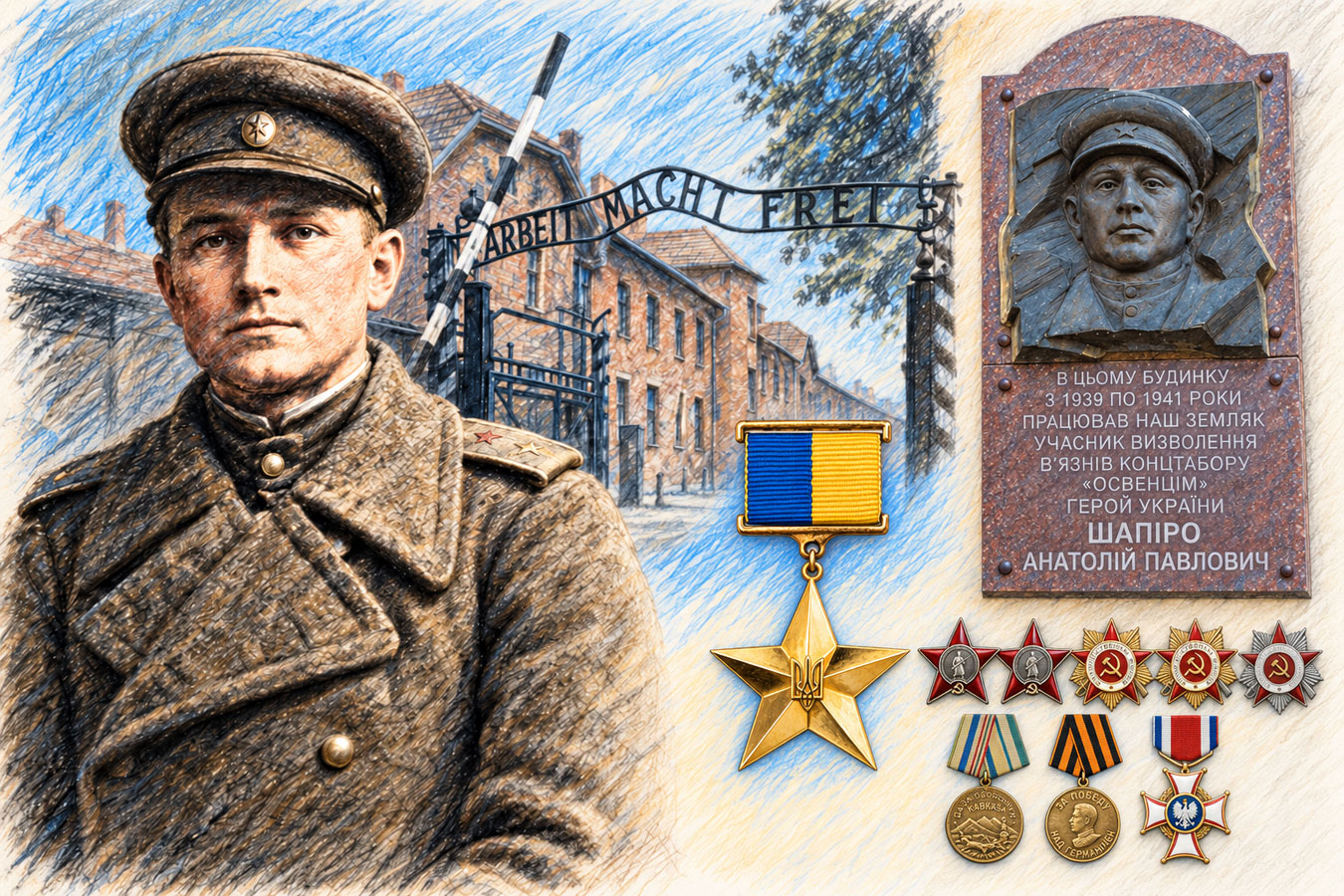
Anatoly Shapiro was awarded several Soviet combat orders and numerous medals. Biographical sources mention twenty orders and medals. The Zaporizhzhia Regional State Administration, in a publication on May 9, 2008, separately mentioned fourteen medals.
Among the established Soviet awards:
- Two Orders of the Red Star — awarded on February 7 and October 28, 1943. In the materials of the Zaporizhzhia Regional Administration, they are associated with battles near Tuapse and Kanev.
- Two Orders of the Patriotic War, 1st class. One of them is dated April 30, 1945. The date of the second award requires separate confirmation from the award document.
- Order of the Patriotic War, 2nd class — August 5, 1944.
- Medal “For the Defense of the Caucasus” — May 1, 1944.
- Medal “For the Victory over Germany in the Great Patriotic War of 1941–1945” — May 9, 1945.
The dates of the listed awards are provided according to the archival card index of the Ministry of Defense of the USSR. The information from the Zaporizhzhia Regional Administration also mentions awards for battles near Krakow and Prague.
Polish state award. In 2005, on the sixtieth anniversary of the liberation of Auschwitz, Shapiro was awarded a Polish distinction. Biographical publications mention the Cross of Merit of the Republic of Poland; in some sources, there is also mention of the officer’s degree of the Order of Merit of the Republic of Poland. The exact list of Polish awards requires verification with original Polish documents.
Due to his poor health, Shapiro could not travel to Poland for the commemorative events. The award was presented to him in New York with the participation of Polish Consul Agnieszka Miszewska. At the celebrations in Krakow, his video message was shown, in which he urged not to allow the repetition of Nazi crimes.
Hero of Ukraine. On September 21, 2006, already after Shapiro’s death, President Viktor Yushchenko awarded him the title of Hero of Ukraine with the Order of the Golden Star. This is the highest state title of Ukraine, awarded for personal courage, heroic self-sacrifice, and steadfastness in the fight against Nazi invaders.
It is important to distinguish between the two distinctions existing in the system of the title of Hero of Ukraine: the Order of the Golden Star is awarded for a heroic deed, and the Order of the State is for outstanding labor achievements. Shapiro was posthumously awarded the “Golden Star.”
How Ukraine commemorated Anatoly Shapiro
On September 21, 2006, President of Ukraine Viktor Yushchenko signed decree No. 768/2006 “On awarding the title of Hero of Ukraine.” Anatoly Shapiro was posthumously awarded the title of Hero of Ukraine with the Order of the Golden Star.
In the decree, he is named the commander of a separate rifle battalion of the 100th Rifle Division and a participant in the liberation of the Auschwitz concentration camp. The same document posthumously awarded the title of Hero of Ukraine to Tatiana Iosifovna Markus — a Jewish participant in the anti-Nazi underground in Kyiv, executed by the Nazis in 1943.
Thus, with one presidential decree, Ukraine honored two people of Jewish origin who participated in the fight against Nazism: an underground fighter from Kyiv and a frontline officer born in Konstantinograd.
On May 9, 2008, a memorial plaque to Anatoly Shapiro was unveiled in Zaporizhzhia on the building where the city executive committee was located from 1939 to 1941. He worked there until he went to the front. By the time the plaque was unveiled, the building housed the city police department.
The ceremony was attended by the acting first deputy minister of foreign affairs of Ukraine Yuri Kostenko, the acting head of the Zaporizhzhia Regional State Administration Valery Cherkaska, the mayor of Zaporizhzhia Yevgeny Kartashov, and Shapiro’s relatives.
On behalf of the family, his grandson Yuri Shapiro, who lived in Zaporizhzhia, spoke, thanking the participants of the ceremony for preserving the memory of his grandfather. The author of the memorial plaque was Zaporizhzhia architect Alexey Mashkadov.
On the memorial plaque, made in Ukrainian, a bas-relief of Shapiro in military uniform is installed. The inscription states that in this building from 1939 to 1941, a native, a participant in the liberation of the prisoners of the Auschwitz concentration camp, Hero of Ukraine Anatoly Pavlovich Shapiro worked.
His memory was also preserved in the United States: a memorial stand dedicated to Shapiro was set up in the Brooklyn Holocaust Survivors Club.
How Anatoly Shapiro is remembered in Israel
Although Anatoly Shapiro never lived in Israel, his name is present in Israeli historical journalism, museum stories about World War II, and even in speeches by Knesset members. Here he is remembered primarily as a Jewish officer of the Red Army who participated in the liberation of Auschwitz.
Museum of the Jewish Warrior in Latrun
In the Museum of the Jewish Warrior of World War II named after Chaim Herzog (מוזיאון הלוחם היהודי במלחמת העולם השנייה), located in the Latrun area near Jerusalem, Shapiro’s story is part of the narrative about Jewish servicemen who fought against Nazi Germany.
In January 2025, on the 80th anniversary of the liberation of Auschwitz, the Israeli newspaper “Yedioth Ahronoth” published an article by journalist Iris Lifshitz-Kliger “הגבורה היהודית כפי שלא ראיתם” — “Jewish heroism as you have not seen it.”
Deputy Director of the Museum for Information and Excursion Work Asaf Efrati said that visitors are explained: among those who participated in the liberation of Auschwitz was a Jewish major of the Red Army, Anatoly Shapiro, who voluntarily went to war despite being exempt from conscription.
The museum is dedicated to approximately one and a half million Jews who served in the armies of the Allies and participated in the resistance to the Nazis. Alongside Shapiro, they tell about the navigator of the Soviet aviation Polina Gelman and the leader of the anti-Nazi underground in Algeria Jose Aboulker.
January 27, 2026: Shapiro’s name was mentioned in the Knesset
Eighty-one years after the liberation of Auschwitz, on January 27, 2026, Knesset member Yevgeny Sova spoke at a special session dedicated to International Holocaust Remembrance Day and the fight against anti-Semitism.
Talking about the contribution of Jews to the defeat of Nazi Germany, he recalled his own family, relatives who fought in the Red Army, and Anatoly Shapiro. According to the deputy, Shapiro was a Jewish major who participated in the liberation of Auschwitz and spoke with the liberated prisoners in Yiddish.
Sova emphasized that the history of Jewish soldiers who fought against Nazism should occupy an important place in the historical memory of the Jewish people. In conclusion, he expressed hope that future generations would remember the names of these servicemen alongside other heroes of Jewish history.
The speech was preserved in the transcript of the Knesset session on January 27, 2026. The details provided by the deputy relate to his public account and do not remove archival questions about Shapiro’s exact position in January 1945.
Israeli press and biography in Hebrew
On January 24, 2018, the English-language Israeli newspaper The Jerusalem Post published an article by journalist Martin Siff “Auschwitz hero” — “Hero of Auschwitz.” The material was dedicated to Anatoly Shapiro as a Jewish combat commander who participated in the liberation of the Nazi camp.
A separate biography of Anatoly Shapiro is available in the Hebrew Wikipedia under the title “אנטולי שפירו.” The article details his pre-war work in Zaporizhzhia, military service, liberation of Auschwitz, emigration to the USA, awards, and posthumous awarding of the title of Hero of Ukraine. It also reproduces his testimony about how the liberated prisoners touched the Soviet soldiers, trying to believe that the liberators had come.
In the Hebrew Wikipedia and several Israeli publications, Shapiro is called an officer who personally opened the gates of Auschwitz. However, in the study of Soviet military documents, this version did not receive unequivocal confirmation. Therefore, information from Israeli publications should be compared with archival research, not confusing the memory of the person with the question of exact precedence in the camp’s liberation.
To date, it has been possible to document mentions of Shapiro in the Israeli parliament, museum narrative, and press. However, confirmations of the existence of a separate monument, memorial plaque, or street named after him in Israel have not yet been found.
The last years of life and the testimony that remained
Anatoly Shapiro died on October 8, 2005, in New York at the age of 92. He was buried at the Jewish cemetery Beth Moses on Long Island.
The veteran gave his last interviews already in a severe condition. He could not travel to Poland for the sixtieth anniversary of the liberation of Auschwitz, but he continued to tell journalists about the prisoners he saw in January 1945.
Among these memories was the story of two children who shouted to the Soviet soldiers: “We are not Jews!”
We do not know their names, we do not know where they were deported from, and we cannot trace their further lives according to Shapiro’s words. But thanks to his testimony, it is known what fear the children experienced even at the moment of liberation.
Anatoly Shapiro was born into a Jewish family in Konstantinograd, Ukraine, worked in Zaporizhzhia, went through the war, participated in the liberation of Auschwitz, and left memories of what he experienced. After the war, he worked as an engineer for decades, and spent his last years in the USA.
His merits were recognized with Soviet and Polish awards, a posthumous title of Hero of Ukraine, and a commemorative plaque in Zaporizhzhia. But the most famous testimony of Shapiro remains the story of two children who did not yet know that the arriving soldiers had saved their lives.