
In Haifa, the international MASHAV course titled “Innovative Approaches to Early Childhood Education and Development” has started — “Innovative Approaches to Early Childhood Education and Development.”
On July 6, 2026, the Embassy of Israel in Ukraine reported this on the official page Ізраїль в Україні – Israel in Ukraine.
Maria Prytula, acting head of the youth initiatives department of the Office “Lviv – European Youth Capital” of the Lviv City Council, represents Ukraine in the program.
At first glance, this is an ordinary diplomatic news about a professional course.
But in reality, it is about a much more important topic: Israel continues to share practical experience with Ukraine in a field that becomes one of the key areas during the war — working with children, families, communities, and urban support programs.
MASHAV course in Haifa: dates, location, and organizers
The full name of the program is Innovative Approaches to Early Childhood Education and Development.
According to the official brochure of the organizers, the course takes place in Israel from July 5 to 17, 2026. The arrival day of the participants is July 5, the official opening is on July 6, the course closure is scheduled for July 16, and the departure of participants is on July 17, 2026.
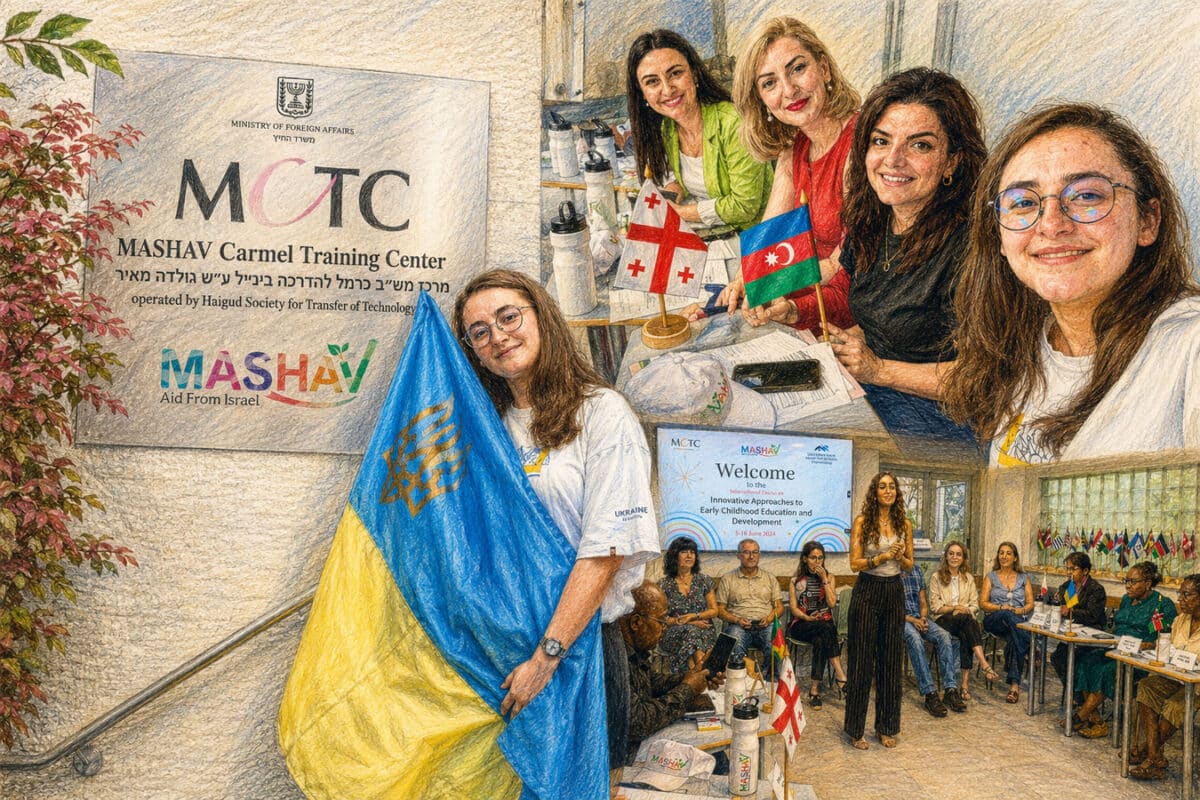
The organizer is MASHAV — the Agency for International Cooperation under the Ministry of Foreign Affairs of Israel.
The program is conducted in cooperation with University of Haifa, specifically with the Center for the Study of Child Development and the International Master’s Program in Early Childhood Education and Development at the School of Therapy, Counseling, and Human Development.
The venue is The Golda Meir MASHAV Carmel International Training Center, also known as MCTC.
The center is located on Mount Carmel in Haifa, at 12 David Pinsky Street. The official description states that the building includes residential facilities, classrooms, recreation areas, and dining for participants.
For Israel, this is not a one-time educational initiative.
MCTC was founded back in 1961 and operates in several areas: sustainable community development, early childhood education and development, entrepreneurship, and innovation. According to the organizers, about 30,000 participants from more than 147 countries have gone through the center’s programs.
Who participates and why it is important for Ukraine
The program is designed for mid- and high-level specialists.
The organizers indicate that the course is intended for representatives of government and municipal structures, non-governmental organizations, the academic environment, and other professional organizations involved in early childhood education and development.
Specific requirements were set for participants: relevant education or equivalent professional qualification, at least 5 years of practical experience, participation or intention to participate in early childhood education and development projects, knowledge of English, and an age range of 25–55 years.
In this context, the participation of Maria Prytula from Ukraine does not seem merely symbolic.
She represents a city institution in Lviv related to youth initiatives and urban program development. For Ukraine, where the war has changed the lives of millions of children, parents, educators, and communities, such experience can have practical significance — from preschool programs to urban family support services.
The Embassy of Israel in Ukraine noted in its message that the course brought together specialists from different countries to exchange experiences and study modern approaches to early childhood education and development.
For НАновости — News of Israel | Nikk.Agency, this story is also important because it shows not a loud declaration, but a living mechanism of cooperation between Israel and Ukraine.
Not a press release about intentions.
But a specific course, a specific city, a specific Ukrainian participant, and a specific topic that concerns the future of children.
What is studied in the program
The official course program covers several areas.
Among the stated topics are early childhood education and care in Israel, early emotional and social development, early intervention programs, priorities in early childhood education, creating a positive environment for child development, and coordination between community services.
A separate emphasis is placed on the resilience of the child, family, and community.
The program mentions the development of internal resources through various therapeutic approaches — art, music, movement, and other tools. For Ukraine, where children have been growing up for several years in conditions of anxiety, displacement, loss, and constant military threat, this part of the course is especially sensitive.
An important block is modern technologies in early childhood education.
Another is professional visits to Israeli kindergartens, day centers, organizations, and services that support children and their families.
So it’s not just about lectures.
The course format includes introductory sessions, professional visits, observations, workshops, and discussions. Participants are expected not only to familiarize themselves with the Israeli experience but also to present ideas that can be adapted in their countries and professional environments.
Why early childhood has become a separate topic of international cooperation
The course organizers directly call early childhood the first and most important period of a person’s life.
The official program description emphasizes that the first years of life are both a period of great opportunities and great risks. The quality of early experience affects brain development, learning ability, health, and further functioning of a person throughout life.
This is not an abstract pedagogical formula.
For a country at war, early childhood becomes a matter of national resilience. A child who receives support, a safe environment, quality education, and attention to emotional state has a better chance of recovering from crises and developing further.
Israel understands this logic well.
The official course brochure separately describes the Israeli experience: education in Israel begins at a very early age, many children aged 2–4 attend preschool institutions, some programs operate under local authorities, some under women’s organizations or in the private sector. Preschool education for five-year-old children is free and mandatory.
It is also noted that the curricula of preschool institutions are directed and controlled by the Ministry of Education of Israel to provide children with a solid foundation for further learning.
For Ukraine, this experience cannot be transferred mechanically.
But it can be useful as a model: how to build municipal programs, how to combine education, social support, work with parents, early intervention, and child protection.
MASHAV: Israeli diplomacy through knowledge
MASHAV is not a charitable foundation or a private educational project.
It is the official agency for international cooperation under the Ministry of Foreign Affairs of Israel, responsible for development and humanitarian aid programs. The MASHAV website states that the agency was established in 1958 and operates through the development of human potential, the transfer of Israeli experience, technologies, and proven methodologies.
One of the key principles of MASHAV is training of trainers, that is, the preparation of specialists who can then pass on knowledge further in their countries and professional communities.
That is why the participation of a Ukrainian representative in the course in Haifa should be considered more broadly than just one educational trip.
If such knowledge returns to Ukrainian cities, institutions, and community programs, it can work not only for one participant but for dozens and hundreds of specialists, families, and children.
In the official description of MASHAV, education is highlighted as one of the priority areas. The agency states that its activities in this field cover early childhood education, adult education, special education, programs for at-risk youth, innovations in the educational system, and teacher training.
Israel and Ukraine: cooperation where the future is decided
The Ukrainian agenda in Israel often sounds through war, security, diplomacy, aid, rocket attacks, recovery, and political decisions.
But there is another layer — working with human capital.
Children, families, educators, psychologists, municipal teams, social services — these are the people and structures that will hold Ukrainian society in the coming years.
That is why the MASHAV course in Haifa deserves attention.
It shows that Israeli-Ukrainian cooperation can be not only military or humanitarian in a narrow sense but also educational, professional, and long-term.
For Israel, this is part of international responsibility and development diplomacy.
For Ukraine — an opportunity to take practical experience from a country that has been building systems of resilience, education, community support, and early intervention in complex security conditions for decades.
For readers of НАновости — News of Israel | Nikk.Agency, the main conclusion here is simple: such programs rarely become big headlines, but it is through them that a real connection between countries is formed.
Not only at the level of embassies.
But at the level of people who work with children, cities, and the future.
If you want to see the Israeli-Ukrainian agenda without the Russian lens — add НАновости to Google.
https://www.google.com/preferences/source?q=nikk.agency
