
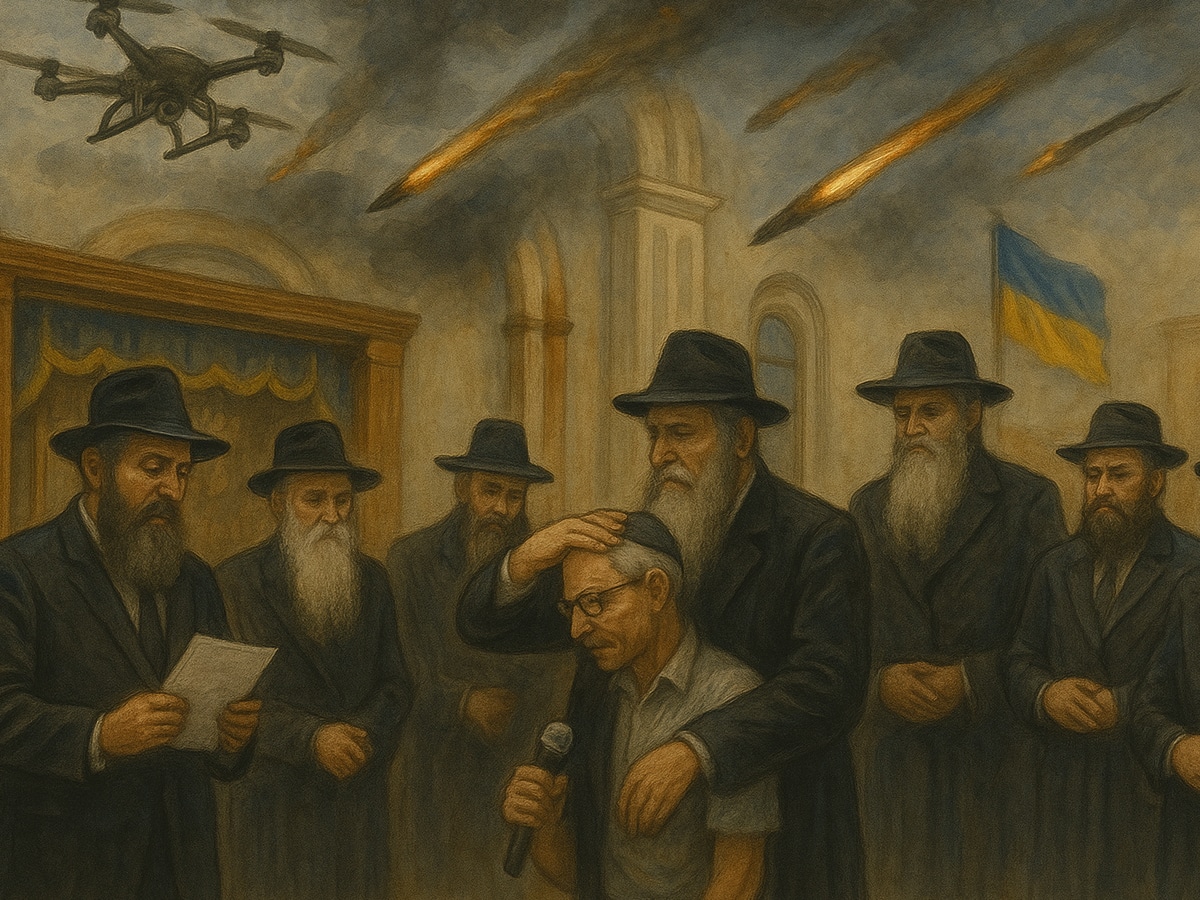
Against the backdrop of war, in the heart of Ukraine, a commandment forgotten for generations comes to life. Jews from all corners of the country — infants, teenagers, adults, and the elderly — gathered in Kremenchuk to perform a ritual that, for many, took a lifetime to reach.
Kremenchuk: A Ukrainian city struck again and again
Kremenchuk is the industrial heart of Poltava region, a city on the Dnipro River, a bridge between Central and Eastern Ukraine. From the first weeks of Putin’s full-scale invasion, it came under the fire of Russian missiles and drones. Since 2022, they have bombed the oil refinery, bridges, thermal power plant, residential buildings, and shopping centers. Dozens of civilians were killed. One of the most horrifying tragedies was the attack on the Amstor shopping mall on June 27, 2022 — 22 people died and over 50 were injured.
Since then, Kremenchuk has been under constant attack. The city withstands the strikes, treats the wounded, repairs the destruction, and continues to live. And just in recent weeks, Kremenchuk has again become a frontline target.
On the night of June 21, 2025, Kremenchuk suffered one of the most massive attacks of the entire war: according to Ukraine’s General Staff, Russia launched 272 Shahed drones and 8 missiles, including ballistic Iskander-M and cruise missiles Kalibr. There were over 40 explosions, residential buildings were burning, the refinery was damaged, energy infrastructure was hit, and at least one person was injured.
On July 6, late at night, a Russian kamikaze drone hit a military enlistment office and a neighboring residential building. The fire engulfed around 700 m², 14 buildings were damaged, and at least two civilians were injured.
But even under a storm of attacks, Jews and Ukrainians in Kremenchuk stand together — they take part in rituals, build, support each other, and do not lower their heads. This is not just resilience. This is a bond tested by iron and fire.
This event is a unique religious ritual called “Pidyon ha-Ben” (פדיון הבן), translated from Hebrew as “Redemption of the Firstborn.” But this time it took place in an unusual format.
What is “Pidyon ha-Ben” and why is it performed?
This event is a unique religious ritual that takes place on the 30th day after the birth of a baby boy. According to tradition, the father “redeems” his firstborn from a kohen — a descendant of an ancient priestly family. But why is such a redemption necessary, and where does it come from?
The ritual’s origins lie in the Exodus from Egypt
According to the Torah (Book of Exodus (שמות), chapter 13), God commanded the Jewish people that all firstborn males are special and belong to Him. This is related to the final plague in Egypt — as the Torah says, God spared the Jewish firstborns, striking only the Egyptian ones. As a sign of gratitude, Jews were commanded that every firstborn must be consecrated to God.
Originally, firstborns were meant to perform sacred duties in the Tabernacle — assisting in worship, participating in rituals, and caring for the sacred vessels.
However, everything changed after the incident with the golden calf. Only the tribe of Levi remained faithful to God, refusing to participate in idolatry. As a reward, the Levites were given the duties of temple service — instead of the firstborns. Since then, the kohanim (priests) and Levites became the temple functionaries, while “regular firstborns” did not.
Who are kohanim and Levites?
Kohanim are descendants of Aaron, the brother of Moses, from the tribe of Levi. They performed the main priestly roles: offering sacrifices, blessing the people, and teaching the law. Levites, in turn, assisted the kohanim: they sang in the Temple, guarded the grounds, and handled various duties. Serving in the Temple was not a privilege but an inherited obligation.
Why must firstborns be redeemed?
Since the kohanim and Levites replaced the firstborns in the Temple, any firstborn boy born into a non-kohen or non-Levite family must be “redeemed”. This is not a literal transaction but a symbolic act: the father gives the kohen five silver shekels (or equivalent), thereby releasing his son from the spiritual responsibility he cannot fulfill by birth.
When is “Pidyon ha-Ben” performed?
The ritual is performed on the 30th day of the baby’s life, if all the following conditions are met:
- The baby boy is the first child to open the mother’s womb;
- The birth was natural, not a C-section;
- The parents do not descend from the tribe of Levi or the kohanim family.
If these conditions are not met — redemption is not required.
What happens during the actual ceremony?
At the ceremony, the kohen asks the father: “Do you want to leave the child with me, or redeem him?” The father replies: “I want to redeem him.” He gives silver to the kohen, the kohen blesses the child, sometimes a shofar is blown, prayers are recited, and a festive meal is held. The child, of course, doesn’t understand anything yet, but those present feel — they are participating in a tradition that is thousands of years old.
And what happened in Kremenchuk?
This story was told on July 13, 2025, by the official website of the Israeli organization “Hidabroot” (הידברות) — one of the world’s largest Jewish religious media platforms.
It was founded by Rabbi Zamir Cohen (רב זמיר כהן) and focuses on spreading Jewish values, Torah, and tradition to a broad audience — both religious and secular.
Hidabroot’s mission: To unite the Jewish people and bring secular Jews closer to their roots through modern, appealing multimedia content. The platform actively uses TV, radio, YouTube, and social networks, and also organizes seminars and Shabbatons.
The event became historic for several reasons:
- 24 firstborns participated at the same time — from infants to elderly men (the oldest was 70!).
- This is unusual, as the ceremony is typically performed individually during infancy.
- All participants were Jews from Ukraine who, for various reasons, had not performed this ritual before. Now they chose to fulfill this commandment.
- The ceremony was held in full accordance with Jewish law (halakha).
- The venue was the central synagogue complex in Kremenchuk, which has become an important center of Jewish life.
Why is this important?
This is not just a religious event — it is a sign of the spiritual revival of Jewish life in Ukraine. In times of war, instability, and crisis, such events speak to the preservation of identity and faith.
This kind of mass ceremony, including elderly men, also shows that Jews whose families were disconnected from tradition want to reconnect with their ancestors and with the Torah.
It all started with the birth of one boy
When the daughter of Rabbi Shlomo Salomon (שלמה סלומון) — the Chief Rabbi of Kremenchuk — gave birth to her firstborn son, the family began to prepare for the traditional ceremony. But Rabbi Salomon suggested turning their personal joy into something more. He sent out invitations to the community, inviting other Jews who had once been firstborns but were never redeemed to join the ceremony.
At first, only a few responded. But within a few days, the number of those interested grew to over twenty.
Who participated?
Among the 24 participants were infants and men born in the 1950s. Some had never even heard of this commandment until recently. Some came from nearby cities. One man held his newborn son in his arms, another stood next to his grandson — both were performing the redemption ritual for the first time.
“You redeemed not only yourselves”
The ceremony was conducted by Rabbi and Kohen Nachum Arentroi from Zaporizhzhia. He made a special trip to redeem each firstborn according to halakha. He was assisted by rabbis and shluchim from different cities: Poltava, Kyiv, and Dnipro.
At the meal, Rabbi Salomon gave an emotional speech, reminding the audience:
“Everyone who fulfilled this commandment today not only corrected their past, but strengthened the future of Jewish life on this land.”
Especially memorable were the words of Rabbi Meir Stambler, head of the Federation of Jewish Communities of Ukraine:
“You were born in the shadows. In the darkness of the Soviet regime. And yet today, with your own feet, your own will — you came here. You didn’t just do the Pidyon. You did it yourselves. And it’s a loud cry — not in this room, but in the spiritual worlds.”
Light in the midst of war
Kremenchuk was once one of the main centers of the Chabad Hasidic movement. And now, in the midst of war, the city has again become a place where blessings are heard, grown men weep, and a new chapter of Jewish history is being written.
What do we see? Insights from NAnews — Israel News
Even decades later, Jewish tradition returns. Those born in the USSR and raised completely cut off from Judaism are now coming of their own accord to fulfill ancient commandments. This is not nostalgia — it is an inner need to return to their roots.
Kremenchuk is becoming a symbol of spiritual revival. It is no coincidence that in this city — once thriving with Hasidic life — the words of blessings and prayers are once again being spoken. Even in an era of anxiety, the city sends a message to Jewish Ukraine: we are alive.
The commandment of “Pidyon ha-Ben” is not just a formality. We saw how it connects generations: grandfathers, sons, and infants. It is not a religious duty but an act of personal return — sometimes to something one didn’t even know was missing.
Mass participation is a sign of unity. 24 people performed the ceremony in one place — a ritual usually done quietly within the family circle. This reflects a collective desire — not just to perform a mitzvah, but to share it with others.
In times of war, such events are especially important. When sirens sound outside and people are fleeing, the question remains: “Who are we?” The answer is found in a synagogue, where a seventy-year-old man, with tears in his eyes, redeems himself from the kohen. This is a moment with no fear — only memory and light.
Amid Putin’s aggression, Jews and Ukrainians in Ukraine continue to stand together. Their shared resilience — in the face of bombings, destruction, cold, and death — remains unbroken. Jewish communities are not leaving the country, but strengthening their spiritual foundations. Ukrainians are defending not just their land, but their fellow Jewish citizens. This is not just coexistence — it is a bond forged in fire.
The Kremenchuk ceremony is not only a religious act — it is a manifesto: “We do not give up.” Not under rockets, not under ideological pressure. This is a victory of life over fear, of faith over destruction, of peace over violence.