
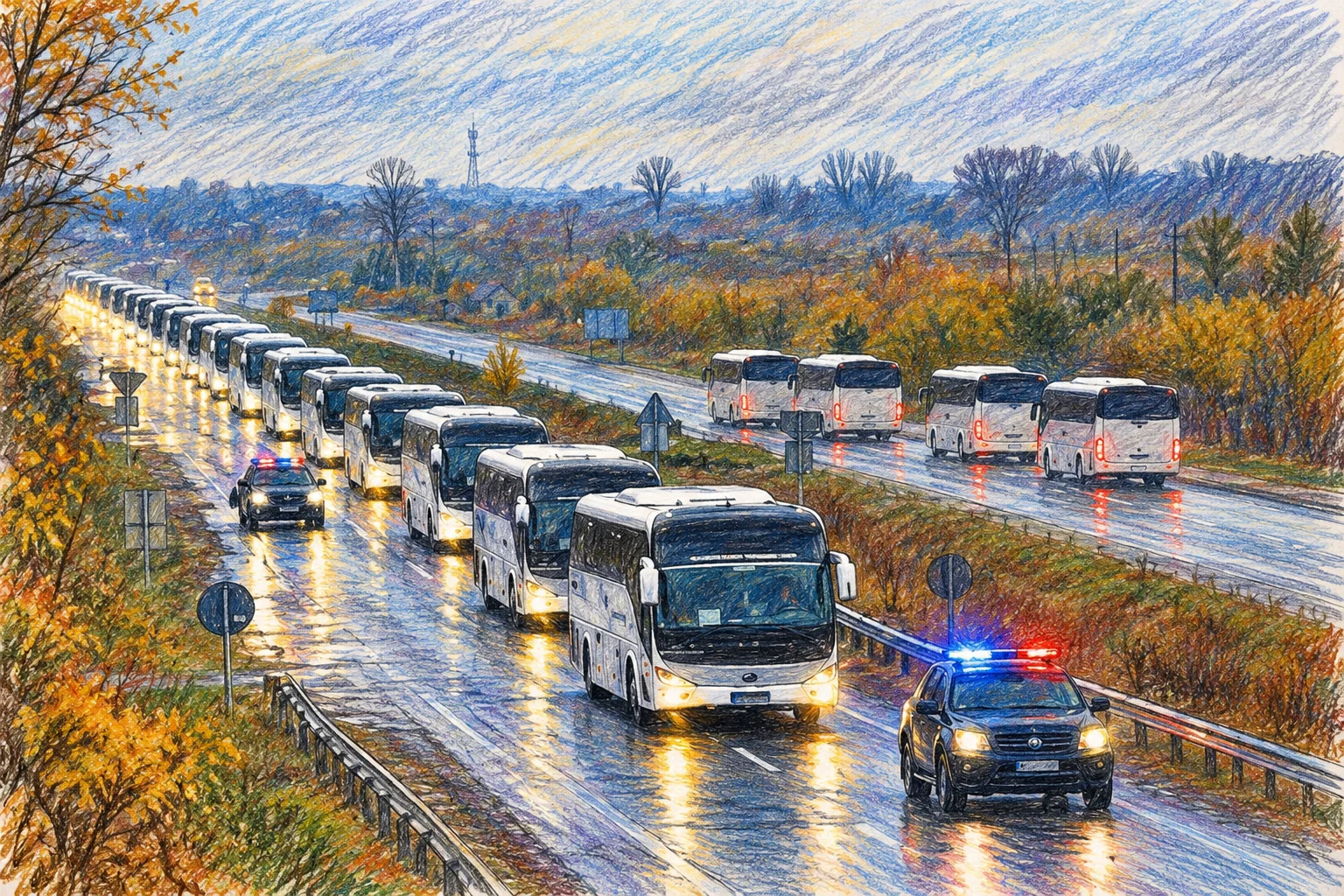
Seventeen buses with residents of the occupied Oleshky headed towards Ukraine, four towards Russia. These figures were published on October 30, 2026, by Russian military blogger Vladimir Romanov, who was present at the humanitarian operation. Later, they disappeared from his message. Ukrainian journalists managed to save and disseminate the original information. It turned out that one of the most striking episodes of the evacuation became known thanks to a Russian source, who clearly did not expect such a result.
October 31, 2026. Kherson region, temporarily occupied territory of Ukraine.
Author: Lev Varshavsky
Behind the numbers lies a more complex story. People were leaving a city that Russia has occupied since 2022, where there has been no normal supply for months, and roads have become dangerous due to mines and drones. To reach Ukrainian-controlled territory, they had to travel through occupied Crimea, southern Russia, and Belarus. The direct route across the Dnipro, separating Oleshky from liberated Kherson, remained inaccessible.
For Halloween at Trump's: the little "Soviet tanker" as the scariest costume of 2026
Where did the 17 and 4 buses come from
On the evening of October 30, 2026, the Ukrainian agency UNIAN and the Kherson publication “Hryvnia” reported an unusual ratio of evacuation buses. Military journalist Andrey Tsaplienko drew attention to the post of Russian blogger Vladimir Romanov, who covered the events directly in Oleshky.
Romanov wrote that 17 buses were intended for the Ukrainian direction, and four for the Russian. He also suggested that Russian television might show more buses of its direction but with closed curtains. Soon this fragment was removed from the publication.
The last detail deserves attention, although it does not prove intentional television staging. The assumption of possible image manipulation belonged to the blogger himself. There is no confirmation yet that Russian TV channels actually used empty buses to create the desired picture.
This story has an arithmetic peculiarity. Ukrainian Ombudsman Dmytro Lubinets officially reported the preparation of 25 buses with 750 passenger seats. Meanwhile, Romanov’s post mentioned 21 buses divided between two directions. The purpose of the remaining four vehicles was not established. The prepared transport and actually filled buses do not necessarily coincide.
The Ukrainian publication “Volyn” cited estimates of more than 500 people heading to Ukraine and about 100 to Russia. These numbers did not receive independent official confirmation. It is impossible to translate the ratio of buses into the exact number of passengers or percentages of all city residents: the occupancy of the vehicles is unknown, and part of the population did not participate in the evacuation at all.
But even with these limitations, the message from the Russian eyewitness turned out to be politically inconvenient for Moscow. After several years of occupation, a noticeable part of the people who had the opportunity to leave the city headed not deeper into Russia but towards Ukraine.
The city opposite Kherson, from which it became almost impossible to leave
Oleshky is located on the left, eastern bank of the Dnipro, approximately nine kilometers in a straight line from Kherson. For a reader in Israel, this geography may seem paradoxical: the cities are located nearby, but an ordinary journey between them has turned into a dangerous military task.
The Ukrainian army liberated Kherson in November 2022. Oleshky on the opposite bank remained under Russian occupation. The river and the front line divided people who used to move freely between neighboring cities. After the destruction of the Kakhovka HPP in June 2023, the region experienced massive flooding, the consequences of which overlapped with military destruction and subsequent deterioration of supplies.
By the fall of 2026, the humanitarian situation became critical. As previously reported by NANews in an investigation about nine kilometers to Kherson and twenty kilometers to food, Oleshky residents were forced to search for food on dangerous roads, cook food from wild greens, and the local hospital experienced a shortage of food for bedridden patients.
The last known full-fledged delivery of food by car took place on May 26. The last regular store stopped operating back in January, as reported by the UN. Electricity, water supply, gas supply, transport communication, and access to medical care were seriously disrupted. For an elderly person or a patient who has difficulty moving, leaving the city was often impossible without outside help.
Before the full-scale Russian invasion, about 24,000 people lived in Oleshky. According to Ukrainian estimates, by the end of October 2026, about 1,700–2,000 residents remained in the city itself. Another estimate — about six thousand — refers to the broader Oleshky community, including surrounding settlements. These indicators should not be mixed.
The city was primarily left with people who could not leave earlier: the elderly, the sick, the immobile, families without sufficient means, and those who did not want to leave their own homes. Their decision on the direction of evacuation was made after a long stay in isolation and conditions of acute shortage of the most necessary.
How Melania Trump helped achieve a humanitarian truce
The preparation of the humanitarian mission began before October 30. Ukrainian Ombudsman Dmytro Lubinets and the representative of the Russian side Yana Lantratova agreed on the conditions for a temporary ceasefire, the routes of the columns, and the order of evacuation.
The First Lady of the United States Melania Trump played a mediating role. The Pope Leo XIV was also involved in diplomatic efforts. Such a composition of mediators is unusual: it was not about negotiations for the final settlement of the war, but about a limited operation aimed at delivering food and medicine to civilians and ensuring the possibility of departure.
The ceasefire regime began to operate on October 27 at 03:00 Kyiv time. For Israel, it was the same moment — 03:00 local time. The parties agreed to temporarily refrain from hostilities in a certain area and along humanitarian routes to allow demining and organize columns.
In the previous NANews material about the agreed truce in Oleshky, it was described in detail why the city needed such a corridor and how negotiations allowed the mission to begin.
On October 30, 2026, Ukrainian and Russian delegations arrived in the Oleshky area. For the residents, 25 buses with 750 seats, nine ambulances, and additional transport for people with limited mobility were prepared. Along with the column, food, medicines, and essential items were delivered.
Ukrainian military correspondent Oleksandr Kirychek told “Army TV” that the operation was carried out in stages: first, those wishing to leave were gathered, then the distribution of humanitarian aid was planned. Necessary goods were also planned to be distributed to the remaining residents.
Lubinets and Lantratova participated in coordinating the mission, including in the area of Armyansk in occupied Crimea. According to the participants, the agreed silence regime was maintained during the movement of the humanitarian column. Fighting continued in other sectors of the front.
A successful local evacuation did not mean the beginning of a general truce between Russia and Ukraine. The Kremlin directly characterized this agreement as a separate case. According to the announced conditions, its effect was limited to the evening of November 1.
Why Ukrainians returned home through Russia and Belarus
On October 30, the head of the parliamentary faction “Servant of the People” David Arakhamia, who participated in the negotiation process, reported that the Ukrainian delegation, together with the evacuated residents, went to Russian Anapa.
The route looked as follows: Oleshky, occupied Crimea, Anapa, then a flight to Belarusian Gomel and a transfer to buses for return through the Ukrainian border. This path was explained by the danger of directly crossing the front line through the Dnipro and the need to use the agreed humanitarian corridor.
On October 31, 2026, Arakhamia announced that the last, fourth plane with evacuated citizens had landed in Gomel. The Ukrainian delegation expected that within the next few hours, the passengers would be on Ukrainian-controlled territory.
For the reception of people, the Ukrainian side prepared medical examinations, temporary accommodation, and provision of necessary items. It was about assistance in Chernihiv, Chernihiv, and Kyiv regions, and then distribution to other regions, taking into account the health condition and needs of the evacuees.
On the Russian direction, Oleshky residents arrived in Simferopol. “Suspilne Crimea,” citing Russian reports, said that among the arrivals were mainly elderly people, some of whom required medical examinations and dressings. Their exact number was not named at that time.
The choice of direction cannot automatically be considered a vote on political affiliation. Someone has relatives in Russia, someone needs treatment, and some people might have been guided by health, safety, or the lack of another available option. Not all residents remaining in Oleshky had the physical ability to reach the buses.
However, the direction of a significant part of the evacuation indeed deserves analysis: people sought to get to Ukraine despite the more complex route and the need to cross several territories controlled by different parties.
How many people were actually evacuated and who stayed
On the morning of October 30, Ukrainian Prime Minister Serhiy Koretsky, speaking in the Verkhovna Rada, reported about 527 Oleshky residents who were being prepared to return to Ukrainian-controlled territory. He spoke about preliminary medical examinations and the preparation of places for accommodation.
Later, Koretsky admitted that he had named an erroneous number and apologized. The Prime Minister asked the media not to spread unconfirmed information until the operation was completed, explaining this by the need to protect people.
Thus, several different figures appeared: 25 prepared buses, 21 buses in Romanov’s message, unofficial estimates of more than 500 and about 100 people, and the withdrawn number of 527 by the Prime Minister. They relate to different stages of the operation and have different levels of reliability.
The head of the “Center for the Study of Occupation” Petro Andryushchenko in a comment to “Suspilne Crimea” reported that up to 150 people could be counted in the photographs of the square in front of the buses. He separately warned: this is not a complete count of evacuees, and the capacity of 750 seats does not itself prove the corresponding number of passengers.
Andryushchenko also drew attention to the role of relatives who maintained contact with people in occupation and persuaded them to take the opportunity to return to Ukraine. Informal communication with relatives could be more convincing than an official information campaign.
Even more serious is the question of those who could not leave. The Ukrainian Ombudsman reported that all those wishing to leave Oleshky in the Ukrainian direction were given such an opportunity. However, volunteer Ksenia Arkhipova, who has been helping residents of the region since 2022, told the publication “Agency” the opposite.
According to her, some roads from nearby settlements remained uncleared of mines, people were stopped at checkpoints, and some immobile residents were not picked up directly from their homes. Arkhipova referred to reports from the residents themselves and their relatives. The publication noted that it could not independently verify all these testimonies.
Here the contradiction concerns not statistics, but real access to salvation. A person might want to evacuate but could not reach the designated gathering place. Without lists of applicants, those who arrived for boarding, and remaining residents, it is impossible to finally establish how fully the mission was accomplished.
What the story of Oleshky means for Ukraine and Israel
Israelis understand the difference between a political agreement to end a war and a limited humanitarian pause that allows civilians to be evacuated. In Oleshky, it was precisely the second option. This is not a resolution of a territorial conflict, not a change in the status of an occupied city, and not a guarantee of cessation of subsequent shelling.
Representatives of two warring states participated in organizing the operation, and the mediators were the American First Lady and the pontiff. At the same time, neither the UN nor the International Committee of the Red Cross were direct organizers of the agreement, although international humanitarian structures monitored the situation. For readers in Israel, this distinction is important: international mediation, control of compliance with humanitarian norms, and negotiations on political settlement are different functions.
The evacuation itself showed how much the lives of civilians depend on specific decisions on the ground. The agreement on the temporary safety of the route, the admission of buses, the examination of passengers, transportation through a third country, and the organization of reception at the border required separate coordination, although geographically Oleshky is very close to Ukrainian Kherson.
There is also the question of information control in the occupied territory. For years, Russian authorities have portrayed Kherson region as part of the Russian Federation. But when residents of one of the cities were offered the opportunity to leave in different directions, a message appeared about a significant advantage of the Ukrainian route. It was spread by a person working from the Russian side, and then the corresponding figures disappeared.
It cannot be asserted that the distribution of buses proves the political views of each evacuee. But it casts doubt on the convenient representation for Russian propaganda that prolonged occupation automatically turns the population of the captured territory into supporters of Moscow.
For Ukrainians who found themselves in Israel after the start of the full-scale war, this plot is also related to the issue of return. A home may be just a few kilometers from the liberated territory and remain practically unreachable. In the case of Oleshky, the path to Ukraine lay through Russia, Belarus, medical points, and several transfers.
The main result of this operation should be evaluated by two criteria: how many civilians were delivered to a safe place and how many willing were left without help. The ratio of 17 and 4 buses is an expressive political detail, but it should not overshadow the people for whom evacuation was the only chance to leave a dangerous city.
By October 31, four planes with evacuees arrived in Belarus. The final number of people delivered to Ukraine and Russia, and the number of residents who could not take advantage of the evacuation, required additional confirmation.
Oleshky remained a Ukrainian city under Russian occupation. Those who chose the road to Ukraine overcame a significant part of the way, but the issue of the safety of the remaining residents was not closed.
If it is important for you to see how world events affect Israel and Ukraine, add NANews to Google and follow our publications.