
Ukraine is once again discussing the possible seizure of the economic interests of Russian entrepreneurs in Kyivstar. The main reason is the decision of the European Union on September 22, 2026, to exclude Mikhail Fridman from the sanctions list. A native of Lviv, holding citizenships of Russia and Israel, he retained a stake in an international investment structure associated with the largest Ukrainian mobile operator. The Russian newspaper “Our Version” defended these assets after the resumption of the discussion and spoke about geopolitical boundaries.
Author: R. Verter
What Ukraine wants to nationalize and who owns Kyivstar
On September 28, Vladislav Nedashkovsky in “BusinessCensor” estimated Fridman’s indirect economic interest in Kyivstar Group at 16.9%, Petr Aven’s at 5.4%, and Andrey Kosogov’s at 21.1%. In total, about 43.4%. These are not direct shares of the Ukrainian Kyivstar and certainly not proof of these people’s access to subscriber data.
The ownership chain goes through Luxembourg’s LetterOne, international VEON, and Bermuda-registered Kyivstar Group. LetterOne owns 45.46% of the shares and votes of VEON, and receives another 7.89% economic interest through the independent voting structure STAK. VEON controls 83.6% of Kyivstar Group. In LetterOne, Fridman, Aven, and Kosogov’s shares are 37.86%, 12.13%, and 47.24%, respectively. Hence the journalists’ calculation, not direct ownership of 43.4% of the national operator.
On October 26, reports appeared about the government’s consideration of nationalizing Fridman’s interest. The source was blogger Lachen: there is no published decision of the Cabinet of Ministers or an approved method of confiscation yet. Therefore, saying that the state is already taking Kyivstar is incorrect.
In October 2023, Ukrainian courts arrested 47.85% of VEON’s corporate rights in Kyivstar and rights in Ukraine Tower Company, Kyivstar.Tech, and Helsi. On November 29, 2024, the arrest was lifted. The discussed bill on the seizure of all company rights with subsequent return of shares to uninvolved investors was withdrawn. Other cases differ: Sense Bank, the former Ukrainian Alfa-Bank, was nationalized by the state in 2023; former owners are contesting the decision. Separate legal procedures continue regarding IDS Ukraine’s assets, including Morshinska and Myrhorodska.
The stakes are rising along with the business. Besides communications, Kyivstar Group is developing Uklon, the medical platform Helsi, the pharmacy service Tabletki.ua, and Kyivstar TV. On October 27, the company signed an agreement to acquire the cloud provider GigaCloud worth up to $50 million; the completion of the deal still depends on meeting conditions. Here, national security and data protection issues are clear, but publications do not prove that Russian shareholders gained access to travel or medical information.
NAnews Israel News Nikk.Agency previously reported on the Russian strike on September 27 on Kyivstar’s Kyiv office.
Who among the owners of Russian capital holds Israeli citizenship
Mikhail Fridman is a citizen of Russia and Israel; he obtained Israeli citizenship in 2014. Petr Aven holds Russian and Latvian citizenship. For Andrey Kosogov, Russian citizenship is confirmed, but there is no reliable evidence of Israeli citizenship.
German Khan is another entrepreneur from the Alfa Group circle with Israeli citizenship. However, he left LetterOne in 2022 along with Alexey Kuzmichev and is not included in the current 43.4%.
Fridman and Aven left management in 2022, their corporate rights and payments were restricted. After the lifting of EU sanctions, restrictions from Ukraine, the US, and the UK continued to apply. Blocking the right to receive dividends does not mean the disappearance of ownership.
For Israel, this distinction is significant: Fridman’s Israeli passport does not create immunity from Ukrainian sanctions, and his private assets do not become state assets of Israel. There is no confirmation that the Israeli government participated in attempts to protect his share.
Who in Russia spoke about red lines and what does the FSB have to do with it
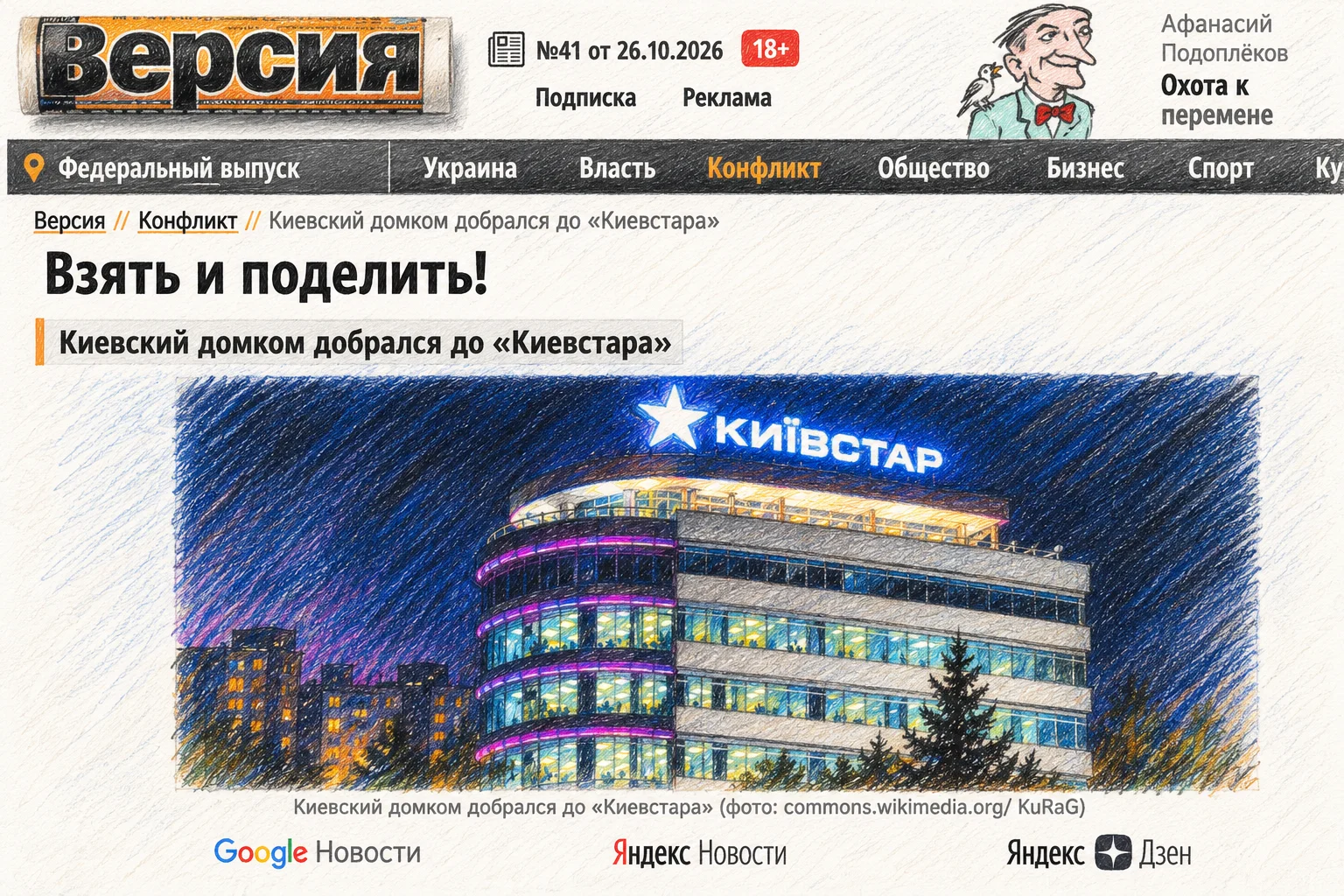
On October 28, the Russian “Our Version” published a text by Nikolai Olkhin “The Kyiv House Committee reached Kyivstar”. According to the author, Russian investors supposedly gifted Ukraine the telecommunications business, and the authorities are now going to “squeeze” it.
He attacks journalist Yuri Butusov, mentions Sergey Pashinsky, Volodymyr Zelensky, Kyrylo Budanov, and David Arakhamia, compares the events to Germany in the 1930s, uses hints about Fridman’s Jewish origin, his Lviv Alfa Jazz Fest, and the Babyn Yar memorial. The article does not provide evidence of the alleged business takeover plan.
In defense of the international company, former US Secretary of State and CIA Director Mike Pompeo, former British Minister Brandon Lewis, Duncan Perry, Betsy Cohen, and Michiel Suting are named. The publication reminds of Kyivstar Group’s entry on Nasdaq through Cohen Circle in August 2025 and the declared investments of $1.3 billion since 2023. But the positions of these people do not mean they share the newspaper’s stance.
“There are businesses that cannot be squeezed,” the author concludes, warning of “strategic geopolitical interests” and spheres of influence to which Kyiv supposedly does not belong. This is the rhetoric of the editorial office, not an official warning from the Russian government.
Since March 2025, the newspaper has belonged to Saratov Regional Duma deputy Vyacheslav Kalinin, founder of “Veteran News”. In 2024, Politico, citing Western intelligence materials, reported on his alleged ties with the FSB and cooperation with Serbian trade unionist Novica Antic in influence operations. The holding named the FSB and the Russian Ministry of Defense as information partners; Politico’s accusations are not equivalent to a court verdict.
On October 25, Kalinin himself released a column “Time to Divide Ukraine?”, discussing Russian claims to Odesa, Kharkiv, Poltava, Sumy, Chernihiv, and the transfer of Lviv to Poland, Bukovina to Romania, and Transcarpathia to Hungary. Three days later, his newspaper warned that touching Russian commercial interests in Ukraine is unacceptable.
Ukrainian authorities have not yet announced how and whether they will seize this property. And the Russian publication has already turned a possible corporate dispute into a story about geopolitical boundaries. After all previous warnings from Moscow about “red lines,” the question in the headline sounds less rhetorical.