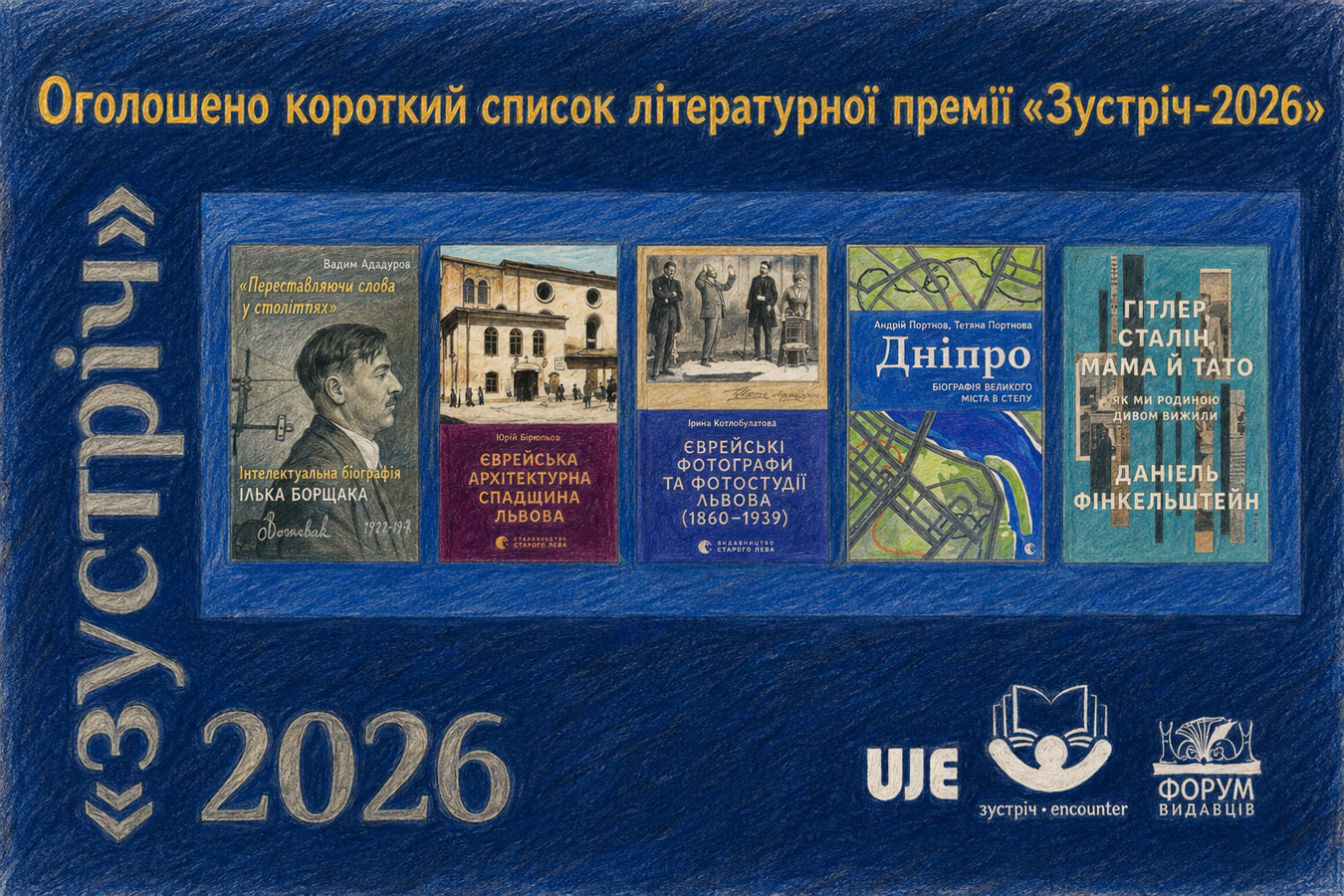
On August 10, 2026, the literary award “Zustrich” announced five finalist books in the non-fiction category. The award is conducted by the Canadian organization “Ukrainian Jewish Encounter” (UJE) and the Lviv “Forum of Publishers,” and its central theme is the shared historical and cultural experience of Ukrainians and Jews.
From the initial long list of nine works, the jury left five.
Among them are studies of Jewish Lviv, a biography of a historian with a complex Ukrainian-Jewish identity, the history of multinational Dnipro, and family memoirs where the Holocaust and Stalinist repressions were tragedies of one family.
From Israel, another name is immediately noticeable on this list — or rather, its absence. Natan Sharansky, a native of Donetsk, former Soviet political prisoner, Israeli politician, and one of the symbols of the struggle of Soviet Jews for repatriation, was among the nine nominees with the Ukrainian edition of his memoirs “Fear No Evil,” but did not make it to the final five.
Five books — and five ways to return Jewish history to the history of Ukraine
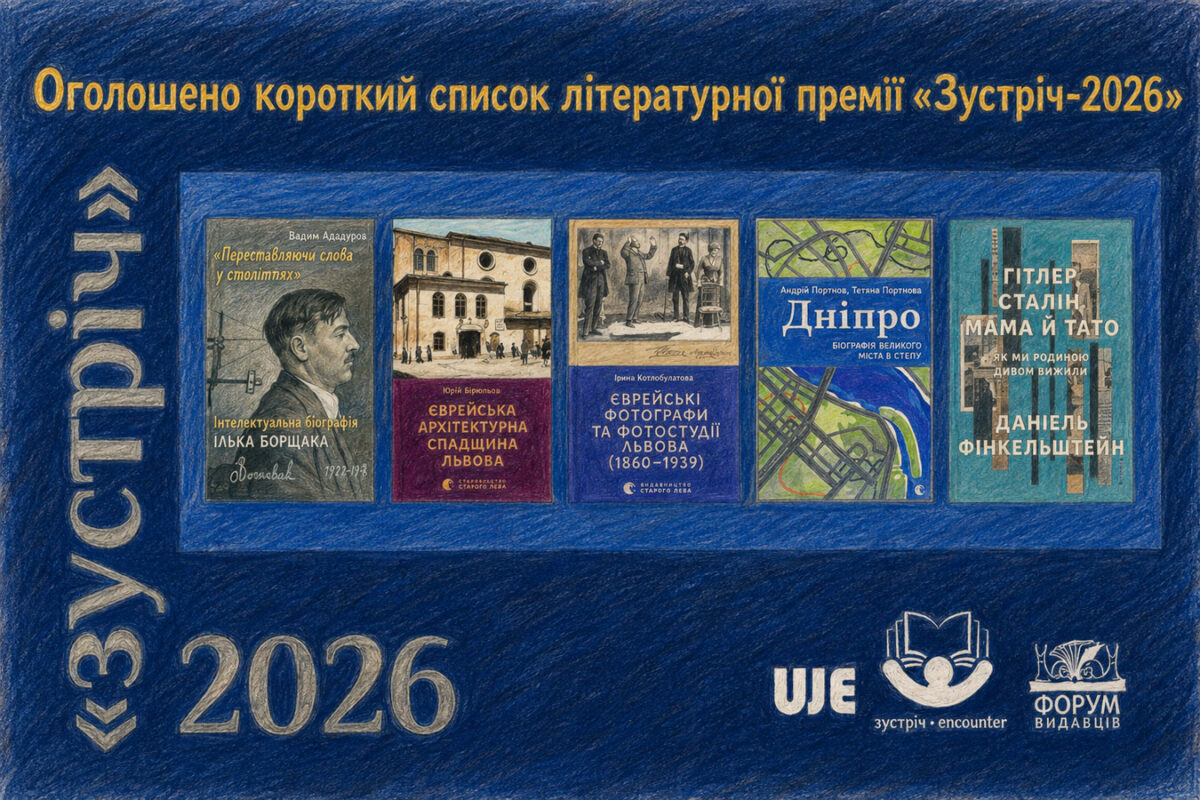
If you simply list the titles of the finalists, it becomes an ordinary literary news. But if you lay out these books not by the authors’ names, but by how each of them works with memory, a much more interesting picture emerges.
One book brings people back through architecture. The second — through old photographs. The third — through the biography of a person who cannot be neatly placed into just one national identity. The fourth shows Jews within the biography of a large Ukrainian city. The fifth turns the history of two totalitarian regimes from a textbook into the history of a specific family.
These are no longer five random books on one topic. Together they show the change in the very conversation about Ukrainian Jews.
Vadim Adadurov and Ilko Borshchak: a biography that is difficult to categorize by nationality
The first finalist is Vadim Adadurov with the book ““Rearranging Words in Centuries”: The Intellectual Biography of Ilko Borshchak” (“Rearranging Words in Centuries”: The Intellectual Biography of Ilko Borshchak), published by the Ukrainian Catholic University in 2024.
Ilko Borshchak, real name Ilya Barshak, was a historian and publicist of Jewish origin, a significant part of whose intellectual biography was connected with Ukraine, the Ukrainian movement, and France. His life spanned several political and national spaces.
That is why the question is particularly interesting here: how to consider a person if their origin, language, political views, and cultural choices do not fit into one convenient category? Borshchak’s story reminds us of how conditional modern attempts can be to retrospectively divide the people of Eastern Europe into completely isolated national histories.
For the “Zustrich” award, such a hero is almost symbolic. The Ukrainian and Jewish components of his biography do not exist separately from each other.
Jewish Lviv preserved in stone
Yuriy Biryulev made it to the shortlist with the study “Jewish Architectural Heritage of Lviv” (“Jewish Architectural Heritage of Lviv”).
This is the story of hundreds of objects of Jewish architectural heritage in Lviv — not only synagogues and religious buildings. It is about residential houses, public buildings, architects, owners, builders, and people who created the city over several centuries.
Here arises a simple but uncomfortable question for many historical schemes: can the history of Lviv be told at all by first cutting Jews out of it?
If Jewish families owned houses, architects designed streets, entrepreneurs built buildings, and the community participated in city life for generations, Jewish heritage ceases to be a separate excursion through “Jewish places.” It becomes part of the ordinary history of Lviv.
People who left photographs of the city and then disappeared themselves
Iryna Kotlobulatova is represented by the book “Jewish Photographers and Photo Studios of Lviv (1860–1939)” (“Jewish Photographers and Photo Studios of Lviv (1860–1939)”).
Here the same city is restored not through walls, but through the lenses of photographers. Jewish masters photographed families and streets, political events, construction, holidays, sports, city incidents, and ordinary Lviv residents.
The tragedy is that many of the people, thanks to whom it is possible to see everyday Lviv at the end of the 19th and the first third of the 20th century, along with their families, were destroyed during the Holocaust.
Photography in such a case becomes more than an illustration. Initially, these people created the visual memory of the city, then they almost disappeared from its memory themselves — and now the researcher simultaneously returns both the photographs and the names of those who stood behind the camera.
Dnipro: Jewish history without a separate “Jewish chapter”
Andriy Portnov and Tetyana Portnova made it to the top five with the book “Dnipro. Biography of a Great City in the Steppe” (“Dnipro. Biography of a Great City in the Steppe”).
This is a particularly indicative choice because the book is not exclusively about Jews. It tells the biography of Yekaterinoslav, Dnipropetrovsk, and modern Dnipro as one changing city — with industrialization, revolutions, wars, the Soviet period, culture, and different population groups.
Jews here do not exist in a separate historical container next to the “main” history. They are inside the history of the city along with Ukrainians and other residents.
This approach is important for understanding the numerous Israeli families of Ukrainian origin. Their ancestors did not exist solely between the synagogue, pogrom, and emigration: they worked, educated children, created enterprises, took photographs, built houses, debated politics, and participated in the everyday life of Ukrainian cities.
Daniel Finkelstein: Hitler and Stalin within the history of one family
The fifth finalist is British journalist and writer Daniel Finkelstein with the Ukrainian edition of the book “Hitler, Stalin, Mom and Dad. How We Miraculously Survived as a Family” (“Hitler, Stalin, Mom and Dad. How We Miraculously Survived as a Family”).
Finkelstein reconstructs the history of two branches of his Jewish family. One faced Nazi persecution and the Holocaust, the other — Soviet repressions, deportations, and forced labor.
The Ukrainian line is connected with Lviv, where his father’s family lived. After the Soviet authorities came, the family found themselves under repression.
The strength of this story lies precisely in the scale of the family. Nazism and Stalinism appear here not as two abstract chapters of European history that historians compare decades later, but as two forces that invaded the lives of one person’s relatives.
Why Natan Sharansky did not make it to the shortlist
Natan Sharansky participated in the competition with the Ukrainian edition of the book “Fear No Evil”, published in 2025.
There were nine books on the long list.
In addition to Sharansky, after the next stage of selection, Oleksandr Kotis, Ivan Monolatii, and Dmytro Polyukhovych were eliminated.
The author’s fame itself also guarantees nothing. The jury selects a specific book within a specific award, not determining the historical significance of a person.
For the Israeli audience, the very fact of Sharansky’s participation is still noteworthy. NAnews previously detailed Natan Sharansky, his Ukrainian roots, Soviet imprisonment, and connection with Israel and Ukraine.
Sharansky was born in Donetsk and subsequently became one of the most recognizable figures from the vast circle of Jews born in Ukraine who played a significant role in the history of Israel. Therefore, his appearance on the long list of the Ukrainian-Jewish literary award itself connects several historical layers.
But the final of the award in 2026 turned out to be different.
What is “Ukrainian Jewish Encounter” — UJE
“Ukrainian Jewish Encounter”, or Ukrainian Jewish Encounter — UJE, is a Canadian non-governmental organization working since 2008 on Ukrainian-Jewish dialogue, history, and culture.
Its original idea is quite simple: Ukrainian and Jewish history on the territory of Ukraine cannot be fully understood if told separately. Hence the project’s formula: “Our stories are incomplete without each other”.
Behind this formula are complex themes. For centuries, the territory of modern Ukraine was home to one of the largest Jewish communities in the world; there were periods of peaceful coexistence and cultural exchange, political conflicts, pogroms, the Holocaust, Soviet repressions, emigration, and the destruction of entire cultural worlds.
UJE engages in historical and educational projects, exhibitions, books, research, and public discussions. At the same time, the organization is neither a Ukrainian state agency nor a body of the State of Israel.
Why UJE needed a separate literary award
The “Zustrich” award appeared in 2019 in collaboration with UJE and the Lviv “Forum of Publishers”.
Its principle is noticeably broader than the formulation “the best book about Jews of Ukraine.” Works that fully or partially deal with the Ukrainian-Jewish experience and help to see both histories in interconnection are considered.
Fiction and non-fiction alternate. In 2026, the award considers non-fiction: historical research, biographies, memoirs, essays, and other documentary genres.
It is indicative that the Ukrainian language here also becomes the language of returning Jewish history to the Ukrainian cultural space. This resonates with what NAnews already observes in the biographies of people connecting the two countries. For example, Oleksandr Khmelnytsky in the ongoing theme “Jews from Ukraine” recently told about Haim Hazaz — a native of the Ukrainian village of Sidorovychi, who became the first laureate of the Israel Prize for Literature.
The connection here is not artificial. From Hazaz to Sharansky, from old Lviv to modern Dnipro, one plot constantly repeats: part of Israel’s history began in the cities, villages, and families of Ukraine.
Who chooses the winner of the “Zustrich” award 2026
In the large jury of 2026, three specialists work: Olya Hnatiuk, Serhiy Hirik, and Vladyslava Moskalyets.
Olya Hnatiuk deals with Ukrainian culture and identity issues. Historian Serhiy Hirik specializes, among other things, in the history of Jews in Ukraine, Judaica, and political movements, while Vladyslava Moskalyets researches the social history of Jews in Galicia and Ukrainian-Jewish relations.
This is not a reader’s vote or a popularity contest for authors. That is why the presence of the world-famous name Sharansky on the long list did not mean that the book should automatically be among the five finalists.
The winner will receive 4000 euros
The total prize fund of the award is 7000 euros.
The author of the winning book is to receive 4000 euros, the publisher — 2000 euros. The remaining four finalists of the shortlist will receive 250 euros each.
The award ceremony is planned as part of the Lviv International BookForum 2026. As of August 10, the final winner has not yet been determined.
But the monetary part is unlikely to explain the significance of the competition.
What the 2026 shortlist says about Ukrainian-Jewish memory
If you look at the five books together, a structure appears that is not in a simple list of nominees.
Architecture preserves the physical presence of Jews in the Ukrainian city.
Photography returns the faces of people and everyday life that existed before the catastrophe.
Borshchak’s biography shows an identity that cannot be divided into Ukrainian and Jewish without losses.
The history of Dnipro places Jews inside the general urban history.
The Finkelstein family connects the Ukrainian space, the Holocaust, and Soviet repressions already at the level of personal memory.
Such a comparison changes the question itself. Instead of the usual “what happened between Ukrainians and Jews?” another arises: how can the history of Ukraine be told at all if Jews are removed from it?
The answer these books give is quite obvious — a complete history will not work.
Why this topic does not end in Ukraine
For Israel, Ukraine is not an abstract Eastern European country with which there are diplomatic relations. For a huge number of Israelis, Kyiv, Odesa, Lviv, Chernivtsi, Dnipro, Donetsk, Zhytomyr, Vinnytsia, Poltava, and hundreds of smaller towns and villages are the geography of family memory.
Here, the difference between history and contemporary politics is especially visible. The relations between the governments of Israel and Ukraine may improve or worsen, politicians may argue, votes in international organizations may cause irritation. The family and cultural connection does not disappear because of this.
NAnews — News of Israel considers this topic as cumulative. The separate story of Sharansky, the biography of Haim Hazaz, the Jewish architecture of Lviv, or the history of multi-ethnic Dnipro become more important when read not in isolation, but as parts of one long line.
The “Zustrich” 2026 shortlist just makes this line visible. Jewish history of Ukraine here is no longer limited to a list of tragedies and commemorative dates: it returns to homes, photographs, literature, family archives, and city biographies.
Who among the five authors will receive the award will be known later. But already on August 10, another result of the competition is clear: five completely different books ended up together because each in its own way shows the same thing — Ukrainian history without the Jewish part remains incomplete, as does the history of many Israeli families without their Ukrainian past.