Since the full-scale Russian invasion of Ukraine in February 2022, thousands of Ukrainian children have been forcibly moved, transferred, or deported to Russia and to the temporarily occupied territories of Ukraine. Russia began this alarming practice of deportation after the invasion of Crimea in 2014, and since 2022 it has escalated into a targeted policy of mass deportation of Ukrainian children.
Russia seeks to erase the Ukrainian identity of children by restricting access to the Ukrainian language and history, limiting alternative sources of information, and forcibly imposing Russian citizenship.
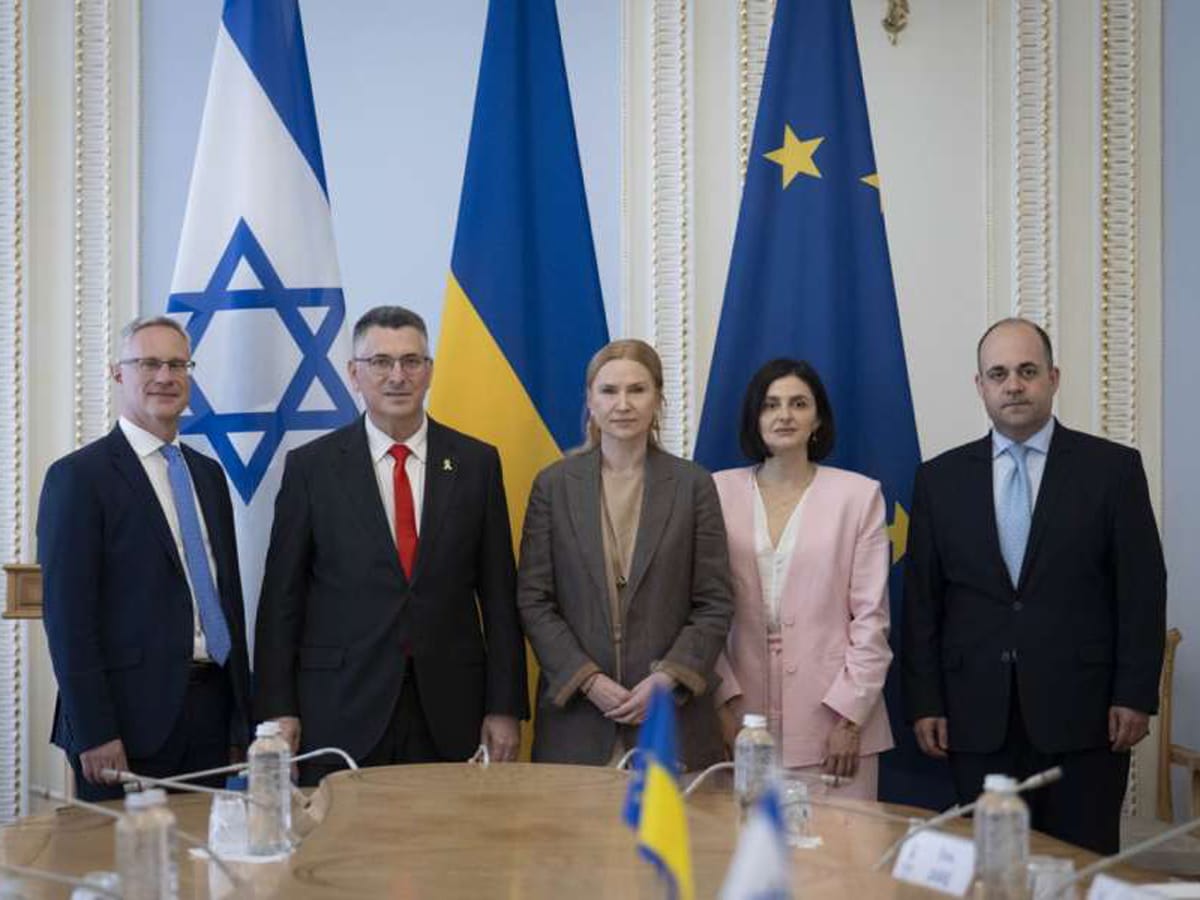
23 July 2025, in Kyiv, the Deputy Speaker of the Verkhovna Rada of Ukraine, Olena Kondratiuk, met with the Minister of Foreign Affairs of Israel, Gideon Saar, who arrived on an official visit.
The parties discussed in detail the issue of Israel’s accession to the International Coalition for the Return of Ukrainian Children, which has united more than 40 countries worldwide, as well as the possibility of considering in the Knesset a resolution on children abducted by Russia.
This was reported on 24 July 2025 by the official website of the Verkhovna Rada of Ukraine.
The meeting was attended by co-chair of the parliamentary friendship group with Israel Olga Vasylevska-Smaglyuk, Ukraine’s Special Representative for the Middle East and Africa Maksym Subkh, and the Ambassadors of Ukraine and Israel, Yevhen Korniichuk and Michael Brodsky.
Why This Matters for Both Countries
For Ukraine, the coalition has already become an effective mechanism: from February 2024 to July 2025, more than 600 children forcibly taken from combat zones and occupied territories have returned home.
The International Coalition unites over 40 countries and the Council of Europe, including the USA, Canada, the UK, Poland, Germany, France, and others.
Israel has unique experience in protecting civilians in conflict zones and successfully organizes humanitarian corridors. Israel’s accession would allow:
- Expanding the network of safe routes for evacuating children
- Involving Israeli specialists in child psychology and rehabilitation
- Strengthening diplomatic pressure on Russia for the unconditional return of children
Course of the Negotiations
Olena Kondratiuk openly stated: “For us, Israel’s support of Ukraine’s sovereignty and territorial integrity is important. We are interested in air defense systems to protect civilians, because this is not a military but a humanitarian need.”
“We expect the Knesset to adopt the bipartisan resolution submitted to the US Congress as its basis. It requires Russia to unconditionally return all deported children outside the negotiation process—before any peace agreements,” said Deputy Speaker Olena Kondratiuk.
In response, Gideon Saar noted:
“I condemn the Russian attacks on Ukraine’s civilian population. I came on this visit to acknowledge the incredible resilience of the Ukrainian people and to demonstrate Israel’s solidarity with them.”
The minister confirmed that the Ministry of Foreign Affairs of Israel will consider the proposal and submit it for discussion in the Knesset.
Participants noted the constructive cooperation between the Verkhovna Rada and the Knesset at the level of parliamentary leadership and friendship groups.
On Additional Initiatives
The meeting also covered:
- Invitation for Israel to join the Crimea Platform—a global forum on the de-occupation of Crimea and human rights protection
- Support in the Knesset for recognizing the Holodomor of 1932–33 as genocide of the Ukrainian people
For Ukraine, participation in these initiatives signals readiness for broader cooperation on historical justice and human rights issues.
What the Coalition for the Return of Ukrainian Children Is
The International Coalition was launched on 2 February 2024 at the initiative of the governments of Ukraine and Canada. Its secretariat is based on the Bring Kids Back UA platform. The coalition works in four areas:
- Unconditional repatriation—returning every child regardless of negotiation progress
- Psychological and social rehabilitation—support in schools and foster families
- Monitoring and evidence collection—a unified database of testimonies, medical reports, and family statements
- Advocacy—campaigns at the UN, Council of Europe, and social networks (#BringKidsBack)
To date, 41 countries and the Council of Europe have joined the initiative. Israel is not yet on the official list, but discussions at the MFA level could change that.
In its first year, the coalition returned home more than 600 children. Mobile rehabilitation teams were established in five regions of Ukraine, educational programs were launched, and legal support for families in international courts was provided.
Upcoming plans include:
- Expanding the coalition to 50 countries
- Developing an international agreement to protect children’s rights in conflicts
- Creating additional rehabilitation centers and psychological services
NAnews – News of Israel will follow every new development and promptly report on Knesset decisions and the fulfillment of coalition obligations.
The initiative “Israel to consider joining the International Coalition for the Return of Ukrainian Children” is not just a diplomatic gesture but a concrete step toward saving children’s lives. Israel’s participation will strengthen the coalition’s work and allow even more children to return home. Against this backdrop, ties between the two nations are being reinforced, demonstrating genuine solidarity between the Jewish and Ukrainian peoples.“`