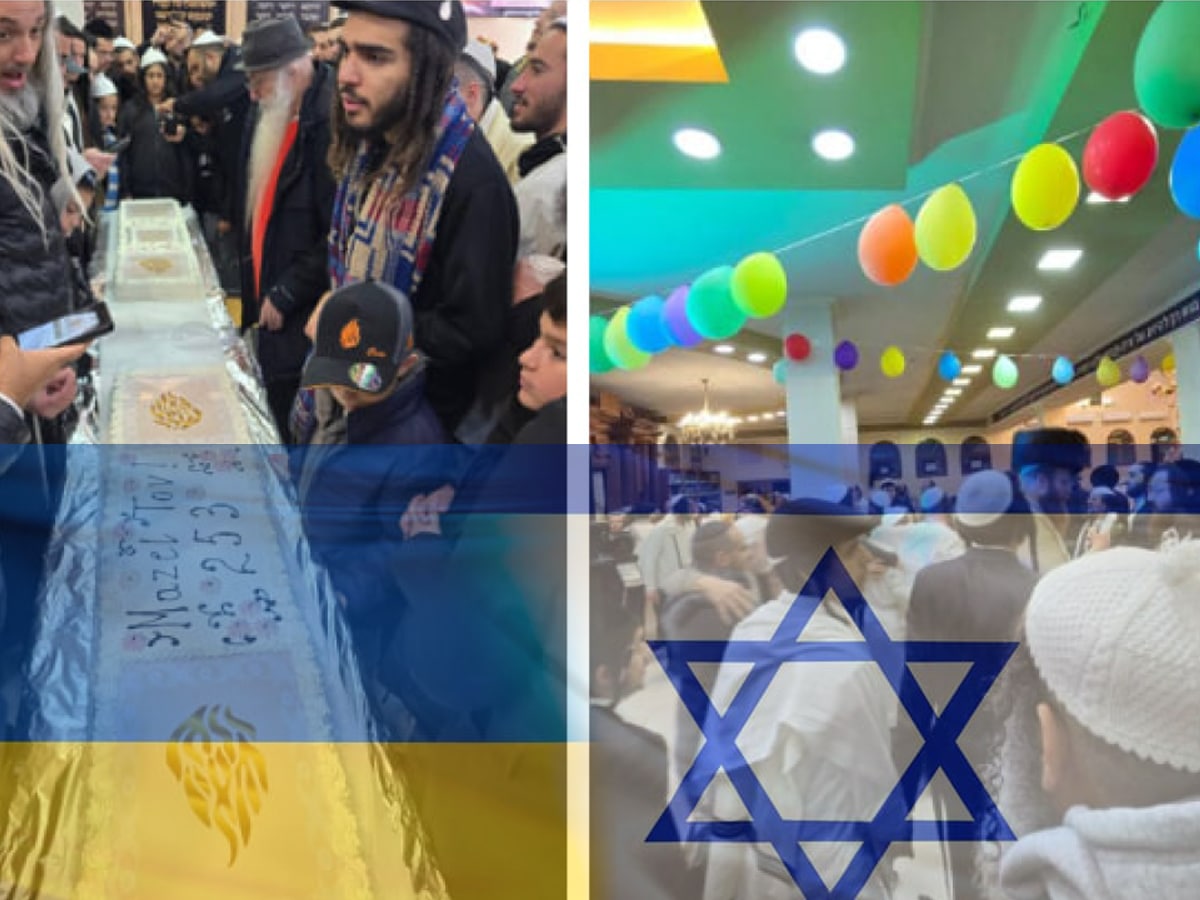
On March 31, 2025, the Bratslav Hasidim completed their traditional pilgrimage to Uman, timed with the birthday of the tzadik Rabbi Nachman, who is buried in the city.
The head of the International Charitable Foundation named after Rabbi Nachman, Natan Ben Nun, reported that around 2,000 pilgrims from Israel, the USA, and Europe came to Uman for the celebration.
The PR director of the Charitable Foundation named after Rabbi Nachman, Anastasia Baryshnikova, stated that the event went smoothly without any incidents. According to her, everything took place at the tomb of Rabbi Nachman: Jews sang, danced, prayed, and baked a three-meter cake with excerpts from the Torah. Anastasia added that the Hasidim prayed for various needs and left their wishes in a special box, hoping for their quick fulfillment.
“The Hasidim gather at the tomb of the tzadik, read holy books, sing, and dance. Each person asks their spiritual mentor for what is most important. One seeks health, another – children, someone else – financial well-being. It is known that whatever is asked for on this day, is received,” reported Irina Rybnytska, executive director of the Charitable Foundation “Historical and Cultural Center of the City of Uman”.
Natan Ben Nun also reported that in their prayers at Rabbi Nachman’s tomb, Jewish pilgrims asked for the war to end and for peace to come to Ukraine.
The first deputy mayor of Uman, Oleg Hanich, noted that the city authorities provided comfortable conditions for both the residents of Uman and the pilgrims. He explained that the municipal guard controlled the order in the city, and the communal services worked as usual. According to him, compared to Rosh Hashanah, when up to 40,000 guests arrive, the two thousand pilgrims this year did not cause any inconvenience.
Rabbi Nachman was born on April 4, 1772, according to the Gregorian calendar, which corresponds to 1 Nisan 5532 in the Jewish calendar. However, since the Jewish calendar differs from the Gregorian one, the date of his anniversary is observed on 1 Nisan in the Jewish calendar. In 2025, this date falls on March 30, which will be the day when Hasidim from all over the world will gather in Uman to honor Rabbi Nachman’s memory.
Biography of Rabbi Nachman
Rabbi Nachman of Breslov was born on April 4, 1772, in Medzhybizh, a small Ukrainian town that became the center of Hasidism due to his great-grandfather, Israel Baal Shem Tov. This spiritually rich place played a key role in shaping Rabbi Nachman’s spiritual path. He was the great-grandson of Baal Shem Tov and was deeply immersed in the traditions of Hasidism.
His father, Rabbi Simcha, was one of Baal Shem Tov’s disciples, and his mother, Rebbetzin Feiga, was the daughter of Baal Shem Tov’s only daughter, Adele. From childhood, Nachman was immersed in the study of the Torah and Jewish mysticism.
Moving Around Ukraine
Rabbi Nachman spent most of his life in different cities of Ukraine, which influenced his spiritual development and the spread of his teachings. In 1798, at the age of 26, he went on a pilgrimage to the Land of Israel, visiting Safed and Tiberias, but due to the invasion of Napoleon’s army, his plan to go to Jerusalem was not realized. However, this journey strengthened his connection to spiritual practice and the Land of Israel, which later influenced his teachings.
After returning from this journey, Rabbi Nachman settled in Medvedivka and then moved to Zolotopol, where he continued to develop his teachings and attract followers. He became known not only for his spiritual strength but also for his commitment to deep inner purification, constantly spending time in prayer and solitude. Rabbi Nachman lived under constant tension with other Hasidic leaders of the time, criticizing them for their superficial observance of traditions and straying from true spiritual practices.
Settling in Uman
Despite his active life, Rabbi Nachman also faced internal and external difficulties. He was forced to move several times, relocating from one city to another. In the final years of his life, Rabbi Nachman settled permanently in Uman, a town that became the center of his spiritual life. It was here that he passed away on October 16, 1810, from tuberculosis.
He asked his followers to bury him in Uman, and over the years, his tomb became the most important pilgrimage site for Hasidim. The prayers offered by the faithful in Uman became a symbol of their spiritual striving and connection to Rabbi Nachman.
Rabbi Nachman and His Connection to Israel
Although Rabbi Nachman never lived in Israel, his connection to the land held deep symbolic meaning for his followers. In 1798, he made a journey to the Land of Israel, visiting such holy cities as Safed and Tiberias. However, despite his intention to reach Jerusalem, he could not complete his journey due to the invasion of Napoleon’s army. This journey was a significant moment in Rabbi Nachman’s life, strengthening his connection to spiritual practice and tying his teachings to the Land of Israel.
Despite not having lived in Israel, his spiritual legacy, influence, and commitment to religious tradition continued to impact Israeli Hasidic communities, which still follow his teachings and dedicate pilgrimages to Uman. Israel became an important element of his spiritual mission, which is reflected in his teachings and connection to the Jewish people, as well as the support of Hasidic communities worldwide, including in Israel, which continue to adhere to his teachings and make pilgrimages to Uman, the site of his burial.
Pilgrims Continue the Tradition Despite the War
Despite the ongoing war in Ukraine, Hasidim do not abandon their pilgrimage tradition. This event holds not only religious but also historical significance for many believers. In their prayers, they ask for peace for both Ukraine and Israel, underscoring the importance of this moment for both countries.
Pilgrimage and Security
To ensure security during the pilgrimage to Uman, law enforcement and migration services operate in the city. Visa regulations are strictly controlled, as pilgrims come from many different countries. Despite the martial law in place, Hasidim adhere to restrictions, including curfew enforcement.
Spiritual Legacy of Rabbi Nachman and the Significance of Pilgrimage for Jews
Rabbi Nachman had a significant impact on the development of Hasidism. His teachings are centered around spiritual freedom, prayer, and reflection. It is important to note that despite the challenges of modern times, believers continued to visit Uman even during World War II. Today, there are many communities in Israel and Ukraine that follow the legacy of Rabbi Nachman.
For Jews in Israel, as well as for all Hasidim, this moment is important not only from a religious perspective but also as a way to maintain a connection to their spiritual tradition. His teachings continue to inspire prayers for peace, both for Israel and for Ukraine. The prayers of the Hasidim unite both countries in the search for spiritual harmony.