
Text by Oleksandr Khara (ukr.) (ZN.UA, January 21, 2026) — this is not about “liking/disliking Trump.” This is an analysis of the mechanics: why the idea of “gathering the Peace Council, appointing those responsible, declaring the end of the war” sounds convincing at a press conference but almost doesn’t work where the conflict has lived for years and is fueled by fear, hatred, and profit.
The main idea of the author is simple and unpleasant: peace does not appear from a loud name and a beautiful management scheme. Peace appears when there are tools that force the parties to change behavior — and when the parties have any motivation to do so.
The text describes Trump’s “Peace Council” as a replacement for the familiar international architecture (UN and related mechanisms). At the start, it is presented as a “pragmatic alternative”: less bureaucracy, more “common sense,” a rejection of institutions that “often failed.”
But then the author emphasizes: the problem with such a project is not even in the slogans, but in the empty spaces in the charter.
If an institution does not have real procedures for early warning, mediation, verification, preventive diplomacy, if it is not specified who and how responds to violations — this is not a peacekeeping mechanism. This is a showcase.
You can write a mission in the style of “strengthening stability” and “ensuring lasting peace,” but war is not read through the eyes of the mission. War is read through the eyes of “what will happen if I break the agreement?” and “who will stop me?”.
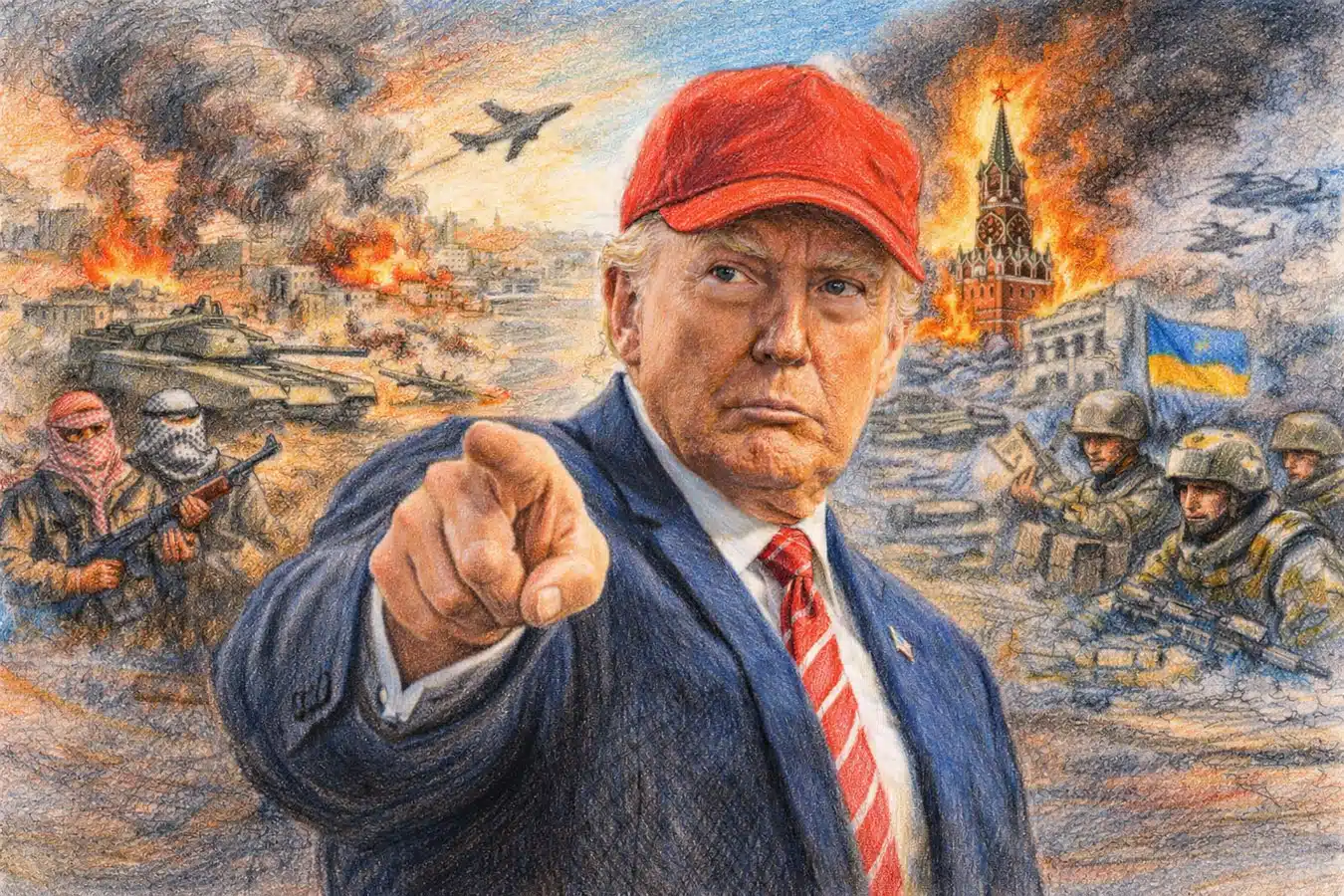
Gaza as a reality test: “peace” on declaration and “peace” on the ground
The author takes the example of Gaza as the first public case: Trump announces the “end of the war,” a multi-level management structure appears — from the “supreme body” to the regional executive structure and even a “national committee” for administration.
On the surface, everything looks like a system.
But Khara shows that in a short time reality begins to gnaw at this system piece by piece: Israel strikes, clashes erupt, Hamas announces withdrawal from agreements, new combat episodes are recorded even after the launch of the next phase of the plan.
And here is an important thesis: a “zero-sum” conflict cannot be turned off with a political button.
When both sides think like this: “either we win, or we are destroyed,” any attempt to impose “pause = peace” turns into a temporary pause that each side uses for its own purposes. Without coercion and without transparent control, the pause becomes a tactical window, not a resolution.
Personalization instead of institution: why the scheme relies on one person
One of the harshest parts of the text is about the principle of management.
Khara describes that the chairman of the Peace Council (i.e., Trump) receives a lifelong role and practically sole control over membership. In such logic, the institution becomes an extension of personality.
This is critical for two reasons.
First, if membership and decisions depend on the political will of one leader, it kills the trust of other players. They do not know if these are rules or mood.
Second, such a system poorly survives crises. Institutions are created precisely to work when people are in trouble, when emotions and ambitions rise. And here, according to the author, everything is built around ego and improvisation.
As a result, the Peace Council looks not like a replacement for the UN, but like a political stage where the main tool is access to the negotiation table and the right to include/exclude.
The most toxic detail: the aggressor as a “guarantor” and participant in “peacekeeping”
Further, the author applies the model to Ukraine — and here, according to his logic, a systemic error appears that cannot be “cosmetically corrected.”
If Russia is included in the “council” on the Ukrainian direction, then the aggressor state ceases to be a party that needs to be coerced and turns into a participant who is given the status of “supporting peace” or even “guarantor.”
This is not just a dispute about wording.
This is a change of role.
What should be a mechanism to stop aggression turns into a mechanism of bargaining with the aggressor — and that is why, the author writes, the scheme is doomed to fail until the parameters of the war change fundamentally.
Why “ceasefire” without prerequisites doesn’t work
Khara explains in detail what prerequisites are generally needed for a ceasefire to become something more than a pause.
One of the parties needs to either lose, or recognize the unattainability of goals, or hit the limit of resources (economic, demographic, internal political). Otherwise, it has no reason to retreat from maximalist goals.
In the Ukrainian case, the author assumes that the Kremlin continues to believe in the possibility of imposing de facto capitulation on Ukraine, which means it will drag out time, seek concessions, sell “peace” as a tool of pressure.
Hence the conclusion: “peace through trade” and soft economic constructions do not work with authoritarian regimes that are ready to pay with human and material resources for a geopolitical goal.
The text separately notes that Russia’s resource inertia of war remains high (for at least a year or two), and there is also a calculation for China’s support and that Washington will not pursue a hard line of pressure specifically on the Ukrainian track.
“Guarantees like Article 5” and reality: promises without an umbrella and without automatism
Khara touches on one of the most sensitive topics: when plans mention “security guarantees similar to Article 5,” it sounds like NATO.
But in essence, it may turn out to be a set of political promises without a nuclear “umbrella” of deterrence, without the automatism of a collective response, without strict obligations and a pre-written mechanism of reaction.
That is, it is not a guarantee, but a declaration of readiness to help under certain conditions.
The author directly asks: if even with the current formats of assistance Trump has already blocked military packages and avoided public pressure on Putin, what will happen at the moment of a new violation of “peace” by Russia?
And he answers quite grimly: predictably. If there are no coercion tools, the prospect of success disappears.
“Just peace” vs “peace as a compromise at the cost of sovereignty”
Another block is about justice.
The author reminds that the international order has been held for decades on the inviolability of borders, sovereignty, and equality of states. And if the “peace plan” bypasses the topic of liberating occupied territories, punishing war criminals, and compensations, it does not look fair.
The text separately mentions examples of how “reaffirmation of Ukraine’s sovereignty by Russia” looks absurd in itself — and how such formulas can lead to real limitations of sovereignty: the size of the army, non-nuclear status, regimes of joint use of strategic objects like the Zaporizhzhia NPP.
That is, “peace” can be framed in such a way that Ukraine formally remains a state but becomes a state with limited ability to defend itself and make decisions.
And that is why the author contrasts “peace as the absence of shooting” and “peace as a stable order,” quoting an approach where peace is institutions, norms, and mechanisms that prevent the return of violence, not just a pause.
Historical framework: why peace is institutions, not a club
In the second half of the text, Khara broadens the perspective: he reminds that humanity has been searching for ways to limit war for centuries.
Grotius and the principle “treaties must be observed.”
The Peace of Westphalia and the recognition of sovereignty.
Ideas of collective security (up to coercion by force).
The League of Nations, then the UN.
The European architecture after World War II and the role of NATO.
The meaning of this excursion is not academic. The author says: existing institutions are imperfect, but they built predictability. And predictability is a reduction of chaos.
If instead a structure appears that resembles a “commission” for conflict resolution (the author even compares this to a mafia commission of the 1930s, only in a world where states have weapons of mass destruction), then this is not an enhancement of security. This is an imitation of risk management.
Geopolitical conclusion: Trump as a factor of chaos, Europe as a center of gravity
In the finale, the author connects the Peace Council with Trump’s broader behavior: confrontation with the EU, talks about annexation/purchase of Greenland, blows to trust in NATO, attempts to replace the allied system with the logic of deals.
Even if viewed cynically, in political realism less chaos is more beneficial.
And here he comes to a practical conclusion for Ukraine: relying on the “goodwill” of Washington under Trump is risky because decisions will be situational, which means the only stable center of gravity is Europe, which circumstances may force to restructure so that Ukraine becomes a critically important element of its security.
And this is precisely where the text “from Gaza to Ukraine” returns to our reality in Israel: any “quick plans” for the region, not backed by mechanisms, almost guaranteedly leave more uncertainty than clarity.
NANews — News of Israel | Nikk.Agency
Original Text by Oleksandr Khara (ukr.) (ZN.UA, January 21, 2026) – https://zn.ua/ukr/WORLD/chomu-plani-trampa-ne-pratsjujut-vid-hazi-do-ukrajini.html