
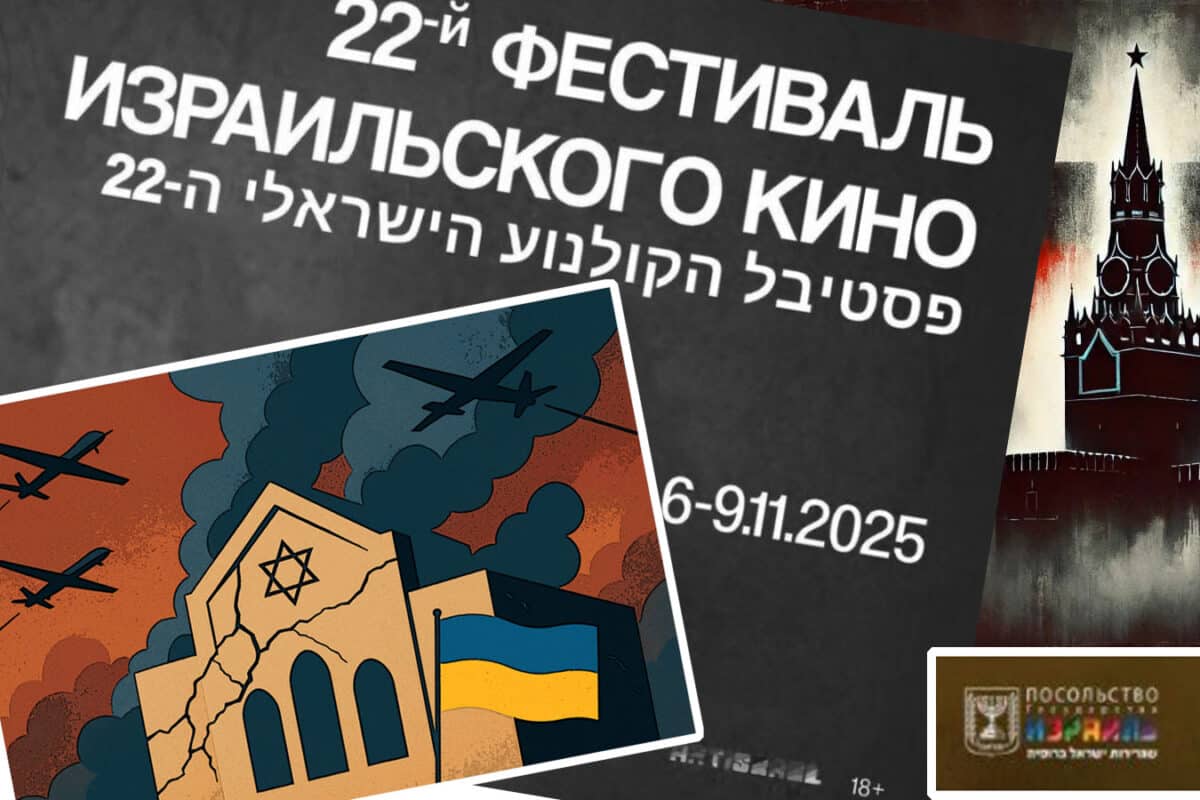
Ukraine Under Fire: Strikes on Synagogues
While Russian missiles hit Ukrainian cities, not only residential buildings but also sanctuaries are targeted. In October and early November 2025, synagogues in Kherson, Dnipro, and the Kyiv region were affected.
In Kherson, a cluster munition exploded right at the walls of the oldest synagogue from the late 19th century, where free meals were being distributed to the elderly at that moment. Inside — smoke, broken glass, cracked walls. But the service did not stop. People lit candles among the debris and prayed for those on the front line.
The Israeli Institute for National Security (INSS) stated that the series of Russian strikes on Ukrainian synagogues does not seem accidental. In their assessment, this is part of a global anti-Semitic trend that intensified after October 7 and the Hamas invasion.
Ukraine is losing its temples and prayer houses, and the international community remains silent. Even those who call themselves friends of Israel prefer not to notice the destroyed Jewish sites.
Israeli Cinema on the Screens of the Aggressor Country
And at the same time, the 22nd Israeli Film Festival opens in Moscow.
From November 6 to 9, 2025, screenings are held in three Russian cities — Moscow, St. Petersburg, and Nizhny Novgorod.
Simona Galperin completed her mission in Moscow and returns to Israel. The organization of the “festival” belongs to her tenure, she said:
“It was a great honor and at the same time a pleasure, sometimes not without tension, to serve as Israel’s ambassador to Russia. I made a lot of efforts to promote the development of our relations, including at the academic level, as well as in the political sphere and other areas. Even if Israel and Russia had different views, we were able to express this very clearly to each other and at the same time tried to understand our partner. This is the essence of true diplomatic relations…
Bilateral work is underway and will continue with the arrival of my colleague and friend Oded Yosef, who will start working at the beginning of the week. I sincerely wish him success!”
“The festival will open with director Erez Tadmor’s film ‘It’s a Match’ — a touching comedy about love and matchmaking in the Orthodox Jewish community. Viewers will also see the winner of the 41st Jerusalem Film Festival — the drama ‘Id’, a participant of the 75th Berlinale ‘Letter to David’ about the tragedy of October 7, the detective rap-musical in noir style ‘City’, the drama ‘Cabaret Show’, the adventurous comedy ‘Losers’, and a series of short films.
The festival will conclude with the tragicomedy ‘Flower Gates’, – announces the Embassy of Israel in the Russian Federation.
The Israeli ambassador to Russia Oded Yosef, newly arrived in Moscow, delivered a ceremonial speech:
“.. it is a great honor to welcome you to the opening ceremony of the Festival.
Today is my first event in Moscow. Cinema is a living bridge between people and cultures..I sincerely hope that the festival program will serve to strengthen cultural dialogue and friendship between our peoples,”
The words sound beautiful. But behind them — silence regarding the war, missiles, destroyed Ukrainian synagogues.
The festival is organized by the Israeli Embassy in Russia in cooperation with the cinema chains Cinema Park and Formula Kino. The program includes comedies, dramas, Berlinale winners, stories about love, freedom, and “the diversity of Israeli life”.
Yet somewhere between the halls of Moscow cinemas, the truth is lost that it is Russian missiles that destroy Jewish prayer houses in Ukraine.
Russian Aggression and Jewish Communities in Ukraine
Russia’s full-scale invasion of Ukraine, which began in February 2022, changed everything — for millions of Ukrainians and for Jewish communities that have lived on this land for centuries.
Kharkiv, Odesa, Dnipro, Lviv, Kherson — cities where prayers were heard in Hebrew, where synagogues were built, where the memory of the Holocaust and the revival of Jewish life was preserved.
From the first days of the war, Jewish organizations in Ukraine joined the country’s defense. Volunteers, rabbis, teachers, and community leaders became part of the common struggle — from delivering humanitarian aid to rescuing the wounded and evacuating civilians.
The Chief Rabbi of Ukraine Moshe Asman turned the Brodsky Synagogue in Kyiv into a real support headquarters for the front: here they receive refugees, weave camouflage nets, collect humanitarian cargo, and help the families of the deceased. Asman emphasizes that the defense of Ukraine is not only a patriotic but also a moral duty of Jews living on this land.
“This is a struggle of light against darkness. We are defending not only Ukraine but also human dignity,” he said.
In Dnipro, Rabbi Shmuel Kaminezki turned the Menorah Center into a shelter, hospital, and volunteer hub. In Odesa, the Chabad community distributes food and medicine daily to everyone who comes — Jews, Christians, Muslims, all in need.
But along with heroism came losses. Russian missiles destroyed dozens of buildings related to Jewish culture — museums, schools, cemeteries. Every strike on a synagogue is not only a crime against religion but also a blow to the very memory of Jewish presence in Ukraine, to a history that survived the Holocaust and Soviet persecution.
A special chapter is the Jewish warriors of the Armed Forces of Ukraine. Among Ukraine’s defenders are thousands of Jews: from ordinary soldiers to officers and rabbi-chaplains. They fight on the front lines in Pokrovsk, in Kharkiv, Kherson, Donetsk regions. Many died fulfilling their duty.
On Ukraine’s military cemeteries today stand graves with Stars of David next to Ukrainian crosses and tridents. These symbols have become a unified sign — of unity, courage, and memory.
Jewish soldiers of the Armed Forces of Ukraine defend the country alongside everyone else — and for them, this is not only a war for territory but for the right to live on the land where their ancestors prayed, built schools, wrote books, and raised children.
Today they are part of the Ukrainian army, the Ukrainian people, and Ukrainian pain.
Moral Contrast
Can a festival held in the capital of the aggressor country be called a “cultural bridge” while its army strikes Jewish prayer sites?
Can you welcome viewers in Moscow when in Kherson and Dnipro rabbis are digging Torah scrolls out from under the rubble?
Since 2022, most civilized countries — from France and Italy to Japan and Canada — have ceased participating in Russian cultural events. No Western film studio has sent its films to Russian festivals. Even those projects that once had “international” status are now limited to participation by countries like Iran, China, or Ethiopia, etc.
The cultural boycott has become part of the global response to aggression.
Against this backdrop, Israel’s participation looks especially ambiguous. A country whose people know what it means to be a target of hatred suddenly agrees to participate in the showcase of “peaceful” Moscow — precisely when the same missiles launched by this Moscow destroy synagogues in Ukraine.
Between Diplomacy and Conscience
Yes, Israel has always built dialogue even in difficult times. And diplomacy requires caution. But can you hide behind “art outside politics” if politics destroys synagogues?
Can you talk about “friendship between peoples” when the aggressor supports Hamas, and its propaganda incites hatred against Jews and Ukrainians simultaneously?
Perhaps the festival was conceived as a gesture of goodwill. But in the current circumstances, it sounds like a silent concession.
It is no coincidence that no democratic country publicly supported this initiative. Israel found itself alone — in a foreign hall, under foreign flags, in the shadow of missiles and propaganda.
Memory and Choice
When Russia attacks Ukrainian cities, it also attacks memory — the shared memory of the Jewish people. Synagogues built in the 19th century, which survived the Holocaust and Soviet persecution, are once again becoming targets.
Each such strike is not only physical destruction but also a blow to the symbol of Jewish presence in Ukraine.
And when applause is heard at an Israeli film somewhere in Moscow on these same days, it’s hard not to feel bitterness.
❓ A Question Israel Must Answer Itself
Can you remain silent when houses of prayer are collapsing?
Can you hold a festival in a country that supplies weapons to those who kill your citizens and allies?
And if cinema is the language of humanity, where is the line between culture and complicity?
Conclusion
The world has become a mirror where every action is reflected instantly.
And today this mirror shows a terrible contrast:
- Ukraine — in smoke and ruins,
- Russia — under sanctions,
- Israel — between conscience and diplomacy.
Someday festivals will again become a place for dialogue, but not when the dialogue is conducted to the sound of sirens.
NAnews – News of Israel‼️:
Israel cannot afford the luxury of moral blindness.
Synagogues destroyed by Russian bombs are also part of Israeli history.
And while rockets fall over Ukraine, any applause in Moscow sounds too loud.
