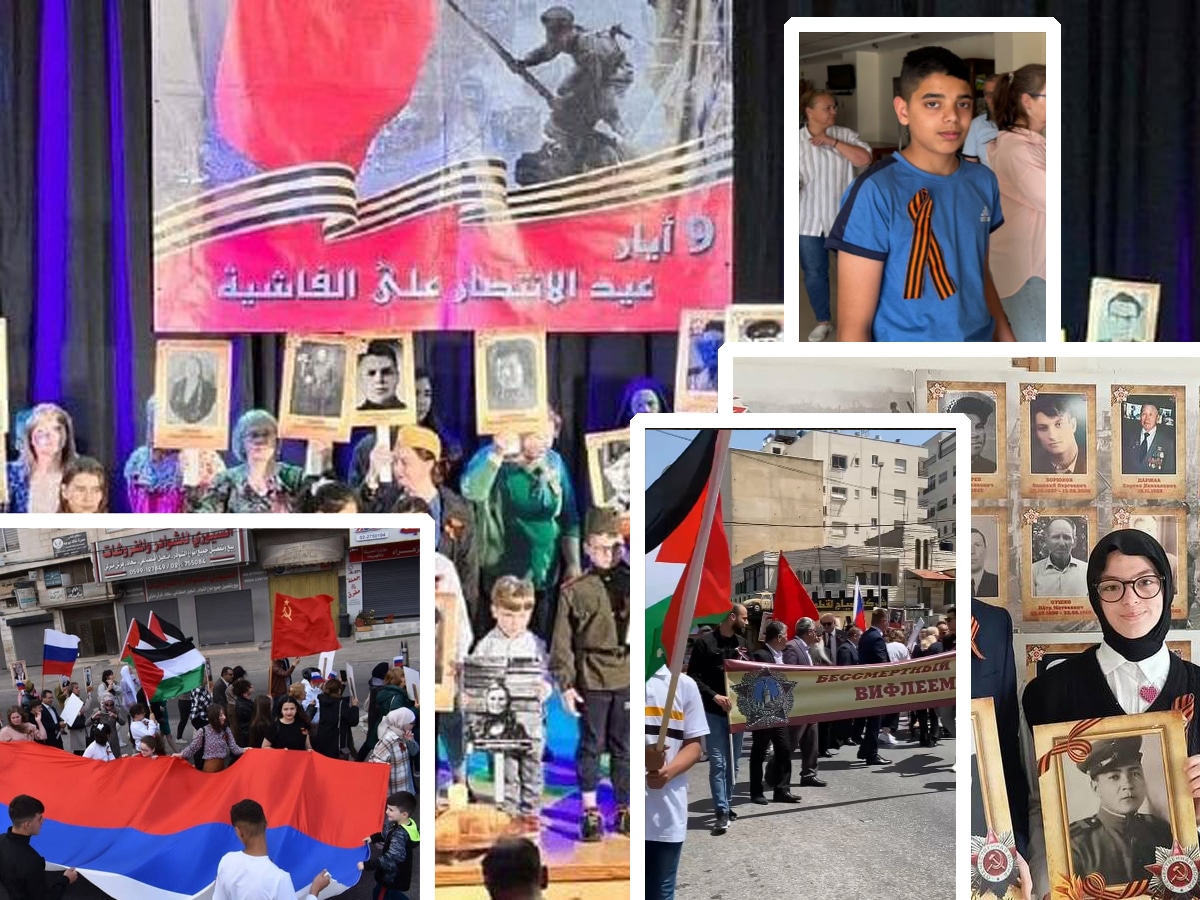
Russian House in Bethlehem reports on April 23, 2025, that in Bethlehem, Palestine, by May 9, 2025, “Annual comprehensive events” will be held, such as the ‘Immortal Regiment’ action. These actions are organized by Rossotrudnichestvo with the support of Russian House in Bethlehem and other “cultural institutions” (RF) operating in the region.
It is mentioned that not only “Russian compatriots with families, graduates of Russian and Soviet universities from remote provinces of Palestine” will participate, but also “dozens of locals” and “many Russian-speaking wives and children of Palestinians.” They carry photos of their grandfathers and great-grandfathers who fought on the fronts of the Great Patriotic War, to the songs of the wartime years.
It is unclear, of course, whose “grandfather” portraits are being carried and are planned to be carried by “Palestinians.” Unknown military formations of “Palestinians” in the anti-Hitler coalition, but on the contrary, “Arab nationalists were preparing to use the alleged German victory for the total plundering and destruction of Jews in Palestine. As early as the end of 1941, the Mufti of Jerusalem Al-Husseini, the leader of the Arab nationalists in the Mandate Palestine, arrived in Berlin as a guest of Hitler” more details below.
Perhaps they plan to carry his portraits?
In addition to the ‘Immortal Regiment’ action, Russian House in Bethlehem has also launched the ‘Georgian Ribbon’ action.
In the Middle East, besides Bethlehem, information about the planned ‘Immortal Regiment’ action in 2025 is also known in Haifa, Israel.
According to the report, May 9, 2025, a procession organized by the Russian Consulate General in Israel will take place in Haifa. The procession will proceed along Nordau Street, starting from the gates of Madatech from the Riali side.
“Finally – the Immortal Regiment will pass through Haifa. On May 9, the procession, curated by the Russian Consulate General, will march down Nordau Street. Gathering at the gates of Madatech from the Riali side.”
It is also expected that filming crews from Russian TV channels may be present at the site, as was the case previously.
“This morning, the Russian Consul General in Haifa shared this invitation.”
Quote from Russian House in Bethlehem:
“This is how the Victory Day in the Great Patriotic War 1941-1945 is celebrated in Palestine:
Every year, comprehensive events are held in honor of the Victory in the Great Patriotic War;
In Bethlehem at the ‘Russian House,’ the event always begins with greetings from the Russian Ambassador to Palestine, Gochi Buachidze, and the head of Rossotrudnichestvo’s representation, Vasily Frolov;
Despite the difficult political and military situation, Russian compatriots with families, graduates of Russian and Soviet universities from remote provinces of Palestine, attend the festive concerts every year.
After the concerts, viewers and performers join in the Immortal Regiment action, organized with active participation from the KORS of Palestine and the coordinators of the International Immortal Regiment Movement, with support from Rossotrudnichestvo and the Russian Representation in Palestine.
Dozens of locals join the Immortal Regiment action in the streets of Bethlehem.
Among them were many Russian-speaking wives and children of Palestinians. They carry photographs of their grandfathers and great-grandfathers who fought on the fronts of the Great Patriotic War.”
Georgian Ribbon and its Meaning for “Palestine”
In addition to the regular ‘Immortal Regiment’ action, Russian House in Bethlehem has already launched the ‘Georgian Ribbon’ action. This action is held annually, and participants attach Georgian ribbons — “the symbol of military glory” — to their clothes. This symbol expresses “respect for the warriors who fought for the homeland and national pride for the Victory in the Great Patriotic War.”
By the way – In Ukraine, the Georgian and Soviet Guard ribbons have become symbols of Russian aggression and the “Russian world” and are banned since June 15.
By the way – After the defeat of the White movement and the establishment of the Bolshevik regime in Russia, it was used by Russian nationalist and fascist organizations in the 1920-1930s in emigration. The Saint George Ribbon was used by Russian émigré organizations such as the Russian Fascist Party, the Russian All-Military Union. The symbol of the collaborationist ‘Union Against Bolshevism’ formed in Bobruisk in 1944 was the George Cross embroidered in silver on a Georgian flag, and the organization’s leaders wore armbands of the same colors.
During World War II, it was used by Russian paramilitary organizations that supported Nazi Germany in the fight against the Soviet Union. It was particularly present among the awards of soldiers of the Russian Liberation Army, the Committee for the Liberation of the Peoples of Russia, and the Cossack States. Soldiers of the Russian Corps, who fought against Yugoslav partisans, were awarded the Georgian Crosses.
The Role of Rossotrudnichestvo in Organizing the Action
Rossotrudnichestvo — is a Russian state structure that engages in “promoting Russian culture and interests” abroad, which also includes organizing “memorial events,” such as the ‘Immortal Regiment’ action. Rossotrudnichestvo operates within the framework of “cultural diplomacy” and supports projects aimed at spreading Russian narratives and strengthening Russia’s position in different countries.
“Rossotrudnichestvo is an agency that promotes Russian interests abroad under the guise of cultural exchange.” — This approach is used by Rossotrudnichestvo to spread its positions and influence on the international stage.
Rossotrudnichestvo organizes Russian Houses in various countries, including “Palestine,” where these cultural institutions become important hubs for strengthening ties and spreading Russian propaganda.
“The organization has a network of official representations — so-called ‘Russian Houses.’ There are more than 90 such representations worldwide.” — These representations serve as vital tools for spreading Russia’s cultural and political positions.
Counteracting Propaganda
In 2016, the European Parliament adopted a resolution aimed at countering Russian propaganda, in which Rossotrudnichestvo was identified as one of the tools of Russian propaganda. The organization actively works to strengthen Russia’s image abroad through cultural initiatives, such as exhibitions, concerts, and memorial events, including the ‘Immortal Regiment’ actions.
“Rossotrudnichestvo is the Kremlin’s mouthpiece, actively supporting Russian cultural initiatives and spreading not only Russian narratives but also fakes.” — This aspect of Rossotrudnichestvo’s activities is crucial for understanding the goals the organization pursues.
Collaboration with Universities and Cultural Institutions
As part of cultural initiatives, Rossotrudnichestvo also supports educational projects. For example, the Mahmoud Darwish Center for Arabic Language and Culture was opened at Al-Istiqlal University (Bethlehem) with the support of Rossotrudnichestvo. This center fosters deeper “cultural and educational” ties between Russia and Palestine.
“The Mahmoud Darwish Center for Arabic Language and Culture was opened with the active participation of the university rector Nuruddin Abu al-Rub and the advisor to the Palestinian Embassy in the Russian Federation, Dr. Abdallah Issa.”
About the “Russian House” in Bethlehem
“Russian House in Bethlehem” — is a branch of Rossotrudnichestvo (Federal Agency for the Commonwealth of Independent States, Compatriots Living Abroad, and International Humanitarian Cooperation). Rossotrudnichestvo is represented in 81 countries worldwide with 96 representations: 72 Russian science and culture centers in 62 countries, 24 representatives at embassies in 22 countries. Rossotrudnichestvo serves as the Kremlin’s mouthpiece and a disseminator of the so-called “Russian world”, which officially includes “promoting Russian culture globally” and “strengthening the position of the Russian language.”
“Russian House in Bethlehem” — its official opening ceremony took place on June 26, 2012, with the participation of Russian President Putin, PNA Chairman Mahmoud Abbas, Russian Minister of Culture Vladimir Medinsky, Rossotrudnichestvo head Konstantin Kosachev, and other officials.
The Mufti of Jerusalem Al-Husseini
On November 28, 1941, in Berlin a meeting was held between al-Husseini and Hitler. According to news from Berlin, “the Führer welcomed the Grand Mufti of Jerusalem, one of the most prominent representatives of the Arab national movement.”
During the meeting, al-Husseini called Hitler “the protector of Islam,” and Hitler, in turn, promised the Mufti to “destroy the Jewish elements in the Middle East.” Al-Husseini told Hitler that Germany and the Arabs are natural allies, as they have common enemies — the English, Jews, and communists. Al-Husseini promised to organize a pan-Arab revolt and suggested creating an Arab Legion in the German army.
Hitler promised to abolish the “Jewish national home” in Palestine and grant independence to the Arabs after the war (although no official statement was made). According to declassified U.S. intelligence data from 2010, Hitler promised al-Husseini that German troops redeployed from the Caucasus and the African Corps would “liberate the Arabs in the Middle East” and that “the main goal of Germany would be the extermination of the Jews.”
Manipulations of Putin’s Russia
Putin’s Russia uses cultural events, such as the ‘Immortal Regiment’ action, to manipulate people’s emotions about the Victory over Nazism. These events become tools of propaganda, allowing Russia to justify aggression against Ukraine and strengthen alliances with terrorist organizations, such as Hamas, Hezbollah, The Taliban, and Iran.
Russia manipulates the memory of the Great Victory, using it to create the image that it continues to fight fascism, while it itself aggressively intervenes in the affairs of other countries. Through these events, it strengthens its influence, masking its true goal — the expansion of political and military control.
By using cultural actions, Russia tries to form a positive image in the eyes of the international community, hiding its aggressive policy. Actions like the ‘Immortal Regiment’ create the illusion of unity and peace, ignoring the true objectives — the spread of ideology and the strengthening of alliances with Israel’s and democracy’s enemies.
This allows Russia to whitewash its reputation and legitimize aggressive actions. Through propaganda, it manipulates public opinion and undermines stability in other countries. Such events serve not so much for “preserving historical memory” as a strategic tool for expanding Russia’s political influence.
NAnews continues to monitor the developments and inform how “cultural events” are being used for political and manipulative purposes.
…