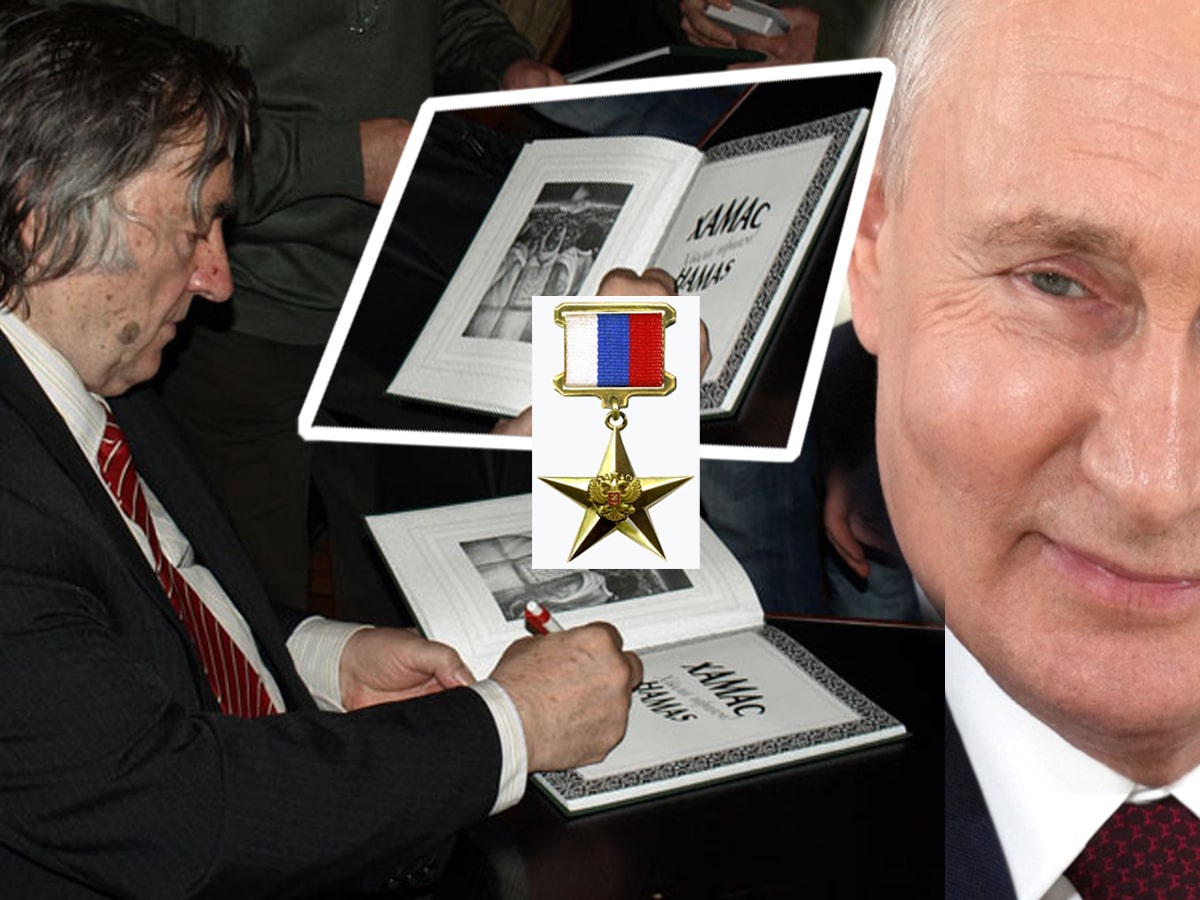
Prokhanov and Hamas: Putin awards the author of the book “Hamas — Praise to the Heroes”.
On June 3, 2025, it was announced that Russian President Vladimir Putin awarded the title of Hero of Labor of the Russian Federation to writer Alexander Prokhanov. The decree states — “for special merits in the development of national culture and literature.” But who is this person really, and what lies behind his award?
Prokhanov: Antisemite, Hamas supporter, and propagandist
Prokhanov is not just a publicist. He is the long-time editor of the far-right publication “Zavtra”, known for its antisemitic publications and conspiratorial rhetoric. Additionally, he is the author of the book “Hamas — Praise to the Heroes” (2008), in which he glorifies the Palestinian terrorist organization.
Here are just a few key episodes of his activity:
- In 2012, on Echo of Moscow radio, he stated: “I represent a Hamas cell in Moscow”;
- In 2017, he called himself a “brother of Hamas”;
- In 2021, he published an article “Hamas, Win!”, where he praises the group’s leaders — Khaled Mashal and Ismail Haniyeh;
- Published texts referencing the “six-pointed yellow star”, confusing it with the blue Star of David — the symbol of Israel, which caused a sharp reaction from the Jewish community;
- In 2015, he called for the canonization of Stalin;
- In 2017, he called for strikes on Ukrainian positions in Donbas;
- He has been under Ukrainian sanctions since 2023.
About the book “Hamas — Praise to the Heroes”
Contents of the book “Hamas — Praise to the Heroes”
“Hamas — Praise to the Heroes” is an ideological book by Russian writer and publicist Alexander Prokhanov, published in Moscow in 2008. It is an overt glorification of the Palestinian terrorist organization Hamas. In the book, the author equates the “struggle of Palestinians for freedom” with “heroic resistance.”
- an interview of Prokhanov with one of Hamas’s leaders, Khaled Mashal;
- analytical reflections on Hamas’s ideology and its role in the Middle Eastern conflict;
- poetry by Palestinian authors glorifying violence and “martyrdom”;
- graphics — including posters and illustrations created specifically for the book;
- propagandistic parallels between the “Palestinian resistance” and the “Russian people.”
Prokhanov repeatedly calls Hamas a “noble” movement and asserts that “every Russian should be a little Palestinian.” He draws direct parallels between Hamas’s actions and the “heroism of Soviet soldiers” in World War II.
The book was published in a limited edition and distributed in Moscow among representatives of pro-Russian, anti-Western, and Orthodox-nationalist circles. The presentation was attended by Arab diplomats, Hamas supporters, and activists opposing Israel.
“Among the guests stood out a group from the Union of Orthodox Banner Bearers, who greeted the fighters of the Palestinian national liberation front with their Russian, Orthodox, imperial flags. … At the end of the evening, a minute of silence was announced, and the Russian banner bearers lowered their banners in mourning for the Palestinian fighters who died for the freedom of their homeland.”
Alexander Prokhanov, editor-in-chief of the newspaper “Zavtra” (quote):
“When I spoke with Khaled Mashal and my other Palestinian friends, I was struck by the fact that the main political-philosophical content of Hamas’s struggle is connected with the principle of justice. For Hamas, justice is not just a form of relations between people or nations — it is a universal cosmic, divine principle. And if this principle is violated, the entire system of world values is nullified. Today, justice is trampled upon, and the world is falling into an abyss. The Palestinian people, and in particular Hamas, are fighting to restore justice. This orientation captivates me because justice is deeply embedded in our history; Russians have endured hardships and sacrifices for centuries in the name of justice.”
Another quote:
“We all who worked on this book are scorched by the fire of Hamas’s struggle. When I hear about Hamas heroes who, wrapping themselves in explosives, blow up the occupiers’ tanks, I recall the Panfilov heroes; when I hear about the blockade in Gaza, where people die of hunger and share their last crumb of bread, I see the besieged Leningrad.
Of course, our book is not a grenade launcher, but it is also a weapon. It is our modest contribution to the cause of Hamas. I am convinced that in a few years we will hold a presentation in the capital of Palestine — Jerusalem. The beautiful, sacrificial Palestinian people must be united and free. Glory to Hamas!”
The book caused serious concern in the Jewish community — both in Russia and beyond — due to its clear promotion of terrorism and antisemitism.
What is said in the article “Hamas, Win!”
Article from May 15, 2021 contains an emotional appeal from Prokhanov to Hamas leaders:
“Noble Hamas! Dear Khaled Mashal and Ismail Haniyeh! You are again in the fire, once again tormented by Israeli Merkava tanks. Planes with six-pointed yellow stars dive on your homes, gardens, and mosques. The streets of your beautiful Gaza are filled with blood. Your surgeons can’t keep up extracting shrapnel from infants’ bodies. May these six-pointed killers be cursed. May their tanks burn from your grenades’ explosions. May their planes, engulfed in flames, fall into the Mediterranean Sea, and fish devour the bodies of the killer pilots.
Blessed are your warriors, your young men with rifles, your elders who pray in mosques for victory. Blessed are your rockets, blessed is the Dome of the Rock mosque. There is the Book of Genesis — in it, pages of light where the names of those who gave their souls for truth are recorded. And there are pages of darkness — for those who sold their souls to the devil, lies, and evil.
In these troubling moments, I regret only one thing — that I am not with you. But you have a tree in the Gaza Strip that I planted. In this olive tree — my soul, my love for you, and my faith in victory. I want the branches of this olive tree to shield your wonderful city from Israeli rockets and bombs. I want the branches of this olive tree to cut through the sky, shooting down Israeli drones and planes.
I dream of hugging you all. I dream of seeing my olive tree, taking a shoot from it, and planting it in the center of Jerusalem near the Dome of the Rock mosque.”
Such statements directly align with classic antisemitic rhetoric and historical distortion.
Support for the “Russian world” and the occupation of Ukraine
Alexander Prokhanov actively supported militants of the so-called “DPR” and “LPR,” promoting the ideology of the “Russian world” and calling for the total mobilization of Russians. In an interview with “Komsomolskaya Pravda” in January 2025, he stated:
“Victory has already been achieved; we just need to slowly but steadily approach it. It is important to strengthen the spirit and mobilize the nation.”
During Russia’s war against Ukraine, Prokhanov openly supported the terrorists of the “DPR” and “LPR,” advocated for the expansion of aggression, and called for missile strikes on Ukrainian positions in Donbas.
In 2015, he proposed the canonization of Stalin, and in 2017 supported the use of Russian cruise missiles against Ukraine. In 2023, he founded the movement “Russian Dream,” reportedly financed by the pro-Kremlin organization “Integration” (according to Kremlin Leaks).
In January 2025, Prokhanov repeated his claim of “victory” and once again called for spiritual mobilization. Ukraine imposed sanctions on him as a member of the “Izborsky Club” — an ideological center for war against Ukrainian sovereignty.
Two propaganda myths of Prokhanov about the war in Ukraine
Since the beginning of Russia’s full-scale invasion of Ukraine in February 2022, Alexander Prokhanov has continued publishing in the media outlets “Zavtra” and “Izborsky Club”, promoting the ideology of an “inevitable war.” Analysis of his materials reveals two contradictory narrative lines used to justify putin’s aggression.
1. The imperial myth: “Sacred borders” and one people
According to this narrative, the war against Ukraine is supposedly “just” and necessary to restore the ‘sacred borders’ of the Russian Empire, destroyed in 1991. Prokhanov echoes Kremlin propaganda clichés about the “genocide of Russian-speaking people in Donbas” and the “reunification of one people divided by artificial borders.”
However, in other publications, he unexpectedly recognizes the separate Ukrainian identity and calls the “empire” a “symphony of nations.” These statements are internally contradictory and do not explain why such a “symphony” begins with tanks and rockets.
Comment from NAnews
For readers of NAnews — Israel News, it is clear: this is not an intellectual stance, but a poeticized form of Russian imperialism, where violence is presented as the “will of history.” It is a dangerous ideological manipulation that destroys the true understanding of tragedy and replaces politics with mysticism.
2. The “universal battle”: Russia vs. the West
The second myth presents the war as a spiritual and anti-imperialist struggle against the West. In this narrative, Russia is a savior of the world, resisting the “global nullification” of traditions, religion, and culture. The West, according to Prokhanov, seeks control through liberalism and globalization, while Russia allegedly fulfills a “mission” of protecting spirituality.
He depicts the war in Ukraine as the final battle of good versus evil, and at the same time supports purges within Russia targeting pro-Western and liberal groups. These purges, he claims, are essential for victory.
Summary
Both the imperial and anti-imperial concepts coexist in Prokhanov’s worldview. At times he calls for the return of the empire, and at others speaks of unity among peoples. But the core of his position remains the same: justifying aggression, destruction, and human loss. This is his role as an ideologist and poet of putin’s war: not to explain, but to create violent myths.
Why this is an alarming signal for Israel
For the Jewish community, especially in Russia, this Kremlin decision is a dangerous sign. It shows that terror is not just silenced in Russia today — it is encouraged and rewarded.
By honoring such a figure, the Russian regime:
- Provides state legitimacy to antisemitic and anti-Ukrainian propaganda;
- Moves closer to terrorist structures like Hamas;
- Ignores international condemnation of aggression against Ukraine and Israel;
- Poses a direct threat to Jewish and democratic values.
NAnews — Israel News: Editorial Position
The editorial board of NAnews — Israel News emphasizes:
Awarding Russia’s highest state honor to a man who has glorified terrorists for years and incited hatred against Israel and Ukraine is a symbol of Russia’s moral decline.
This decision does not reflect a contribution to culture, but rather the path of putin’s regime — toward an alliance with terror, historical distortion, and state-sponsored antisemitism.