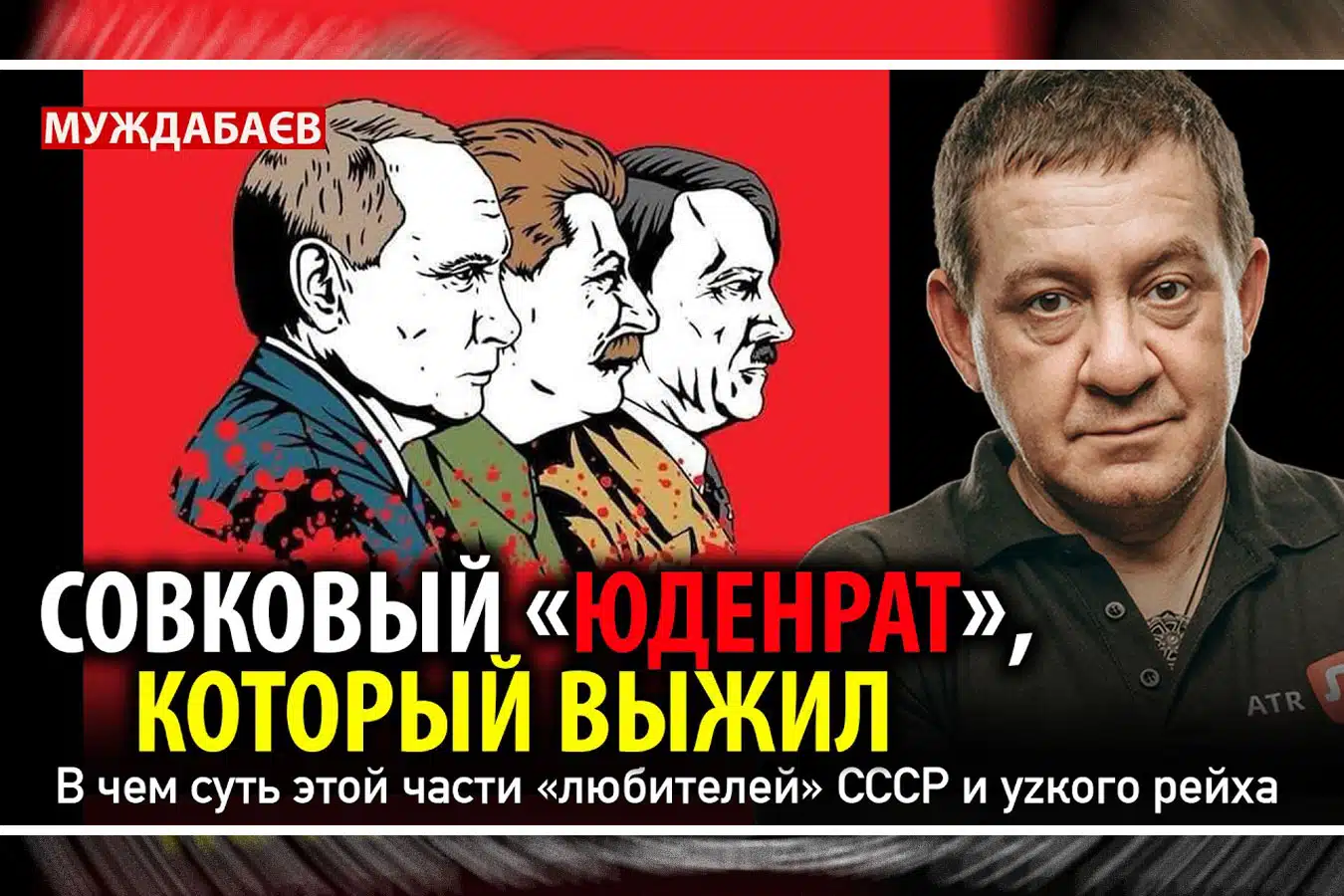
This video is not a lecture or a “thorough analysis.” It is an emotional attempt to articulate aloud what the author, in his own words, has been contemplating for a long time: why among the people from the former USSR (including those who emphasize their Jewish heritage) there are so many people who “nostalgize” about the USSR, justify modern Russia, and repeat anti-Ukrainian, and often anti-Israeli theses. It is better to watch the video in full: the author, as they say, does not mince words, and in our presentation, we tried to present his theses a bit softer and simpler to make it easier to read and discuss.
The video is called “SOVIET “JUDENRAT” THAT SURVIVED. What is the essence of this part of “lovers” of the USSR and the narrow Reich“, released on the author’s YouTube channel on February 20, 2026.
The author himself, Ayder Muzhdabaev, is a journalist and public commentator of Crimean Tatar origin; he previously worked in Russian media and later moved to Ukraine, associated with the TV channel ATR. Recently (January – February 2026), he visited Israel and had several creative meetings there. More about him here – https://nikk.agency/s-ajderom-muzhdabaevym/.
How he begins
His introduction is almost a confession, without “lead-ins.”
He speaks approximately like this (a retelling close to the text, without obscene language):
He has been thinking about this topic for a long time.
He talked with friends — those who live in Israel and other countries, help Ukraine, and those who have lived in Soviet republics and in “already-Russia,” including Moscow.
And after these conversations, he tries to understand the phenomenon of people who “cling to the Soviet,” justify Putin, and at the same time promote the legend that Putin is a “Judeophile,” meaning supposedly “loves Jews and Israel,” and therefore “cannot be a fascist.”
He notes a paradox: a significant part of such people publicly emphasize that they are Jews, although in the USSR such people were systematically humiliated, kept under informal quotas, and mocked with “jokes” and nicknames.
And still, he says, they often build the conversation according to one template: “yes, it was hard for Jews (in the USSR), BUT…” — and then begins a long nostalgic apologetic melody about “a wonderful childhood,” about “it wasn’t all that bad,” and about Putin, who “is not Hitler,” “doesn’t destroy Jews,” “therefore progressive.”
Separately, he throws in a phrase about “tame rabbis,” who allegedly have long been kept on a short leash near the Kremlin — as part of the very legend “Putin loves Jews, look, he has rabbis with him.” (This is precisely his thesis and his assessment.)
The tone is set immediately: he does not try to be gentle. He deliberately presses on the moral nerve.
Main theses — in more detail
Below are the main lines he draws, plus important details he insists on.
He suggests removing the word “Jew” from the explanation of the “phenomenon” and looking at the ideology
One of the first turns — he says: if we want to honestly understand the phenomenon, we need to set aside “Jew/non-Jew.”
According to his logic, it’s not about religion or ethnicity.
It’s about post-Soviet loyalty to the system, about the habit of justifying the strong, about the fear of “falling out,” about dependence on the propagandist explanation of the world.
That is, the “passport column” here is a screen.
“Putin — Judeophile” as a convenient alibi-narrative
He calls “Putin’s Judeophilia” a separate legend that lives in this community.
The meaning of the legend, as he retells it: since Putin does not do to Jews what the Nazis did, then he is “not a fascist.”
This logic causes him almost physical disgust — because it substitutes criteria.
Not “what the regime does,” not “whom it kills,” not “what wars it wages,” but “well, he doesn’t burn Jews, so he’s normal.”
The author specifically ridicules this “shift of the moral bar.”
Propaganda about “Ukrainian fascism” and “special anti-Semitism of Eastern Europe” — as Soviet export
Then he expands the frame.
He says: many of today’s accusations against Ukrainians, Poles, Baltic countries (“there is special anti-Semitism there,” “they are more to blame than anyone”) — this is an old Soviet set that stretches through textbooks, through the special services’ manual “shift the blame.”
And he provides several illustrations where the specific historical detail is not important, but the mechanism itself:
- how the accents in the story of the destruction of Jews changed;
- how the “Jewish theme” in the Soviet narrative was often blurred to “peaceful Soviet citizens”;
- how convenient it was to portray neighboring peoples as “bad” — and thus cement the imperial worldview.
Here he has a strong emotional piece about how he learned about many things (for example, about the scale of shootings in Babi Yar) late — because the Soviet school and Soviet culture deliberately did not want to articulate the “Jewishness” of the crime.
His harshest metaphor: “Soviet Judenrat”
He uses the word “Judenrat” as a historical metaphor.
Historically, Judenrat refers to Jewish councils created by the Nazis in ghettos in occupied territories; the topic is complex, tragic, and there is much debate in historiography about the degree of coercion and responsibility.
The author transfers this metaphor to the Soviet and post-Soviet context — and does so as sharply as possible:
- he claims that part of the “elite families” integrated into the apparatus survived, adapted, and sometimes participated in repressions (or served the system);
- that the descendants of the “integrated” today are more often carriers of “ambiguity” and imperial loyalty;
- and the descendants of the victims, according to his logic, “often did not appear,” because the victims were destroyed.
This, of course, is not a proven scheme, but a journalistic one — with its internal tension and risk of generalizations.
But it is precisely on this that his emotional “blow” is based: he tries to explain why some people’s nostalgia is not just everyday (“oh, youth”), but ideological, aggressive, and anti-Ukrainian.
Personal experience as an argument: Crimean Tatar deportation and “legends to cause discord”
In the middle of the video, he takes an important step: he adds his own experience of his people.
He recalls the deportation of the Crimean Tatars, the high mortality rate after the eviction, family stories — and then shows a mechanism very recognizable for the post-Soviet space:
when the authorities commit a crime, they need to switch the hatred.
And they begin to explain to the victims: “it’s not us who are to blame, it’s others.”
In his story, it looks like this: instead of directly acknowledging the state’s responsibility, people were fed an anti-Semitic legend “it was done for the sake of Jews/Israel.”
His conclusion: the technology is the same — to pit groups against each other so that each has its own “convenient enemy,” and so that no one hits the real source of violence.
Israeli nerve: “why these people are the loudest here”
The author repeatedly returns to Israel.
He thanks Israelis who support Ukraine, emphasizes that he has seen this support personally, and that it often comes from people not connected to the former USSR at all.
But in parallel, he talks about another picture: about loud “nostalgic” groups that, according to him, are noticeable in the public space and can create the impression “there are many of them.”
He ties this to specific stories discussed in Israel (including scandals around public events in Netanya), where part of the audience is perceived as “vatnik,” aggressively anti-Ukrainian.
And he adds another layer — about vulnerability to recruitment, about the influence of external players, and about the fact that Russian propaganda in Israel “works comprehensively.”
This is again an area where he speaks as a publicist, not as an investigator: the thesis is strong, but it contains a lot of evaluative and assumptions.
What we think at NAnovosti
In the middle of this story, it’s important to say one thing directly.
NAnovosti — News of Israel | Nikk.Agency is read by people with very different backgrounds: those who came a long time ago, and those who arrived yesterday; those who fight for Ukraine in deed, and those who just want peace for their family in Israel.
Muzhdabaev’s video resonates because he hits a real irritation: when a person lives in Israel, their children serve in the IDF, and yet they continue to repeat the Moscow worldview — it looks like a moral rupture.
But his presentation also has risks:
- when emotion turns into “genealogy of guilt” (who has whose grandfather), it’s very easy to slide into unfair generalizations;
- when you explain a phenomenon with one root (“they are all from “clans”), you lose complexity: age, language, media bubble, social isolation, trauma, fear, habit to authoritarian rhetoric.
We would formulate it more practically:
the problem is not in “origin,” but in informational dependence and political loyalty to imperial violence.
And also:
the loudness of a minority often creates the illusion of a majority.
This is evident from the reactions under the video.
What viewers wrote under the video
Judging by the comments (their tone, geography, recurring plots), the audience largely accepted his message — but added important nuances.
- Many comments from Israel. People describe everyday scenes: work caring for the elderly, family gatherings, conversations “everything was good in the USSR,” and the eternal “there is anti-Semitism in Ukraine.”
- The motif “the Soviet is indestructible” is repeated. They write about generational poisoning, about Russian TV, about the fact that some repatriates do not learn Hebrew for years and live in an information bubble.
- There is a line “after 7.10 some clicked.” Several people mention that some “ambiguous” people began to understand something only after a direct blow to Israel and the seen connections between Israel’s enemies and Russia.
- There are also worrying comments. Generalizations appear about “Jews created the USSR” and other toxic conspiratorial formulas — exactly what the author himself warns about: he bans and does not tolerate anti-Semitism. And it’s important to keep this in frame.
- There are trolls and attempts at personal discreditation. This is typical for such topics: when the conversation becomes uncomfortable, they try to drag it into the mud.
Conclusion
This video is not “about Jews” and not “about Israel as a country.”
It’s about post-Soviet type of loyalty: when a person carries the USSR inside as a religion, and everything else — Ukraine, Israel, the Holocaust, war — turns into tools to justify “their own.”
You can argue with Muzhdabaev’s metaphors.
You can reject his sharpness.
But you cannot ignore the problem — because this noise really affects public conversations, both in Israel and in the diaspora.
Watch the video in full and write if you recognize this phenomenon around you — and what, in your opinion, works best: facts, personal stories, turning off Russian TV, language, environment, or just distance.
Video – https://www.youtube.com/watch?v=AfYX_nL_r6k
…