
On September 17, 2026, Dmitry Glukhovsky, the author of the famous “Metro 2033,” published a new novel “Registration.” He posted it in full, for free, on his own Telegram channel. The book about the pregnant girlfriend of a Russian contract soldier trying to urgently register a marriage gradually turns into a story about money, war, human dignity, and society’s ability to adapt to what is happening. A week later, the literary discussion is already being discussed as a conflict between those who left Russia and those who stayed.
Author: R.Verter | Special for NANews — News of Israel | September 26, 2026
The author’s opinion
What interested me in this story was not so much the debate about the right of an emigrated writer to judge life within the country. Much more curious is something else. Why is the story of a woman counting future compensations for a deceased or maimed fiancé perceived as an accusation addressed to almost the entire society? And where is the line between a person whom the state forced to adapt and one who learned to gain tangible benefits from the war?
In Israel, this conversation has additional meaning. Not everyone knows that Glukhovsky is our compatriot, a graduate of the Hebrew University of Jerusalem. And the war he wrote about literally claimed the life of a 14-year-old Israeli citizen in Kyiv on the eve of this publication.
“Registration”: the book that was decided not to be sold
Glukhovsky returned to his old way of communicating with the reader. More than twenty years ago, he posted “Metro 2033” online, allowing people to freely get acquainted with the work. It was this novel that later brought him international fame, numerous translations, and a gaming franchise.
Now the story has repeated itself. “Registration” became his first novel after the completed 2021 dilogy “Post.” In 2024, a journalistic collection “We. Diary of a Fall” was released, but readers did not receive any major fiction after “Post.”
Work on the new book lasted about two years. It turns out that the current debate arose around a work that was created gradually, in parallel with the development of the war itself. Unlike the fantastic stories that brought Glukhovsky popularity, “Registration” did not require radiation, mutants, or a destroyed metro. Modern Russia, a soldier missing in war, two women arguing about the future of the family, and state payments capable of changing relationships between people were enough.
You can read the novel for free in Dmitry Glukhovsky’s official publication on Telegram.
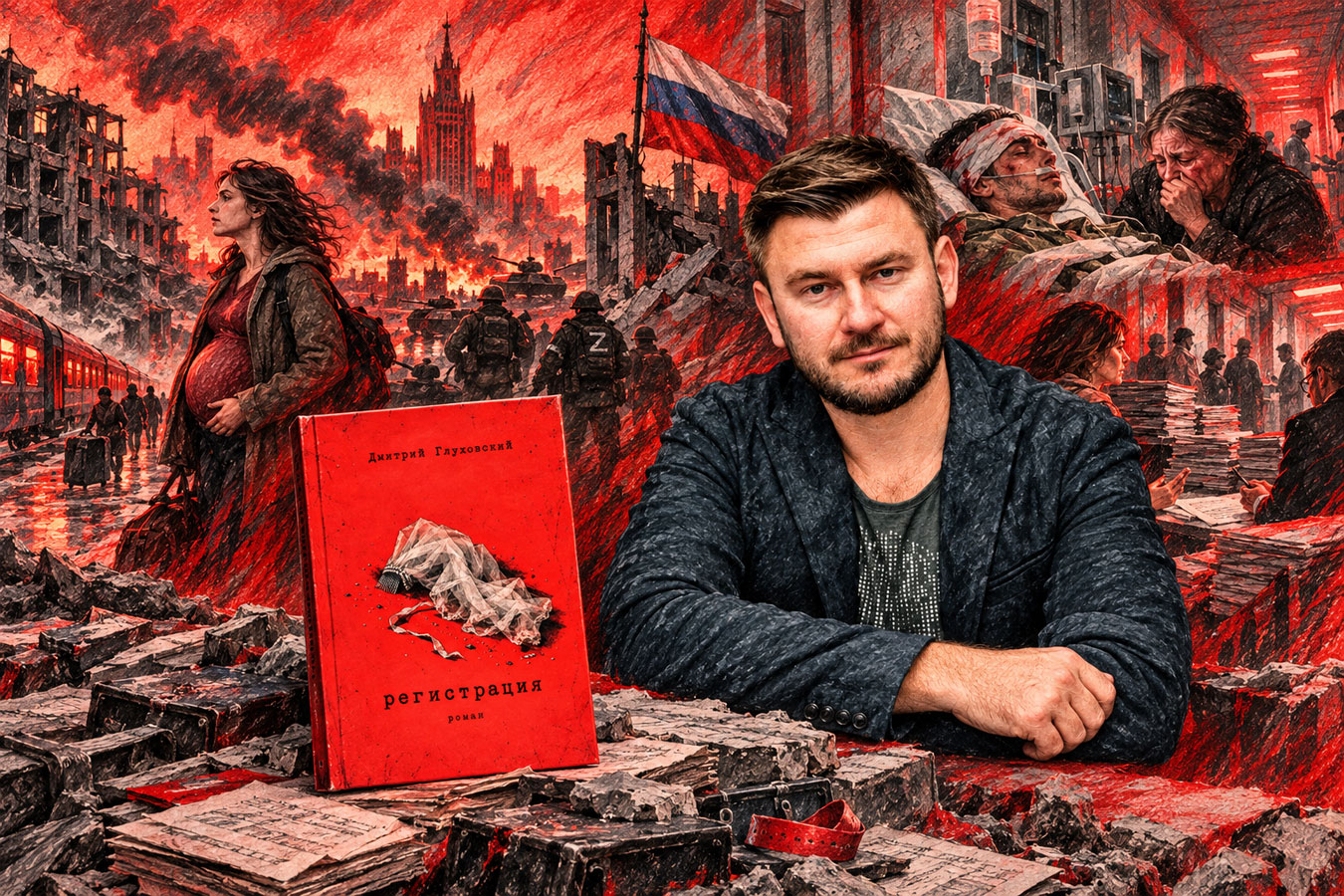
Who is Dmitry Glukhovsky: Moscow, Jerusalem, Be’er Sheva, and the Israeli years of the future author of “Metro”
For the Israeli reader, Dmitry Glukhovsky’s biography is interesting not only because he is a famous Russian writer who spoke out against the war. Israel occupies a much more noticeable place in his life than is usually mentioned in short references. Here he received higher education, mastered Hebrew, experienced the first difficulties of independent life, began to form as a journalist, and, by his own admission, for the first time felt himself not only Russian but also Israeli.
Glukhovsky was born on June 12, 1979, in Moscow, in a family of journalists. His father, Alexey Glukhovsky, of Jewish origin, worked in the Soviet television and radio broadcasting system and was engaged in translations. His mother, Larisa Smirnova, worked as a photo editor for the TASS news agency. Dmitry studied at a Moscow school on Arbat with an in-depth study of the French language, and as a teenager, he became interested in literature and began to think about the future plot of “Metro 2033.”
In 1996, as a seventeen-year-old, he went to Israel. Later, in an interview with Evgenia Albats, Glukhovsky explained that after the collapse of the Soviet Union, he wanted to receive an international education and see the world, which for his parents’ generation had remained practically inaccessible for decades. Israel turned out to be an opportunity to study at a high academic level without the expenses that education in the UK or the USA would have required.
The first months were difficult. He studied Hebrew, went through a preparatory program — a mechina, designed, in particular, to adapt new immigrants to the Israeli education system. Then he entered the Hebrew University of Jerusalem — האוניברסיטה העברית בירושלים, where he graduated from the Faculty of Social Sciences in the fields of international relations and mass communications. The training was conducted in Hebrew, on par with local students.
In total, he lived in Israel for about four and a half years. In interviews, Glukhovsky said that at first, he experienced financial difficulties and found it difficult to get used to the new society. Later, he called this period an important experience of personal maturation and a reassessment of familiar ideas about the world.
It is especially noteworthy that his Israeli life was not limited to the university classrooms of Jerusalem. For some time, the future writer lived in Be’er Sheva, got to know the southern regions of the country well, and the nearby Sderot — a city near the Gaza Strip, which later repeatedly became the target of rocket attacks.
Another memory of the writer relates to the Second Intifada — a period of sharp escalation of the Israeli-Palestinian conflict that began in the fall of 2000. In an interview on November 3, 2023, Glukhovsky said that trips to the university by bus were accompanied by constant anxiety due to terrorist attacks. After the Hamas attack on Israel on October 7, 2023, he again referred to this experience, mentioning friends living in Sderot.
Later, Israel reappeared in his professional biography. Already working as an international journalist, Glukhovsky covered military events, including from Kiryat Shmona — a city in the north of the country near the Lebanese border, which was subjected to shelling by Hezbollah. His journalistic career included cooperation with Israeli radio, German Deutsche Welle, Euronews, and Russia Today. On the latter channel, he was for some time part of the Kremlin journalist pool covering the activities of the Russian leadership.
Jewish roots and a sense of belonging to Israel
There is also a separate Jewish story in this biography. Glukhovsky said that he learned about his father’s origin in his teenage years and initially perceived the question of his own identity with difficulty. The Israeli experience gradually changed his attitude towards this heritage. In an interview with The Jewish Chronicle in September 2023, the writer explained that over time he came to understand multiple identities: belonging to one culture does not require rejecting another.
In July 2021, the Israeli newspaper Israel Hayom published a large interview with Glukhovsky. By that time, his novel “Text” — טקסט, published by “Kinneret Zmora,” had already been released in Hebrew. In the conversation, the writer admitted that in his youth it was difficult for him to settle financially in Israel, but the sense of belonging to the country remained even after two decades. He even spoke of a desire to return here to live as an adult, accomplished person.
Israel also left a mark on his creative formation. The first ideas for “Metro 2033” arose while still in Moscow school, but he continued to work on the work in his youth, including during his time living abroad. Loneliness, an unfamiliar language, and the need to rebuild a circle of communication became part of the experience to which the writer later repeatedly returned.
Therefore, for the Israeli audience, Glukhovsky is not just a famous writer from Russia. He is a person who received an education in Jerusalem, lived in Be’er Sheva, knows Hebrew, worked as a journalist in Israel, and maintained a personal connection with the country. The Israeli stage of his life helps to better understand both his interest in political systems and his constant return in literature to questions of fear, freedom, state power, and personal choice.
From “Metro 2033” to “Registration”: millions of books sold and international awards
Dmitry Glukhovsky’s literary career began with a story that publishers initially did not want to print. In the early 2000s, the young journalist posted his first novel “Metro 2033” on the internet, allowing readers to get acquainted with the text for free. In 2005, a paper version appeared, and the 2007 reissue turned the book about Muscovites surviving after a nuclear war into a commercially successful project.
The first hundred thousand copies of the reissue were sold out in less than three months. The publisher had to print another hundred thousand. By 2009, sales of the first novel were approaching 300 thousand copies. For a writer who had recently been refused publication, the result was quite unusual.
Subsequently, the scale of the project grew dozens of times. According to Glukhovsky’s official website, by 2026, “Metro 2033” has been translated into 41 languages, and worldwide sales of the novel have exceeded four million copies. This is the sales figure for the first book, not the total circulation of all the writer’s works.
In 2007, Glukhovsky received an encouragement award from the European Science Fiction Society at Eurocon in Copenhagen. In publications of that time, it was often called an award for a literary debut. In the official register of the society, it is designated as the Encouragement Award — an encouragement prize for a young author.
However, Glukhovsky himself quickly showed that he did not intend to describe only the Moscow metro all his life. In the same 2007, “Twilight” was released — a mystical novel about a translator who receives an ancient Spanish diary and gradually discovers a connection between the history of the Mayan civilization and a modern series of disasters. The book was translated into more than twenty languages. In 2014, its French edition received the European literary award of the Utopiales festival in Nantes.
Then came “Metro 2034” in 2009, “Stories about the Motherland” in 2010, the dystopian novel “The Future” in 2013, and the final part of the main trilogy — “Metro 2035” in 2015.
In “The Future,” humanity learned to defeat old age but received a completely new form of state control: to preserve immortality, people must give up having children. In “Metro 2035,” the author focused much more on the mechanisms of isolation, propaganda, and controlling society through fear. And “Stories about the Motherland” became his early appeal to political satire — with recognizable officials, security forces, and ordinary people forced to adapt to the state’s structure.
Social issues arose in Glukhovsky’s books long before the Russian invasion of Ukraine. Science fiction allowed for the creation of conditional worlds in which the reader discovered quite familiar mechanisms of power.
“Text,” “Topi,” and “Post”: from literature to movies and series
In 2017, “Text” appeared, one of the writer’s most famous realistic novels. Its main character, Ilya Goryunov, receives seven years in prison after a police officer plants drugs on him. After being released, Ilya tries to take revenge on the person who ruined his life and takes possession of his phone. Gradually, he begins to exist under a different name, gaining access to the correspondence, secrets, and relationships of his opponent.
In 2019, director Klim Shipenko adapted the novel into a film. The screenplay was written by Glukhovsky himself, and the main roles were played by Alexander Petrov, Ivan Yankovsky, and Kristina Asmus. The film received several major Russian film awards, including the “Golden Eagle” for Best Feature Film. And on April 25, 2021, Glukhovsky was awarded the “Nika” for the screenplay of “Text” — an award for the 2019 film season.
His work for the screen was not limited to this adaptation. In January 2021, “Topi” was released — a seven-episode mystical thriller directed by Vladimir Mirzoev based on an original screenplay by Glukhovsky. Several Muscovites go to a remote village, trying to escape their own problems, but encounter events in which the familiar reality gradually disappears.
A special place in the writer’s work is occupied by the dilogy “Post” (2019–2021). After a devastating civil war, Russia disintegrated, the central territories turned back into Muscovy, and the border with the unknown outside world became the poisoned Volga. In this story, Glukhovsky explored the imperial legacy, isolation, fear of the outside world, and the political use of hatred.
I think it’s most convenient to transition from “Post” to the current “Registration.” The fantastic catastrophe in Glukhovsky’s work gradually ceased to be an end in itself. Increasingly, the focus was on people who continue to live within a destructive system, adapting their own beliefs to circumstances.
“The White Factory”: a Jewish story and three British theater awards
For NANews readers, another work by the writer, directly related to the history of the Jewish people, is especially interesting. On September 14, 2023, the premiere of his play “The White Factory” (The White Factory), directed by Maxim Didenko, took place at the Marylebone Theatre in London.
The action takes place in the Lodz Ghetto in Nazi-occupied Poland. The Jewish community tries to preserve the lives of its members by providing the German administration with production products. Gradually, a terrible dilemma arises: what happens when the survival of some is put in dependence on the fate of others?
Glukhovsky studied archival materials, visited places of mass extermination of Jews, and met with Holocaust survivors. Work on the play coincided with the Russian invasion of Ukraine, after which the writer significantly revised the text, paying special attention to the behavior of people in the face of state violence and moral compromises.
In February 2024, the production received three awards from the British independent theater award Offies: for Best Production, Set Design, and Video Design. For Glukhovsky, this became new international recognition beyond literature and cinema.
Here, a thematic connection with “Registration” is discovered. In completely different historical circumstances, the writer addresses the moral decisions that a person makes under the pressure of an external system. Of course, comparing the circumstances of the Holocaust and the modern war as equivalent would be historically incorrect. It is about the author’s recurring literary interest in people’s behavior under extreme pressure.
After February 24: anti-war stance, emigration, and eight years in prison in absentia
On March 9, 2022, Glukhovsky published an article “This is not our war,” in which he spoke out against the full-scale Russian invasion of Ukraine. He placed responsibility for the decision to start the war on the Russian leadership, warned of its consequences for the Russians themselves, and called for openly speaking about what was happening.
In June 2022, it became known about the initiation of a criminal case against him under the article on spreading knowingly false information about the Russian armed forces. In October, the Russian Ministry of Justice included the writer in the register of foreign agents. On August 7, 2023, the Basmanny District Court of Moscow sentenced him in absentia to eight years in a penal colony. The basis for the prosecution was Glukhovsky’s publications dedicated to Russian military actions in Ukraine.
For the Israeli audience, there is an important detail here: Glukhovsky also has Israeli citizenship. NANews reported on this back then. Today, our material about Glukhovsky’s sentence is worth rereading already considering his new book.
In 2024, his journalistic book “We. Diary of a Fall” was published in emigration. It combined articles and reflections on the political and social transformation of Russia, which the author had been publishing over the previous fifteen years. The book later appeared in French, German, Polish, and other languages.
Ukrainian 4A Games and the new Metro 2039: continuation of the story
The story of “Metro” has long ceased to be exclusively a book. In 2010, the Ukrainian studio 4A Games released the computer game Metro 2033. Then came Metro: Last Light in 2013 and Metro Exodus in 2019. The gaming franchise significantly expanded the international audience of the world created by Glukhovsky.
4A Games itself was founded in Kyiv in 2005 by people from the Ukrainian gaming industry. It retained a Ukrainian creative and personnel base, although over time it became an international company.
On April 16, 2026, 4A Games and publisher Deep Silver presented Metro 2039 — the fourth main game in the series. It is being created in collaboration with Glukhovsky but is not a direct adaptation of any new novel. In September, the publisher confirmed a specific release date — February 4, 2027. The game is announced for PlayStation 5, Xbox Series X|S, and personal computers.
Developers openly say that the full-scale war of Russia against Ukraine influenced the atmosphere and plot of the new project. Studio employees continued to work during drone attacks, used generators, and took shelter from shelling. According to them, the new Metro addresses the consequences of war, state violence, propaganda, fear, and the price of freedom.
At the same time, the action again unfolds in the Moscow metro. After decades of confrontation, the stations are united under the power of a regime that uses propaganda and the promise of a new war as tools of control.
For me, this connection is indicative from a literary point of view. The world invented by a young man who once studied in Jerusalem is now developing together with Ukrainian authors who create a post-apocalyptic story while under the threat of real Russian strikes.
An unusual creative biography turned out: from a novice writer posting a manuscript on the internet to an author of works with multimillion sales, international literary and theater awards, adaptations, and a global gaming franchise. And now — to a realistic novel that is discussed not so much for its literary merits as for the questions posed to the reader.
Ulyana, Sasha, and the money that cannot be divided
Now about the plot itself. Some significant circumstances of the novel will be revealed here, although I will leave the denouement to the reader.
Ulyana lives in Vologda, works in a small beauty salon, and finds out she is pregnant. Her fiancé Sasha went to the Russian war against Ukraine and went missing. The girl goes to Moscow, tries to find out his fate, and register the marriage.
Sasha is found in a hospital. He is alive but has lost both legs. And here begins another story: Ulyana and Tatyana, the soldier’s mother, gradually become participants in a struggle for the money due to his injury or possible death.
Tatyana is already counting on her son’s income to pay off the mortgage. Ulyana thinks about the future child, the apartment, and financial independence. Between them is Sasha — a person whose own desire, as events unfold, interests those around him less and less.
What is truly frightening in this construction is that it is not necessary to wish someone dead to start calculating how much their death will bring. War gradually becomes an economic system of family relationships. A living person turns into a source of salary, compensation, benefits, social guarantees. His injuries and death acquire material value.
However, Glukhovsky does not limit himself to a provincial family. In Moscow, an intellectual couple appears — Maxim, the owner of a bookstore, and Marina, fulfilling orders from the city administration. They are against the war, read independent publications, try to maintain their usual way of life. But state orders feed the family, and their own safety gradually forces them to reconsider their principles. Their son Kirill also faces the consequences of what is happening.
It is this storyline that prevents the novel from being reduced to a caricature of provincial war supporters. The behavior of people who participate in the system, even without accepting its public ideology, is called into question.
Why the story of compensations is not a literary fantasy
In April 2025, Radio Liberty published an investigation about so-called “black widows” — women who marry Russian servicemen to receive compensation after their death. Similar stories were discussed in Russian media and social networks.
We are talking about a real financial mechanism. Military contracts are accompanied by substantial payments that depend on federal and regional funding. Legal family members have separate rights to compensation after the death of a serviceman.
But I would not, following the most emotional commentators, declare all Russian wives and mothers as hunters for funeral money. Receiving legal compensation, a fictitious marriage for payment, and consciously encouraging a person to participate in the war are completely different situations. The scale of fraud is also not established.
For understanding the novel, however, another point is more important. Glukhovsky shows not a court case about fraud, but a gradual restructuring of ideas about what is permissible. A prospect of large sums of money arises in the family, which cannot be obtained by ordinary work. And what would have seemed unthinkable not long ago becomes the subject of quite practical discussion.
For this reason, I do not see in the book exclusively a story about female cruelty. Men, officials, Moscow relatives, representatives of state structures — all are present in this chain. It’s just that women in this plot manage the future that the state offered them to pay for with someone else’s injuries.
The people were deceived or learned to use the system?
Here begins the most uncomfortable conversation. There is an explanation according to which Russian society primarily became a victim of propaganda, years of suppression of independent media, and the destruction of political competition. This explanation has documentary grounds, but there are also sociological data on support for the war, and they cannot be ignored.
According to a Levada Center study published on September 1, 2026, 68% of respondents stated support for the actions of the Russian armed forces in Ukraine, 21% — non-support. At the same time, 59% spoke in favor of moving to peace negotiations, and 31% — for continuing hostilities. In authoritarian conditions, such surveys require careful reading, but they show that public positions are heterogeneous and support for the army can be combined with a desire for negotiations.
I think it is fundamentally important not to replace this data with a convenient formula. Not every supporter of official policy is ready to fight. Not every opponent of the war is ready to protest. And not everyone who does not protest supports what is happening.
However, there are actions that are difficult to explain with just television: voluntary participation in recruitment, production of weapons, conscious fraud with payments, denunciations, public justification of violence for career or material advantages.
Ordinary tax payment is not equivalent to direct participation in the production of weapons. Living in a country and voluntarily serving its military machine are different circumstances.
In their materials, NANews — News of Israel | Nikk.Agency repeatedly returned to this distinction when covering the war. The Russian state, its armed forces, Russian citizens, Russian-speaking people, and Jews who came from the former USSR are not interchangeable concepts. For our audience, this is especially important: a common language in itself says nothing about a person’s political beliefs.
Indian resistance, Russian protests, and the question of civil disobedience
In one of the sharp reader responses to the novel, a comparison of Russians with participants in the Indian movement for independence from Britain was made.
Indians did indeed use mass civil disobedience. The non-cooperation movement of 1920–1922 included a boycott of British goods, state schools, courts, and administrative institutions. In 1930, the famous Salt March of Mahatma Gandhi began — a protest against the British salt tax, which received wide continuation.
But the Indian movement had mass organization, leaders, public networks, and decades of political development. Comparing its results with the current Russian opposition without considering these circumstances is incorrect.
Moreover, the assertion that Russians limited themselves to flowers after the murder of Boris Nemtsov and flashlights after the attempt on Alexei Navalny is unfair to people who really resisted.
According to OVD-Info, from February 24, 2022, to July 24, 2025, 20,103 detentions for anti-war positions were recorded in Russia, 1,181 defendants in criminal anti-war cases, and more than 11.5 thousand administrative cases on so-called discrediting the army.
Repression cannot be considered a fictional excuse. But the existence of repression does not cancel the question of the voluntary participation of other people in the state military system. Both circumstances need to be discussed simultaneously.
From Nemtsov and Navalny to the school Yunarmiya: the state and mechanisms of control
The death of opposition politicians, the persecution of demonstrators, and the situation of prisoners are part of the context in which the action of “Registration” unfolds.
On February 14, 2026, the UK, Germany, France, Sweden, and the Netherlands reported the results of a study of samples from Alexei Navalny. They found epibatidine — an extremely toxic substance. Five states stated that they consider poisoning the most likely cause of his death in a Russian colony in February 2024. Russia previously claimed that Navalny died of natural causes. Let me remind you, the story with “Novichok” and underwear relates to another episode — the 2020 attempt.
Inside Russia, a system of patriotic education continues to exist, which includes schools and youth organizations, in particular Yunarmiya. Its application in the occupied territories of Ukraine is of particular concern: Human Rights Watch in July 2026 documented pressure on children, the imposition of Russian identity, and elements of military training.
And technological control is also not science fiction from “Metro.” Back in October 2022, Human Rights Watch talked about the use of the Moscow facial recognition system to find people evading mobilization and identify protest participants.
In this context, it is especially interesting that in the novel, one of the tools of pressure becomes a denunciation. A person discovers that they can use state power against another person for their own interest.
Prisons, prisoners, and the price of normalizing violence
When it comes to violence, it is more useful to refer not to the most terrible videos from social networks, but to documented investigations.
On September 23, 2025, the Office of the UN High Commissioner for Human Rights published a report on the treatment of Ukrainian civilian detainees. Based on, in particular, the testimonies of 215 released people, widespread and systematic use of torture, sexual violence, and ill-treatment by Russian authorities was established. Separate UN investigations recorded similar practices concerning Ukrainian prisoners of war.
Violence exists not only at the level of public statements by state leaders. It is carried out by specific executors, provided by institutions, serviced by administrative structures.
And yet, a fictional novel does not replace an investigation, just as a person’s belonging to Russian society is not proof of their participation in these crimes. Responsibility is determined by actions and circumstances.
Why “Registration” sparked controversy among those who left and those who stayed
On September 24, Meduza published a review by a literary critic dedicated to Glukhovsky’s new work. It examines the emerging controversy: some readers perceive “Registration” as an accusation by an emigrated writer against those who remained living in Russia, facing restrictions and risks.
The critic suggests a broader reading. In her opinion, Glukhovsky tries to capture the moral state of modern society, without dividing his characters into impeccable ones who left and guilty ones who stayed. At the same time, literary shortcomings are noted — individual dialogues, stylistic redundancy, and attempts to reproduce contemporary colloquial language.
On September 21, Nina Agisheva in ZIMA Magazine also noted the transformation of war into a source of personal strength, material expectations, and habitual existence.
I am interested here in the conflict itself between the writer and his readers. Literature is not a sociological study, and its characters are not required to represent all population groups proportionally to their numbers. But the reader has the right to ask how recognizable the depicted social environment is and whether artistic exaggeration becomes an independent obstacle to understanding what is happening.
The novel can be discussed as a work — its language, the persuasiveness of the characters, plot constructions. And separately discuss the social issues it touches upon.
Why this conversation concerns not only Russia
In emotional responses to the book, there are examples of television commentators, artists, and other public figures who have worked with the Ukrainian audience for years and subsequently began to reproduce Russian military rhetoric. In particular, Sergey Sosedov and Anton Krasovsky are mentioned.
But attributing specific personal motives to each of them — solely money, fear, or career calculation — without independent evidence would be wrong.
The phenomenon of public figures adapting to the state agenda, however, deserves discussion. As does the change in behavior of those who publicly distance themselves from the war but continue to receive income from state-related contracts.
This brings us back to Glukhovsky’s Moscow characters. It is they who make the work significantly more complex than a story about two women sharing military payments.
Moral dilemmas do not end at the Russian border. They concern emigration, journalism, business, public organizations — any environment where a person is forced to relate their own beliefs to material circumstances. The difference lies in the opportunities available to them and specific decisions.
Ukraine and Israel: a debate about the novel against the backdrop of a real war
For the Ukrainian reader, ‘Registration’ inevitably has a different emotional coloring than for the Russian one. For the former, the war means destroyed cities, deceased relatives, occupation, captivity, and the constant threat of new attacks. For the latter, the subject of discussion may become the possibility of maintaining a familiar life, disagreement with the state, or one’s own degree of responsibility.
These positions cannot be artificially equalized, just as the chronology of the war cannot be changed retrospectively. Russia began a full-scale invasion on February 24, 2022. Subsequent Ukrainian attacks on Russian territory cannot serve as an explanation for the invasion that occurred several years earlier.
And another factual correction to the examples discussed on social networks. The largest warehouse of the Ukrainian marketplace Rozetka in Brovary was finally destroyed by a Russian missile strike on the night of August 5, 2026, not in the spring of 2022. This was reported by the co-owner of the company, Irina Chechetkina.
For Israel, the events of recent days have made this conversation particularly close. On September 25, it became known about the death of a 14-year-old Israeli citizen as a result of a Russian attack on a residential building in Kyiv. His mother was injured, and his younger brother survived. The Israeli Ministry of Foreign Affairs condemned the Russian strikes and expressed condolences to the family. More about this story — in the NANews article about the death of the Israeli teenager.
I do not consider it necessary to look for a special literary symbol in this event. It is about a deceased child and his family, not an illustration for a literary work.
But the juxtaposition of the two news items — the discussion of the price of life in Glukhovsky’s novel and the death of an Israeli teenager in Kyiv — reminds us of how far the consequences of the Russian war extend beyond Ukraine’s borders.
And yet — what is ‘Registration’ about?
What interests me most in this book is the gradual change in the very notion of normality. A person goes to war for money. The family makes plans, taking into account his military salary. Injury creates the right to some payments, death to others. Around these circumstances, conflicts, compromises, legal schemes, and new family decisions arise.
Other characters observe what is happening, condemn it, but find that their own lives are also connected to the state system.
One can argue about how convincingly Glukhovsky reproduced the speech of Vologda residents, whether certain scenes are too straightforward, whether the characters are complex enough. This is normal literary criticism. I myself think that some of the novel’s constructions too openly suggest to the reader what they should think about.
But the conflict depicted by the author is much broader than the confrontation between those who left and those who stayed. Where is the line between forced adaptation to circumstances and voluntary exploitation of someone else’s misfortune? Can one disagree with what is happening while simultaneously deriving material benefit from it? How do family relationships change when the state begins to pay for war with sums unattainable for a person over many years of ordinary work?
Perhaps this is why ‘Registration’ is discussed so emotionally. Glukhovsky wrote a work in which war is present not only on the front. It penetrates into conversations about mortgages, family disputes, relationships with relatives, business decisions, and ideas about one’s own future.
This does not provide grounds to accuse every Russian of the actions of literary characters. But it allows us to see the mechanism by which violence gradually becomes part of everyday life.
And I would advise reading ‘Registration’ with this question in mind, rather than with a pre-prepared answer about the guilt or innocence of an entire nation. Moreover, the book is available for free. You can form your own opinion, not limited to retellings, indignant comments, and other people’s quotes.
And fans of ‘Metro’ are left to wait for the next meeting with Glukhovsky’s universe. The already announced Metro 2039 is being created in collaboration with the Ukrainian studio 4A Games, and its authors promise a new story in which the themes of propaganda, fear, and freedom receive further development.
Read the novel ‘Registration’ for free: official publication by Dmitry Glukhovsky.
Author: R.Verter — NANews
This is an author’s column. Literary assessments and interpretations belong to the author.
