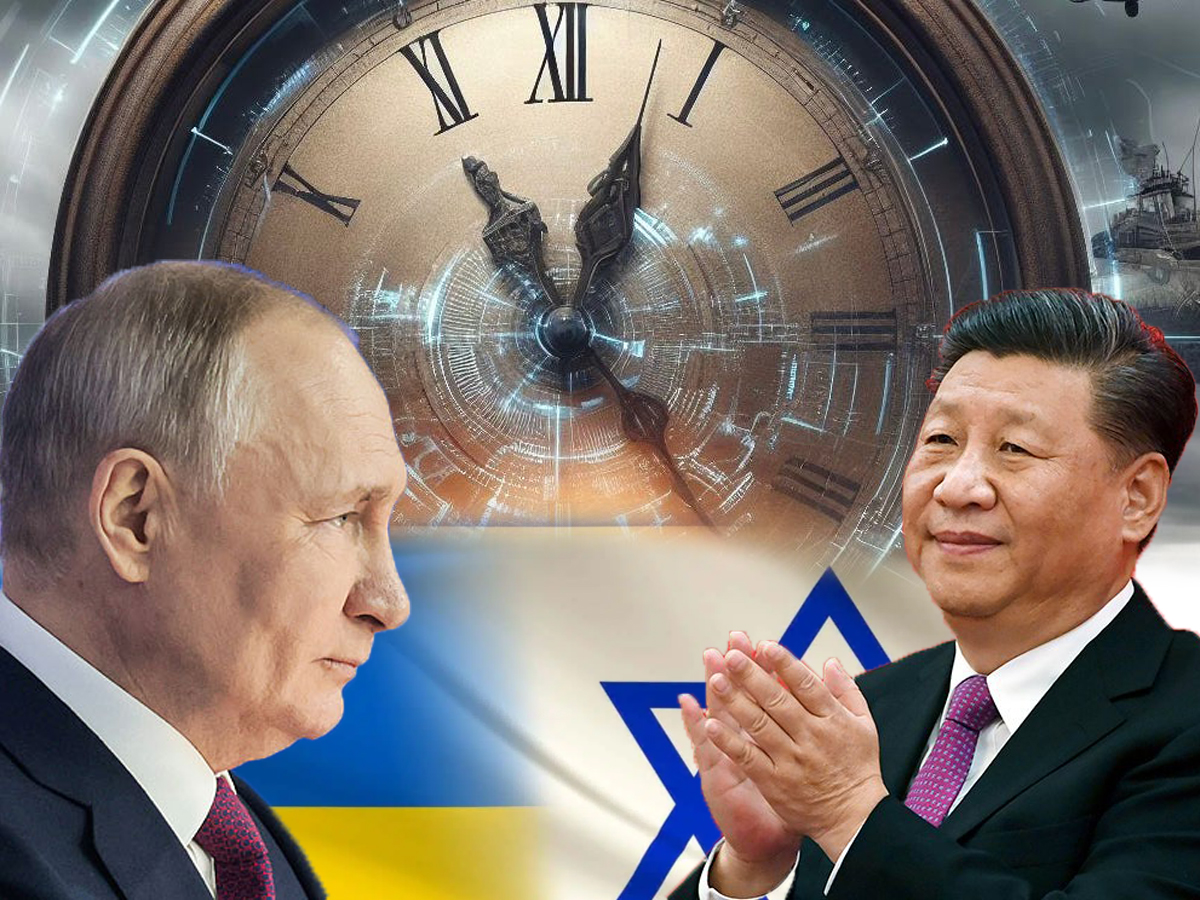
China and Russia have long supported the Palestinians, but recently they have taken on new roles as mediators in the conflict between Israel and the Palestinians, writes BBC.
“Moscow is not committed to resolving the conflict, since this would reduce its influence in the region; if the conflict between Israel and the Palestinians were resolved, “both sides would no longer need Russia” and would switch to cooperation with the West or China for economic development.” .
In July 2023, Hamas, Fatah and other Palestinian factions signed a preliminary agreement in Beijing to create an “interim government of national reconciliation” to govern Gaza after the end of the war. Similar meetings took place in Moscow, for example, in February 2023, when Palestinian groups also sought similar agreements.
Interestingly, unlike the United States, neither China nor Russia consider Hamas a terrorist organization, which allows them to interact with this group. This makes their position unique compared to the West. In addition, both countries maintain close ties with important regional players such as Iran, Syria and Türkiye.
However, experts the BBC spoke to doubt that mediation between China and Russia will lead to significant results. According to analysts, Beijing and Moscow are pursuing two main goals: to increase their international influence and to counter US political dominance in the region.
From Mao Zedong to Xi Jinping
Since the founding of the People's Republic of China in 1949, China has consistently supported the Palestinians. China's founder, Mao Zedong, saw Israel as the same threat as Taiwan – a tool of Western imperialism designed to control potential opponents of the US-imposed world order. As researcher Ahmed Abudu notes, China “saw its own experience in the suffering of the Palestinians,” referring to the anti-colonial and anti-Western sentiments of China at the time.
Mao was not limited to rhetoric alone: he supported the Palestine Liberation Organization (PLO) not only ideologically, but also with arms supplies. However, with Deng Xiaoping coming to power in 1978, China's foreign policy shifted towards pragmatism. Instead of supporting revolutionary movements, China sought to expand diplomatic relations with large and medium-sized states, which was necessary to implement reforms and open up the economy.
However, under China's current leader, Xi Jinping, who came to power in 2012, ideological elements have begun to reappear in Chinese foreign policy, although always with the country's practical interests in mind. The conflict between Israel and Palestine fits perfectly into this approach – on the one hand, it allows China to maintain international relations, and on the other, to continue anti-Western rhetoric, notes BBC.
From Stalin to Putin
Russia's relations with the Palestinians have developed somewhat differently than with Israel. Following Israel's declaration of independence in 1948, the Soviet Union, under the leadership of Joseph Stalin, became one of the first countries to recognize the Jewish state. As Professor Mark Katz explains in an interview with BBCat that point, “Israel seemed to be socialist-minded,” making it an ally of the USSR while neighboring countries were still under European colonial control.
However, in the mid-1950s, with the rise to power of Nikita Khrushchev, the Soviet Union shifted its support towards Arab nationalism. Moscow began to actively support the Palestinian side, which allowed it to strengthen its position among Arab countries against the background of the pro-Israel policy of the United States.
At the same time, as Katz notes, for Moscow the Palestinian problem has always been a matter of political gain, and not a position of principle. The Soviet Union supported the Palestinians, but was not willing to go so far as to risk conflict with the United States. “They were never truly anti-Israel,” Katz adds.
With the collapse of the USSR and the easing of previous hostility, Russia's relations with Israel gradually improved, especially after Jewish emigration to Israel was allowed. By the time Vladimir Putin came to power in 2000, about a million Israelis had Soviet roots, and the Kremlin began to seek a balance between relations with Israel and support for the Palestinians.
However, after the Hamas attack on Israel on October 7, 2023 and the subsequent war in Gaza, Russia’s relations with the Israeli government worsened, notes BBC.
Alternative world order
China has become the world's largest oil importer, sourcing about half of its supplies from the Middle East and Persian Gulf. The question is whether China's mediation in the Israeli-Palestinian conflict is related to its economic interests in the region. However, according to Ahmed Abudu, a researcher at Chatham House, the answer is no. BBC he is quoted as saying, “China is not connecting the two issues,” as many Arab countries have already normalized relations with Israel, and countries such as Saudi Arabia may do so after the end of the Gaza war.
Moreover, as explained BBCChina is seeking to establish itself as a world power interested in mediating and maintaining peace. Beijing also wants to offer the world an alternative view of the global order, different from the American one, especially against the backdrop of support for the Palestinians by countries in the Global South.
However, as Abudu notes, China does not have a clear plan to resolve the Israeli-Palestinian conflict, and its interests do not lie in directly resolving this confrontation.
Distracting attention from Ukraine
The conflict between Hamas and Israel turned out to be useful for Russia, as it diverted the attention of the world community from the war in Ukraine. Professor Mark Katz notes that after October 7, news coverage of events in Europe, especially around the war in Ukraine, decreased significantly, and some of the military aid that Ukraine's allies, especially the United States, planned to send to Kyiv, was redirected to Israel.
In addition, as Professor Katz emphasizes in an interview BBCThe Kremlin believes the West is using double standards by blaming Russia for its occupation of Ukraine but remaining relatively silent on Israel's actions towards Palestine.
Ahmed Abudu from Chatham House adds that Russia’s mediating role in the conflict is aimed at breaking out of the international isolation in which the country found itself after the start of the invasion of Ukraine. “There are Gulf countries that are willing to continue doing business with Russia,” Abudu adds.
Despite ideological differences with Hamas, Russia cooperates with the movement and leverages its relationship with it. Professor Katz explains that it is important to Putin that Hamas does not support jihadist groups inside Russia, especially in Chechnya.
Beijing and Moscow: different strategies
Russia and China, despite sharing common goals such as undermining US influence in the Middle East and Global South, use very different methods to achieve these goals. As indicated BBCRussia is involved in military conflicts in the region, such as the Syrian war, while China avoids military intervention.
Beijing seeks to preserve the existing regional order while making minor changes to protect its interests. In contrast, Russia, according to Ahmed Abudu of Chatham House“wants to completely destroy the regional order and rebuild it in its favor.” Abudu also adds that China would like to resolve the conflict with the creation of a Palestinian state, over which it would have significant control.
Russia, on the other hand, is taking a different approach. Moscow is not seeking to resolve the conflict, as this would reduce its influence in the region. Abudu notes that if the conflict between Israel and the Palestinians were resolved, “both sides would no longer need Russia” and would switch to cooperation with the West or China for economic development.
As Professor Katz notes, Russia is interested in maintaining instability, but “not excessively.” They prefer to keep the pot boiling but not overflowing.