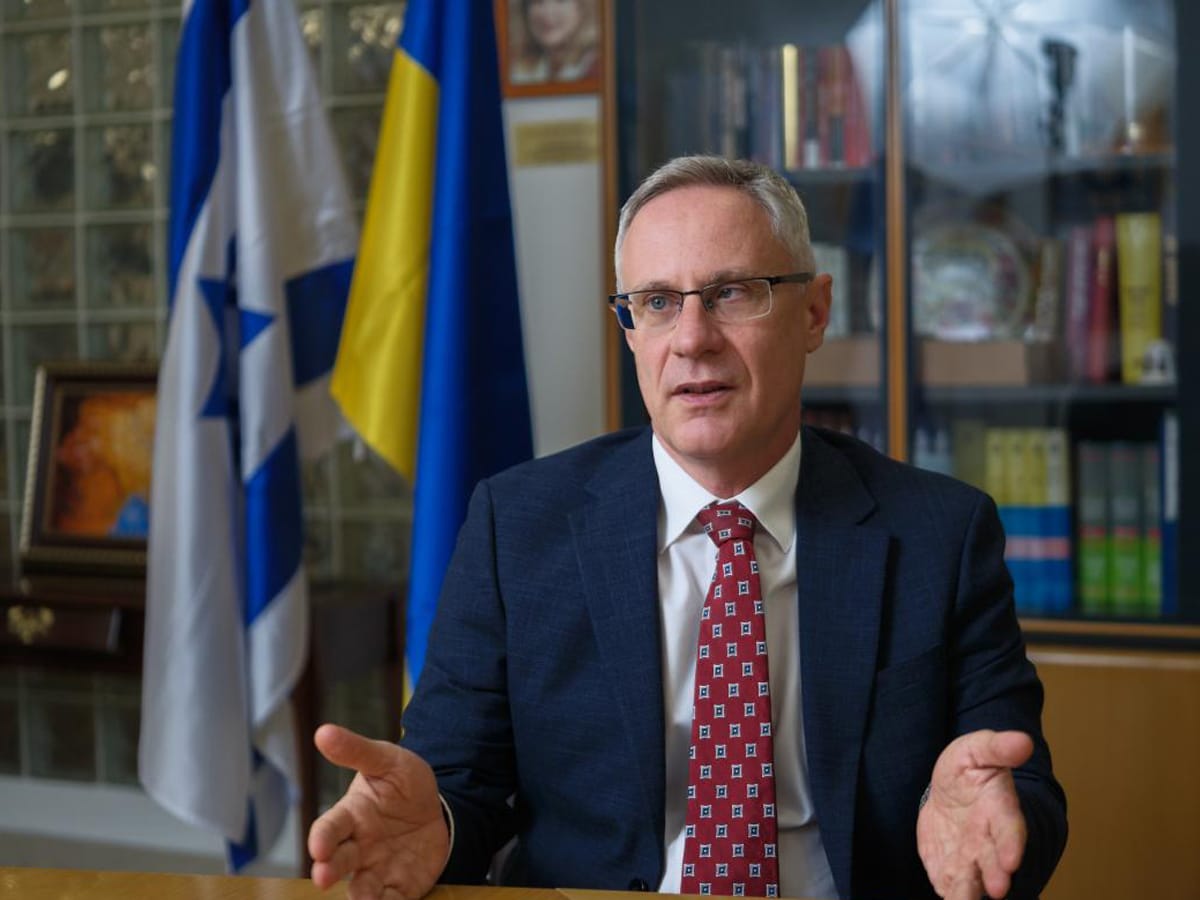
On whether a major war will start in the Middle East, relations between Israel, the USA, and Ukraine, the future arrival of Hasidic pilgrims, and Ukrainian refugees — Israeli Ambassador to Ukraine Michael Brodsky discussed these topics in an interview with RBC-Ukraine.
Combat actions in the Gaza Strip have become routine for the world, similar to the war in Ukraine. Attention increases only during periods of sharp escalations. The Middle East is currently experiencing such a moment — after the elimination of one of the leaders of the terrorist organization Hamas, Ismail Haniyeh, in Tehran, Iran has been threatening severe “retaliatory measures” against Israel for several days. These measures could likely involve Iranian proxy forces in the region, primarily Hezbollah based in Lebanon.
Michael Brodsky, the Israeli Ambassador to Ukraine, noted that Israel has been preparing for a potential war on several fronts for many years. However, Israel is not interested in a major war in the region and hopes that Iran and Hezbollah are also not interested in a full-scale attack on Israel, as it would be very costly for them.
Since the beginning of the last major escalation in the Middle East — with Hamas militants attacking Israel in October last year — Ukraine, both at the highest political level and at the level of ordinary citizens, has fully solidarized with Israel. While anti-Israeli sentiments have become more noticeable in most Western countries, Ukraine remains “one of the most pro-Israeli countries in Europe,” says Brodsky.
Bilateral relations between Ukraine and Israel have noticeably warmed over the past couple of years. Complaints and mutual accusations are practically non-existent. Instead, the countries cooperate, including on quasi-military issues, although the details of this cooperation are kept secret.
At the end of June, there was information that Israel might transfer several relatively old but fully operational Patriot systems to the USA, which the Americans could then supply to Ukraine. But, according to Brodsky, a decision on this matter has not yet been made, and it all depends on the situation in the Middle East, as Israel may need all its air defense systems.
The Middle East — a powder keg
Michael Brodsky, in a conversation with RBC-Ukraine, emphasized that the “fuse” on the Middle Eastern powder keg never stops burning. He explained that sometimes the fire increases, sometimes it decreases, but Israel has been sitting on top of this keg since the state’s creation. Already the day after the creation of Israel, it had to repel the attacks of Arab armies in the War of Independence. Since then, the country has lived in conditions of insecurity and various threats.
Brodsky noted that today’s main threat does not come from Arab countries but from Iran and its proxies in the Middle East, such as Hezbollah, Hamas, and the Houthis. He emphasized that this new threat could manifest itself in different parts of the world. For decades, Iran has organized or attempted to organize terrorist attacks against Israelis and Israeli diplomatic missions in Argentina, Europe, Asia, and other places. According to Brodsky, Iran is doing everything to destroy Israel, as they have promised.
Brodsky added that Israel takes threats from Iran seriously, and Iran has long since moved to action. Now, perhaps, the situation has reached its climax.
The risk of a truly major war in the Middle East
Michael Brodsky noted that the risk of a major war in the Middle East always exists, and Israel is ready for such a scenario. Israel has been preparing for a multi-front war for many years. He added that the tragedy of October 7 revealed some miscalculations that now need to be analyzed and corrected. Nevertheless, Israel is ready to defend its citizens from threats from Iran, Hezbollah, and Hamas.
Brodsky emphasized that Israel is not interested in a major war and hopes that Iran and Hezbollah are also not interested in a full-scale attack, as it would come at a high cost. He noted that this cost would affect not only Hezbollah but also Lebanon, which suffers from internal conflicts and bears responsibility for the threat from its territory.
In recent months, pro-Palestinian/anti-Israeli sentiments have clearly dominated the world — why?
Michael Brodsky discussed that after the Hamas attack on October 7, the world initially expressed solidarity with Israel, but soon pro-Palestinian sentiments began to dominate. In his opinion, this is because the world tends to pity the suffering of Jews but does not support their right to defend themselves.
He explained that Israel is in a difficult situation, trying to defend itself from terrorists operating within civilian populations. Brodsky noted that terrorism does not allow for sterile military operations, as terrorists use civilians as human shields. Israel, he said, does everything possible to minimize harm to civilians, spreading warnings and urging people to leave combat zones.
He added that the residents of Gaza are indeed held hostage by Hamas, which uses them as human shields. This makes it difficult to distinguish between hostages and sympathizers. Brodsky emphasized that Hamas has been in power for a long time, and its ideology may have influenced the local population’s perception, so the situation can be considered both as hostages and as a breeding ground for terrorism.
How Israel Can Successfully Say “No” to its Partner, the USA
Michael Brodsky commented on a recent case where the USA asked Israel to halt its operation in Rafah, but Israel refused. He explained that this decision is based on the profound support Israel receives from the USA. According to Brodsky, US support for Israel is not limited to the White House; it encompasses all layers of society, including Congress and public institutions. He noted that despite some tension, Israel receives full support from the USA in the context of current military operations.
Brodsky emphasized that relations between Israel and the USA are strategic and mutually beneficial. He pointed out that Israel and the USA depend on each other, and it is not merely a client-patron relationship.
When asked about how the US elections might affect Israel, Brodsky replied that interest in US elections in Israel is not as high as in Ukraine. He explained that US support for Israel does not depend solely on the president’s personality, although the president does influence international relations.
Relations Between Ukraine and Israel in the First Months After Russia’s Full-Scale Invasion Were Far From Ideal
Michael Brodsky discussed the current state of relations between Ukraine and Israel. He noted that at the beginning of Russia’s full-scale invasion of Ukraine, relations between the two countries were tense, with many harsh statements and emotions. But, as Brodsky noted, the emotional intensity has now decreased. The reason for this is the worsening situation in the Middle East and the focus of both countries on their own conflicts. He expressed hope that Ukraine now better understands how to build relations with Israel, emphasizing that attempts to exert pressure through the media and ultimatums before the war were mistaken and ineffective.
When Hamas attacked Israel in October last year, Ukrainian President Volodymyr Zelensky called on world leaders to come to Israel and express support. Brodsky noted that this gesture was noticed and appreciated in Israel, adding that Ukraine remains one of the most pro-Israeli countries in Europe. Ukraine’s position and support expressed at that moment were highly valued in Israel, and this solidarity was felt at all levels, including public opinion.
Nevertheless, President Zelensky has not yet visited Israel, although such a visit would be welcomed. Preliminary dates for the visit were scheduled, but they were postponed at the initiative of the Ukrainian side. There are no specific new dates for the visit yet, but Israel hopes that President Zelensky will come in the future.
The Russian-Iranian Alliance
Michael Brodsky emphasized that the Russian-Iranian military alliance has significantly impacted relations between Israel and these countries. Israel is closely monitoring the development of cooperation between Russia and Iran and disapproves of it. Israel is particularly concerned about military cooperation and, more dangerously, nuclear cooperation between these two countries. Brodsky noted that such alliances do not contribute to stability in the Middle East and represent a serious threat to the region.
Attitudes in Israeli Society Towards Ukraine
Michael Brodsky noted that support for Ukraine in Israeli society over the past year has generally remained at a good level, although there is no current sociological data. He believes that most Israelis still support Ukraine in its conflict with Russia.
However, according to Brodsky, active support from Israelis has decreased due to some actions by official representatives of Ukraine. He recalled how, in the early days of the war, Israelis were collecting donations and showing support for Ukraine. But later, factors emerged that negatively impacted this support.
Brodsky pointed to specific examples, such as voting in the UN and statements suggesting that Israel should provide weapons to Ukraine. He noted that such complaints, like discussing a lack of humanitarian aid or suggesting that Israel could have prevented injuries to Ukrainian children, have caused dissatisfaction.
In his opinion, Israel is willing to help, but it is important to express gratitude for the help correctly and to discuss more sensitive issues through special channels, not through ultimatums and the media.
“We often had to face the statement that if Israel had given Ukraine weapons, there would not have been injured children brought to Israel for treatment later. Or wounded soldiers brought for prosthetics in Israel. But this is a distorted logic. I believe that if a country helps, you should first of all say thank you for the help. And then discuss other issues not through ultimatums and not through the media, but through special channels, especially such sensitive issues as military-technical cooperation.”
Negotiations Between the USA, Ukraine, and Israel on the Transfer of Eight Patriot Systems
Michael Brodsky noted that while there is information circulating about the transfer of eight Patriot systems from Israel through the USA to Ukraine, no final decision has been made yet. He explained that in the current situation in Israel, all air defense systems, including the Patriot, are necessary to ensure the country’s security. Specifically, the Iron Dome effectively intercepts short-range missiles but struggles with longer-range and ballistic missiles that Israel faces.
Brodsky pointed out that the Patriot systems, which Israel received in the early 1990s, played a crucial role in defending the country from Iraqi missile attacks during the Persian Gulf War. He mentioned that there was discussion about possibly decommissioning old Patriot systems that could be useful for Ukraine. However, no final decision has been made on transferring these systems due to the current threats Israel faces in the region.
Red Lines Concerning Military Aid to Ukraine
Michael Brodsky noted that the red lines regarding military aid to Ukraine have not changed. Israel still has to consider the Russian military presence in the Middle East and Russia’s influence on Iran and Syria. This also relates to the need to maintain communication with Russia regarding the actions of the Israeli Air Force in Syria. Brodsky emphasized that these factors continue to define the limitations on providing military aid to Ukraine.
Antisemitic Manifestations in Russia, Hamas, and Iran
Michael Brodsky noted that Russia regularly allows antisemitic manifestations from both officials and on social media. He emphasized that such manifestations are noticed in Israel, not only among politicians and diplomats but also in a society that has historical ties with Russia.
Brodsky clarified that everyday antisemitism, present in various countries including Russia, is a global problem. However, more serious are the political actions, such as meetings of Russian officials with leaders of Hamas and Iran. He added that Israel considers the invitation of Hamas leaders to Moscow as indirect support for terrorism and openly expresses its dissatisfaction with this to Moscow.
The Topic of “Negotiations” Between Ukraine and Russia
Michael Brodsky noted that the topic of negotiations between Ukraine and Russia is actively discussed, and this is noticeable in diplomatic circles. He pointed out the nuances: sometimes the freezing of the conflict is discussed, and sometimes the end of the war, which does not necessarily require negotiations. Brodsky emphasized that this topic has become more relevant now than, for example, six months ago.
Wars in Ukraine and Israel
Michael Brodsky explained that the attention of the world press often shifts depending on events. When Russia’s invasion of Ukraine began, it remained on the front pages for a long time. However, after the Hamas attack on Israel on October 7, the focus shifted to the Middle East. Now, with global events like the US election race back in the spotlight, both wars, in Ukraine and Israel, have receded into the background.
Brodsky noted that this is part of the media’s job: when something new or extraordinary happens, attention focuses on that event. During the two and a half years of war in Ukraine, the world has become accustomed to the ongoing conflict, and thus current news about the war and shelling is perceived as routine. The same applies to Israel, where terrorist attacks and shelling, such as Hezbollah’s daily attacks on northern Israel, no longer draw much interest in world news.
Brodsky emphasized that the world tends to focus on new and unusual events, and when the situation becomes routine, attention returns to conflicts only when significant changes occur.
Pilgrims in Uman and Visa Relations
Michael Brodsky noted that despite constant warnings from the Israeli government about security, pilgrims from Israel continue to travel to Ukraine. It is expected that the number of pilgrims this year will almost double compared to last year. Brodsky explained that while Ukraine does not restrict the entry of pilgrims, and Israel cannot and does not want to do so, they continue to come. He also noted that Ukrainian services, such as the National Police, the Ministry of Internal Affairs, and the Emergency Service, effectively help ensure the safety of pilgrims in Uman, and Israeli police will again assist this year.
Additionally, Brodsky commented on the electronic notification system, which applies to citizens of all visa-free countries, including Ukraine. This is not a visa system, but simply an electronic notification intended to facilitate entry control and avoid issues with illegal employment. Israel decided to postpone the implementation of this system for several months due to technical reasons, and this will not increase the percentage of entry refusals. On the contrary, the system will help filter out those intending to work illegally at the ticket purchase stage, reducing deportation cases at the airport.
Situation with Ukrainian Refugees in Israel
Michael Brodsky noted that recently the flow of Ukrainian refugees to Israel has practically stopped. At the beginning of the war, about 15,000 refugees arrived in Israel, but it is currently unknown how many of them are still in the country. Some refugees have left for other countries or returned to Ukraine.
Brodsky also noted that the situation in Israel, including security issues, may influence the flow of refugees. Despite this, the rights of those who remained are preserved. They continue to receive support from the state, including health insurance, although this costs Israeli taxpayers money.