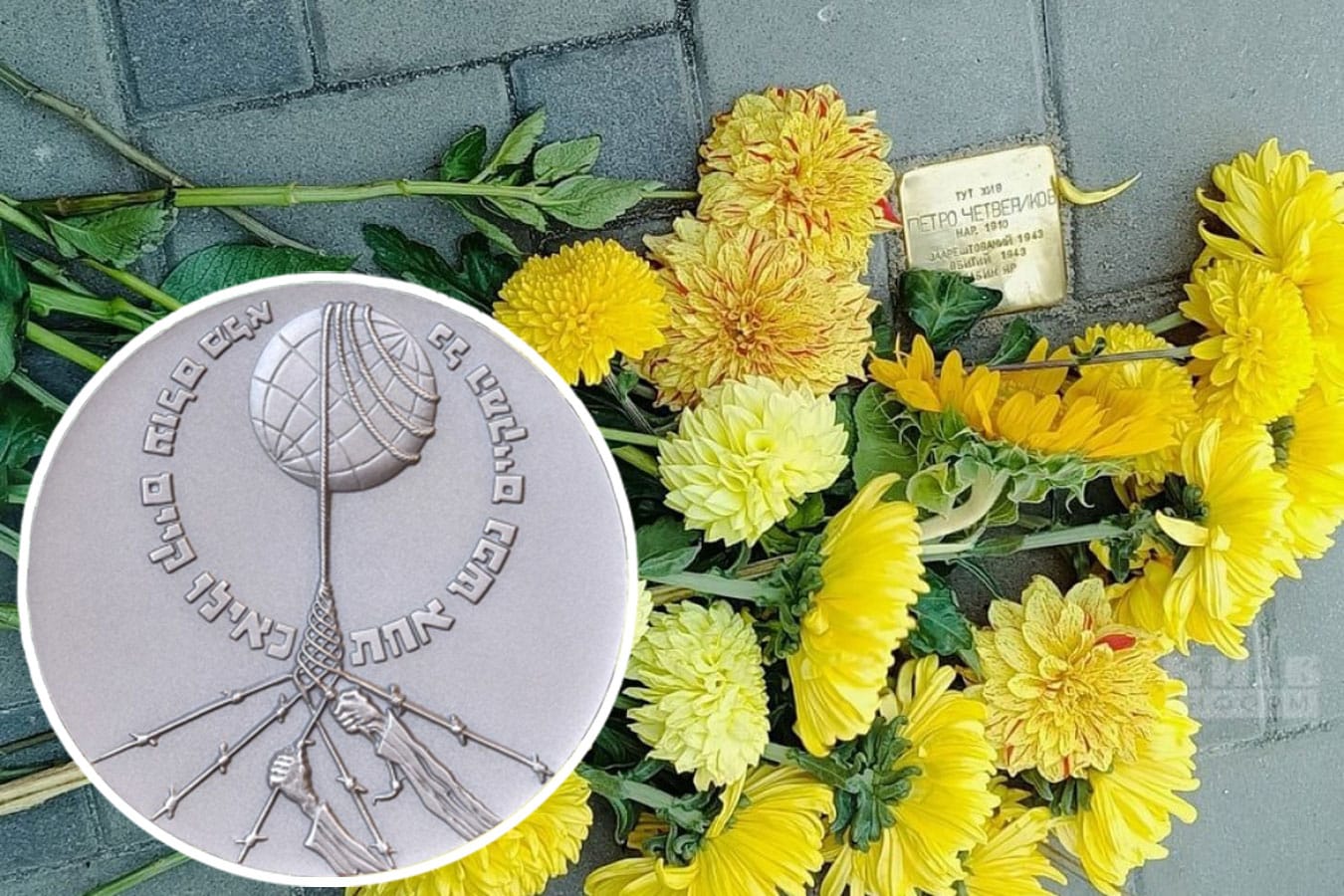
In Kyiv, another “stumbling stone” has been installed — a mini-memorial in honor of the Righteous of Babyn Yar, Petro Chetverikov (a local honorary title within Kyiv’s memory initiatives; not to be confused with the formal title “Righteous Among the Nations” at Yad Vashem — the sources specifically use the term “Righteous of Babyn Yar”). In Sokal, trilingual information stands have been mounted near the ruins of an ancient synagogue and next to the house of the Righteous Among the Nations, Franciszka and Helena Galamay.
Why it matters: both initiatives return specific names and addresses to the urban space, strengthening the shared memory of Ukraine, Israel, and the Jewish diaspora.
Sometimes the most powerful monuments are the smallest. A brick-sized slab underfoot and a concise stand by an old foundation speak of moral choice louder than any podium. Kyiv and Sokal have recently reminded us: memory is not a museum genre but part of the everyday route. People rush to work, children go to school, tourists look for cafes, and suddenly a glance catches a surname, a year, a short line about salvation. This is how “urban memory” works: quietly but inevitably.
The material was prepared based on information from September 26-28, 2025, from the United Jewish Community of Ukraine.
Kyiv: “stumbling stone” named after Petro Chetverikov
A new element of the “stumbling stones” series has appeared in the capital. These are small metal plaques embedded in the pavement — markers of addresses where those condemned to death by the Nazis lived or were helped. The new “stone” is in honor of Petro Chetverikov, the Righteous of Babyn Yar, killed by the Nazis in 1942 for saving two Jewish girls aged 12 and 17.
His name has been returned to the city map near the Central Children’s Library named after Taras Shevchenko (Beresteisky Avenue, 25a).
It is also symbolic how this is done. The ceremony is attended by schoolchildren, historians, and representatives of cultural initiatives. It seems like a small thing, but this is how a new habit begins: knowing not only the main squares but also the addresses of courage. This approach is akin to a “memory microcircuit” that can be read in two lines — and never forgotten.
Petro Chetverikov — Righteous of Babyn Yar
The story of Petro Chetverikov is a documented example of how one person in occupied Kyiv took a step that cost him his life. In 1942, together with his wife Maria, he sheltered Jewish girls in their home. The first, a 12-year-old girl, was taken to a village to acquaintances, where she was adopted and thus saved from death.
Some time later, another girl, 17 years old, came to their home. She managed to escape a roundup, and the Chetverikovs found a way to transfer her to a partisan unit.
These actions did not go unnoticed. In 1943, the Gestapo arrested Petro Chetverikov. According to available testimonies, he was executed in Babyn Yar — a place that became a symbol of the tragedy of Kyiv’s Jewry. The exact date of arrest and execution is unknown (only the year and place are known).
Chetverikov was also connected with the underground: his house sometimes served as a meeting place for underground fighters, which only increased the risks.
Decades passed, and his name could have dissolved in archival footnotes if not for the work of researchers and public initiatives. On September 23, 2025, in Kyiv, near the Central Children’s Library named after T. Shevchenko on Beresteisky Avenue, 25a, a “stumbling stone” was installed in honor of Petro Chetverikov. The ceremony was timed to the 84th anniversary of the beginning of the executions in Babyn Yar.
This was the first “stone” after a four-year break in the project, and it is symbolic that Chetverikov’s name became the starting point of a new stage.
Thus, the biography of this man consists of a few but vivid facts: an ordinary Kyiv resident who decided to help two girls; a family that risked themselves for the lives of others; arrest and death in 1943; and the return of his name to the city map in the 21st century.
Sokal: three stands at the synagogue and the house of the Righteous
Sokal is a small town, but its history resonates far. Trilingual stands have been installed at the ruins of one of the oldest Galician synagogues: Ukrainian, English, Polish. This choice of language is not a detail but an invitation. Locals, guests from neighboring Poland, travelers from Israel — all can read the story without intermediaries.
The second stand is at the house where Franciszka Galamay and her daughter Helena Galamay — the Righteous Among the Nations — lived. During the Holocaust, they did what always requires silence: sheltered, fed, kept watch by the window, listening to night footsteps. These everyday, almost imperceptible movements make up the fabric of salvation.
Why the stand is an effective format
A stand is a short, clear story, not overloaded with academic language. It is important here to keep the focus on two or three facts: who saved, who was saved, what was risked. When all this is said simply and in three languages, the city receives a working tool of memory. Not ceremonial, but everyday.
Franciszka and Helena Galamay — the story of a mother and daughter who saved Jewish families
Franciszka Galamay was born in Sokal in 1885. Before the war, she and her daughter Helena had a small farm. When the German occupation began, Jewish families Kram, Malts, and Kindler found refuge in their home. The women hid people in hiding places above the pigsty and under the kitchen floor.
In November 1942, Franciszka herself offered shelter to cattle trader Moishe Malts and doctor David Kindler with their families, who fled the ghetto. They were joined by painter Josef Kram with his wife and son. To hide the fact that Jews were hiding in the barns and outbuildings, Franciszka kept pigs and chickens and brought food there, hiding it among the waste. To divert suspicion, she even allowed herself anti-Semitic remarks in public.
Over twenty months, the mother and daughter saved 16 people out of 6,000 pre-war Jews of Sokal. Only about 30 survived the war. Among the saved was Moshe Malts, who left memoirs “Years of Horror — A Glimmer of Hope.” His writings became a valuable testimony of life in the ghetto and covert survival.
An interesting detail: simultaneously with the Jewish families, Franciszka also sheltered a young German deserter soldier, Wilhelm, who asked to be hidden from being sent to the Eastern Front. He lived on the farm for almost two years, but in 1944 he was discovered and executed by Soviet soldiers.
On July 19, 1944, the Red Army entered Sokal, and the end of the 20-month nightmare came for those in hiding. The Jews left the Galamay house and soon emigrated. The family maintained contact with them for many years.
In 1984, Yad Vashem recognized Franciszka and Helena Galamay as Righteous Among the Nations. Later, their story was included in the American documentary “No. 4 on Virgin Mary Street” and in Jenny L. Witterick’s book “My Mother’s Secret.” In 2011, the heroine was posthumously awarded the “For Courage and Care” prize, received by her descendants.
Thus, the biography of Franciszka and Helena Galamay is a story of two women who not only saved almost half of all surviving Jews of Sokal but also managed to deceive suspicious neighbors and the Nazis themselves, showing incredible ingenuity and determination.
The common thread of two stories: memory as a shared territory
Kyiv and Sokal speak the same language — the language of addresses, dates, and names. NANews — News of Israel regularly reports on projects where memory ceases to be a monologue and becomes an inviting dialogue. There is no “imposed” pathos here, but there is a clear logic: we place a slab, attach a stand, read names, ask children questions.
Conclusion: small forms — big meanings
The Kyiv “stumbling stone” named after Petro Chetverikov and the Sokal stands about Franciszka and Helena Galamay are two different tools of the same work. Both give a voice to those who once said “no” to evil and “yes” to human solidarity. Both are firmly woven into the fabric of the city: they don’t need to be sought in museum halls, they are nearby — on the pavement and on the wall.
For readers of “NANews” and those following News of Israel, this is an opportunity to see in the Ukrainian agenda not only politics but also careful, targeted preservation of memory. This is perhaps where the strength lies: not in loudness, but in regularity and honesty.
Stumbling stones: memory you can’t skip over
A “stumbling stone” is a small brass memorial sign embedded directly into the pavement. It is engraved with the name, years of life, and brief fate of a Holocaust victim or a person who saved Jews during the Nazi occupation.
History of the project
The idea was conceived by German artist Gunter Demnig in the 1990s. Initially, these were individual plaques, but over time they turned into the largest decentralized memorial in Europe. Today, “stumbling stones” can be found in thousands of cities in Germany, Poland, France, the Netherlands, Ukraine, and other countries.
Why they are needed
The main idea is for the memory of the Holocaust to be not only in museums and books but right on the streets. A person walks along a familiar route, sees a surname and year underfoot, “stumbles” with their gaze, and mentally returns to history. This is a very personal and intimate way to remember.
Significance for Israel and the diaspora
For readers of NANews — News of Israel, such initiatives in Ukraine are close and understandable. Israel has been carefully preserving the memory of the Righteous for decades, and when “stumbling stones” appear in Ukrainian cities, it becomes a bridge between countries and the Jewish diaspora.