National Day of Mourning and Reminder of the Crime Against the Ukrainian People
On November 22, 2025, Ukraine observes the Day of Remembrance for the Victims of the Holodomor — a date that annually draws attention to the events of 1932–1933. It is not just a historical date but a day when millions of Ukrainians — in Ukraine and beyond — light a candle of remembrance. This gesture has become a universal symbol of reminder: the tragedy was real, it claimed millions of lives, and attempts to deny it are part of the same policy that led to the catastrophe.
The Day of Remembrance for the Victims of the Holodomors is an annual national memorial day in Ukraine, which falls on the fourth Saturday of November. In 2025, it is on November 22.
Legal Justification: Which Period is Recognized as Genocide and Why
Ukraine’s legal framework clearly distinguishes between the famine campaigns of different years. The key document is the Law of Ukraine “On the Holodomor of 1932–1933 in Ukraine” No. 376-V, adopted on November 28, 2006. This law contains an unequivocal formulation: the Holodomor of 1932–1933 is genocide of the Ukrainian people. This norm has direct effect and defines the state position.
The law establishes several fundamental legal consequences:
- public denial of the Holodomor of 1932–1933 is qualified as an insult to the memory of the victims;
- the state is obliged to ensure open access to archives related to the famine period;
- state bodies are responsible for perpetuating the memory of the deceased.
Recognition of the genocidal nature applies exclusively to the period of 1932–1933.
This corresponds to both historical materials and the legal criteria of genocide according to the 1948 UN Convention. Researchers note that it is during this period that a set of signs is recorded: deliberate actions by the authorities aimed at destroying the Ukrainian population as a group, coercive measures, travel bans, repressive practices, and concealment of consequences.
The periods of 1921–1923 and 1946–1947 are legislatively qualified differently.
In the current terminology of Ukrainian legislation, they are defined as “mass artificial famines” — artificial famine campaigns caused by government policy. However, their genocidal nature is not officially established. This is due to the lack of sufficient evidence to formally meet the criteria of the Genocide Convention. Therefore, the use of the term “Holodomors” in the plural in the legal sphere is considered incorrect: it dilutes the meaning of the Holodomor of 1932–1933 as genocide in the strict legal sense.
Ukrainian research institutes and international advisory structures continue to study other periods of famine, but to date, no regulatory acts have been adopted to expand the legal definition of genocide to the years 1921–1923 or 1946–1947.
Thus, legal recognition concerns only one period, as enshrined in Ukrainian law.
The Holodomor is recognized as genocide of the Ukrainian people by dozens of countries. Historians agree on one thing: the famine was not the result of a poor harvest. It was man-made, as a tool for destroying Ukrainian identity, independent peasantry, cultural and political elite.
How Stalin’s Policy Turned Bread into a Weapon
In 1932–1933, the Soviet leadership organized a policy based on the forcible seizure of food, village blockades, travel bans, and criminal prosecution of those who tried to escape. There was a direct ban on helping the starving. Even international offers of food supplies were rejected by the USSR.
The illustrative context: in the same era when Ukrainian families were dying by the thousands daily, the Soviet Union increased grain exports. Ukraine and Kuban — regions with a large share of ethnic Ukrainians — accounted for up to 70% of all Soviet grain exports. This meant one thing: grain was exported while people perished.
Stalin’s famous phrase — “No man — no problem” — conveys the approach to an entire nation. Sources show that decisions were made consciously and methodically. Repressions accompanied every stage of the grain procurement campaigns.
“Law of Five Ears” and the Destruction of the Basic Right to Life
One of the key mechanisms was the policy of criminal penalties for attempting to gather anything for survival. The “Law of Five Ears” led to more than 50,000 people being convicted in the first months of its enforcement. Peasants lost the right to the harvest they themselves had grown.
Simultaneously, settlements were included in the so-called “black boards.” Up to 80% of villages and collective farms in the Ukrainian SSR fell under this definition — with complete food confiscation, travel bans, and accusations of “sabotage.” In practice, this meant the destruction of communities.
Punishments reached absurdity and cynicism. “Natural fines” could include 15 months without meat, confiscation of potatoes, lard, and then almost all products. Repressions made even minimal survival impossible.
Mortality: Real Numbers and Dynamics of the Tragedy
Historians cite different figures for total mortality: from 3 to 7 million within the Ukrainian SSR alone. This does not include Ukrainians who lived outside the republic and also died of hunger, as well as hundreds of thousands deported and destroyed during collectivization.
According to demographic data, in the most difficult period — spring and summer of 1933 — about 28,000 people died daily:
• 1168 people per hour
• 20 people per minute
In fact, the annual population growth of Ukraine was undermined for decades. About 6 million Ukrainians were never born — the demographic pit became one of the direct consequences of the Holodomor.
For merely preserving the facts of what happened, people received up to 10 years in camps. Any attempt to document the events was considered anti-system activity.
Denial of the Crime: Soviet and Modern Russian Rhetoric
The USSR concealed information about mass mortality for decades. Statistics were closed, documents destroyed, publications banned. Only after the collapse of the Union was it possible to restore the picture of the tragedy using archives, demographic studies, and eyewitness accounts.
The modern Russian Federation continues the line of denial or minimization. This is part of a broader strategy of historical revisionism, where Stalinist regime crimes are interpreted as “ambiguous” or “unproven.” However, international research and archives provide unequivocal evidence: the actions were systematic and targeted.
Seven Facts Revealing the Scale of the Holodomor
Below are key data confirmed by research from Ukrainian and foreign historians:
- The USSR increased grain exports fourfold in two years, and Ukrainian regions provided up to 70% of the exports.
- More than 50,000 people were convicted under the “Law of Five Ears” in the first months.
- Up to 80% of Ukrainian villages were placed on “black boards” — with total food confiscation and travel bans.
- “Natural fines” exacerbated hunger, taking away meat, potatoes, lard, and other products.
- People received 10 years in camps for attempting to preserve documentary evidence of the tragedy.
- 6 million unborn Ukrainians — the demographic outcome of the artificial famine policy.
- No one was punished for organizing the Holodomor in Soviet Ukraine.
Israel and the Holodomor: History of Recognition, Limitations, and Political Context
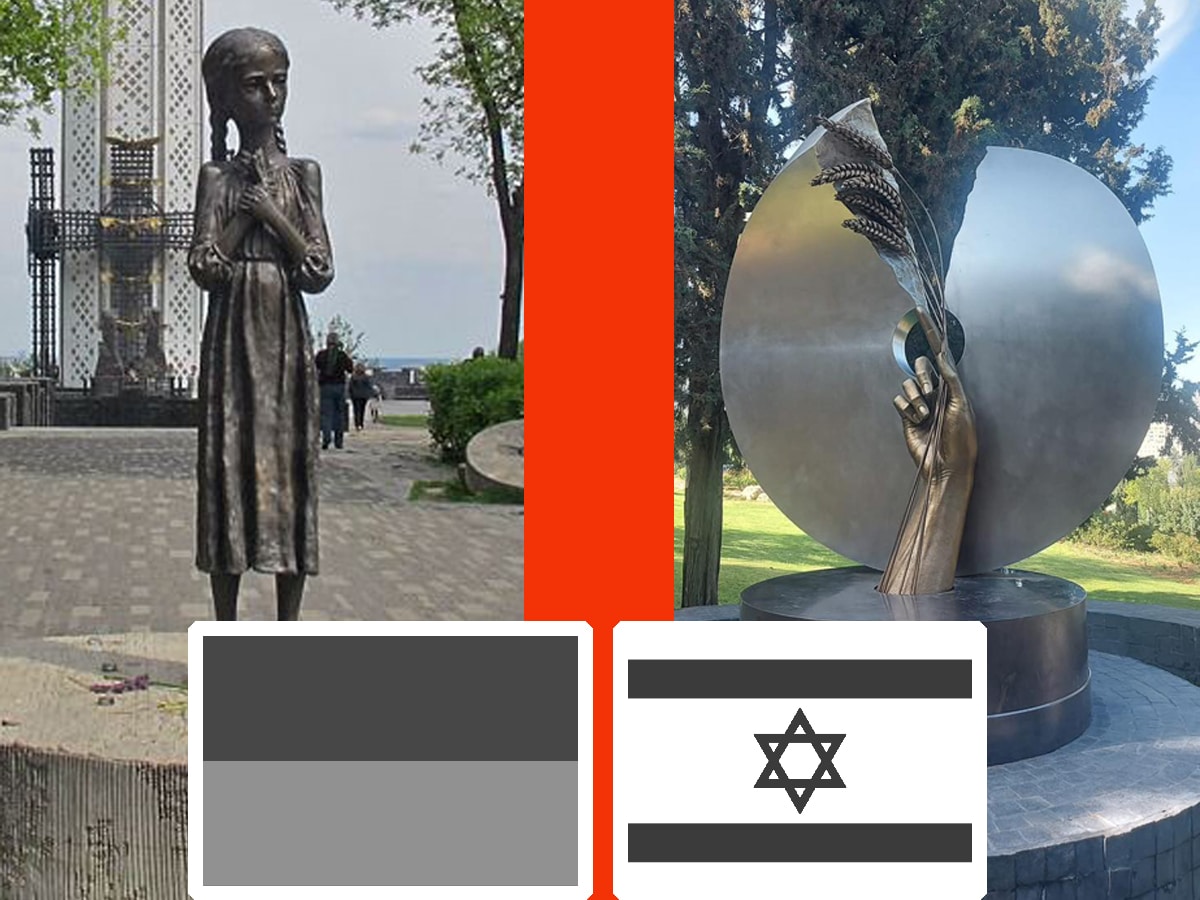
Israel’s attitude towards the Holodomor of 1932–1933 has formed in a complex combination of historical caution, diplomacy, and internal political factors. Israel is one of the few strategic partners of Ukraine that pays significant attention to the tragedy at the level of symbolic gestures but avoids legal recognition of the Holodomor as genocide.
Read more about this in our article –
History of Israel’s Recognition of the Holodomor 1932-1933 in Ukraine as Genocide of the Ukrainian People — (2007 — 2025 — ?)
Official Position of the State of Israel
To date, Israel has not recognized the Holodomor as genocide. The official explanation boils down to two arguments:
- the tragedy affected several national groups of the USSR, not just Ukrainians;
- qualifying the events as “genocide” requires a legal assessment, with which Israel is traditionally extremely cautious in international matters related to historical crimes.
This position has remained unchanged for almost two decades.
This does not mean denial of the tragedy — only caution in the legal sphere.
Official Opening of the Holodomor Victims Memorial in Jerusalem
- 2025: the first Holodomor victims memorial in Israel is installed in Jerusalem, created with the participation of the Ukrainian community and local municipal structures. For a country where recognition of tragedies is associated with very strict internal rules, such a memorial gesture is a significant step.
The Holodomor victims memorial in Israel will be officially opened in Jerusalem in early December 2025. The ceremony will take place during the visit of a Ukrainian government delegation led by Deputy Prime Minister Taras Kachka. The information was confirmed to The Jerusalem Post by Ukraine’s ambassador to Israel, Yevhen Korniychuk.
“This is a significant monument dedicated to the great famine in Ukraine, which claimed the lives of 6 million Ukrainians, including several hundred thousand Jews. For us, it is very important — and important to remember this.”
We wrote about the monument –
The First Holodomor Victims Memorial Installed in Jerusalem 1932-1933 in Ukraine — what is known?
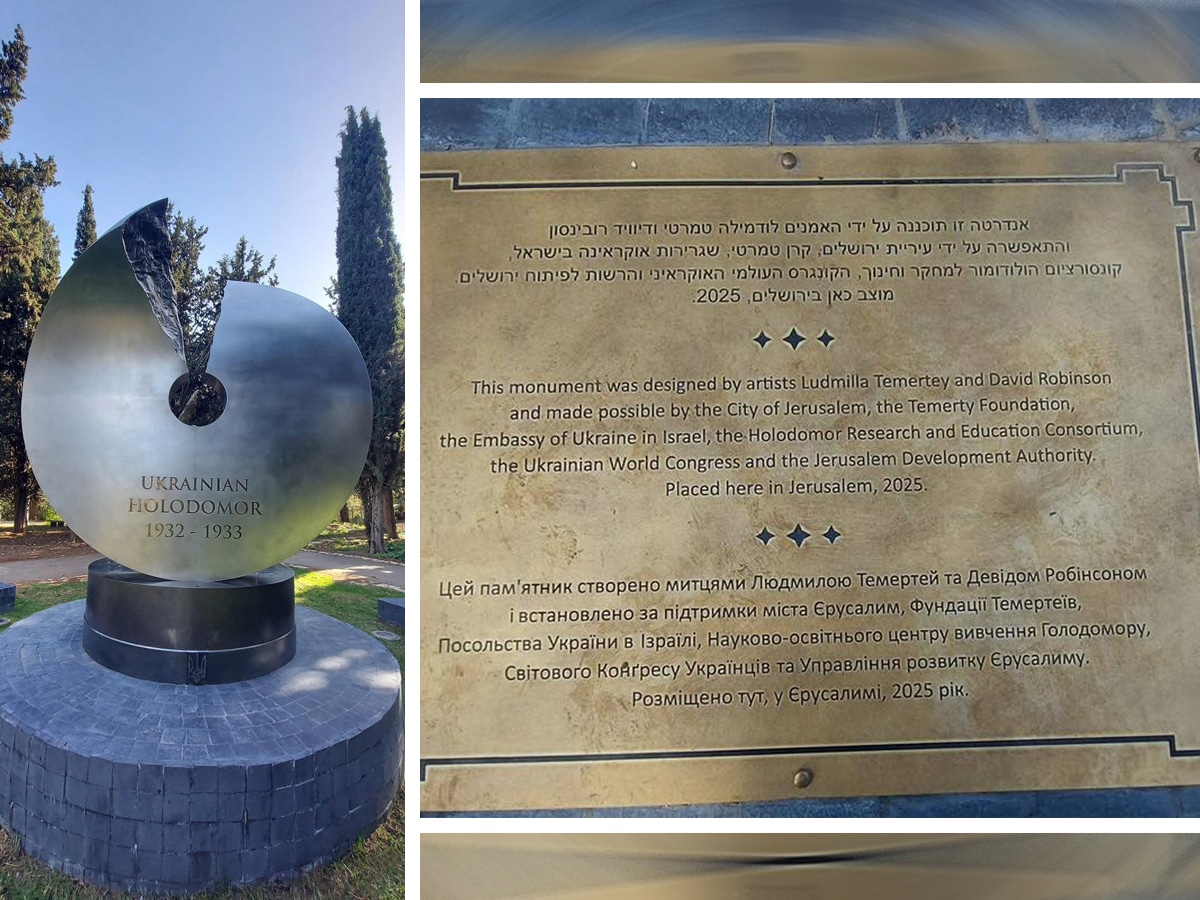
The monument is installed in Wohl Rose Park — a green area between the Knesset building and the Supreme Court of Israel.
The monument is dedicated to approximately 6 million victims, including several hundred thousand Jews who lived in the Ukrainian SSR during the Holodomor years.
Significance for the Ukrainian Diaspora in Israel
For Ukrainians living in Israel, the issue of remembering the Holodomor is not formal. Commemorative events are held annually, and the official opening of the monument in Jerusalem will become an important point of community consolidation.
Even without official recognition of genocide, these steps enhance the international visibility of the tragedy and help Ukrainian memory gain support in a country where historical issues carry special weight.
Why It Is Important to Remember Today — In the Face of New Threats
The context of 2025 makes the memory of the Holodomor particularly relevant. Policies of destruction, denial, pressure, and attempts to deprive Ukrainians of the right to their own history have not disappeared. Comparisons are not direct, but the mechanisms of propaganda and suppression of memory remain familiar.
For Ukrainians in Israel and around the world, the memory of the Holodomor is a reminder of the price of freedom and the reason why resistance to imperial policy continues. Memory is part of the struggle for a future where such tragedies are impossible.
November 22, 2025: Wherever You Are, Light a Candle
Candle of Memory: Why This Symbol Has Become Part of Ukrainian Identity
Every year on this day, Ukrainians around the world light a candle between 16:00 and 20:00. The candle in many diasporas — including Israel, Europe, North America — has become a sign of solidarity and memory. This gesture emphasizes: the tragedy is not forgotten, attempts to erase its consequences do not succeed.
For families whose ancestors survived the Holodomor or did not, the candle is not a ritual but a form of testimony. It reminds that the Ukrainian people went through an attempt at annihilation and preserved their identity.
This day unites those who remember the millions who perished. A candle in the window is a way to say that memory is preserved, and that attempts to destroy the Ukrainian people have failed.
November 22 is a time when one small candle in the window becomes part of a large field of light.
NANews Israel News Nikk.Agency
We remember.
We speak about it.
We will not allow the truth to be erased.
…
