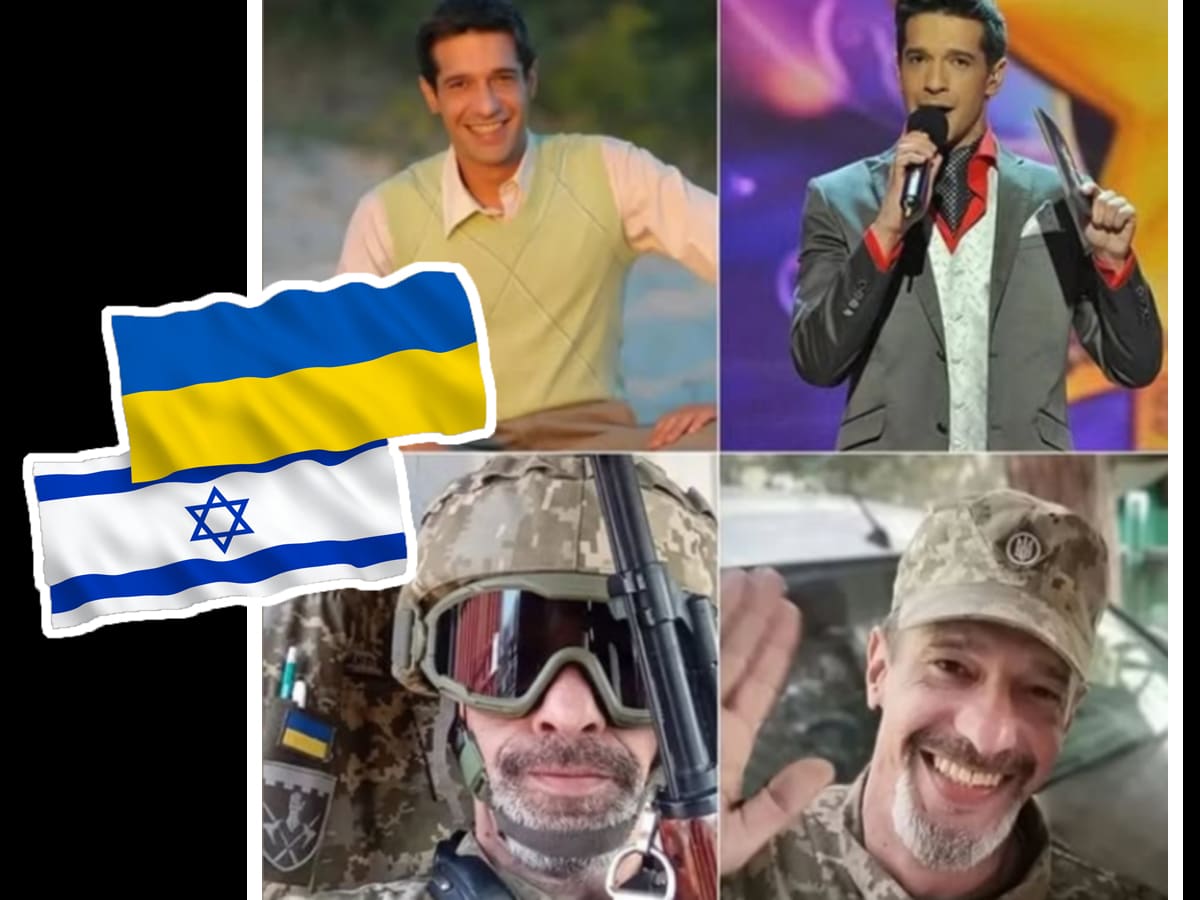
Maksym Nelipa died in battle while defending Ukraine. His son Artem, a soldier in the IDF, cannot attend the funeral due to Ukraine’s mobilization law. Here’s what stands in the way of saying goodbye.
Maksym Nelipa: from television to the front line
Maksym Nelipa was a well-known Ukrainian TV presenter, actor, and showman. He hosted popular television shows, including the Ukrainian version of “Dancing with the Stars”. He was known to millions of viewers. However, after the full-scale Russian invasion began in 2022, he voluntarily joined the front. By March of that year, he had enlisted in the Armed Forces of Ukraine.
Nelipa served in the 14th Separate Unmanned Aerial Vehicle Regiment, held the position of company commander, and had the rank of senior lieutenant. In January 2025, he was wounded, treated in Dnipro, and after recovery returned to the frontline.
He was killed in action on May 12, 2025. He was only 48 years old.
He is survived by his wife Tamara, son Artem, and daughter Mariia.
The farewell ceremony will take place on May 23 in Kyiv at the House of Culture of the Kyiv Polytechnic Institute, which he graduated from in 2001. This is where his public career began — as a member of the KVN team “Cowboys of the Polytechnic”.
The son will not be able to say goodbye to his father
The fallen soldier’s son — Artem Nelipa — currently serves in the IDF, in the elite Golani Brigade. He repatriated to Israel with his mother in 2022, shortly after the invasion began. He was 17 at the time.
Now he is of legal age, a citizen of Israel, and also — under Ukrainian law — a citizen of Ukraine.
Despite serving in the IDF, he cannot travel to Kyiv for his father’s funeral. The reason is Ukraine’s legislation, which restricts the movement of men of conscription age abroad.
Ukrainian law requires that any citizen returning from abroad must register for military service and, if not granted a deferment, is subject to conscription.
The right to deferment exists — but it’s difficult to obtain
According to Article 23 of Ukraine’s Law on Mobilization, a man who has lost his father during the defense against Russian aggression has the right to deferment. In theory, this allows temporary entry and exit from the country. However, to use this right, several documents are required:
- Proof of family relationship with the deceased;
- Official certificate confirming the father’s death in war;
- An issued deferment and corresponding mark in the military ID or relevant document.
For a foreign soldier, especially one without permanent residence in Ukraine, this process is extremely complicated, time-consuming, and involves complex coordination with state authorities. Artem is a soldier in the Israeli army and is unable to handle this urgently — particularly with the funeral approaching so soon.
Diplomatic effort: Israel intervenes
Israel’s Ambassador to Ukraine, Michael Brodsky, submitted an official request to Ukrainian authorities asking for Artem to be allowed to enter the country with the guarantee of returning to Israel. Previously, Kyiv had granted similar temporary permissions at Brodsky’s request to allow Ukrainian men to attend funerals of close relatives in Israel.
However, in this case, the Ukrainian side has not yet responded. This is not just a Ukrainian citizen abroad, but an active-duty soldier in the army of another country. This makes the situation especially sensitive — both in terms of Ukrainian law and national security.
As Maksym’s brother, Andrii Nelipa, explained, Ukraine’s Territorial Recruitment Centers (TCC) informed him that no exceptions exist for men of conscription age — even if they serve in a foreign military.
The family will not travel. The farewell will be filmed
Following discussions with the Israeli Embassy, the family made the difficult decision not to attend the funeral in person. The risk that Artem would not be allowed to return to Israel is too great. Instead, the farewell ceremony will be recorded and the video sent to him.
Andrii Nelipa also said that Artem will receive his father’s personal belongings and the state compensation due to the family of a fallen officer. However, as he noted, no video can replace being present at the funeral.
Multiple citizenship: legal ambiguity
Artem Nelipa is a citizen of both Israel and Ukraine. Although Ukraine does not officially recognize multiple citizenships, in practice, this situation is widespread. Since 2022, thousands of Ukrainians living abroad have obtained citizenship in other countries while keeping their Ukrainian passports.
Since 2019, President Volodymyr Zelenskyy has been promoting the legalization of multiple citizenship. The latest draft law was adopted in the first reading on December 17, 2024. It would allow Ukrainians to hold the passport of Ukraine and that of a friendly state — such as Israel. Exceptions include Russia and other countries that support aggression.
However, even if the law comes into force, Ukrainian legislation will still apply within the country. This means that any citizen with multiple citizenships will still be required to register for military service and apply for a deferment.
As Deputy Prime Minister and Minister for National Unity, Oleksii Chernyshov, explained:
“Unfortunately, under current legislation, if you obtain the passport of another country, you are no longer legally considered a Ukrainian citizen. We want to change that. The law will be adopted by the end of the year.”
As of now, the situation remains legally unresolved.
NAnews editorial: between law and memory
The editorial team at NAnews — Israel News highlights this urgent humanitarian and legal dilemma affecting Ukrainian and Israeli citizens.
Artem Nelipa is not just a soldier in the IDF. He is the son of a man who gave his life for Ukraine — and he cannot say goodbye to him.
We believe such cases must be handled not only from a legal standpoint but with humanity, diplomacy, and historical awareness. The ties between Israel and Ukraine run deep. Strengthening these bonds must go beyond words.
If two friendly countries cannot ensure that a son can bid farewell to his fallen father, then it is time to rethink the mechanisms of intergovernmental cooperation.
The NAnews — Israel News team will continue monitoring the situation and advocating for those caught between two countries, two armies, and two legal systems.