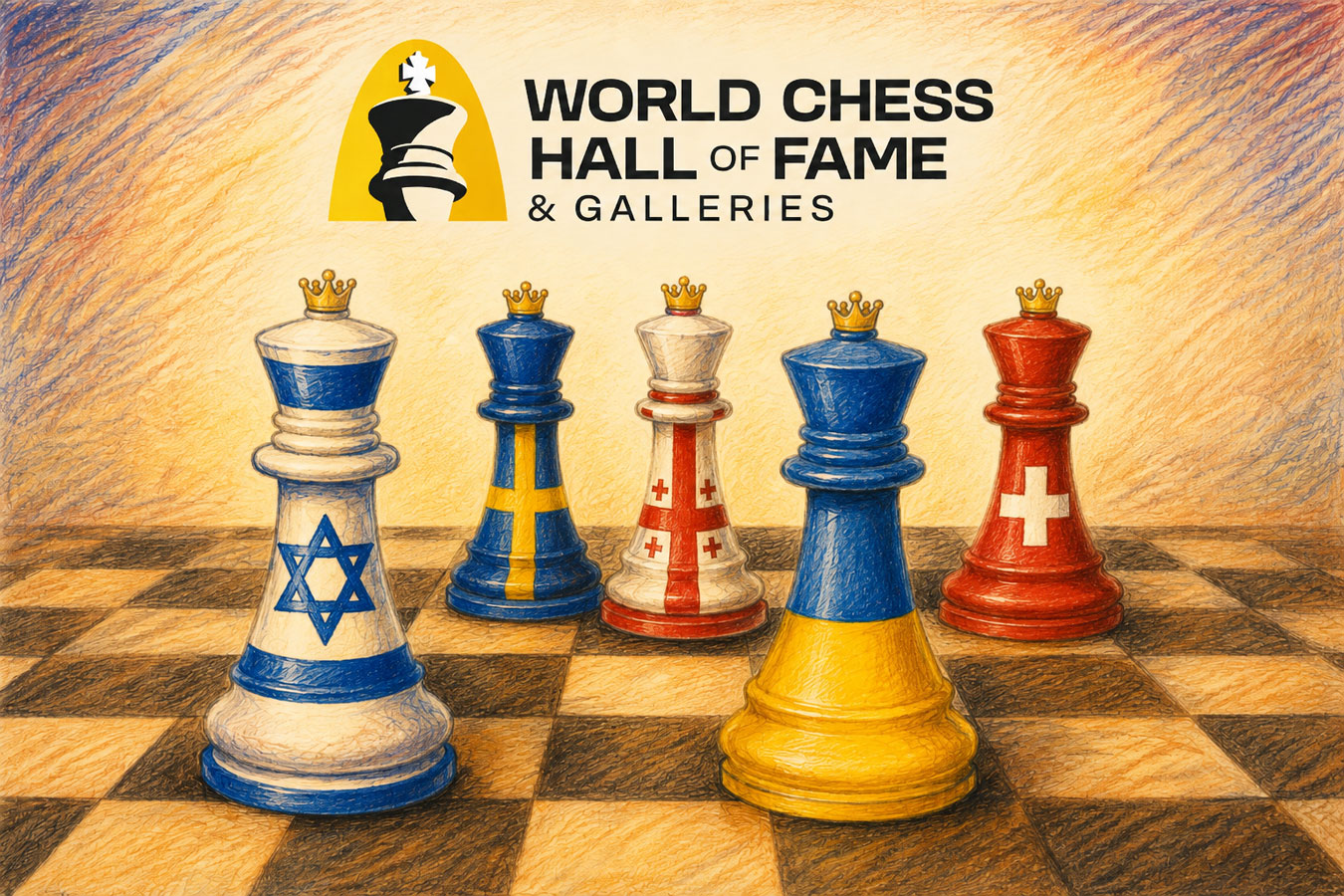
Israeli grandmaster Boris Gelfand and Ukrainian chess legend Vassily Ivanchuk have been inducted into the World Chess Hall of Fame. The class of 2026 was officially announced on July 30: along with them, Swede Ulf Andersson, Georgian Nana Ioseliani, and Swiss representative Alexandra Kosteniuk were selected.
This is a finalized decision, not a list of candidates.
Representatives of the International Chess Federation FIDE nominate and select new members of the World Hall of Fame based on their overall contribution to chess. The celebration of the new laureates will take place in St. Louis in October 2026 during the city’s chess events; the exact separate day of the ceremony for the world five was not specified in the initial announcement.
After the current addition, the World Chess Hall of Fame will have 61 people. But for Israel and Ukraine, this news is more interesting than just a number: Gelfand and Ivanchuk are almost contemporaries who reached the top of the world chess scene at the turn of the 1980s and 1990s and then became iconic figures for two different countries.
For NANews — Israel News | Nikk.Agency, Victoria Katzman compared the official decision of the World Chess Hall of Fame, FIDE data, the history of the two grandmasters’ performances, and Israeli materials on Gelfand’s career. Katzman is originally from Ukraine and regularly works with stories at the intersection of Ukrainian and Israeli life in her publications; here, the author’s task is not to technically analyze chess games but to show why two names in one list have a separate significance specifically for Israel and Ukraine.
How Gelfand and Ivanchuk made it into the World Chess Hall of Fame
World Chess Hall of Fame is not just another tournament or an award only for world champions. The World Hall of Fame can include players, coaches, authors, organizers, and other people whose influence on chess has been significantly broader than a single result.
It is the representatives of FIDE who are responsible for nominating and selecting members of the world part of the Hall of Fame. Therefore, in the case of Gelfand and Ivanchuk, it is not a single tournament in 2026 that is evaluated, but several decades of their presence in the world chess elite.
This is an important boundary. Both grandmasters have received numerous titles, yet neither Gelfand nor Ivanchuk became absolute world champions in classical chess. Nevertheless, their place in the history of the game turned out to be so significant that the absence of the main individual title no longer changes anything fundamentally.
What is more important for chess history then — one crown or several decades during which a player remains a figure of global scale? The class of the World Chess Hall of Fame 2026 effectively gives its answer to this question.
Boris Gelfand: why this is a special story for Israel
Boris Gelfand was born in Minsk in 1968 and developed as a chess player in the Soviet school. In September 1998, he repatriated to Israel, settled in Rishon LeZion, and began to consistently represent the country in major international competitions.
The Israeli Chess Federation later called his aliyah one of the key events for national chess of that period. With Gelfand’s arrival, the Israeli team gained a player from the world’s top ten, and then results came that the team had not achieved before.
The most famous page of his career is the 2012 championship match against Viswanathan Anand. Gelfand earned the right to it after winning the 2009 FIDE World Cup and the 2011 Candidates Tournament.
Twelve classical games against the reigning champion ended with a score of 6:6. In the seventh game, Gelfand even took the lead, but Anand equalized, and the fate of the world crown had to be decided in rapid chess. Anand was stronger in the tiebreak.
For Israel, this remains a unique sports story. Gelfand not only participated in the candidates’ cycle: a chess player representing Israel reached a full-fledged match for the absolute world crown and after twelve classical games was still not inferior to the champion.
The Israeli team with Gelfand also achieved world-class results. In 2008, the team won silver at the Chess Olympiad, and in 2010 — bronze. Before repatriation, Gelfand managed to win the 1990 Olympiad as part of the USSR team, so his biography literally spans two different chess eras.
There is also a detail that makes the inclusion in the Hall of Fame in 2026 even more interesting. At the time of preparing this article, the 58-year-old Gelfand still holds the first place among Israeli chess players in the national ranking of the Israeli Chess Federation; in the August FIDE ranking, he is also the highest-ranked representative of Israel.
So, the World Chess Hall of Fame now includes not a person who has long disappeared from professional chess. Gelfand remains an active grandmaster and the first number of his country almost three decades after repatriation.
Gelfand is not the first Israeli representative in the World Chess Hall of Fame
Here, an important historical clarification is necessary. Calling Boris Gelfand the first Israeli representative in the World Chess Hall of Fame would be incorrect.
In 2017, Alla Kushnir was included in the World Chess Hall of Fame. She was born in the USSR, moved to Israel in 1973, and in 1976 led the Israeli women’s team to victory at the Chess Olympiad. In the official Hall of Fame, Israel and the Soviet Union are listed next to her name.
Therefore, Gelfand’s significance is different. He became the main face of Israeli men’s chess for several decades, led the country to the Olympic podium, and was one tiebreak away from the absolute world crown.
For a small country with a strong chess tradition, this is already a separate chapter of sports history.
Vassily Ivanchuk: a man remembered by the chess world not only for titles
Vassily Ivanchuk was born in 1969 and is only a year younger than Gelfand. Like the Israeli grandmaster, he entered the world elite at the end of the Soviet period, but after Ukraine’s independence, he became one of the main figures of the Ukrainian chess school.
Ivanchuk rose to the second place in the world ranking three times. Above him at different times were chess players of the level of Garry Kasparov and other champions of the era, but the Ukrainian himself was for decades part of the narrow circle of players capable of defeating almost any opponent in the world.
Ivanchuk came closest to the classical world crown in 2002. He reached the final of the FIDE World Championship, where he faced another Ukrainian — Ruslan Ponomariov. Ponomariov won, becoming the youngest FIDE world champion at the time.
But from Ukraine’s perspective, the personal title is only part of Ivanchuk’s story. In 2004 and 2010, he helped the Ukrainian team win the Chess Olympiads. Before that, Ivanchuk twice became an Olympic champion as part of the USSR team — in 1988 and 1990.
In 2016, the Ukrainian added the title of world rapid chess champion to his collection. He was 47 years old at the time — an age when most professional athletes in other sports have long been discussing their careers in the past tense.
But the special attitude of the chess world towards Ivanchuk is explained not only by medals. For decades, he was perceived as one of the most creative and unpredictable grandmasters of his generation — a player capable of choosing unexpected openings, finding unconventional solutions, and defeating the strongest opponent in the world on any given day.
That is why the word “legend” in Ivanchuk’s case does not need artificial newspaper enhancement. It describes the reputation that the chess player earned within the game itself.
Why Gelfand and Ivanchuk are so interesting together
In 1990, both were already among the strongest chess players on the planet. Gelfand was 22 years old, Ivanchuk — 21. The world around them soon changed completely, and each’s chess career continued in new political and national circumstances.
Gelfand made Israel his home in 1998 and played on the first board of the national team for many years. Ivanchuk, after the collapse of the USSR, became one of the symbols of independent Ukraine and twice helped it win the main team chess award.
One almost reached the absolute world title in 2012. The other was the second chess player in the world three times, won the world rapid championship, and for decades maintained a reputation as one of the most unusual players of his generation.
Their stories do not require artificially inventing a “connection between Israel and Ukraine.” It already exists on its own: two people of one chess era went from a common Soviet system to the status of national legends of two different states.
Chess has already appeared on the pages of NANews in such an Israeli-Ukrainian context. In 2024, we talked about a chess tournament in Be’er Sheva in memory of a repatriate from Ukraine, Denis Yakimov, who died in Gaza. There, the game was part of a personal family story; now chess connects Israel and Ukraine at the level of names that have entered the World Hall of Fame.
Who else joined the chess class of 2026
Along with Gelfand and Ivanchuk, three more people representing different generations and schools of world chess were selected.
Ulf Andersson is a Swedish grandmaster known for his positional mastery and endgame play. In 1983, he reached fourth place in the world ranking and remained among the strongest chess players on the planet for many years.
Nana Ioseliani is one of the strongest female chess players of her generation. She twice reached the matches for the women’s world championship and won numerous team and individual Olympic medals, first representing the USSR and then Georgia.
Alexandra Kosteniuk, now representing Switzerland, was the women’s world champion from 2008 to 2010, won the world rapid championship, and other major international competitions.
The diversity of this five well illustrates the principle of the World Chess Hall of Fame. Here, not only holders of absolute world titles are placed side by side, but also people who have shaped the very culture of chess for decades and left a mark much greater than a single entry in a tournament table.
What this means for Israel and Ukraine — and what will happen next
For Israel, the inclusion of Boris Gelfand marks an entire era of national chess on an international level. A repatriate from Belarus became the country’s first number, led the team to Olympic medals, played a match for the world crown for Israel, and remains the leader of the national ranking at 58.
For Ukraine, Ivanchuk’s story is different but no less strong. He became part of a generation that entered big chess before independence, and then brought its most important team victories to Ukraine. The gold of the 2004 and 2010 Olympiads cannot be told separately from the name Vassily Ivanchuk.
Why, after more than three decades, do their names appear together again? Because the Hall of Fame measures a career not by one season. It records what remains after the rating tables have long changed, tournaments have ended, and a new generation of chess players has taken the top spots.
At the time of preparing the material, the following is confirmed: Gelfand and Ivanchuk have already been announced as members of the World Chess Hall of Fame class of 2026, and the new laureates will be honored in St. Louis in October. A separate exact day of the ceremony for the five world laureates has not yet been specified in the initial official announcement.
Therefore, the current news is not awaiting a FIDE decision, but an already established recognition. Israel and Ukraine have received in one class of the World Chess Hall of Fame two players whose careers began almost simultaneously, diverged between two countries, and after decades met again in one historical list.
What is the World Chess Hall of Fame
World Chess Hall of Fame — the World Chess Hall of Fame — is not a ranking of the best active chess players and not another FIDE tournament. It is an international Hall of Fame where people who have left a significant mark in the history of chess are recorded: players, coaches, authors, journalists, researchers, organizers, and other figures of the game. Candidates for the world part of the Hall of Fame are nominated and selected by FIDE representatives, and the overall contribution of a person to chess over their career is evaluated.
The history of the institution itself began in the USA. In 1986, the U.S. Chess Federation created the U.S. Chess Hall of Fame, initially a small museum that opened in 1988 in New Windsor, New York. The collection then moved to Washington, and in 2001 — to Miami, where the institution was named World Chess Hall of Fame and Sidney Samole Museum and the world part of the Hall of Fame appeared.
Since 2011, the World Chess Hall of Fame has been operating in St. Louis, Missouri, opposite the Saint Louis Chess Club. It is both a Hall of Fame and a full-fledged chess museum: it houses historical chess sets, books, photographs, medals, trophies, and other artifacts, and hosts temporary exhibitions about great players, famous games, and the influence of chess on art and culture.
Therefore, inclusion in the World Chess Hall of Fame is different from receiving a sports title. A person may never become an absolute world champion but still end up in the Hall of Fame if their long-term influence on the game is recognized as historically significant. It is on this principle that Boris Gelfand and Vassily Ivanchuk are included in the class of 2026: the decision evaluates not one result, but their entire chess career and contribution to the game.
After the inclusion of five new laureates in 2026, the world part of the Hall of Fame will have 61 people. Among those already there are Garry Kasparov, Anatoly Karpov, Mikhail Tal, Jose Raul Capablanca, Bobby Fischer, Judit Polgar, Nona Gaprindashvili, and other figures without whom the history of chess cannot be imagined.
That is why for Gelfand and Ivanchuk, the current decision is not just another award. Their names are now officially placed in the historical line of people whose influence on chess is meant to be preserved beyond a specific era, rating, or individual championship.