
In recent weeks, Ukraine has once again been living under the almost continuous sound of air raid sirens. The Russian aggressor launches hundreds of strike drones, ballistic and cruise missiles, and guided aerial bombs at Ukrainian cities. Residential buildings, hospitals, schools, enterprises, ambulances, and energy facilities are under attack.
Behind every report of a new attack are dead people, injured children, destroyed apartments, and families who lose everything in seconds.
The last full month for which the UN has already published confirmed data was the hardest for the civilian population of Ukraine since the spring of 2022. In June 2026, at least 293 civilians were killed as a result of military actions, and another 1,990 people were injured. In total, in the first six months of 2026, the UN confirmed the deaths of 1,396 civilians and injuries to 7,978 people. The number of victims was 37% higher than in the same period last year. The main reason for the increase in losses was Russian missile and drone strikes on cities far from the front line.
July began even more terrifyingly. According to the UN Human Rights Monitoring Mission, in just the first days of the month, an average of about 170 civilians were killed or injured daily in Ukraine. Russia continued to use long-range missiles, strike drones, and aerial bombs against Kyiv, Zaporizhzhia, Dnipro, Sumy, and other cities almost daily.
During one of the most massive strikes, the Russian army launched more than 70 missiles of various types and almost 500 strike drones at Ukraine. At that time, more than 20 objects were damaged in Kyiv, mainly ordinary residential buildings. Thirteen people died, and more than 90 were injured. Rescuers had to clear the rubble, search for people, and provide assistance at several destroyed sites.
They go where others try to escape from
After each Russian strike, Ukrainian rescuers are the first to arrive at burning houses. They enter buildings that can collapse at any moment, dismantle concrete slabs, extinguish fires, carry out the injured, and continue searching as long as there is even the slightest hope of finding someone alive.
But today in Ukraine, the danger does not end after the first explosion.
Russian troops regularly carry out repeated strikes on the same places when rescuers, medics, and police are already working there. Employees of the State Emergency Service have to extinguish fires with the constant understanding that a new drone may appear in the sky or another missile may arrive.
During the aftermath of Russian attacks in the Sumy region, rescuers were forced to repeatedly stop work, retreat to a safe place, and then return to burning buildings. The same threat persisted during the extinguishing of large fires in the Poltava and Zaporizhzhia regions.
As a result of a repeated Russian strike on a civilian enterprise in Kharkiv, four State Emergency Service employees were killed, and nine more rescuers were injured. In the Dnipropetrovsk region, a repeated missile attack claimed the life of another rescuer, and his colleague was injured.
The situation remains particularly difficult in the Kherson region. The Russian army attacks settlements daily with artillery, aerial bombs, and FPV drones. Residential buildings, cars, shops, gas stations, and people simply walking down the street or delivering groceries to neighbors are under attack.
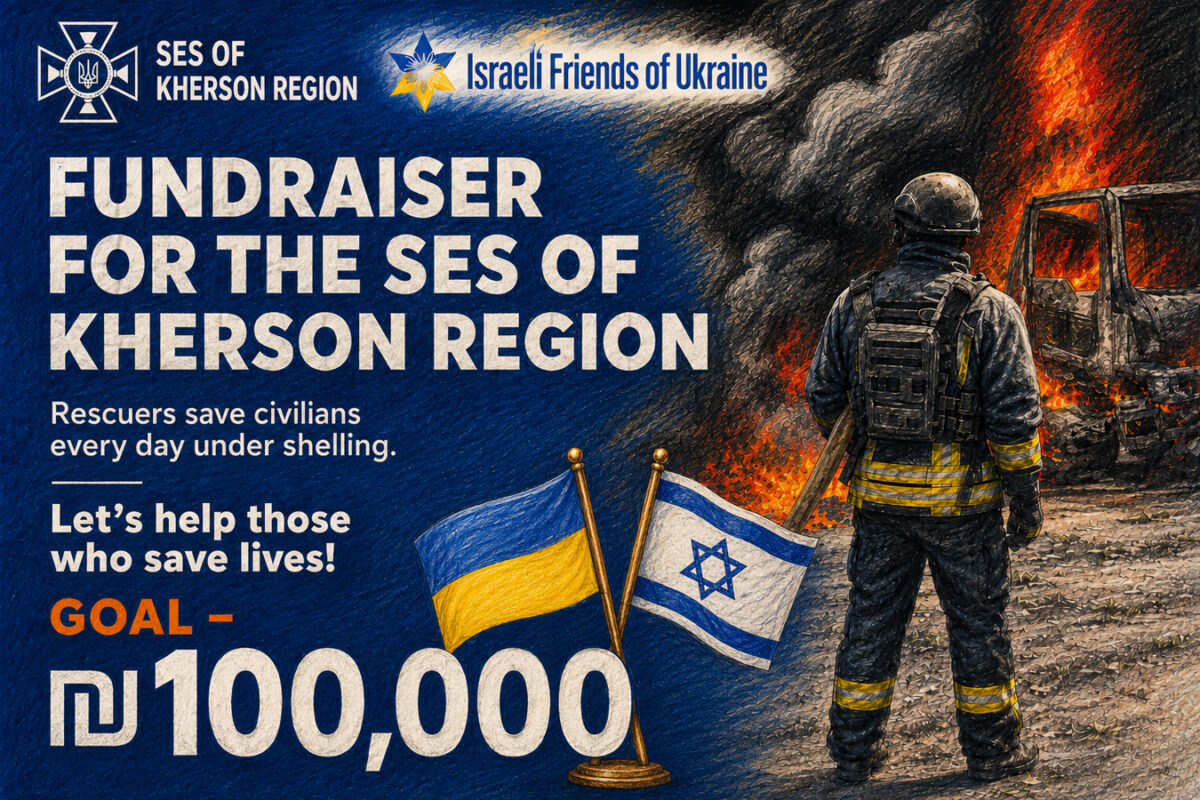
It is for the State Emergency Service units of Kherson that a new charitable fundraiser is currently open in Israel.
In Israel, they are collecting 100,000 shekels
The Israeli non-profit organization Israeli Friends of Ukraine — IFU reported that it received a direct request from the State Emergency Service units of Ukraine in the Kherson region.
The goal of the fundraiser is 100,000 shekels.
Details of the fundraiser:
https://www.facebook.com/share/p/19HCU499k5/
These funds are needed to purchase equipment that will help rescuers extinguish fires, clear rubble, provide first aid, and protect their own lives while working under Russian shelling.
Organizers are raising money for:
- 150 fire hoses;
- five sets of bulletproof vests and protective helmets;
- 50 fire extinguishers;
- five jacks;
- five tool kits;
- 20 backpack fire extinguishing devices;
- 20 powerful flashlights;
- two Halligan tools;
- 10 medical kits;
- three fire hydrants;
- two portable motor pumps;
- two EcoFlow charging stations.
Behind each item on this list is a specific need.
Fire hoses and motor pumps allow water to be delivered where heavy equipment cannot reach. Jacks and tools are needed to lift collapsed structures and reach people under the rubble. Flashlights are necessary during night search operations and power outages.
Bulletproof vests and helmets do not make a rescuer’s job safe, but they can give them an additional chance to survive a shrapnel or repeated strike. Medical kits are needed to provide first aid to both victims and State Emergency Service employees themselves. Charging stations allow maintaining communication, lighting, and equipment operation where power grids have been destroyed by Russian attacks.
This is not an abstract fundraiser “to help Ukraine.” Organizers received a specific request and published an exact list of what the State Emergency Service units of the Kherson region need.
NAnews — News of Israel draws readers’ attention: interim results should not be a reason to postpone help. The fundraising goal remains significant — 100,000 shekels, and the equipment is needed by people who work under daily Russian attacks.
Who organized the fundraiser
Israeli Friends of Ukraine is an Israeli non-profit organization that has been strengthening ties between Israel and Ukraine, developing Ukrainian-Jewish dialogue, humanitarian projects, and informing Israeli society about what is happening in Ukraine since 2014.
After the start of the full-scale Russian invasion, IFU has been collecting and sending humanitarian aid. According to the organization’s official website, about 157 tons of humanitarian cargo, including medical kits, hygiene products, clothing, power sources, and other necessary items, have been delivered to Ukraine to date. The organization also reports raising about two million shekels to help people in Ukraine and delivering 18,500 Israeli bandages and tourniquets.
The new fundraiser for the State Emergency Service of Kherson is another opportunity for Israeli residents to help not with words, but with concrete action.
While the Russian aggressor continues to bombard Ukraine with missiles and drones, rescuers put on helmets again and again, get into vehicles, and go where others are trying to escape from.
They do not know if there will be a repeated strike. They do not know if the damaged walls will hold. But they continue to search for people, extinguish fires, and save lives.
Today they need equipment. And it can be purchased from Israel.
How to help Ukrainian rescuers from Israel
Donations can be made through the Israeli payment system Meshulam.
Details of the fundraiser:
https://www.facebook.com/share/p/19HCU499k5/
Direct link for donation:
https://meshulam.co.il/quick_payment?b=282d80057456b1d4e94a472b7d7a735f
Each person independently chooses the amount of the donation. It can be 20, 30, 50 shekels, or a larger contribution.
One small amount will not allow the purchase of all the necessary equipment. But it is precisely from dozens and hundreds of such transfers that the opportunity to buy a fire hose, medical kit, fire extinguisher, protective helmet, or flashlight is formed.
You can also help by spreading the information. One repost can lead to the fundraising page of a person who is ready to pay for a protection kit, motor pump, or charging station. For a charitable campaign, such dissemination is no less important than a separate transfer.
