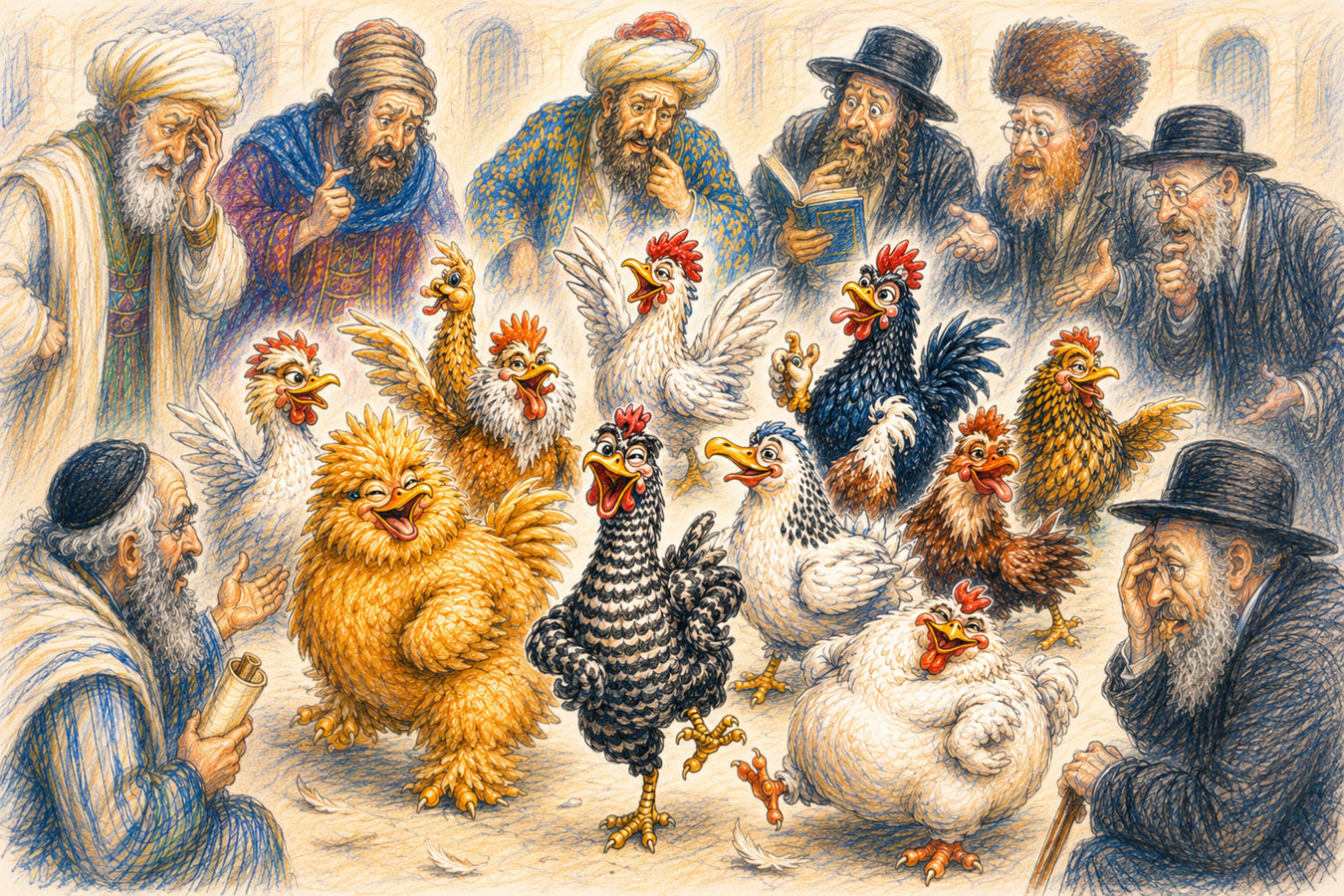
Before starting, it is important to clarify: this article and its accompanying illustration are created with respect for rabbis, Haredim, and halachic tradition. For someone unfamiliar with the laws of kashrut, the debate about chicken breeds, the structure of their legs, and the continuity of consumption tradition may seem unusual or even amusing. However, behind these details lies a serious question: how does an ancient legal system apply its principles to breeding, industrial poultry farming, and new genetic technologies? This complex process of seeking an answer is precisely what the material is dedicated to.
On July 28, 2026, the British Jewish publication The Jewish Weekly published an article “Kosher Chicken Pedigree: 5 Ways Rabbinic Authority Keeps It Safe”, dedicated to an unusual question: how much is the modern industrial chicken connected to the bird whose kosher status has been confirmed by Jewish tradition for generations.
At first glance, the question itself seems strange. Chicken is sold in almost every kosher butcher shop in Israel, served at Shabbat meals, and produced under the supervision of major kashrut organizations. However, the modern broiler grows significantly faster than its ancestors, has a different body shape, and is the result of complex crossbreeding of several breeding lines.
Therefore, the rabbinic discussion is not about whether chicken is allowed at all. The main question is different: how far can breeding change a known bird before it needs to be re-confirmed as belonging to the species covered by the ancient kosher tradition?
Why birds turned out to be more complicated than cows and fish
For land mammals, the Torah establishes two external signs: the animal must have split hooves and chew the cud. This rule is formulated in the book of Leviticus, 11:3, and repeated in the book of Deuteronomy, 14:6.
For fish, fins and scales are necessary. These signs are named in Leviticus, 11:9–12, and repeated in Deuteronomy, 14:9–10.
Regarding birds, the Torah uses a different principle. Instead of a set of universal signs, it lists prohibited categories of birds. The first list is found in Leviticus, 11:13–19, the second in Deuteronomy, 14:12–18.
In the Babylonian Talmud, in the tractate “Chullin”, 63b, the sages explain that the biblical list covers 24 categories of prohibited birds. The tractate “Chullin” is dedicated to the laws of slaughtering animals and birds, their permissibility for food, and other kashrut issues.
The problem arose later when ancient names ceased to unequivocally correspond to specific biological species.
Jewish communities found themselves scattered across different countries. The same bird could be called by different words, and the same name in two regions sometimes referred to completely different animals. The biblical classification was also not a modern zoological system, where each species is assigned a single Latin name.
The Mishnah provides signs of a permitted bird in the tractate “Chullin”, 3:6. The Mishnah is the foundational compilation of the Oral Torah, finalized in the Land of Israel around the beginning of the 3rd century CE.
In this section, the following are listed:
- the presence of a crop;
- a muscular stomach, the inner lining of which can be separated by hand;
- a special back toe, located slightly higher than the others;
- the absence of predatory behavior, called “dores”.
The last criterion caused especially many disputes. Rabbis explained differently what exactly “dores” means: whether the bird grabs prey with its claws, holds food with its foot, catches it in the air, or eats the prey alive.
A specific case that increased caution is described in the Babylonian Talmud, tractate “Chullin”, 62b.
There, a bird called “tarnegolta de-agma”, or swamp chicken, is discussed. Initially, an opinion allowing its consumption is presented, but then Marimar reported that the bird was seen grabbing and eating prey. After this, it was recognized as prohibited.
Thus, it is not about an indefinite range of pages or a legend without a specific source, but about an exact Talmudic episode on the sheet “Chullin”, 62b.
Rashi — Rabbi Shlomo Yitzhaki, who lived in 1040–1105 in the French city of Troyes, — commented on this episode as a warning against hastily permitting unknown birds. Rashi is considered the main medieval commentator on the Tanakh and the Babylonian Talmud; his explanations are still printed in almost all traditional editions of these texts.
It is from this discussion that the principle was strengthened, according to which one external inspection may not be enough: a person can misinterpret the structure or behavior of a bird.
Therefore, the most important significance was given to masoret — the continuous tradition of consuming a specific bird in a reliable Jewish community.
This approach was enshrined in “Shulchan Aruch”, section “Yoreh De’ah”, 82:2–3.
“Shulchan Aruch” was compiled by Rabbi Yosef Karo, who lived in 1488–1575. He was born in Spain, lived in the Ottoman Empire after the expulsion of Jews, and then settled in Safed. Yosef Karo is known as one of the main systematizers of Jewish law.
The Ashkenazi practice was added to this code by RAMA — Rabbi Moshe Isserles, who lived approximately in 1530–1572 in Krakow. His notes, known as “Mapah”, made “Shulchan Aruch” a generally accepted code for Ashkenazi communities as well.
Historical excursion: chicken was not always common food
The ancestor of the modern domestic chicken is considered to be the red junglefowl of Southeast Asia.
According to modern archaeological research, the domestication process began approximately around 1500 BCE and may have been associated with the spread of dry rice cultivation. Birds gained constant access to grain and gradually began to live alongside humans.
From Southeast Asia, chickens spread along trade routes. In the Mediterranean, they appeared around the first millennium BCE, but were initially perceived more as exotic, ritual, or status animals.
In some early European burials, chickens were buried separately or together with people. They became common mass food much later.
This history helps to understand why in biblical texts the chicken does not occupy as prominent a place as the sheep, goat, or dove.
Fattened birds served at King Solomon’s table are mentioned in the book of 1 Kings, 5:3 according to the Jewish numbering of the Tanakh. In most Christian and Russian Synodal editions, the same place is designated as 3 Kings, 4:23.
The verse states that the daily supply of the royal court included large and small cattle, wild animals, and “barburim avusim” — fattened birds.
Saadia Gaon believed that “barburim” referred to geese.
Saadia ben Yosef, known as Saadia Gaon, lived in 882–942. He was born in Faiyum, Egypt, and later headed the famous Talmudic academy of Sura in Babylonia, on the territory of modern Iraq. The title “gaon” denoted the head of one of the leading Babylonian academies. Saadia is known as a philosopher, linguist, translator, and one of the first major systematic commentators on the Tanakh in Arabic.
Rashi offered another interpretation: in his opinion, “barburim” could have been fattened chickens. This version is presented in his commentary on 1 Kings, 5:3, where he also refers to the Talmudic discussion in the tractate “Bava Metzia”, 86b.
By the Talmudic era, the chicken was already a well-known domestic bird.
In the Babylonian Talmud, tractate “Bava Metzia”, 86b, Rabbi Yochanan says: “The best of domestic animals is the ox, and the best of birds is the chicken.”
Rabbi Yochanan bar Nappaha was one of the leading sages of the Land of Israel in the 3rd century and died approximately in 279. He was born in Tzippori and later headed a major rabbinic academy in Tiberias. His statements occupy an important place in both the Jerusalem and Babylonian Talmuds.
The Jewish tradition of consuming chicken, thus, was formed gradually. Masoret is not a biological certificate preserved in written form since Sinai, but a continuous practical chain.
Parents showed children which birds their community consumed. Shochtim knew which animals they were allowed to slaughter. Rabbis ensured that unknown varieties were not introduced into the diet without verification.
Five levels of kosher tradition protection
Based on examples provided by The Jewish Weekly, five interconnected levels of kosher tradition protection can be distinguished.
The first level is the biblical list of prohibited birds, found in Leviticus, 11:13–19, and Deuteronomy, 14:12–18. It sets the initial Torah norm and requires determining whether the bird under investigation belongs to one of the prohibited categories.
The second level is the Talmudic signs, listed in the Mishnah, tractate “Chullin”, 3:6, and thoroughly analyzed in the Babylonian Talmud on sheets “Chullin”, 59a–63b.
Rabbis pay attention to the presence of a crop, the structure of the muscular stomach, the arrangement of toes, and the absence of predatory behavior. These signs help to investigate an unfamiliar bird, but by themselves do not always provide a definitive answer.
The third level is masoret, that is, the continuous tradition of consuming a specific bird in a recognized Jewish community. The requirement for masoret is formulated in Rashi’s commentary on “Chullin”, 62b, and enshrined in “Shulchan Aruch”, “Yoreh De’ah”, 82:2–3.
The fourth level is rabbinic responsa and decisions of halachic authorities. They become necessary when new breeds, hybrids, or breeding technologies appear that did not exist at the time of the classical sources.
The fifth level is practical verification. It may include examining live birds, long-term observation of their behavior, studying the origin of the breeding line, and verifying the claims of breeders and producers.
It is precisely the combination of all these levels that explains why the kosher status of chicken cannot be determined by a single laboratory examination.
A biologist can establish the kinship of breeds, but the halachic answer also depends on tradition, external structure, behavior, line origin, and decisions of previous rabbinic authorities.
19th century: when huge Asian chickens were brought to Europe
The first major dispute over new breeds arose long before the advent of genetic laboratories.
In the mid-19th century, large Asian chickens, known as Cochin-China or Cochins, began to be massively imported into Europe. They were noticeably different from the familiar European birds: they were significantly heavier, had a massive body, unusual plumage, and feathered legs.
Rabbis faced the question: is the Cochin a new breed of the common domestic chicken or a completely different bird that requires a separate masoret?
The discussion became especially acute in the 1860s. Some authorities believed that external differences did not negate the bird’s belonging to the common chicken. Others argued that tradition could not be automatically transferred to an animal noticeably different from all known community breeds.
An additional argument was crossbreeding. Cochins could produce viable offspring with common domestic chickens. Some rabbis considered this proof of belonging to one permitted species.
The Talmudic principle, according to which permitted and prohibited species do not produce viable common offspring, is discussed in the tractate “Bechorot”, 7a. However, in the Talmudic text itself, this question is formulated concerning mammals, not directly to birds.
Chatam Sofer — Rabbi Moshe Sofer, who lived in 1762–1839, — considered the possibility of applying this principle to birds in the responsum “Chatam Sofer”, “Yoreh De’ah”, No. 74.
Moshe Sofer was born in Frankfurt am Main, and from 1806 until his death, he led the community and yeshiva of Pressburg — modern Bratislava. He became one of the most influential halachic authorities in Central Europe and one of the main defenders of traditional Judaism in the era of Enlightenment and religious reforms.
Chatam Sofer used the possibility of crossbreeding as a serious argument but simultaneously considered the objection that the Talmudic principle from “Bechorot”, 7a, might apply only to mammals.
“Avnei Nezer” is the name of the collection of responsa by Rabbi Avraham Bornstein, who lived in 1838–1910 in Poland. He was the rabbi of Sochaczew, an outstanding halachic authority, and the founder of the Sochaczew Hasidic dynasty.
In the responsa “Avnei Nezer”, “Yoreh De’ah”, Part I, No. 75, he thoroughly analyzed the crossbreeding of an unknown bird with a recognized kosher line. Avraham Bornstein considered viable offspring a serious proof that it was about varieties of one species.
At the same time, later researchers noted that the position of “Avnei Nezer” cannot be applied without restrictions: in the neighboring responsum No. 76, he again emphasized the importance of masoret and did not consider one fact of mating sufficient in all possible cases.
Maharam Schick — Rabbi Moshe Schick, who lived in 1807–1879, — considered the problem in the responsa “Maharam Schick”, “Yoreh De’ah”, Nos. 98–100.
He was born in Brezova on the territory of modern Slovakia, studied under Chatam Sofer in Pressburg, and from 1861 until his death was the rabbi of Khust — a city located today in the Zakarpattia region of Ukraine. Maharam Schick was considered one of the greatest students of Chatam Sofer and an important halachic authority of Hungarian and Carpathian Jewry.
He divided several different cases:
- whether the new breed itself can be consumed;
- whether the hybrid can be eaten if the mother was a common chicken;
- whether the decision changes if the unknown breed was the mother;
- what is the status of eggs laid by the hybrid bird.
This discussion shows how complex halachic analysis can be. It took into account not only external signs but also maternal and paternal lines, egg origin, status of doubt, and the appearance of the hatched chick.
How the industrial chicken appeared
Until the 20th century, chickens were usually bred primarily for eggs. Meat was obtained from old layers or surplus young roosters. Specialized meat chickens in the modern sense practically did not exist.
The situation changed after World War II when the demand for affordable animal protein sharply increased in the USA.
In 1945, the A&P trading network, together with the US Department of Agriculture and agricultural consultants, launched the Chicken of Tomorrow contest.
Breeders were offered to develop a bird that grows faster, converts feed into meat more efficiently, and has a larger breast part.
In the 1946–1947 contests, hundreds of lines were grown under the same conditions and compared by growth rate, health status, feed consumption, and carcass structure.
Subsequently, the White Plymouth Rock and meat Cornish lines became the basis for modern Cornish Rock hybrids.
It is important to understand: the common industrial broiler is usually the result of breeding and multi-stage crossbreeding of chicken lines, not a bird into which a gene from another animal was necessarily introduced in a laboratory way.
Since the 1950s, the main directions of breeding have been growth rate, breast meat yield, survival, and feed efficiency.
Research shows that when grown under the same conditions, the growth rate of broilers between 1950 and 2005 increased by more than 400%.
Early contest winners raised a four-pound bird in about 12 weeks and consumed about 12 pounds of feed. A modern broiler can reach five pounds in approximately 42 days, using less than 10 pounds of feed.
Externally, this is indeed a significantly changed bird: massive breast, rapid weight gain, different body balance, and reduced activity.
This is why some rabbis questioned whether the previous masoret applies to an animal so altered by targeted breeding.
For readers of NAnews — News of Israel, it is important to separate two concepts here. A genetically altered chicken in the broad biological sense by breeding and a genetically edited bird by laboratory methods are not the same.
White Leghorn and checking the position of the toes
In the early 2000s, a rumor spread that white Leghorns, widely used for egg production, allegedly lost their kosher status due to years of breeding.
The reason was the position of the toes on the perch.
This criterion goes back to the Mishnah, tractate “Chullin”, 3:6, where Rabbi Eliezer bar Tzadok says that a bird that places two toes on each side of a rope can be considered predatory.
Some observers saw that Leghorns sometimes sit in a “2–2” position and suggested that breeding had given them a trait characteristic of a prohibited bird.
The question was investigated by the Jerusalem BADATZ “Eda Haredit” with the participation of a bird specialist.
Observation showed that the Leghorn usually places its toes in a “3–1” scheme. The “2–2” position occurs temporarily when the bird is just sitting down, trying to hold on to a slippery or uncomfortable perch, or experiencing leg problems.
In March 2004, the Orthodox Union published a conclusion that white Leghorns and the eggs they lay are kosher.
The Orthodox Union is an American Orthodox organization created at the end of the 19th century. Its OU Kosher division is one of the largest international kosher certification systems.
This episode shows that rabbis did not limit themselves to references to old texts. They observed live birds and checked whether the disputed behavior was permanent and natural or occurred only in certain circumstances.
Warning of Rav Shmuel Wosner
In 1998, Rabbi Shmuel Wosner expressed concern about the rapid changes in industrial chickens.
Shmuel Ha-Levi Wosner lived from 1913–2015. He was born in Vienna, studied at the Yeshiva “Chachmei Lublin” in Poland, moved to the Land of Israel before World War II, and later became one of the leading halachic authorities in Bnei Brak.
He is best known for his multi-volume collection of responsa “Shevet Ha-Levi”, after which he was often referred to in rabbinic literature.
Wosner outlined his position on new chickens in a separate letter in 1998. He pointed out that modern birds result from the mixing of different lines, some of which may not have clearly confirmed masoret, and called for a return to breeds with more understandable origins whenever possible.
Other rabbis and experts disagreed with this conclusion. They argued that breeders continue to crossbreed varieties of domestic chickens, and that accelerated growth, increased weight, and changes in individual characteristics do not necessarily create a new halachic species.
A practical question also arose: where to find a “pure” European chicken?
Over the decades, industrial poultry has displaced many old breeds. Proving that a specific line is a direct and completely unchanged descendant of the chickens eaten by pre-war European Jews has proven almost impossible.
The Paradox of the Belgian Braekel
Supporters of returning to old breeds found a farmer in Belgium who bred Braekel chickens and kept detailed records of their origins.
Eggs were delivered to Israel, after which the breeding of Braekels began.
Proponents of the project claimed that the Braekel is an old European chicken with a more reliable pedigree, whereas modern industrial birds are opaque hybrids.
But Rabbi Moshe Sternbuch put forward the opposite argument: a continuous masoret exists precisely with the ordinary chicken that Jews have been buying and consuming daily for decades.
Moshe Sternbuch was born in 1926 in London, later moved to Israel, and became one of the leading ultra-Orthodox halachic authorities in Jerusalem. He is known for his multi-volume responsa “Teshuvot Ve-Hanhagot” and his many years of work in the rabbinical court “Edah HaCharedit”.
The Braekel looks different, matures more slowly, and was previously unknown to most Israeli communities. Therefore, it may require separate confirmation.
Thus, a halachic paradox arose. From the perspective of genetic pedigree, the old pure breed seems more reliable. But from the perspective of living religious practice, the stronger tradition may belong to the modern broiler, which has been slaughtered and consumed under rabbinic supervision for decades.
STAR-K refused to automatically include the Braekel in the list of permitted breeds due to questions about the transmission of masoret.
STAR-K is a Baltimore-based American kosher certification organization, known for its publications on the application of halachic norms to modern food production.
However, the dispute did not lead to a general ban on ordinary industrial chickens.
The Ukrainian Trace in the Debate on the Kashrut of New Chicken Breeds
Rabbis from cities now located in Ukraine played a particularly notable role in the discussions of the 19th and early 20th centuries.
It was in Lviv, Brody, Komarno, Skala-Podilska, Khust, and Mukachevo that different answers were formulated on how to apply the previous tradition to new breeds and their offspring.
There was no single solution in these lands. Lviv and Brody were relatively close to each other, but the positions of their leading rabbinic authorities represented two opposing approaches.
Lviv: Permission Based on a Combination of Evidence
One of the main participants in the polemic was Rabbi Yosef Shaul Nathanson, who lived from 1808–1875.
He was born in Berezhany, a city in the modern Ternopil region, and in 1857 became the rabbi of Lviv, where he served until his death.
Nathanson was considered one of the greatest halachic authorities in Galicia. He is best known for his multi-volume collection of responsa “Shoel U-Meshiv”, in which he answered questions from various areas of Jewish law.
His position on new chickens was relatively permissive. For the Lviv rabbi, not only the reports of local traders were important, but also information from other Jewish communities where similar birds were already being raised and consumed.
He tried to determine whether the imported chickens were truly unknown birds or varieties of the already accepted domestic chicken.
This approach was especially important for Lviv, a major trade and religious center connected with communities in Moldova, the Ottoman and Russian Empires, Western Europe, and the Land of Israel.
In fact, the Lviv position allowed for the tradition to be transmitted between recognized Jewish centers. If a specific bird was already consumed in another reliable community and considered there as a variety of the ordinary chicken, this became a serious basis for its acceptance in Lviv.
Brody: Without a Separate Tradition, a New Bird Cannot Be Accepted
Rabbi Shlomo Kluger, who lived approximately from 1785–1869, took a significantly stricter position.
He was born in Komarov and spent most of his rabbinic career in Brody, in the modern Lviv region. There he served as a dayan—a judge of the rabbinical court—and preacher for about fifty years.
Shlomo Kluger was one of the most prolific halachic authors of the 19th century. He authored hundreds of responsa and commentaries, including the collection “Ha-Elef Lecha Shlomo”.
In the “Yoreh De’ah” section of this collection, he examined birds brought from America or considered American and argued that without confirmed masoret, they could not automatically be recognized as kosher.
He did not consider it possible to accept a new bird just because it resembled the familiar chicken.
For the Brody rabbi, the continuity of known practice was decisive. If the imported variety had not previously been encountered in Eastern Europe and was not consumed by previous generations of local Jews, it could not automatically receive the status of an ordinary chicken.
The disagreement between Lviv and Brody concerned the very mechanism by which Jewish tradition responds to the emergence of new animals.
The Lviv approach allowed for the consideration of evidence from other communities and a combination of proofs. The Brody approach required significantly more caution and placed the burden of proof on those who wanted to introduce a new bird into consumption.
As a result, different practices could exist in a relatively small area. A bird permitted by one authority might not be consumed by the followers of another.
Komarno: The Strictness of the Hasidic Community
A strict position was also supported by Rabbi Yitzchak Isaac Yehuda Yechiel Safrin, who lived from 1806–1874.
He operated in Komarno, located in the modern Lviv region, and became the founder of the independent Komarno Hasidic dynasty.
Safrin was not only a Hasidic leader but also a prolific kabbalistic and halachic author. Among his most famous works are the commentary on the Torah “Eichal Ha-Bracha”, the commentary on the Zohar “Zohar Chai”, and the work on the laws of “Shulchan Aruch” “Shulchan Ha-Tahor”.
The Komarno court adhered to increased caution in matters of food and the origin of animals.
Therefore, new breeds might not be accepted even when permissive decisions already existed in neighboring cities.
The Komarno example shows that the real map of kashrut in Galicia was determined not by administrative boundaries but by the authority of specific rabbis and Hasidic courts.
A family’s decision depended on which rabbi they consulted, which community tradition they adhered to, and whose conclusion they considered binding.
Skala-Podilska: What to Do with the Offspring of Mixed Breeds
A separate place in this story is occupied by Rabbi Shlomo Drimer.
The exact year of his birth is not always indicated in available historical sources, but it is known that in 1830 he became the rabbi of Skala—modern Skala-Podilska in the Ternopil region—and served there until his death in 1872.
Shlomo Drimer founded a rabbinical dynasty, whose representatives led the Skala community for over a hundred years. He is known as the author of the collection of responsa “Beit Shlomo” and the work “Shoresh Yaakov”.
In Skala, the question took on a particularly practical character. Imported birds had already begun to be crossbred with local chickens, and offspring of mixed origin appeared on the markets.
Discussing only the original imported breed became insufficient. It was necessary to determine the status of its offspring.
Establishing the exact pedigree of each bird was impossible. After several generations, new traits spread among the local population, and the boundary between the old and imported chicken became increasingly blurred.
In the responsa “Beit Shlomo,” Drimer examined the origin of a specific egg, the maternal line, and the possibility of permitting offspring when combining several doubts.
This approach allowed avoiding a situation where the unclear origin of one ancestor would prohibit the entire mixed population of the region.
It was in Skala that the practical problem became particularly clear: a strict prohibition regarding a single rare bird could still be observed, but after mass crossbreeding, it became almost unenforceable.
How the Dispute Ended in Galicia
The polemic began to fade in the second half of the 19th century.
An important role was played by information that some controversial varieties were already being consumed by Jews in the Land of Israel.
A key figure was Rabbi Chaim Halberstam, who lived from 1793–1876.
He was born in Tarnogrod, and from 1830 until his death, he was the rabbi of Sanz—modern-day Nowy Sącz in Poland. Chaim Halberstam became the founder of the Sanz Hasidic dynasty and one of the most influential rabbis in Galicia.
He is also known as “Divrei Chaim”—after the name of his collection of responsa and commentaries.
Initially, Chaim Halberstam was cautious about new birds and personally adhered to a stricter practice. However, in 1866, after verifying additional evidence, he recognized the tradition of consuming the Cypriot variety as sufficiently reliable and permitted it.
After this, the permissive practice began to spread much more widely. The decision of the Sanz rabbi did not cancel previous objections but provided communities with a strong halachic support.
Ultimately, the situation was changed by the mass mixing of breeds. New lines spread so widely that even opponents of their consumption faced the impossibility of separating their offspring from ordinary local chickens.
In this regard, the position of Rabbi Shimon Sofer is cited in halachic literature, as outlined in the responsa “Michtav Sofer,” “Yoreh De’ah,” No. 3.
Shimon Sofer lived from 1820–1883. He was born in Pressburg, was the son of the Chasam Sofer, and in 1861 became the chief rabbi of Krakow. In addition to his halachic activities, he represented Jewish interests in the Austro-Hungarian parliament.
He acknowledged that after the widespread distribution of hybrids, it was practically impossible to find a chicken about which one could confidently say that there was no admixture of new lines in its origin.
Thus, in Galicia, the dispute ended not with a formal victory for one side and not with a single gathering of rabbis. It was gradually changed by practice itself: permissive decisions became widespread, and new breeds mixed with the local population.
Mukachevo: A New Boundary at the Beginning of the 20th Century
In Transcarpathia, the dispute resumed around another bird.
At the beginning of the 20th century, chickens of the Faverolles breed, distinguished by having five toes on each foot, were brought to Eastern Europe from France.
This feature should not be confused with the special hind toe of a permitted bird mentioned in the Mishnah, tractate “Chullin,” 3:6.
The Talmudic “additional toe” refers to a hind toe located above the main line of the other toes. In the case of Faverolles, it was a full-fledged fifth toe and a noticeably different foot structure.
Rabbi Chaim Elazar Shapira, who lived from 1868–1937, considered such a difference significant.
He headed the rabbinical court and Hasidic community of Mukachevo, and from 1913 was the chief rabbi of the city and leader of the Mukachevo Hasidic dynasty.
Shapira is best known for his multi-volume collection of responsa “Minchat Elazar”, after which he is often referred to in halachic literature.
He did not claim that having five toes necessarily made the bird forbidden. The main problem was that the noticeable anatomical difference did not allow for the automatic extension of the local tradition of the ordinary chicken to the Faverolles.
In the Mukachevo case, the strict position received broad support. Students of Chaim Elazar Shapira prepared separate halachic justifications against the automatic recognition of this breed.
Thus, a boundary was effectively drawn between economic changes and pronounced anatomical features.
Large size, high productivity, or rapid growth were no longer perceived as sufficient reasons for prohibition. But a bird that significantly differed in structure from the accepted local chicken required independent halachic justification.
What Approach Ultimately Took Hold
In the lands of modern Ukraine, no single decree on new breeds emerged.
However, the practice of Lviv, Brody, Komarno, Skala-Podilska, Khust, and Mukachevo helped formulate an important distinction.
Ordinary new lines of domestic chickens were gradually accepted. This was facilitated by evidence from other communities, permissive responsa from influential rabbis, and the impossibility of separating numerous hybrids from the old population.
Birds with pronounced anatomical differences continued to be considered separately. In their regard, the stricter Mukachevo approach retained influence in subsequent halachic literature.
What Present Genetic Editing Will Change
Today, poultry farming is approaching a new stage. Researchers are working with CRISPR and other genome editing technologies, trying to create chickens resistant to viruses, better able to withstand heat, or possessing other specified properties.
Here, old disputes about selection and interbreeding no longer provide a complete answer.
Rabbis will need to determine:
- whether a bird remains the same halachic species after a targeted genome change;
- whether the source of the added genetic material matters;
- whether the decision changes if editing affects appearance or behavior;
- whether the previous masoret applies to subsequent generations;
- whether a microscopic change can be considered insignificant for halachic classification.
This question cannot be mixed with the ordinary Cornish Cross.
The modern industrial broiler is primarily formed through traditional selection, hybridization, and selection, even if breeders use complex genetic calculations.
Cultivated meat, grown from cells without the birth and slaughter of a whole bird, is considered separately.
Its status depends not so much on the breed of the chicken, but on the origin of the cell line, the composition of the nutrient medium, and whether the final product is considered meat from the perspective of Halacha.
Why ordinary chicken is considered kosher today
Despite ongoing discussions, the largest kashrut organizations have not declared standard industrial broilers or white leghorns as a newly prohibited bird.
The main arguments remain:
- modern lines continue to biologically and externally relate to domestic chickens;
- they originate from the crossing of known chicken breeds;
- their meat and eggs have been continuously consumed by Jewish communities;
- the birds have been slaughtered for decades under the supervision of authoritative rabbinical organizations;
- attempts to find persistent signs of predatory birds in them have not received convincing confirmation.
NAnews — News of Israel emphasizes: the belonging of the bird to a permitted species is only the first stage.
The meat of a specific chicken becomes suitable for kosher cuisine after proper shechita, inspection for damage, blood removal, salting, and passing through the entire production chain under supervision.
Therefore, the publication of The Jewish Weekly does not mean that the kashrut of ordinary chicken is under threat.
On the contrary, it shows how the halachic system works: new technologies are not automatically accepted, but they are not prohibited just because they did not exist in Talmudic times.
Rabbinical authorities compare classical texts, accumulated tradition, biological data, and practical observations.
It is precisely because of this that the chicken on the Shabbat table remains connected not only with the modern poultry farm but also with the centuries-old chain of Jewish communal memory.