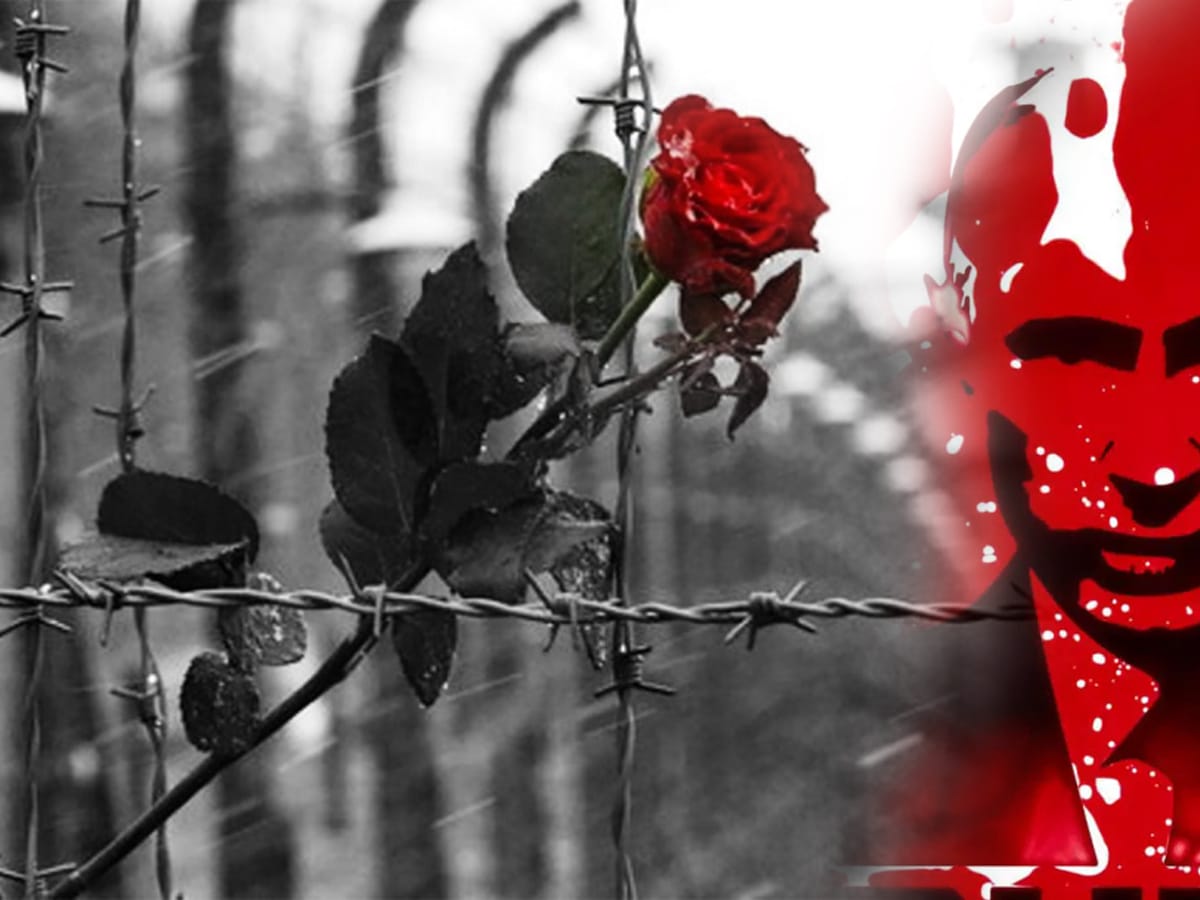
Today, decades after World War II, we are once again facing the repetition of those terrible events.
Putin’s Russia, having started the aggression against Ukraine, is using many of the same practices that the Nazis applied during World War II, including mass extermination of civilians, deportations, and the threat of genocide.
On April 11, 2025, the International Day of Liberation of Nazi Concentration Camp Prisoners is observed, established by the United Nations in honor of the uprising of prisoners at the Buchenwald concentration camp in 1945. This date holds great significance for the whole world, as it reminds us of the terrible crimes of the Nazi regime and commemorates the victims of these catastrophic events. However, as today’s situation shows, history does not always teach us how to avoid repetition.
History and Significance of the International Day of Liberation of Nazi Concentration Camp Prisoners
The International Day of Liberation of Nazi Concentration Camp Prisoners is observed on April 11 because, on this day in 1945, the significant uprising of prisoners at the Buchenwald concentration camp, located in Germany near Weimar, took place. During this uprising, the prisoners, having withstood the horrors of the Nazi regime, took control of the camp before the American troops arrived. As a result of this uprising, nearly one hundred thousand people were saved.
Buchenwald became a symbol of the struggle for freedom and human dignity, as well as a place where the cruel policy of “destruction through labor” was carried out, demanding enormous physical and moral sacrifices from the prisoners. Over the course of the camp’s existence, approximately 250,000 people passed through it, nearly 50,000 of whom perished.
Horrors of Nazi Concentration Camps
The concentration camps of Nazi Germany, which began to appear as early as 1933, became a symbol of inhuman crimes that took place in occupied territories. In total, the Nazi concentration camp system consisted of more than 14,000 institutions, where millions of people from different countries became victims of torture, starvation, diseases, and slave labor.
Among these victims, around 6 million Jews perished, which became one of the most horrifying episodes of the Holocaust.
Here are some additional statistics that help better understand the scale of the tragedy:
- 20 million people from 30 countries passed through Nazi camps.
- 12 million died — among them, about 2 million children.
- 2.4 million Ukrainians became victims of Nazi concentration camps and forced labor.
Terrifying Realities of the Camps:
- Auschwitz — one of the largest death camps, where over 1 million Jews perished.
- Treblinka, Belzec, Sobibor — three other death camps, where hundreds of thousands of Jewish victims were exterminated. These camps became centers of organized genocide, where Jews were exterminated using gas chambers and mass shootings.
- Labor camps and ghettos — another form of sophisticated destruction, in which Jews were subjected to forced labor and died from diseases, starvation, and brutal treatment.
The Importance of Remembering the Victims of the Holocaust
The memory of the Holocaust and its victims is very important not only for the Jewish people but for all humanity. The Holocaust was not only a tragedy for the Jews but for all world civilization. It is important to remember that the Nazis sought to destroy not just physically but also to eradicate the very culture, traditions, and memory of the Jews.
Moreover, the Holocaust was not limited to killing people — it was a process of destroying everything that constituted the Jewish people’s culture. Libraries, synagogues, religious and cultural traditions — all of this became the Nazis’ target as they tried to uproot Jewish identity.
Signs of Repetition
Today, decades after World War II, we are once again facing the threat of repeating those horrific events. Russia, having started the aggression against Ukraine, is using many of the same practices that the Nazis applied during World War II, including mass extermination of civilians, deportations, and the threat of genocide.
This Russian aggression against Ukraine is analogous to the actions of the Nazi regime during World War II. Putin’s aggression and the actions of Russian troops can be seen as a repetition of the historical horrors that humanity has already endured in the last century.
Like the Nazis, Russian troops are destroying civilians, applying cruel methods of coercion, creating conditions for mass extermination, and using deportation as a form of punishment and intimidation. Russia can also be compared to Nazi Germany in terms of its aggressive foreign policy aimed at expanding its borders through violence and fear.
As for the victims, not only Ukrainians but also Jews are once again facing the threat — both in a historical context and in the context of current wars. Modern Nazis, like in the past, apply strategies of terror, violence, and the destruction of entire peoples.
Quote:
“A new history is being written before our eyes, but with the same old content”,
— these words perfectly illustrate the current realities where terrible crimes are repeating, crimes that humanity should have long since put an end to. Russian aggression against Ukraine not only reminds us of Nazi aggression but also carries the same signs of genocide.
Ukraine and Russia: A New Threat of Genocide
With the onset of Russian aggression against Ukraine, the world has witnessed the repetition of Nazi practices — the destruction of civilian populations, deportation, forced labor, and filtration camps. Russia’s war against Ukraine exhibits many characteristics of genocide, and modern “rashists” are repeating inhuman practices that should have stayed in the past.
It is known that on the temporarily occupied territories of Ukraine, there are today many **“filtration camps”** controlled by Russia, where civilians are being destroyed or forcibly relocated, and such practices as human experimentation are once again becoming a reality.
What Happened Next?
After the end of World War II, special camps began to be established in the Soviet-occupied zone of Germany to identify enemies of the communist regime and to carry out denazification. For example, until August 1945, a Soviet repatriation camp was stationed in Sachsenhausen, through which thousands of Soviet citizens, former prisoners of war, and forced laborers passed. Sachsenhausen was not abandoned and was used until the spring of 1950 as a special NKVD/MVD camp No. 7/1. This was the largest camp in the system of NKVD-MVD-MGB special camps in the Soviet occupation zone.
More than 200,000 prisoners from 27 countries passed through Nazi Sachsenhausen, over 100,000 of whom died. At the same time, special camp No. 7/1 housed 60,000 prisoners, of whom about 12,000 were killed over five years. Sachsenhausen was liquidated, but many prisoners were sent to Siberia or transferred to East German prisons.
Many former prisoners of Nazi camps after the war preferred to remain in the zones of occupation of the Allies. They did not want to return home, fearing Soviet repression, and lived in camps for “displaced persons,” from which they later emigrated to the USA, Canada, the UK, and other countries.
Modern Context and Lessons from History
April 11 is an important date for the whole world, and it is crucial not to forget the horrors that took place in Nazi concentration camps. However, we must draw conclusions from history. National memory and the duty of every generation is to pass on this experience to new generations. And for this, it is important not to forget that history has lessons, and these lessons should protect us from the repetition of such terrible events.
In Ukraine, there are also regular memorial events to honor the victims of Nazi camps and remind us of the importance of peace, democracy, and human rights for the entire global community.
Conclusion from НАновости – Israel News:
We live in a world where history continues to teach us the importance of preserving peace and human rights.
Every April 11, we remember not only the victims of the Holocaust but also continue to fight to prevent the repetition of the horrific crimes of the past. Tension on the world stages, including in Ukraine and Israel, shows that the lessons of history have not been fully learned, and only joint efforts can prevent the repetition of the horrors our ancestors faced.
Putin’s aggression, like that of the Nazis, aims to destroy the world, sparing no one, and the repetition of these horrors is not just a threat, it is a reality that we must stop.