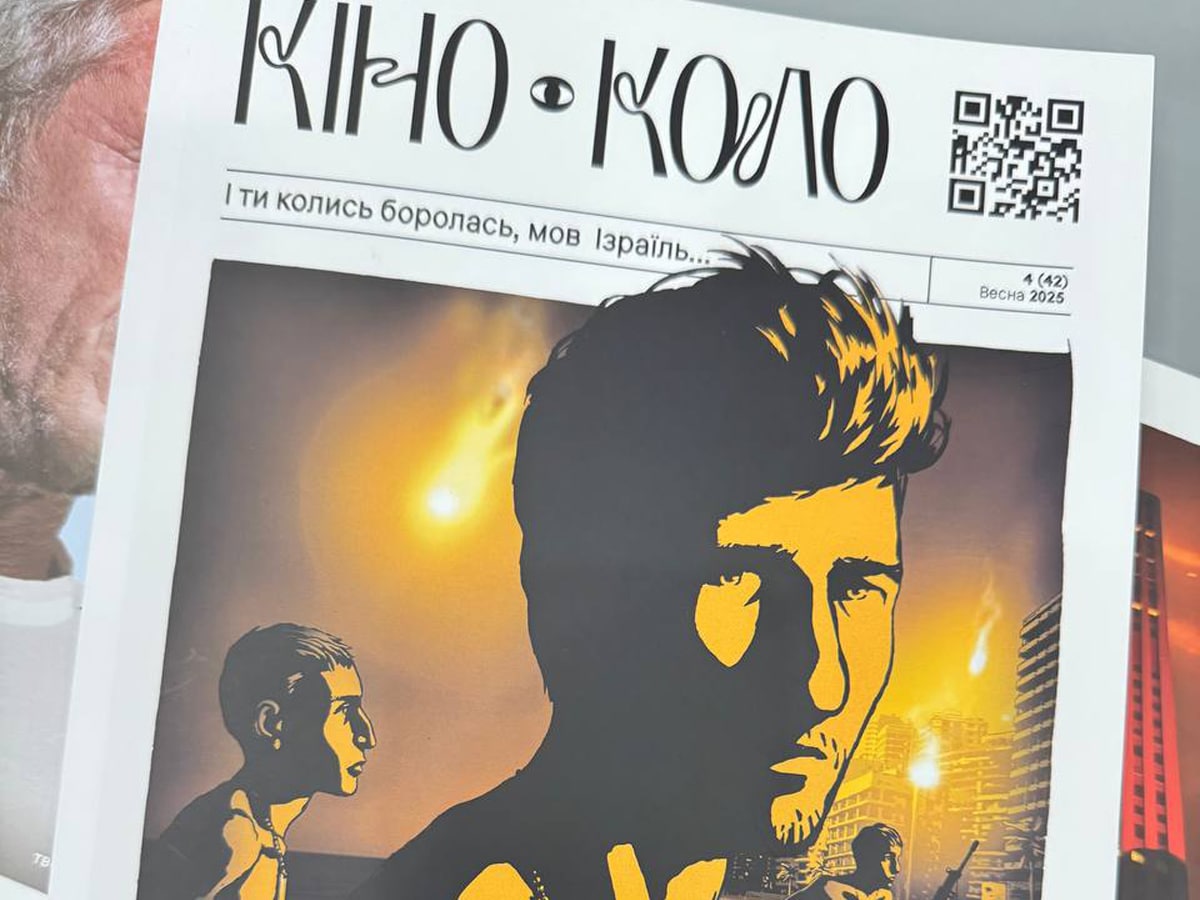
In March 2025, in the capital of Ukraine, at the Cultural Cluster “Krakiv,” during the first-ever Israeli Animation Festival in Ukraine, the presentation of the fourth issue of the journal “CINEMA CIRCLE” took place.
This issue is dedicated to Israeli cinema. Its slogan became a quote from the poem by Lesya Ukrainka “And you once fought, like Israel…”.
“The history of Ukrainian-Jewish coexistence is long and dramatic, spanning thousands of years. We fight for our rightful place under the sun, where else can we feel ourselves but in our own home? Ukraine was subjected to another treacherous attack from the Moscow state three years ago, and Israel from Arab enemies — a year and a half ago.
Here and there, the bloody slaughter continues. Wars for worldview and culture, for history and future. The 42nd issue of the journal “CINEMA CIRCLE” is dedicated to Ukrainian-Israeli mutual understanding and coexistence. On these pages, we bring our nations closer through cinema,” – writes the chief editor of the journal Vladimir Voytenko in the editorial column of the journal.
This issue became a significant step in strengthening cultural ties between Ukraine and Israel, as cinema is a powerful tool for mutual understanding and contributes to the historical rapprochement of the two nations.
About the journal “CINEMA CIRCLE”
The journal “CINEMA CIRCLE” continues its mission of familiarizing the Ukrainian audience with global cinematic achievements, as well as the cultural life of Israel. The fourth issue is entirely dedicated to Israeli cinema and includes articles and materials that highlight both contemporary Israeli cinema and its impact on global culture.
Cinema as a Cultural Bridge
Michael Brodsky, the Ambassador of Israel to Ukraine, in his address to readers emphasized that Israeli cinema is not only entertainment but also a means that helps to understand the internal life of the country, its problems, and solutions. According to him, cinema helps to perceive the culture and history of Israel more deeply.
“What does Ukraine know about the culture of modern Israel? Probably little, but it is cinema that can become the guide that opens Israel to the viewers in a new way,” said Brodsky.
Articles and Materials in the Fourth Issue of the Journal
The new issue of the journal features various articles dedicated to important aspects of Israeli cinema, especially films that have received recognition in world cinema. The included works cover both contemporary works and classics. Among them:
- “Fauda” — a famous Israeli series that continues to remain relevant despite the political situation in the world. This series became a cult hit and one of the most popular Israeli projects.
- “Tehran” — a dramedy telling the story of the complex relationship between Israel and Iran.
- “Shtisel” — a popular Israeli series about the life of ultra-Orthodox Jews, which became a true cultural phenomenon.
- “Foxtrot” — a powerful drama about the harsh consequences of military service in Israel.
- “My Neighbor Adolf” — a comedy film that addresses the difficult issues of moral values and historical memory.
- “Waltz with Bashir” — an animated film about the 1982 war in Lebanon, which was nominated for an Oscar in the “Best Foreign Film” category.
- “Holy Ahava” — a romantic story that highlights complex issues of love and peace in the context of modern Israel.
These films and series featured in the journal helped to better understand not only Israeli culture but also the complex political and social processes taking place in the country.
Articles Published in the Journal
Additionally, the journal published the following materials:
- “Alexander Dovzhenko and the Jews” — an article by film scholar Sergiy Trymbach, which explores the complex relationships between the classic of Ukrainian cinema and Jewish culture, a topic that many researchers have avoided until now.
- “Israeli Cinema Strives to Find Balance” — an article by Israeli film scholar Pablo Utin, who analyzes processes in Israeli cinema over the last few decades and the struggle to find balance in revealing important topics.
- “Field of Blood” — a piece by film critic Dmytro Desiateryk, dedicated to films about the Arab-Israeli conflict.
- “Israeli Animation and War” — a series of articles by Regina Shafir, Cultural Attaché of the Embassy of Israel in Ukraine, which explores current trends in Israeli animation, particularly related to the theme of war, repatriation, and identity.
- Interview with David Polonsky, one of Israel’s most famous illustrators, who shares his thoughts on creativity, art, and his connection to Kyiv.
- Article by cultural expert Svitlana Tyapina, who reflects on why the world is so interested in Israeli series.
- “The Film Industry in Israel” — an article by Max Konoplyov, which explains how the film industry in Israel works, which films are popular there, and what is essential for the success of Israeli film projects.
Cooperation and Understanding Through Cinema
Cooperation between Ukraine and Israel in the cultural sphere continues to develop. In recent decades, Israeli films have become increasingly popular in Ukraine, and many of them, such as “Fauda” and “Shtisel”, are regularly shown on Ukrainian screens. These films not only entertain but also contribute to a better understanding of Israeli culture and problems.
Moreover, the journal features materials that highlight important processes in the Israeli film industry. In particular, Pablo Utin, Israeli film scholar, in the article “Israeli Cinema Strives to Find Balance” shares his thoughts on recent trends and changes in Israeli cinema.
The Influence of Israeli Cinema on Ukraine
Israeli cinema has a significant impact on the cultural perception of Israel in Ukraine. The process of creating and distributing Israeli films in Ukraine has intensified in recent decades, and they have become an important tool in understanding the cultural and social issues of both countries. This is especially important in the context of the current political situation.
As noted by Hanna Sherman, the editor-in-chief of the journal, Israeli cinema continues to attract the attention of viewers in Ukraine, as it provides a deeper understanding of both history and contemporary problems in Israel, which are of great importance to Ukrainians, especially in light of the current war.
Conclusion
The presentation of the journal “CINEMA CIRCLE” in Ukraine highlighted the importance of Israeli cinema as a means for cultural exchange and strengthening mutual understanding between the two countries. NAnews asserts that initiatives like this not only bring cultures closer but also strengthen the ties between Israel and Ukraine.
For detailed information on the latest news, contact us through NAnews — News of Israel.